

|
시장보고서
상품코드
2066657
스페인의 도로 화물 운송 : 시장 점유율 분석, 업계 동향 및 통계, 성장 예측(2026-2031년)Spain Road Freight Transport - Market Share Analysis, Industry Trends & Statistics, Growth Forecasts (2026 - 2031) |
||||||
 Mordor Intelligence
Mordor Intelligence에 의하면, 스페인의 도로 화물 운송 시장 규모는 2025년에 366억 6,000만 달러로 평가되었습니다. 2026년에는 379억 4,000만 달러, 2031년까지 441억 2,000만 달러에 이를 것으로 예상되며, 예측 기간(2026-2031년) CAGR은 3.06%를 나타낼 전망입니다.
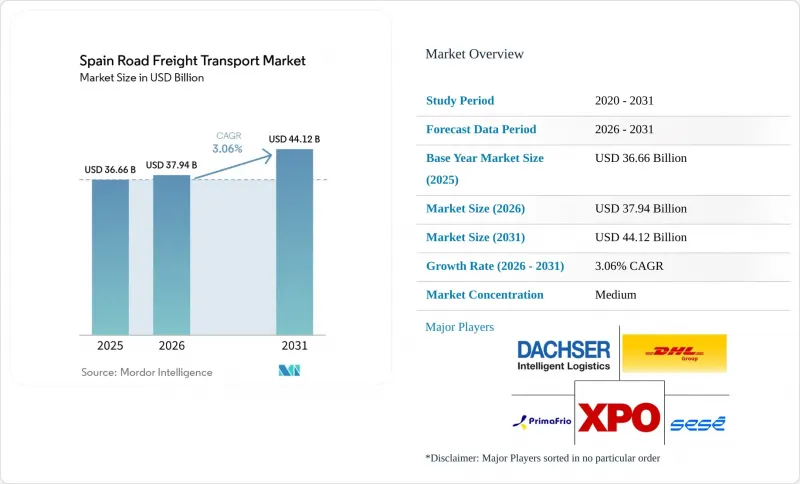
95% 이상의 높은 국내 운송 수단 점유율, 연간 약 15억 톤에 달하는 도로 화물 운송량, 그리고 지중해 지역의 생산 거점이자 대서양으로 향하는 관문이라는 스페인의 이중적 역할이 계속해서 스페인의 도로 화물 운송 시장을 지탱하고 있습니다. 본 보고서는 최종 사용자 산업별(농업 등), 목적지별(국내 등), 트럭 적재량별(FTL 등), 컨테이너화별(컨테이너 운송 등), 운송 거리별(장거리 운송 등), 화물 형태별(액체 화물 등), 온도 관리별(온도 관리 화물 등)로 분류되어 있습니다. 시장 전망은 금액(달러) 기준으로 제시되어 있습니다.
스페인의 도로 화물 운송 시장 동향 및 인사이트
백신 및 고급 식품 수출에 따른 콜드체인의 급속한 성장
2024년에 184억 유로(216억 4,000만 달러) 규모에 달한 의약품 수출에는 2-8℃의 온도 관리가 요구되며, 실시간 모니터링 기능을 갖춘 GDP 준수 운송업체에 대한 프리미엄 요금 수요가 확대되고 있습니다. 동시에, 유기농 감귤류나 이베리코 돼지고기 등 고부가가치 식품의 수출액 620억 유로(729억 3,000만 달러)는 끊김 없는 냉장 관리에 의존하고 있으며, 계절적 변동을 완화하는 연중 무휴 운영을 가능하게 하고 있습니다. 전문 운송업체들은 블록체인을 활용한 추적 시스템과 단열 스왑 바디를 도입하여 이익률 향상을 도모하고 있습니다. EU 규정 2017/625에 따른 수의사의 국경 검사는 운송 중 체류 시간을 늘리지만, 규정 준수 인증을 취득한 사업자의 가치를 높여주고 있습니다. Primafrio와 같은 사업자들은 독자적인 텔레매틱스 기술을 활용하여 일반 화물 운송망을 피하려는 제약 회사들로부터 계약을 수주하고 있습니다.
디지털 화물 마켓플레이스가 빈차 운행을 효율화합니다.
이 플랫폼의 도입으로 공차 주행률은 2020년 28%에서 2024년에는 22%로 감소했으며, 이를 통해 연료비 1억 8,000만 유로(2억 1,173만 달러)를 절감하고 운송업체의 자산 가동률을 12-18% 향상시켰습니다. 실시간 운송 능력 시각화를 통해 2시간 이내의 시간대별 소량 화물 예약은 물론, 24-48시간 후까지 수요 예측이 가능해졌습니다. 소규모 운송업체는 화주의 운송 물량을 직접 확보할 수 있게 되었지만, 투명성이 높아짐에 따라 중개업자의 마진은 줄어들고 있습니다. 통관 절차, ADR(위험물 운송 규정) 및 운전자의 자격 정보를 예약 워크플로에 통합함으로써, 행정 업무의 번거로움이 줄어들고 국경을 넘는 이용이 가속화되고 있습니다. 신진 물류 관리자들은 앱 기반 조달을 선호하는 경향이 있으며, 2024년에는 디지털 거래가 전년 대비 35% 증가했습니다.
EU 모빌리티 패키지 : 카보타주 및 휴식 시간 규정 준수 부담
2024년 규정에 따라 비거주자 운송 사업자의 카보타지 운행 횟수가 7일 동안 3회로 제한되고, 4일간의 쿨다운 기간이 의무화됨에 따라 사업자의 비용이 8-12% 증가했습니다. 4주마다 본국으로 귀국해야 하는 의무로 인해 북유럽 노선의 유효 운행 시간이 15-20% 감소함에 따라, 릴레이 방식 도입이나 추가 운전기사 배치가 불가피하게 되었습니다. 스마트 타코그래프를 통한 원격 감시가 가능해지면서, 규제의 회색지대가 해소되었습니다. 수입국과의 임금 격차가 해소됨에 따라, 프랑스와 독일에서 사업을 영위하는 스페인 운송업체들의 인건비는 최대 30% 증가했습니다. 각 운송사는 트럭의 가동률을 유지하기 위해 국경 근처에 운전기사 교대 거점을 설치하고 있지만, 교대 작업은 일정 수립에 있어 위험 요인이 되고 있습니다.
부문별 분석
2025년, 제조업은 스페인의 도로 화물 운송 시장 점유율의 37.51%를 차지하며, 245만 대의 차량 생산량과 견조한 의약품 수출에 힘입었습니다. 카탈루냐, 아라곤, 바스크 지역의 공장과 항구 간 안정적인 부품 흐름이 주요 운송 경로의 유지를 뒷받침하고 있습니다. 도매·소매업은 연평균 성장률(CAGR) 3.52%로 성장하고 있으며, 이는 빈번한 다중 거점 순회에 의존하는 옴니채널 주문 처리 패턴을 반영하여 소량 화물 운송 이용을 촉진하고 있습니다. 건설 관련 화물 운송은 2026년까지 EU 자금을 통해 지원되는 700억 유로(823억 4,000만 달러) 규모의 프로젝트를 뒷받침할 것으로 보이며, 그 이후에는 점차 감소할 전망입니다. 농업 분야에서는 감귤류와 채소의 수출이 계절적 성수기를 맞아 냉장 운송 능력에 대한 수요가 증가하고 있습니다.
제조업체들이 소매형 유통 방식을 필요로 하는 ‘소비자 직접 판매(DTC)’ 전략을 채택하는 한편, 대형 소매업체들이 간편 조립 사업에 진출하는 등 비즈니스 모델의 진화로 인해 업계의 경계가 모호해지고 있습니다. 이러한 하이브리드화로 인해 운송업체들은 유연한 서비스 메뉴를 제공해야 하는 상황에 놓여 있습니다. 니어쇼어링의 추세가 부품 운송 증가를 뒷받침하는 가운데, 제조업 및 소매업을 합친 스페인의 도로 화물 운송 시장은 더욱 확대될 것으로 전망됩니다. 다양한 분야 수요가 운송량의 변동을 완화하여 안정적인 차량 가동률을 뒷받침하고 있습니다.
2025년 스페인 도로 화물 운송 시장 규모의 64.07%를 차지하는 국내 운송이 주류를 이루었으며, 이는 스페인의 4,700만 명에 달하는 소비자와 지역 간 전문 분업에 힘입은 것입니다. 고밀도의 운송 회랑이 카탈루냐의 공장, 안달루시아의 농장, 마드리드의 소비 거점을 연결하여 예측 가능한 회송을 뒷받침하고 있습니다. 도심 저배출 구역의 도입으로 인해 마드리드와 바르셀로나에서는 이에 대한 대응이 시급해졌으며, 이로 인해 도심 내 전기자동차 차량군의 도입이 촉진되고 있습니다.
이베리아 반도의 육로 노선이 확대되고, ‘오퍼레이션 마르하바’를 통한 모로코와의 화물 운송이 사상 최고치를 기록하는 가운데, 국제 화물 운송은 연평균 성장률(CAGR) 3.60%를 기록하며 더욱 빠르게 확대되고 있습니다. EU의 모빌리티 패키지는 규정 준수를 복잡하게 만들지만, 저임금 경쟁사들과의 공정한 경쟁 환경을 조성하고 있습니다. 현재 검토 중인 지브롤터 해협 터널 계획은 북아프리카와의 획기적인 미래 연결 가능성을 시사하고 있지만, 그 영향이 나타나기 시작하는 것은 2035년 이후가 될 것으로 보입니다.
자동차, 농산물, 건축자재의 대량 수출에 힘입어 풀 트럭 적재(FTL)는 83.07%의 시장 점유율을 유지했습니다. 전용 노선을 통해 운전자의 근무 시간이 최적화되고, 하역 시 발생하는 손상이 줄어들고 있습니다. 생산 일정에 기반한 일관된 왕복 계획 덕분에 비용 절감이 실현되고 있습니다.
소량 화물 운송(LTL)의 연평균 성장률(CAGR) 3.43%는 전자상거래로 인한 소량화 추세와 스페인의 도로 화물 운송 업계가 허브 앤 스포크 방식으로 전환한 데 기인합니다. 디지털 마켓플레이스 도입으로 적재율이 90% 가까이 향상되어, 기존에 존재하던 효율성 격차가 점차 해소되고 있습니다. 물류 업체들은 마드리드와 발렌시아 근교에 자동화된 크로스독 시설에 투자하여 야간 분류 작업의 속도를 높이고 있습니다.
기타 혜택 :
- 엑셀 형식 시장 예측(ME) 시트
- 3개월간의 애널리스트 지원
자주 묻는 질문
목차
제1장 서론
제2장 조사 방법
제3장 주요 요약
제4장 시장 구도
제5장 시장 규모 및 성장 예측
제6장 경쟁 구도
제7장 시장 기회 및 향후 전망
KTH 26.06.29According to Mordor Intelligence, the spain road freight transport market size was valued at USD 36.66 billion in 2025 and is projected to reach USD 37.94 billion in 2026 to USD 44.12 billion by 2031, at a 3.06% CAGR during the forecast period (2026-2031).
High domestic modal share above 95%, annual road-borne freight volumes near 1.5 billion Tons, and the country's dual role as Mediterranean production hub and Atlantic gateway continue to anchor the Spain road freight transport market. This report is Segmented by End User Industry (Agriculture, and More), by Destination (Domestic, and More), by Truckload Specification (FTL, and More), by Containerization (Containerized, and More), by Distance (Long Haul, and More), by Goods Configuration (Fluid Goods, and More), by Temperature Control (Temperature Controlled, and More). The Market Forecasts are Provided in Terms of Value (USD).
Spain Road Freight Transport Market Trends and Insights
Cold-Chain Boom from Vaccine and Premium Food Exports
Pharmaceutical exports worth EUR 18.4 billion (USD 21.64 billion) in 2024 required 2-8 °C integrity, expanding premium-rate demand for GDP-compliant carriers equipped with real-time monitoring. Simultaneously, EUR 62 billion (USD 72.93 billion) in high-value food exports such as organic citrus and Iberian pork hinge on unbroken refrigeration, generating year-round utilization that mitigates seasonality. Specialized fleets adopt blockchain-enabled traceability and insulated swap bodies to capture margin uplift. Veterinary border inspections under EU 2017/625 add transit dwell but reinforce the value of compliance-certified providers. Operators like Primafrio leverage proprietary telematics to win contracts from pharmaceutical manufacturers that shun general freight networks.
Digital Freight Marketplaces Streamline Backhauls
Platform adoption lowered empty running from 28% in 2020 to 22% in 2024, saving EUR 180 million (USD 211.73 million) in fuel and improving carrier asset utilization by 12-18%. Real-time capacity visibility enables partial-load booking within two-hour windows and demand forecasting 24-48 hours ahead. Smaller fleets gain direct access to shipper volumes, but broker margins compress as transparency rises. Integration of customs, ADR, and driver credentials into booking workflows cuts paperwork friction, accelerating cross-border uptake. Youthful logistics managers favor app-based procurement, pushing digital transactions up 35% year-over-year in 2024.
EU Mobility Package Cabotage and Rest-Time Compliance Burden
The 2024 rules cap non-resident carriers at three cabotage trips in seven days and enforce four-day cooling-off periods, lifting operator costs 8-12%. Mandatory home return every four weeks reduces productive driving by 15-20% on Northern Europe runs, compelling relay systems or extra drivers. Smart tachographs enable remote enforcement, removing gray zones. Wage alignment with host countries inflates Spanish carrier labor cost up to 30% in France or Germany. Fleets deploy driver-swap hubs near borders to protect truck utilization, but handovers introduce scheduling risk.
Other drivers and restraints analyzed in the detailed report include:
- Low-Emission Fleet Incentives and Scrappage Schemes
- Iberian Land-Bridge Demand Post-Brexit Rerouting
- Rail-Freight Subsidy Shift Under Mercancias 30 Program
For complete list of drivers and restraints, kindly check the Table Of Contents.
Segment Analysis
Manufacturing contributed 37.51% of Spain road freight transport market share in 2025, underpinned by 2.45 million vehicle outputs and robust pharmaceutical exports. Consistent component flows between Catalonia, Aragon, and Basque plants and ports sustain high-volume lanes. Wholesale and retail trade, scaling at a 3.52% CAGR, mirrors omnichannel fulfillment patterns that depend on frequent multi-stop rounds, stimulating less-than-truck-load uptake. Construction freight rides EUR 70 billion (USD 82.34 billion) EU-funded projects through 2026 before tapering. Agriculture's seasonal peaks in citrus and vegetable exports intensify refrigerated capacity requirements.
Evolving models blur boundaries as manufacturers adopt direct-to-consumer strategies needing retail-style distribution, while large retailers move into light assembly. This hybridization compels carriers to offer flexible service menus. The Spain road freight transport market for manufacturing and retail combined is projected to widen further as nearshoring trends spark incremental component shipments. Diverse sectoral demand smooths volume volatility and underpins steady fleet utilization.
Domestic shipments dominated with 64.07% of the Spain road freight transport market size in 2025 backed by the nation's 47 million consumers and inter-regional specializations. High-density corridors connect Catalonia's factories, Andalusia's farms, and Madrid's consumption hub, supporting predictable backhauls. Urban low-emission zones force adaptation in Madrid and Barcelona, catalyzing electric urban fleets.
International freight expands faster at 3.60% CAGR as Iberian land-bridge routes grow and Morocco traffic via Operation Marhaba sets new records. The EU Mobility Package complicates compliance but levels the playing field against low-wage competitors. Pending Gibraltar Strait tunnel studies hint at transformative future links to North Africa, yet impacts remain post-2035.
Full-truck-load maintained 83.07% market share owing to large batch exports of autos, produce, and construction material. Dedicated routes optimize driver hours and reduce handling damage. Savings accrue from consistent round-trip planning anchored by production calendars.
Less-than-truck-load's 3.43% CAGR traces back to e-commerce parcelization and the Spain road freight transport industry pivot to hub-and-spoke. Digital marketplaces raise load factors toward 90%, closing the historical efficiency gap. Operators invest in automated cross-docks near Madrid and Valencia to speed nightly sort cycles.
List of Companies Covered in this Report:
- A.P. Moller-Maersk
- DACHSER
- Almar Iberia Logistics
- Alonso Group (Transportes Alonso Salcedo)
- CMA CGM Group (CEVA Logistics)
- DHL Group
- DSV A/S
- FM Logistic
- Girteka
- Grupo Sese
- International Distributions Services (GLS)
- JSV Logistics
- La Poste Group (Seur Geopost)
- Marcotran
- Primafrio
- Rhenus Group
- Rohlig Logistics
- Transfesa Logistics
- Trucksters
- XPO, Inc.
Additional Benefits:
- The market estimate (ME) sheet in Excel format
- 3 months of analyst support
TABLE OF CONTENTS
1 Introduction
- 1.1 Study Assumptions and Market Definition
- 1.2 Scope of the Study
2 Research Methodology
3 Executive Summary
4 Market Landscape
- 4.1 Market Overview
- 4.2 GDP Distribution by Economic Activity
- 4.3 GDP Growth by Economic Activity
- 4.4 Economic Performance and Profile
- 4.4.1 Trends in E-Commerce Industry
- 4.4.2 Trends in Manufacturing Industry
- 4.5 Transport and Storage Sector GDP
- 4.6 Logistics Performance
- 4.7 Length of Roads
- 4.8 Export Trends
- 4.9 Import Trends
- 4.10 Fuel Pricing Trends
- 4.11 Trucking Operational Costs
- 4.12 Trucking Fleet Size by Type
- 4.13 Major Truck Suppliers
- 4.14 Road Freight Tonnage Trends
- 4.15 Road Freight Pricing Trends
- 4.16 Modal Share
- 4.17 Inflation
- 4.18 Regulatory Framework
- 4.19 Value Chain and Distribution Channel Analysis
- 4.20 Market Drivers
- 4.20.1 Cold-Chain Boom from Vaccine and Premium Food Exports
- 4.20.2 Digital Freight Marketplaces Streamline Backhauls
- 4.20.3 Low-Emission Fleet Incentives and Scrappage Schemes
- 4.20.4 Iberian Land-Bridge Demand Post-Brexit Rerouting
- 4.20.5 Wind-Farm Component Super-Load Projects
- 4.20.6 32-m Mega-Truck Regulations Enhance Corridor Capacity
- 4.21 Market Restraints
- 4.21.1 EU Mobility Package Cabotage and Rest-Time Compliance Burden
- 4.21.2 Rail-Freight Subsidy Shift under Mercancias 30 Program
- 4.21.3 Flood-Related Insurance Premium Escalation on Mediterranean Routes
- 4.21.4 Container-Port Automation Delays Causing Landside Congestion
- 4.22 Technology Innovations in the Market
- 4.23 Porter's Five Forces Analysis
- 4.23.1 Threat of New Entrants
- 4.23.2 Bargaining Power of Buyers
- 4.23.3 Bargaining Power of Suppliers
- 4.23.4 Threat of Substitutes
- 4.23.5 Competitive Rivalry
5 Market Size and Growth Forecasts (Value, USD)
- 5.1 By End User Industry
- 5.1.1 Agriculture, Fishing, and Forestry
- 5.1.2 Construction
- 5.1.3 Manufacturing
- 5.1.4 Oil and Gas, Mining and Quarrying
- 5.1.5 Wholesale and Retail Trade
- 5.1.6 Others
- 5.2 By Destination
- 5.2.1 Domestic
- 5.2.2 International
- 5.3 By Truckload Specification
- 5.3.1 Full-Truck-Load (FTL)
- 5.3.2 Less than-Truck-Load (LTL)
- 5.4 By Containerization
- 5.4.1 Containerized
- 5.4.2 Non-Containerized
- 5.5 By Distance
- 5.5.1 Long Haul
- 5.5.2 Short Haul
- 5.6 By Goods Configuration
- 5.6.1 Fluid Goods
- 5.6.2 Solid Goods
- 5.7 By Temperature Control
- 5.7.1 Non-Temperature Controlled
- 5.7.2 Temperature Controlled
6 Competitive Landscape
- 6.1 Market Concentration
- 6.2 Key Strategic Moves
- 6.3 Market Share Analysis
- 6.4 Company Profiles (Includes Global Level Overview, Market Level Overview, Core Segments, Financials as Available, Strategic Information, Market Rank/Share for Key Companies, Products and Services, and Recent Developments)
- 6.4.1 A.P. Moller-Maersk
- 6.4.2 DACHSER
- 6.4.3 Almar Iberia Logistics
- 6.4.4 Alonso Group (Transportes Alonso Salcedo)
- 6.4.5 CMA CGM Group (CEVA Logistics)
- 6.4.6 DHL Group
- 6.4.7 DSV A/S
- 6.4.8 FM Logistic
- 6.4.9 Girteka
- 6.4.10 Grupo Sese
- 6.4.11 International Distributions Services (GLS)
- 6.4.12 JSV Logistics
- 6.4.13 La Poste Group (Seur Geopost)
- 6.4.14 Marcotran
- 6.4.15 Primafrio
- 6.4.16 Rhenus Group
- 6.4.17 Rohlig Logistics
- 6.4.18 Transfesa Logistics
- 6.4.19 Trucksters
- 6.4.20 XPO, Inc.
7 Market Opportunities and Future Outlook
- 7.1 White-Space and Unmet-Need Assessment


