

|
시장보고서
상품코드
2066659
인도네시아의 도로 화물 운송 : 시장 점유율 분석, 업계 동향 및 통계, 성장 예측(2026-2031년)Indonesia Road Freight Transport - Market Share Analysis, Industry Trends & Statistics, Growth Forecasts (2026 - 2031) |
||||||
 Mordor Intelligence
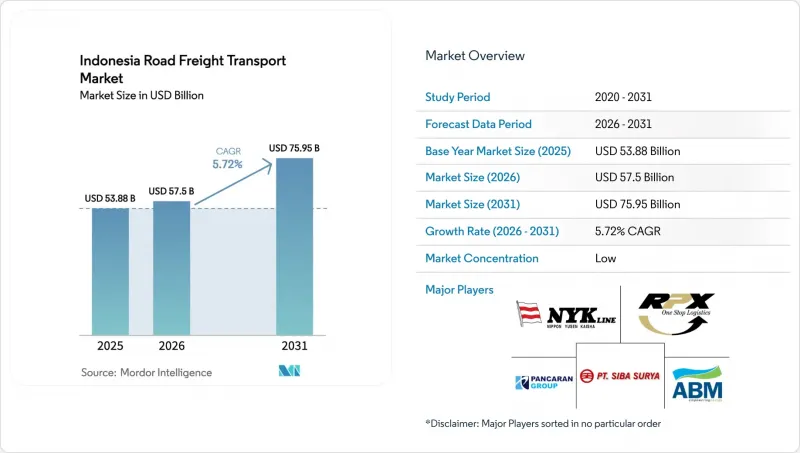
Mordor Intelligence에 의하면, 인도네시아의 도로 화물 운송 시장은 2025년 538억 8,000만 달러로 평가되었습니다. 2026년에는 575억 달러로 확대되어 2031년까지 759억 5,000만 달러에 이를 것으로 예상되며 2026년부터 2031년에 걸쳐 CAGR 5.72%로 성장할 전망입니다.
‘국가 물류 생태계(NLE)’ 도입이 진행됨에 따라 도어-투-포트(door-to-port) 사이클 타임이 단축되는 한편, 유로 4 디젤 배출 기준 도입으로 차량의 신뢰성이 향상되면서 운송 사업자들은 설비 현대화를 서둘러야 하는 상황에 놓여 있습니다. 본 보고서는 최종 사용자 산업별(농업 등), 목적지별(국내, 국제), 트럭 적재량별(FTL, LTL), 컨테이너화(컨테이너 운송, 비컨테이너 운송), 운송 거리(장거리, 단거리), 화물 형태(액체, 고체), 온도 관리(비온도 관리, 온도 관리)별로 분류되어 있습니다. 시장 전망은 금액(달러) 기준으로 제시되어 있습니다.
인도네시아의 도로 화물 운송 시장 동향 및 인사이트
국가 물류 생태계를 통한 전자 통관이 도어-투-포트(Door-to-Port) 사이클 타임을 단축
NLE는 세관, 항만 운영사, 포워더를 단일 디지털 플랫폼으로 통합하여 서류 처리 소요 시간을 3-5일에서 24시간 미만으로 단축하고 있습니다. 이전에는 대기 시간으로 인한 비용을 부담하던 육상 운송업체들은 게이트 통과까지 걸리는 시간이 단축됨에 따라 트럭 가동률이 향상되었고, 수주부터 입금까지의 주기가 단축되었습니다. 이 시스템을 조기에 도입한 기업들로부터 ‘도어 투 포트’ 소요 시간이 18-22% 단축되었다는 보고가 있습니다. 이 플랫폼은 아세안 통관 환적 시스템과 연동되어 국경을 넘는 운송의 예측 가능성을 높이고, 적시 생산을 지원합니다. 제2항구로의 확장이 지속됨에 따라, 이러한 이점은 자바섬 이외의 지역으로도 확대되어 인도네시아의 도로 화물 운송 시장 전체의 성장을 가속하게 될 것입니다.
국내 백신 및 생물학적 제제 생산에 따른 의약품 콜드체인의 급증
바이오-파마사의 연간 생산량은 이미 10억 회분을 넘어섰으며, 2026년 말까지 15억 회분으로 증가할 것으로 예측됩니다. 이러한 운송량에는 2-8℃의 온도 관리 및 실시간 모니터링 기능을 갖춘, 적정 유통 기준(GDP)을 준수하는 운송 수단이 필요합니다. 카르베 파마와 인도파마는 바이오의약품 생산 라인을 추가함에 따라, 냉장 트레일러 및 데이터 로거 시스템에 대한 수요가 두 배로 증가하고 있습니다. BPOM(인도네시아 식품의약품감독청)의 엄격한 감독으로 인해 비정규 사업자의 진입 장벽이 높아지면서, 검증된 절차를 갖춘 기존 운송업체들이 유리한 입지를 점하고 있습니다. 그 결과, 콜드체인 부문은 인도네시아의 도로 화물 운송 시장 전체를 웃도는 성장세를 보이고 있습니다.
자바·수마트라 회랑에서 화물 도난 보험료의 급등
도난 건수가 18-22% 증가한 데 따라, 고가 화물의 보험 비용이 15-20% 급등했습니다. 중소 운송업체들은 이익률 압박에 직면하거나, 위험을 화주에게 전가할 수밖에 없어 경쟁력이 떨어지고 있습니다. GPS 장치, 봉인 장치, 호송대 등에 드는 추가 비용으로 인해 운영 비용은 3-5% 더 상승하고 있습니다. 주 경계를 넘나드는 법 집행 기관 간의 협력 부족으로 인해 조직 범죄 집단이 휴게소의 취약점을 악용할 수 있게 되었으며, 화주들은 화물 입찰 시 고도의 보안 대책을 의무화하고 있습니다. 그 결과, 인도네시아의 도로 화물 운송 시장에서 업계 재편이 가속화되고 있습니다.
부문별 분석
2025년, 인도네시아의 도로 화물 운송 시장 규모의 34.24%를 도매·소매업이 차지했으며, 이는 자바 섬의 1급 및 2급 도시에서 나타나는 활발한 소비자 수요를 반영했습니다. 또한, 편의점의 확대와 약국 체인의 건강·웰니스 상품 출시 확대에 따라, 이 부문은 6.58%라는 가장 높은 연평균 성장률(CAGR)을 기록하고 있습니다. 현재 네트워크 설계 분야에서 소비재와 바이오의약품을 혼적하는 추세가 확대되고 있으며, 이에 따라 운행 빈도가 증가하고 차량 가동률이 향상되고 있습니다. 제조업은 카라완에 위치한 자동차 산업 거점과 바탐에 위치한 전자 산업 클러스터를 통해 안정적인 기반을 유지하고 있지만, 전 세계적인 리쇼어링 추세가 미치는 영향은 계속해서 주시해야 할 사항입니다.
석유 및 가스, 광업, 채석업은 술라웨시 섬의 니켈 가격 상승과 칼리만탄 섬의 석탄 수출로 인한 혜택을 누리고 있어, 전용 중량물 운송 장비가 요구되고 있습니다. 건축자재의 운송은 진행 중인 국가 전략 프로젝트와 연계되어 있으며, 시멘트와 철강이 예측 가능한 일정에 따라 운송되고 있습니다. 농업 및 수산 양식 분야에서는 새우와 망고스틴의 수출 프리미엄을 확보하기 위해 냉장 물류가 도입되고 있는 반면, 데이터센터 건설과 같은 신흥 분야에서는 프로젝트별로 불규칙한 화물이 발생하고 있습니다. 이처럼 서로 겹쳐지는 물류 흐름이 인도네시아의 도로 화물 운송 시장의 다양한 성장을 뒷받침하고 있습니다.
2025년에도 국내 운송이 여전히 62.88%의 점유율을 차지했으며, 화주들은 도로와 페리를 결합한 운송 수단을 통해 6,000개의 유인도에 서비스를 제공합니다. 자바섬과 수마트라섬의 유료 도로 확충으로 이동 시간이 최대 20% 단축되었으며, 서비스 신뢰성이 향상됨과 동시에 재고 감축 전략의 기반이 되고 있습니다.
그러나 말레이시아, 싱가포르, 태국으로의 국제 운송량은 연평균 성장률(CAGR) 6.65%라는 빠른 속도로 확대되고 있으며, NLE와 아세안(ASEAN) 간의 시스템 상호운용성 덕분에 국경에서의 대기 시간이 약 50% 단축된 점이 이를 뒷받침하고 있습니다. ‘씨-톨웨이’의 운항으로 인해 예측 가능한 복합운송 거점이 형성되면서, 국내 노선 계획 수립이 강화되고 있습니다. 한편, 바타무와 메단 인근의 보세 물류 센터는 국제 복합 운송의 거점으로 자리 잡고 있습니다. 쿠알라룸푸르·싱가포르·자카르타 회랑에서는 현재 전자기기 및 의약품을 대상으로 한 ‘저스트 인 시퀀싱(Just-in-Sequence)’ 배송이 가능해졌으며, 해상 운송과의 서비스 비용 격차가 줄어들고 있습니다. 이처럼 서로 보완해 주는 물류 흐름이 인도네시아의 도로 화물 운송 시장의 꾸준한 성장을 뒷받침하고 있습니다.
2025년, 인도네시아의 도로 화물 운송 시장에서 풀 트럭 적재(FTL)는 80.19%의 점유율을 유지했습니다. 이는 트레일러를 자연스럽게 채우는 팜유, 석탄, 니켈 광석의 대량 수송이 주도한 결과입니다. ODOL(중량·치수 규제) 준수에 따라 차량은 다축 모듈식 트럭으로 전환되고 있으며, 이로 인해 법정 적재량이 최대 30% 증가하여 FTL의 비용 경쟁력이 향상되고 있습니다.
한편, 소량 화물(LTL) 부문은 Kargo Technologies나 Deliveree와 같은 플랫폼이 중소기업의 화물을 통합하고, 최적화된 다중 배송 경로를 구축함으로써 연평균 성장률(CAGR) 6.41%라는 견실한 성장세를 보이고 있습니다. 알고리즘을 활용한 배차와 동적 가격 책정을 통해 차량 적재율이 향상되었으며, 소규모 화주의 단위당 운임이 낮아지고 있습니다. 기존의 FTL 운송업체들은 이에 대응하여, 항공 화물을 온디맨드 LTL 화물로 채우는 하이브리드형 서비스를 출시하고 있으며, 카테고리 간의 경계가 점차 모호해지고 있습니다. 이러한 이중적인 발전은 인도네시아의 도로 화물 운송 시장의 건전한 다각화를 뒷받침하고 있습니다.
기타 혜택 :
- 엑셀 형식 시장 예측(ME) 시트
- 3개월간의 애널리스트 지원
자주 묻는 질문
목차
제1장 서론
제2장 조사 방법
제3장 주요 요약
제4장 시장 구도
제5장 시장 규모 및 성장 예측
제6장 경쟁 구도
제7장 시장 기회 및 향후 전망
KTH 26.06.29According to Mordor Intelligence, the indonesia road freight transport market is expected to increase from USD 53.88 billion in 2025 to USD 57.50 billion in 2026 and reach USD 75.95 billion by 2031, growing at a CAGR of 5.72% over 2026-2031.
Rising adoption of the National Logistics Ecosystem (NLE) compresses door-to-port cycle times, while Euro-4 diesel standards improve fleet reliability, pushing carriers to modernize equipment. This report is Segmented by End-User (Agriculture, and More), by Destination (Domestic, International), by Truckload (FTL, LTL), by Containerization (Containerized, Non-Containerized), by Distance (Long Haul, Short Haul), by Good Configuration (Fluid, Solid), and by Temperature (Non-Temperature Controlled, Temperature Controlled). The Market Forecasts are Provided in Terms of Value (USD).
Indonesia Road Freight Transport Market Trends and Insights
National Logistics Ecosystem E-clearance Accelerating Door-to-Port Cycle Times
NLE integrates customs, port operators, and freight forwarders on one digital platform, shrinking documentation processing from three to five days to under 24 hours. Road carriers that previously absorbed idle-time costs now experience faster gate release, improving truck utilization and shortening order-to-cash cycles. Early adopters have reported 18-22% shorter door-to-port intervals. The platform's alignment with the ASEAN Customs Transit System improves predictability for cross-border trips and supports just-in-time manufacturing. Ongoing rollout to secondary ports will extend these gains beyond Java, fostering broader Indonesia road freight transport market growth.
Pharmaceutical Cold-chain Surge from Domestic Vaccine & Biologics Production
Bio Farma's annual output already exceeds 1 billion vaccine doses, and capacity is expected to rise to 1.5 billion by 2026 end. These volumes require Good Distribution Practice-compliant transport holding 2-8 °C and real-time monitoring. Kalbe Farma and Indofarma have added biologics lines, doubling demand for refrigerated trailers and data-logger systems. Strict BPOM oversight increases barriers for informal operators, favoring established fleets with validated processes. The cold-chain segment therefore outpaces the overall Indonesia road freight transport market.
Sharp Rise in Cargo-Theft Insurance Premiums Along Java-Sumatra Corridors
Insurance costs for high-value cargoes have surged 15-20% after an 18-22% uptick in theft incidents. Smaller carriers endure margin compression or shift risk onto shippers, reducing competitiveness. Added expenses for GPS devices, seals, and convoy escorts raise operating costs by another 3-5%. Law-enforcement coordination gaps across provinces enable organized crime to exploit rest-area vulnerabilities, encouraging shippers to mandate advanced security when tendering loads. Market consolidation thus accelerates in the Indonesia road freight transport market.
Other drivers and restraints analyzed in the detailed report include:
- Mandatory Euro-4 Diesel Transition Improving Fleet Reliability and Resale Values
- B40 Biodiesel Mandate Stabilizing Diesel Supply Costs for Long-Haul Carriers
- Persistent Port Gate-Out Congestion Post-Privatization Extending Dwell Times
For complete list of drivers and restraints, kindly check the Table Of Contents.
Segment Analysis
Wholesale and retail trade accounted for 34.24% of the Indonesia road freight transport market size in 2025, reflecting dense consumer demand across Java's tier-1 and tier-2 cities. This segment also exhibits the fastest 6.58% CAGR as convenience stores expand and pharmacy chains roll out health-and-wellness lines. Network designs now co-load consumer goods with biologics, intensifying route frequency and boosting vehicle utilization. Manufacturing sustains a steady baseline via automotive hubs in Karawang and electronics clusters in Batam, though exposure to global re-shoring remains a watch point.
Oil and gas, mining, and quarrying benefit from Sulawesi's nickel upswing and Kalimantan's coal exports, calling for specialized heavy-haul equipment. Construction freight aligns with ongoing National Strategic Projects, moving cement and steel on predictably scheduled runs. Agriculture and aquaculture adopt refrigerated logistics to capture export premiums for shrimp and mangosteen, while emerging verticals such as data-center construction generate episodic project loads. The overlapping flows collectively support diversified growth in the Indonesia road freight transport market.
Domestic moves still dominate with a 62.88% share in 2025 as shippers service 6,000 inhabited islands via road-ferry combinations. Toll-road build-out on Java and Sumatra cuts travel times by up to 20%, raising service reliability and underpinning inventory reduction strategies.
However, international volumes into Malaysia, Singapore, and Thailand are expanding faster at a 6.65% CAGR, assisted by NLE-to-ASEAN system interoperability that slashes border waits by roughly 50%. Sea Tollway sailings create predictable intermodal nodes, enhancing domestic route planning, whereas bonded logistics centers near Batam and Medan anchor international consolidation. The Kuala Lumpur-Singapore-Jakarta corridor now supports just-in-sequence deliveries for electronics and pharma, narrowing cost-of-service gaps with ocean freight. These complementary flows anchor resilient expansion for the Indonesia road freight transport market.
Full-truck-load retained 80.19% of Indonesia road freight transport market in 2025, driven by bulk palm oil, coal, and nickel ore consignments that naturally fill trailers. ODOL compliance pushes fleets toward multi-axle modular rigs that lift legal payload by up to 30%, enhancing FTL cost competitiveness.
Less-than-truck-load, meanwhile, grows at a brisk 6.41% CAGR as platforms such as Kargo Technologies and Deliveree aggregate SME volumes into optimized multi-drop routes. Algorithmic dispatch and dynamic pricing improve vehicle load factors, lowering per-unit freight for smaller shippers. Established FTL fleets respond by launching hybrid offerings that back-fill empty legs with on-demand LTL loads, blurring category lines. This dual evolution supports healthy diversification within the Indonesia road freight transport market.
List of Companies Covered in this Report:
- Bali Pro Cargo
- CJ Logistics Corporation
- DHL Group
- DSV
- Geodis
- JNE Express
- Ninja Express
- NYK Line
- NYK Line (Yusen Logistics Malaysia)
- Pancaran Group
- PT ABM Investama Tbk (PT Cipta Krida Bahari)
- PT Citrabati Logistik International
- PT Prima International Cargo
- PT Repex Wahana (RPX)
- PT Samudera Indonesia Tangguh
- PT Siba Surya
- PT.DMS Logistics Indonesia
- Rhenus Group
- Seacon Logistics
- Total Logistics
Additional Benefits:
- The market estimate (ME) sheet in Excel format
- 3 months of analyst support
TABLE OF CONTENTS
1 Introduction
- 1.1 Study Assumptions and Market Definition
- 1.2 Scope of the Study
2 Research Methodology
3 Executive Summary
4 Market Landscape
- 4.1 Market Overview
- 4.2 GDP Distribution by Economic Activity
- 4.3 GDP Growth by Economic Activity
- 4.4 Economic Performance and Profile
- 4.4.1 Trends in E-Commerce Industry
- 4.4.2 Trends in Manufacturing Industry
- 4.5 Transport and Storage Sector GDP
- 4.6 Logistics Performance
- 4.7 Length of Roads
- 4.8 Export Trends
- 4.9 Import Trends
- 4.10 Fuel Pricing Trends
- 4.11 Trucking Operational Costs
- 4.12 Trucking Fleet Size by Type
- 4.13 Major Truck Suppliers
- 4.14 Road Freight Tonnage Trends
- 4.15 Road Freight Pricing Trends
- 4.16 Modal Share
- 4.17 Inflation
- 4.18 Regulatory Framework
- 4.19 Value Chain and Distribution Channel Analysis
- 4.20 Market Drivers
- 4.20.1 National Logistics Ecosystem (NLE) e-clearance accelerating door-to-port cycle times
- 4.20.2 Pharmaceutical cold-chain surge from domestic vaccine & biologics production
- 4.20.3 Mandatory Euro-4 diesel transition improving fleet reliability and resale values
- 4.20.4 B40 biodiesel mandate stabilising diesel supply costs for long-haul carriers
- 4.20.5 Sulawesi nickel-to-battery corridor creating heavy inbound raw-material flows
- 4.20.6 ODOL phase-out law spurring demand for higher-capacity modular trucksets
- 4.21 Market Restraints
- 4.21.1 Sharp rise in cargo-theft insurance premiums along Java-Sumatra corridors
- 4.21.2 Persistent port gate-out congestion post-privatisation extending dwell times
- 4.21.3 Fragmented non-Jasa-Marga toll billing systems inflating en-route cost variance
- 4.21.4 Sparse LNG refuelling network delaying alternative-fuel truck adoption
- 4.22 Technology Innovations in the Market
- 4.23 Porter's Five Forces Analysis
- 4.23.1 Threat of New Entrants
- 4.23.2 Bargaining Power of Buyers
- 4.23.3 Bargaining Power of Suppliers
- 4.23.4 Threat of Substitutes
- 4.23.5 Competitive Rivalry
5 Market Size and Growth Forecasts (Value, USD)
- 5.1 End User Industry
- 5.1.1 Agriculture, Fishing, and Forestry
- 5.1.2 Construction
- 5.1.3 Manufacturing
- 5.1.4 Oil and Gas, Mining and Quarrying
- 5.1.5 Wholesale and Retail Trade
- 5.1.6 Others
- 5.2 Destination
- 5.2.1 Domestic
- 5.2.2 International
- 5.3 Truckload Specification
- 5.3.1 Full-Truck-Load (FTL)
- 5.3.2 Less than-Truck-Load (LTL)
- 5.4 Containerization
- 5.4.1 Containerized
- 5.4.2 Non-Containerized
- 5.5 Distance
- 5.5.1 Long Haul
- 5.5.2 Short Haul
- 5.6 Goods Configuration
- 5.6.1 Fluid Goods
- 5.6.2 Solid Goods
- 5.7 Temperature Control
- 5.7.1 Non-Temperature Controlled
- 5.7.2 Temperature Controlled
6 Competitive Landscape
- 6.1 Market Concentration
- 6.2 Key Strategic Moves
- 6.3 Market Share Analysis
- 6.4 Company Profiles (Includes Global Level Overview, Market Level Overview, Core Segments, Financials as Available, Strategic Information, Market Rank/Share for Key Companies, Products and Services, and Recent Developments)
- 6.4.1 Bali Pro Cargo
- 6.4.2 CJ Logistics Corporation
- 6.4.3 DHL Group
- 6.4.4 DSV
- 6.4.5 Geodis
- 6.4.6 JNE Express
- 6.4.7 Ninja Express
- 6.4.8 NYK Line
- 6.4.9 NYK Line (Yusen Logistics Malaysia)
- 6.4.10 Pancaran Group
- 6.4.11 PT ABM Investama Tbk (PT Cipta Krida Bahari)
- 6.4.12 PT Citrabati Logistik International
- 6.4.13 PT Prima International Cargo
- 6.4.14 PT Repex Wahana (RPX)
- 6.4.15 PT Samudera Indonesia Tangguh
- 6.4.16 PT Siba Surya
- 6.4.17 PT.DMS Logistics Indonesia
- 6.4.18 Rhenus Group
- 6.4.19 Seacon Logistics
- 6.4.20 Total Logistics
7 Market Opportunities and Future Outlook
- 7.1 White-Space and Unmet-Need Assessment


