
|
시장보고서
상품코드
2072487
그래픽 처리 장치(GPU) : 시장 점유율 분석, 업계 동향 및 통계, 성장 예측(2026-2031년)Graphics Processing Unit (GPU) - Market Share Analysis, Industry Trends & Statistics, Growth Forecasts (2026 - 2031) |
||||||
 Mordor Intelligence
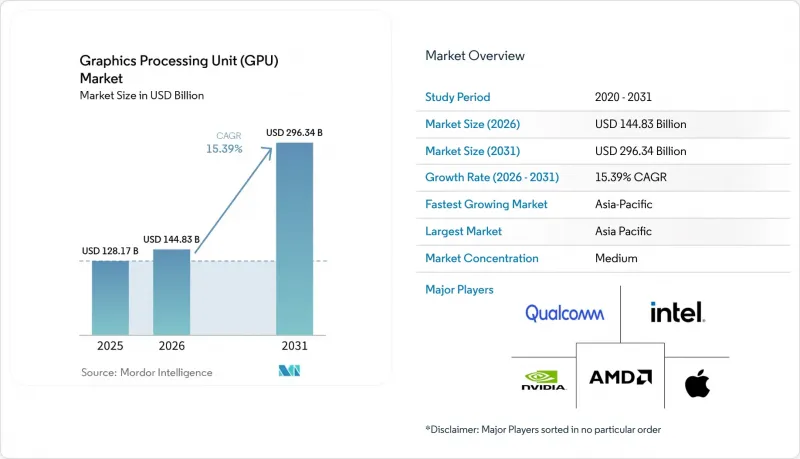
Mordor Intelligence에 의하면, 그래픽 처리 장치(GPU) 시장 규모는 2025년 1,281억 7,000만 달러로 평가되었습니다. 2026년에는 1,448억 3,000만 달러로 확대되어 2031년까지 2,963억 4,000만 달러에 이를 것으로 예상되고 2026년부터 2031년에 걸쳐 CAGR 15.39%로 성장할 전망입니다.
본 보고서는 통합형(통합형 GPU 및 디스크리트 GPU), 기기 용도(모바일 기기 및 태블릿, PC 및 워크스테이션, 서버 및 데이터센터용 가속기, 게임기 및 휴대용 단말기, 자동차 및 ADAS, 기타 임베디드 및 엣지 기기), 그리고 지역별로 분류되어 있습니다. 시장 전망은 금액(달러) 기준으로 제시되어 있습니다.
세계의 그래픽 처리 장치(GPU) 시장 동향 및 인사이트
하이퍼스케일 AI 훈련 및 추론 클러스터의 확장
그래픽 처리 장치(GPU) 시장은 정기적인 모델 훈련부터 훈련, 훈련 후, 추론에 이르는 모든 단계에서 클러스터를 지속적으로 가동하는 ‘ '상시 가동형 AI 공장' 로의 전환에 힘입어 성장이 가속화되고 있습니다. 아마존, 구글, 메타, 마이크로소프트는 2026년 설비 투자 총액이 2025년의 4,100억 달러에서 7,250억 달러로 증가할 것이라고 밝혔으며, 이 증가분의 대부분은 AI 인프라에 투입될 예정이며, 이 분야에서 GPU는 여전히 주요 하드웨어 비용 항목으로 남아 있습니다. 공급 측면의 동향도 비슷한 추세를 보였는데, NVIDIA의 데이터센터 매출은 2027 회계연도 1분기에 752억 달러에 달한 반면, 컴퓨팅 매출은 604억 달러, 네트워크 매출은 148억 달러로 증가했습니다. 따라서 대규모 AI 팩토리에서는 고밀도 상호 연결 패브릭과 가속기가 필요하기 때문에 그래픽 처리 장치(GPU) 시장은 컴퓨팅과 네트워킹 양쪽 수요를 충족시키기 위해 확대되고 있습니다. 또한 NVIDIA는 데이터센터 매출 중 하이퍼스케일러가 차지하는 비중이 고작 절반에 불과하다고 밝혔으며, 이는 수요가 클라우드 전문 기업, 기업용 도입 및 국가 주도의 프로그램으로 확대되고 있음을 시사합니다. 이는 그래픽 처리 장치(GPU) 시장에 있어 중요한 의미를 지닙니다. 이는 단일 구매자 그룹에 대한 의존도를 낮추고, 현재 수요를 하이퍼스케일러의 짧은 주기보다 더 지속 가능한 것으로 만들기 때문입니다.
엔터프라이즈 AI 팩토리와 국가 주도의 컴퓨팅 조달
국가 차원의 컴퓨팅 프로그램과 기업의 AI 팩토리가 GPU 클러스터를 단순한 선택적 기술 자원이 아닌 전략적 인프라로 자리매김하기 시작하면서, 그래픽 처리 장치(GPU) 시장에 새로운 수요 흐름이 생겨났습니다. 중동 및 유럽에서의 조달은 기존의 하이퍼스케일러 유통 채널과는 별개의 고객층을 형성했으며, 하이엔드 GPU 구매가 지리적으로 확대되었습니다. EU의 AI 법안과 규제 대상 부문에서의 데이터 거주 요건 강화 역시 더 많은 컴퓨팅 자원을 국내에 유지하도록 유도했으며, 현지 액셀러레이터 조달을 단순한 성능상의 판단이 아닌 규정 준수상의 과제로도 자리매김하게 했습니다. 이로 인해 가격 책정 동향에 변화가 생겼습니다. 왜냐하면 주권적인 구매자들은 대개 하이퍼스케일러의 대량 구매 한도 밖에서 거래를 진행하며, 정가 또는 그 이상의 가격으로 공급을 흡수해 왔기 때문입니다. 또한, 클라우드 이용이 확대되었음에도 불구하고 최상위급 가속기의 할당 대기 목록이 길어지면서, 일반 기업들이 그래픽 처리 장치(GPU) 시장에 접근하기는 더욱 어려워졌습니다. 그 결과, 정부 계열 및 규제 대상 기업들은 시장의 향후 전망을 명확히할 것을 요구하고 있는 반면, 소규모 구매자들에게는 공급 균형이 더욱 악화되는 상황이 되고 있습니다.
차량 1대당 ADAS 및 차량 내 컴퓨팅 기능 증가
또한, ADAS의 인식 처리, 센서 융합, 콕핏 렌더링이 중앙 집중형 컴퓨팅 플랫폼으로 전환됨에 따라, 그래픽 처리 장치(GPU) 시장은 자동차 분야에서 더욱 장기적인 성장 궤도를 그리고 있습니다. NVIDIA의 DRIVE Thor 플랫폼은 레벨 4 용도를 위해 2,000 TOPS를 목표로 설정되어 있으며, 이는 자동차 설계가 차량당 컴퓨팅 밀도를 대폭 높이는 방향으로 나아가고 있음을 보여줍니다. ADAS 및 콕핏의 워크로드를 더 고성능인 소수의 프로세서에 집중시킴으로써, 플랫폼당 반도체 탑재량이 증가하게 되며, 이는 모델 세대를 초월하여 지속적인 GPU 수요를 뒷받침하게 될 것입니다. 이러한 변화는 검증된 자동차 등급의 소프트웨어와 안전 기능을 갖춘 공급업체에게도 유리하게 작용합니다. 왜냐하면 설계 채택은 순수한 성능뿐만 아니라 규제 준수 여부에도 크게 좌우되기 때문입니다. 소프트웨어 정의 차량 및 차량 안전과 관련된 규제는 양산차에서 지속적인 실시간 추론의 필요성을 높임으로써 이러한 방향성을 더욱 뒷받침하고 있습니다. 그래픽 처리 장치(GPU) 시장에서 이는 자동차 분야의 매출이 데이터센터 분야의 매출보다 완만한 성장에 그칠 것임을 의미하지만, 대당 탑재량은 구조적으로 견고해지고 있습니다.
부문별 분석
2025년 기준으로 디스크리트 GPU는 그래픽 처리 장치(GPU) 시장 점유율의 63.84%를 차지했으며, 이 부문은 2031년까지 연평균 성장률(CAGR) 15.78%로 확대될 것으로 전망됩니다. 이 부문의 우위는 전용 메모리, 높은 대역폭, 그리고 고부하 AI 워크로드와의 호환성이 하이엔드 분야에서 시스템 리소스를 공유하는 방식으로는 도저히 따라잡을 수 없습니다는 점을 반영하고 있습니다. NVIDIA의 Blackwell 세대에서는 온패키지 메모리가 대폭 강화되었으며, B200은 H100의 80GB에 비해 192GB의 HBM3e를 탑재하고 있어, 단일 제품 주기 내에서도 메모리 요구 사항이 얼마나 급속도로 증가하고 있는지를 여실히 보여주고 있습니다. 또한 NVIDIA는 10 TB/s의 NV-HBI를 통해 연결된 듀얼 다이 설계를 채택하고 있으며, 이는 하이엔드 디스크리트 설계가 연산 밀도를 유지하기 위해 모노리식 설계의 한계를 넘어 진화하고 있음을 보여줍니다. 그래픽 처리 장치(GPU) 시장에서는 훈련 및 대규모 배치 추론 분야에서 여전히 디스크리트 제품이 주류를 이루고 있습니다. 이는 이러한 워크로드가 메모리 대역폭이나 로컬 가속기의 용량에 의해 계속해서 제약을 받고 있기 때문입니다.
2026년에는 통합형 GPU가 크게 발전하면서, 클라이언트 AI 시스템 및 저비용 추론 환경에서 그 역할이 확대되었습니다. AMD의 Ryzen AI 400 시리즈는 최대 60 TOPS의 NPU 연산 능력과 통합된 Radeon 800M 시리즈 그래픽을 결합했으며, Ryzen AI Halo 플랫폼은 더욱 강력한 그래픽 기능과 대규모 통합 메모리 풀을 갖추어 해당 모델 라인업을 확장했습니다. 이러한 발전 덕분에, 저렴한 비용과 엄격한 전력 소비 제한이 요구되는 전문가용 노트북, 개발자용 시스템 및 워크스테이션급 기기에서 로컬 추론이 더욱 실용적으로 활용될 수 있게 되었습니다. 그렇긴 하지만, 통합 메모리 플랫폼은 아직 HBM 기반 가속기의 대역폭에는 미치지 못하기 때문에 GPU 업계는 최첨단 훈련 및 고처리량 추론 분야에서 여전히 디스크리트 제품에 의존하고 있습니다. 따라서 그래픽 처리 장치(GPU) 시장에서는 엣지 분야에서 통합형 제품의 중요성이 계속해서 높아지는 한편, 디스크리트 제품이 성능 면에서 최첨단을 유지하고 수익의 대부분을 차지할 가능성이 높습니다.
지역별 분석
2025년, 아시아태평양은 전 세계 매출의 43.16%를 차지했으며, 이 지역의 그래픽 처리 장치(GPU) 시장은 2031년까지 연평균 성장률(CAGR) 15.37%로 확대될 것으로 전망됩니다. 이 지역이 주도적인 위치를 차지하게 된 것은 주요 최종 수요뿐만 아니라 메모리, 패키징, 시스템 제조 분야에서 중요한 공급망 거점으로서의 역할도 겸비하고 있었기 때문입니다. 중국은 국내 공급업체들이 현지 조달 추진을 강화함에 따라 상용화를 가속화했기 때문에 계속해서 그래픽 처리 장치(GPU) 시장의 중심적인 위치를 유지했습니다. Biren과 Iluvatar CoreX는 모두 2025년에 세 자릿수의 매출 성장률을 기록했습니다. 이는 수출 환경이 점점 더 어려워지는 가운데, 중국 수요가 현지 공급업체에 대한 지원을 강화하고 있음을 반영하고 있습니다. 한국은 삼성과 SK하이닉스가 최첨단 가속기의 성능을 뒷받침하는 HBM 스택을 공급하고 있기 때문에 여전히 중요한 위치를 차지하고 있습니다. 한편, 일본은 하이퍼스케일 데이터센터와 산업용 디지털 트윈의 도입을 통해 수요를 확대했습니다.
북미는 세계 최대 규모의 하이퍼스케일 구매 기업을 보유하고 있으며, 전 세계 AI 클러스터 구축에 있어 주요 구매 권한을 행사하고 있어 그래픽 처리 장치(GPU) 시장에서 2위의 규모를 유지했습니다. 아마존, 구글, 메타, 마이크로소프트는 2026년에 총 7,250억 달러 규모의 설비 투자를 계획하고 있으며, 이러한 지출 동향에 힘입어 미국은 계속해서 액셀러레이터 자금 조달의 중심지로 자리매김했습니다. 또한, 북미는 정책 면에서도 세계 시장에 영향을 미쳤습니다. 미국의 수출 통제 체제가 선진적인 GPU 공급업체들이 어느 해외 시장에 서비스를 제공할 수 있는지에 직접적인 영향을 미쳤기 때문입니다. 캐나다가 국가 주권에 기반한 컴퓨팅 이니셔티브를 추가함에 따라, 해당 지역 수요 구조가 민간 하이퍼스케일 기업을 넘어 확대되고 있으며, 향후 공공 부문의 조달이 더욱 중요해질 것이라는 전망이 뒷받침되었습니다. 따라서 이 지역은 다른 어느 지역보다도 그래픽 처리 장치(GPU) 시장 수요 및 공급 양측에 큰 영향을 미쳤습니다.
유럽의 그래픽 처리 장치(GPU) 시장은 규정 준수, 디지털 주권, 그리고 규제 대상 부문에서의 AI 도입이 현지 컴퓨팅 투자를 보다 체계적인 단계로 끌어올림에 따라 발전했습니다. 중동 및 아프리카의 중요성이 커졌습니다. 이는 걸프 연안 국가들의 정부 주도의 프로그램이 인구 규모만으로는 예상되는 수준을 뛰어넘는 규모로 하이엔드 클러스터 발주를 시작했기 때문입니다. 남미는 여전히 개발 주기의 초기 단계에 있으며, 브라질은 코로케이션의 성장과 금융 서비스 분야의 AI 수요를 주도하는 주요 거점 역할을 했습니다. 유럽, 중동 및 아프리카, 남미 전역에서 그래픽 처리 장치(GPU) 시장은 순수한 소비자 수요라기보다는 전략적 필요성이나 정책적 일관성에 의해 확대되고 있으며, 그 결과 지역별 성장 양상은 이전 주기보다 더욱 다양해지고 있습니다.
기타 혜택 :
- 엑셀 형식 시장 예측(ME) 시트
- 3개월간의 애널리스트 지원
자주 묻는 질문
목차
제1장 서론
제2장 조사 방법
제3장 주요 요약
제4장 시장 구도
제5장 시장 규모 및 성장 예측
제6장 경쟁 구도
제7장 시장 기회 및 향후 전망
KTHAccording to Mordor Intelligence, the GPU market size is expected to increase from USD 128.17 billion in 2025 to USD 144.83 billion in 2026 and reach USD 296.34 billion by 2031, growing at a CAGR of 15.39% over 2026-2031.
This report is Segmented by Integration Type (Integrated GPUs, and Discrete GPUs), Device Application (Mobile Devices and Tablets, Pcs and Workstations, Servers and Datacenter Accelerators, Gaming Consoles and Handhelds, Automotive and ADAS, and Other Embedded and Edge Devices), and Geography. The Market Forecasts are Provided in Terms of Value (USD)
Global Graphics Processing Unit (GPU) Market Trends and Insights
Hyperscale AI Training and Inference Cluster Expansion
The GPU market is being pushed higher by a shift from periodic model training to always-on AI factory operations that keep clusters busy across training, post-training, and inference. Amazon, Google, Meta, and Microsoft confirmed a combined 2026 capital expenditure of USD 725 billion, up from USD 410 billion in 2025, and most of that increase was directed toward AI infrastructure, where GPUs remain the main hardware cost item. Supply-side results pointed to the same pattern as NVIDIA's data center revenue reached USD 75.2 billion in Q1 FY2027, while compute revenue reached USD 60.4 billion, and networking revenue rose to USD 14.8 billion. The GPU market is therefore expanding to meet both compute and networking demand, as larger AI factories require dense interconnect fabrics and accelerators. NVIDIA also said hyperscalers accounted for only half of its data center revenue, indicating that demand had broadened to cloud specialists, enterprise deployments, and sovereign programs. This matters for the GPU market because it reduces dependence on a single buyer group and makes current demand more durable than a narrow hyperscaler cycle.
Enterprise AI Factory and Sovereign Compute Procurement
The GPU market gained another demand stream as national compute programs and enterprise AI factories began treating GPU clusters as strategic infrastructure rather than optional technology capacity. Procurement in the Middle East and Europe added a separate customer layer that sat outside the traditional hyperscaler channel, widening the geographic spread of high-end GPU buying. The EU AI Act and tighter data residency rules in regulated sectors also pushed more compute to remain within national borders, making local accelerator procurement a compliance issue as well as a performance decision. This shifted pricing behavior because sovereign buyers often operated outside hyperscaler volume frameworks and absorbed supply at or above list pricing. The GPU market also became harder for mainstream enterprises to access because allocation queues for top-end accelerators stayed long even as cloud access expanded. As a result, sovereign and regulated enterprises demand that the market's forward visibility be strengthened while also tightening the supply balance for smaller buyers.
Rising ADAS and In-Cabin Compute Content Per Vehicle
The GPU market also has a longer-cycle growth path in vehicles as ADAS perception, sensor fusion, and cockpit rendering move onto centralized compute platforms. NVIDIA's DRIVE Thor platform was positioned at 2,000 TOPS for Level 4 applications, which showed how automotive designs are moving toward much higher compute density per vehicle. Consolidating ADAS and cockpit workloads onto fewer, more capable processors raises semiconductor content per platform and supports sustained GPU demand across model generations. The same shift also favors suppliers with validated automotive-grade software and safety capabilities, because design wins depend on compliance as much as raw performance. Regulations tied to software-defined vehicles and vehicle safety are reinforcing that direction by increasing the need for continuous real-time inference in production fleets. In the GPU market, that means automotive revenue grows more slowly than datacenter revenue, but content growth per vehicle is becoming structurally stronger.
Other drivers and restraints analyzed in the detailed report include:
- Edge AI Upgrade Cycle in PCs and Mobile Devices
- Export Controls and Tariff Volatility
- Elevated GPU and Memory ASPs Slowing Mainstream Adoption
For complete list of drivers and restraints, kindly check the Table Of Contents.
Segment Analysis
Discrete GPUs held 63.84% of the GPU market share in 2025, and this segment is projected to expand at a 15.78% CAGR through 2031. The segment's lead reflected the fit between dedicated memory, high bandwidth, and intensive AI workloads that shared system resources cannot match at the top end. NVIDIA's Blackwell generation raised on-package memory sharply, with the B200 carrying 192 GB of HBM3e versus 80 GB on the H100, underscoring how quickly memory requirements have risen within a single product cycle. NVIDIA also used a dual-die design connected via NV-HBI at 10 TB/s, demonstrating how high-end discrete designs are moving beyond monolithic limits to sustain compute density. The GPU market continued to favor discrete products in training and large-batch inference because those workloads remain constrained by memory bandwidth and local accelerator capacity.
Integrated GPUs improved materially in 2026, which widened their role in client AI systems and lower-cost inference setups. AMD's Ryzen AI 400 Series combined up to 60 TOPS of NPU compute with integrated Radeon 800M Series graphics, and the Ryzen AI Halo platform extended that model with stronger graphics capability and large unified memory pools. That progress made local inference more practical for professional notebooks, developer systems, and workstation-class devices that need lower cost and tighter power envelopes. Even so, the GPU industry still relies on discrete products for frontier training and high-throughput inference because unified memory platforms do not yet match the bandwidth of HBM-based accelerators. The graphics processing unit (GPU) market is therefore likely to continue to see integrated products gain relevance at the edge while discrete products hold the performance frontier and most of the profit pool.
Complete Report Scope:
- By Integration Type
- Integrated GPUs (iGPU)
- Discrete GPUs (dGPU)
- By Device Application
- Mobile Devices and Tablets
- PCs and Workstations
- Servers and Datacenter Accelerators
- Gaming Consoles and Handhelds
- Automotive and ADAS
- Other Embedded and Edge Devices
- By Geography
- North America
- United States
- Canada
- Mexico
- Europe
- Germany
- United Kingdom
- France
- Italy
- Rest of Europe
- Asia-Pacific
- China
- Japan
- South Korea
- India
- Southeast Asia
- Rest of Asia-Pacific
- South America
- Middle East and Africa
- North America
Geography Analysis
Asia-Pacific held 43.16% of global revenue in 2025, and the regional GPU market is projected to expand at a 15.37% CAGR through 2031. The region led because it combined major end demand with critical supply chain positions in memory, packaging, and system manufacturing. China remained central to the GPU market as domestic vendors accelerated commercialization under a stronger local procurement push. Biren and Iluvatar CoreX both reported triple-digit revenue growth in 2025, reflecting the growing support of Chinese demand for local suppliers amid a tighter export environment. South Korea remained vital because Samsung and SK Hynix supply the HBM stacks that underpin leading-edge accelerator performance, while Japan added demand through hyperscale data centers and industrial digital twin adoption.
North America remained the second-largest center of the GPU market because it houses the largest hyperscale buyers and the primary purchasing authority for global AI cluster deployments. Amazon, Google, Meta, and Microsoft together planned USD 725 billion in 2026 capital expenditure, and that spending profile kept the United States at the center of accelerator procurement. North America also shaped the global market through policy, since the US export control framework directly affected which overseas markets advanced GPU vendors could serve. Canada's addition of sovereign compute initiatives widened the region's demand profile beyond private hyperscalers and supported the view that public sector procurement would matter more over time. The region, therefore, influenced both the demand and the supply sides of the GPU market more than any other geography.
Europe's GPU market advanced as compliance, digital sovereignty, and regulated-sector AI adoption pushed local compute investment into a more structured phase. The Middle East and Africa became more important because Gulf sovereign programs started ordering high-end clusters at a scale that exceeded what population size alone would suggest. South America remained earlier in its development cycle, with Brazil serving as the primary base for colocation growth and AI demand in financial services. Across Europe, the Middle East and Africa, and South America, the GPU market expanded more through strategic need and policy alignment than through pure consumer demand, making regional growth patterns more diverse than in earlier cycles.
- NVIDIA Corporation
- Advanced Micro Devices, Inc.
- Intel Corporation
- Qualcomm Incorporated
- Arm Holdings plc
- Apple Inc.
- Samsung Electronics Co., Ltd.
- MediaTek Inc.
- Imagination Technologies Group Limited
- Huawei Technologies Co., Ltd.
- Moore Threads Intelligent Technology (Beijing) Co., Ltd.
- Biren Technology Co., Ltd.
- VeriSilicon Co., Ltd.
- Zhaoxin Semiconductor Co., Ltd.
- VIA Technologies, Inc.
- UNISOC Technologies Co., Ltd.
- Renesas Electronics Corporation
- Rockchip Electronics Co., Ltd.
- Loongson Technology Corporation Limited
- Bolt Graphics, Inc.
Additional Benefits:
- The market estimate (ME) sheet in Excel format
- 3 months of analyst support
TABLE OF CONTENTS
1 INTRODUCTION
- 1.1 Study Assumptions and Market Definition
- 1.2 Scope of the Study
2 RESEARCH METHODOLOGY
3 EXECUTIVE SUMMARY
4 MARKET LANDSCAPE
- 4.1 Market Overview
- 4.2 Impact of Macroeconomic Factors on the Market
- 4.3 Market Drivers
- 4.3.1 Hyperscale AI Training and Inference Cluster Expansion
- 4.3.2 Enterprise AI Factory and Sovereign Compute Procurement
- 4.3.3 Edge AI Upgrade Cycle in PCs and Mobile Devices
- 4.3.4 Rising ADAS and In-Cabin Compute Content per Vehicle
- 4.3.5 Chiplet-Based GPU Road Maps Improving Yield and Product Scaling
- 4.3.6 GPU-as-a-Service Broadening Access Beyond Hyperscalers
- 4.4 Market Restraints
- 4.4.1 Export Controls and Tariff Volatility
- 4.4.2 Elevated GPU and Memory ASPs Slowing Mainstream Adoption
- 4.4.3 HBM and CoWoS Allocation Bias Toward AI Racks
- 4.4.4 Grid Interconnection Delays for High-Density GPU Campuses
- 4.5 Industry Value Chain Analysis
- 4.6 Supply-Chain Analysis
- 4.7 Regulatory Landscape
- 4.8 Technological Outlook
- 4.9 Porter's Five Forces Analysis
- 4.9.1 Bargaining Power of Suppliers
- 4.9.2 Bargaining Power of Buyers
- 4.9.3 Threat of New Entrants
- 4.9.4 Threat of Substitutes
- 4.9.5 Intensity of Competitive Rivalry
5 MARKET SIZE AND GROWTH FORECASTS (VALUE)
- 5.1 By Integration Type
- 5.1.1 Integrated GPUs (iGPU)
- 5.1.2 Discrete GPUs (dGPU)
- 5.2 By Device Application
- 5.2.1 Mobile Devices and Tablets
- 5.2.2 PCs and Workstations
- 5.2.3 Servers and Datacenter Accelerators
- 5.2.4 Gaming Consoles and Handhelds
- 5.2.5 Automotive and ADAS
- 5.2.6 Other Embedded and Edge Devices
- 5.3 By Geography
- 5.3.1 North America
- 5.3.1.1 United States
- 5.3.1.2 Canada
- 5.3.1.3 Mexico
- 5.3.2 Europe
- 5.3.2.1 Germany
- 5.3.2.2 United Kingdom
- 5.3.2.3 France
- 5.3.2.4 Italy
- 5.3.2.5 Rest of Europe
- 5.3.3 Asia-Pacific
- 5.3.3.1 China
- 5.3.3.2 Japan
- 5.3.3.3 South Korea
- 5.3.3.4 India
- 5.3.3.5 Southeast Asia
- 5.3.3.6 Rest of Asia-Pacific
- 5.3.4 South America
- 5.3.5 Middle East and Africa
- 5.3.1 North America
6 COMPETITIVE LANDSCAPE
- 6.1 Market Concentration
- 6.2 Strategic Moves
- 6.3 Market Share Analysis
- 6.4 Company Profiles (includes Global Level Overview, Market Level Overview, Core Segments, Financials as available, Strategic Information, Market Rank/Share, Products and Services, Recent Developments)
- 6.4.1 NVIDIA Corporation
- 6.4.2 Advanced Micro Devices, Inc.
- 6.4.3 Intel Corporation
- 6.4.4 Qualcomm Incorporated
- 6.4.5 Arm Holdings plc
- 6.4.6 Apple Inc.
- 6.4.7 Samsung Electronics Co., Ltd.
- 6.4.8 MediaTek Inc.
- 6.4.9 Imagination Technologies Group Limited
- 6.4.10 Huawei Technologies Co., Ltd.
- 6.4.11 Moore Threads Intelligent Technology (Beijing) Co., Ltd.
- 6.4.12 Biren Technology Co., Ltd.
- 6.4.13 VeriSilicon Co., Ltd.
- 6.4.14 Zhaoxin Semiconductor Co., Ltd.
- 6.4.15 VIA Technologies, Inc.
- 6.4.16 UNISOC Technologies Co., Ltd.
- 6.4.17 Renesas Electronics Corporation
- 6.4.18 Rockchip Electronics Co., Ltd.
- 6.4.19 Loongson Technology Corporation Limited
- 6.4.20 Bolt Graphics, Inc.
7 MARKET OPPORTUNITIES AND FUTURE OUTLOOK
- 7.1 White-Space and Unmet-Need Assessment