|
시장보고서
상품코드
2072807
사료용 비료 시장 : 시장 점유율 분석, 업계 동향 및 통계, 성장 예측(2026-2031년)Feed Fertilizer - Market Share Analysis, Industry Trends & Statistics, Growth Forecasts (2026 - 2031) |
||||||
 Mordor Intelligence
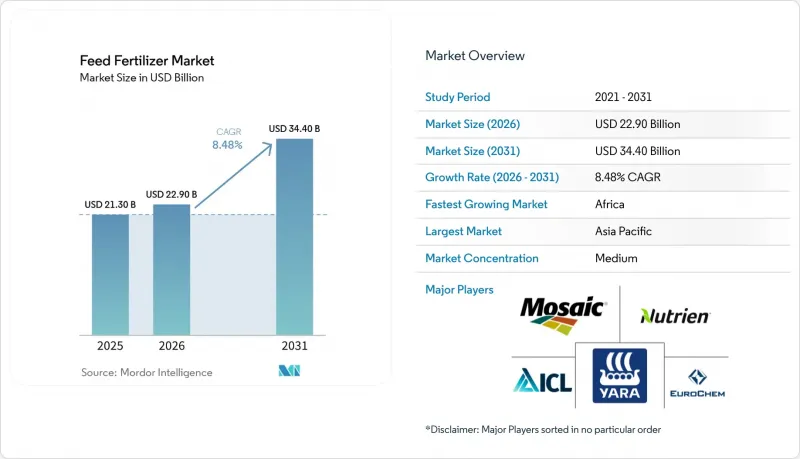
Mordor Intelligence에 의하면, 사료용 비료 시장 규모는 2025년 213억 달러로 평가되었고, 2026년 229억 달러로 추정되고, 2031년까지 344억 달러로 확대될 것으로 예측되며, 2026-2031년 CAGR 8.48%를 기록할 전망입니다.
본 보고서는 제품 유형별(질소계, 인산계 등), 형태별(건조 과립 등) 및 지역별(북미, 남미, 유럽, 아시아태평양, 중동 및 아프리카)로 분류되어 있습니다. 시장 전망은 금액(달러) 기준으로 제시되어 있습니다.
세계의 사료용 비료 시장 동향 및 인사이트
지속 가능한 축산 생산성에 관한 정부의 규제
2025년, 유럽연합(EU)의 공동농업정책에 따라 영양소 수지 관리에 관한 의무 규정이 도입되어, 농장들은 토양 기준치에 따라 비료 사용량을 기록해야 할 의무가 부과되었습니다. 마찬가지로, 미국과 캐나다에서는 보조금 수급 자격을 영양분 감사 결과와 연계하는 규정 준수 조치가 시행되고 있으며, 완벽한 추적성을 갖춘 정밀 시비 제품의 도입이 촉진되고 있습니다. 이러한 규제 체계는 농업 분야의 혁신을 촉진하고 있으며, 그 한 예로 2025년에 야라 인터내셔널이 'YaraPlus' 플랫폼을 출시한 점을 들 수 있습니다. 이 플랫폼은 규제 요건에 부합하는 실시간 권장 사항을 제공하는 동시에, 서비스 기반의 새로운 수익 기회를 창출하고 있습니다. 이러한 전 세계적인 노력을 보완하는 차원에서 인도도 같은 해 발효 유기비료 프로그램을 도입하고 소규모 낙농가들에게 도입 비용의 50%를 지원했습니다. 이러한 노력들은 전 세계적으로 지속 가능한 축산 관행으로의 전환을 여실히 보여주고 있으며, 환경적·경제적 목표에 부합하는 동시에 정밀 농업 및 유기 자재에 대한 수요 증가를 촉진하고 있습니다.
신흥 경제국에서 고단백 식단에 대한 수요 증가
아시아태평양의 식생활 변화, 즉 육류, 어류, 계란 소비 증가는 사료 수요 증가를 이끌고 있으며, 이는 결국 사료용 비료 시장에도 영향을 미치고 있습니다. 이러한 추세는 인도네시아, 방글라데시, 베트남 등 국가들의 가처분 소득 증가에 힘입어 더욱 가속화되고 있으며, 이로 인해 정밀한 질소 및 인산 비료 시비가 필요한 집약적인 새우 양식 사업의 확장이 촉진되고 있습니다. 가금류 사료가 여전히 주류를 이루고 있는 반면, 태국과 같은 성숙한 수출국에서는 그 성장세가 안정화되면서 투자자들은 자본을 어류 및 새우 밸류체인로 전환하고 있습니다. 그 결과, 단백질 수요 증가로 인해 시장은 폐쇄형 시스템에 최적화된 액상 농축 사료로 전환되고 있으며, 기존의 광범위 재배용 과립 사료에서 벗어나 이러한 신흥 경제국의 변화하는 요구에 부응하고 있습니다.
주요 원자재의 가격 변동
인산염과 질산염의 가격 변동은 조달 계획을 혼란스럽게 하고, 사료용 비료 공급업체의 영업이익률을 떨어뜨리고 있습니다. 뉴트리엔(Nutrien)사가 2025년에 트리니다드의 질소 생산 시설을 폐쇄하고 암모니아 생산량을 70만 메트르톤 감축하기로 한 결정은 지속적인 비용 상승으로 인해 생산 능력 축소가 불가피한 현실을 여실히 드러내고 있습니다. 동시에, 중국이 2025년에 시행한 인산염 수출 할당 제한은 세계 공급을 위축시켜 아프리카와 남미에서 가격 급등을 초래했습니다. 수직 통합이나 장기 계약을 맺지 않은 소규모 생산자들은 이러한 충격의 영향을 고스란히 받게 되며, 그 결과 혁신에 대한 투자가 줄어들고 축산 농가의 비용이 증가하여, 결국 시장 성장이 제약을 받게 됩니다.
부문별 분석
질소계 사료용 비료는 가장 큰 시장 점유율을 차지했으며, 2025년 사료용 비료 시장 매출의 42.5%를 차지했습니다. 이는 단백질 합성에서 차지하는 중요한 역할과 전 세계 암모니아 네트워크와의 연계성을 반영한 것입니다. 바이오 유래 사료용 비료 시장 점유율은 제한적이었으나, 2026-2031년 12.7%라는 가장 높은 연평균 성장률(CAGR)을 기록할 전망이며, 탄소 친화적인 투입 자재에 대한 수요가 증가하고 있음을 시사합니다. 인산계 사료용 비료는 가금류와 돼지의 골격 성장에 필요한 영양소로서 수요에 힘입어 시장에서 상당한 점유율을 차지했습니다. 한편, 칼륨계 비료는 반추동물용으로 사용되었습니다. 따라서 이 부문의 동향은 질소계가 지배적인 위치를 계속 유지하는 한편, 바이오 유래 제품이 프리미엄 틈새 시장으로 부상해 나가는 양상을 보이고 있습니다.
콜로만델 인터내셔널은 'Gromor Bio Organic'의 출시 이후, 2025 회계연도 3분기에 특수 영양소 부문에서 18%의 성장률을 기록하며, 인도 낙농 업계에서 확고한 지지를 얻고 있음이 드러났습니다. 2025년 브라질에서 출시된 'YaraBasa TURBO'는 암모니아 손실을 30% 줄여주는 우레아제 억제제를 함유하고 있으며, 기존 기업이 개선된 화학 기술을 통해 시장 점유율을 지키고 있는 사례입니다. 중국의 수출 할당제로 인해 인산염 공급이 위축되고 가격 차이가 확대됨에 따라, 구매자들은 질소·칼륨 혼합 비료로 전환하고 있습니다. 2026-2031년 질소계 사료용 비료 시장은 견조한 성장세를 유지할 것으로 보이며, 포트폴리오의 성장은 탄소 크레딧 수익을 반영한 바이오 혁신 제품으로 전환될 것입니다.
지역별 분석
2025년에는 아시아태평양이 38.2%의 점유율로 시장을 주도했습니다. 이는 중국의 집약적인 양계 클러스터, 인도의 낙농 사업 확대, 그리고 베트남과 인도네시아의 견조한 새우 양식이 원동력이 되고 있습니다. 중국의 인산염 수출 할당량 축소에 따라 질소 및 바이오 복합비료로의 다각화가 진행되면서, 단위당 부가가치가 향상되었습니다. 아프리카는 2026-2031년 연평균 성장률(CAGR) 9.4%로 성장할 것으로 전망되며, 단백질 자급자족을 촉진하기 위한 정부의 이니셔티브와 사료 인프라 구축이 진행되고 있습니다. 물류상의 과제가 있는 품목의 경우, 모바일 결제 및 협동조합 거점을 통해 유통 체계가 개선되고 있습니다.
북미에서는 가축 분뇨 유래 비료를 지원하는 탄소 크레딧의 수익화가 꾸준한 성장의 원동력이 되고 있는 반면, 남미에서는 투입 비용을 최적화하는 수직 통합형 가금류 및 돼지 공급망이 성장에 기여하고 있습니다. 유럽의 성장은 여전히 엄격한 영양염 예산으로 인해 제약을 받고 있지만, 고효율 프리미엄 제품들이 판매량 감소를 완화하고 있습니다. 중동에서는 식량 안보를 위한 국내 비료 복합 시설에 대한 투자를 통해 시장이 확대되고 있는 반면, 러시아에서는 제재로 인해 정밀 농업 기술에 대한 접근이 제한되고 있어 가축 군 재건에 대한 노력이 주춤하고 있습니다.
지속가능성에 대한 요구와 단백질 소비량 증가에 따라 전 세계적인 수요가 증가하고 있습니다. 아시아태평양의 규모가 가격의 기준이 되고 있으며, 아프리카의 급속한 성장이 새로운 판매량 기회를 창출하고, 북미와 남미에서 시작된 혁신은 파트너십을 통해 전 세계로 확산되고 있습니다. 이러한 상호 연관된 지역적 동향은 연계된 정책 인센티브와 디지털 플랫폼을 통해 뒷받침되어, 도입 격차를 줄이고 전 세계 사료용 비료 시장을 주도할 것으로 예측됩니다.
기타 혜택 :
- 엑셀 형식 시장 예측(ME) 시트
- 3개월간의 애널리스트 지원
목차
제1장 서론
제2장 조사 방법
제3장 주요 요약
제4장 시장 구도
제5장 시장 규모 및 성장 예측
제6장 경쟁 구도
제7장 시장 기회 및 향후 전망
AJYAccording to Mordor Intelligence, the feed fertilizer market size is projected to expand from USD 21.3 billion in 2025 and USD 22.9 billion in 2026 to USD 34.4 billion by 2031, registering a CAGR of 8.48% during 2026-2031.
This report is Segmented by Product Type (Nitrogen-Based, Phosphate-Based, and More), by Form (Dry Granules, and More), and by Geography (North America, South America, Europe, Asia-Pacific, Middle East, Africa). Market Forecasts are Provided in Terms of Value (USD).
Global Feed Fertilizer Market Trends and Insights
Government Mandates on Sustainable Livestock Productivity
In 2025, the European Union Common Agricultural Policy introduced mandatory nutrient budgeting rules, requiring farms to document fertilizer usage in accordance with soil threshold limits. Similarly, in the United States and Canada, compliance measures tie subsidy eligibility to nutrient audits, encouraging the adoption of precision-dosed products with full traceability. These regulatory frameworks have driven innovation in the agricultural sector, as seen with Yara International's launch of the YaraPlus platform in 2025, which provides real-time recommendations aligned with regulatory requirements and creates new service-based revenue opportunities. Complementing these global efforts, India introduced a fermented organic manure program in the same year, subsidizing 50% of setup costs for smallholder dairy farmers. Together, these initiatives highlight a global shift towards sustainable livestock practices, fostering increased demand for precision agriculture and organic inputs while aligning with environmental and economic goals.
Growing Demand for High-Protein Diets in Emerging Economies
Dietary shifts in the Asia-Pacific region toward higher consumption of meat, fish, and eggs are driving growth in compound feed volumes, subsequently impacting the feed fertilizer market. This trend is further supported by rising disposable incomes in countries such as Indonesia, Bangladesh, and Vietnam, which are fueling the expansion of intensive shrimp farming operations requiring precise nitrogen and phosphate applications. While poultry remains dominant, its growth is stabilizing in mature exporting countries like Thailand, prompting investors to redirect capital toward fish and shrimp value chains. Consequently, the increasing demand for protein is steering the market toward liquid concentrates optimized for closed-loop systems, marking a shift away from traditional broad-acre granules and aligning with the evolving needs of these emerging economies.
Price Volatility of Key Raw Materials
Fluctuations in phosphate and nitrate prices disrupt procurement planning and reduce operating margins for feed fertilizer suppliers. Nutrien's 2025 closure of its Trinidad nitrogen facility, cutting 0.7 million metric tons of ammonia production, underscores how sustained cost inflation forces capacity reductions. Simultaneously, China's 2025 phosphate export quota tightened global supply, driving price surges in Africa and South America. Smaller producers, lacking vertical integration or long-term contracts, face the full impact of these shocks, leading to reduced innovation spending and higher costs for livestock farmers, ultimately constraining market growth.
Other drivers and restraints analyzed in the detailed report include:
- Expansion of Aquaculture Requiring Water-Soluble Feed Fertilizers
- Rising Adoption of Precision Farming in Animal Husbandry
- Stringent Residue Limits in Animal-Source Foods
For complete list of drivers and restraints, kindly check the Table Of Contents.
Segment Analysis
Nitrogen-based feed fertilizers held the largest share, accounting for 42.5% of 2025 revenue in the feed fertilizer market, reflecting their critical role in protein synthesis and their linkage to global ammonia networks. Bio-based feed fertilizers held only a limited share yet posted the fastest 12.7% CAGR through 2026-2031, suggesting a rising appetite for carbon-friendly inputs. Phosphate-based feed fertilizers captured a prominent share of the market, driven by skeletal growth requirements in poultry and swine, while potash served ruminants. The segment narrative, therefore, revolves around nitrogen defending its dominant position while bio-based lines become premium niches.
Coromandel International recorded 18% specialty-nutrient growth in Q3 FY 2025 after the launch of Gromor Bio Organic, indicating tangible traction among Indian dairies. YaraBasa TURBO, launched in Brazil in 2025, integrates urease inhibitors that reduce ammonia loss by 30%, illustrating how incumbents defend their share via upgraded chemistries. China's export quotas pressure phosphate availability, widening price differentials, and nudging buyers toward nitrogen-potash blends. Over 2026-2031, the feed fertilizer market for nitrogen remains sturdy, but portfolio growth will tilt toward bio-based innovations that bundle carbon credit revenue.
Complete Report Scope:
- By Product Type
- Nitrogen-Based Feed Fertilizers
- Phosphate-Based Feed Fertilizers
- Potash-Based Feed Fertilizers
- Bio-Based Feed Fertilizers
- By Form
- Dry Granules
- Liquid Concentrates
- By Geography
- North America
- United States
- Canada
- Mexico
- South America
- Brazil
- Argentina
- Rest of South America
- Europe
- Germany
- France
- Russia
- Rest of Europe
- Asia-Pacific
- China
- India
- Japan
- Rest of Asia-Pacific
- Middle East
- Saudi Arabia
- United Arab Emirates
- Rest of Middle East
- Africa
- South Africa
- Egypt
- Rest of Africa
- North America
Geography Analysis
In 2025, Asia-Pacific led the market with a 38.2% share, driven by concentrated poultry clusters in China, expanding dairy operations in India, and robust shrimp farming in Vietnam and Indonesia. Tightened phosphate-export quotas in China prompted diversification into nitrogen and bio-based blends, enhancing per-unit value. Africa is projected to grow at a 9.4% CAGR during 2026-2031, is advancing through government initiatives promoting protein self-sufficiency and feed infrastructure upgrades, with mobile payments and cooperative hubs improving distribution despite logistical challenges.
North America's steady growth is fueled by carbon-credit monetization supporting manure-derived fertilizers, while South America benefits from vertically integrated poultry and swine chains that optimize input costs. Europe's growth remains constrained by strict nutrient budgets, though premium enhanced-efficiency products mitigate tonnage declines. The Middle East is expanding through investments in domestic nutrient complexes for food security, while Russia's herd rebuilding efforts are tempered by limited access to precision-farming technologies due to sanctions.
Global demand is rising as sustainability mandates and protein consumption increase. Asia-Pacific's scale sets pricing benchmarks, Africa's rapid growth adds new volume opportunities, and innovation from North and South America spreads globally through partnerships. These interconnected regional dynamics, supported by synchronized policy incentives and digital platforms, are anticipated to narrow adoption gaps and drive the global feed fertilizer market forward.
- Yara International ASA
- Nutrien Ltd.
- The Mosaic Company
- ICL Group Ltd.
- EuroChem Group AG
- OCP S.A.
- Koch Agronomic Services, LLC (Koch Industries Inc.)
- CF Industries Holdings, Inc.
- Wilbur-Ellis Nutrition, LLC (Wilbur-Ellis Holdings, Inc.)
- Coromandel International Ltd. (Murugappa Group)
- Haifa Negev Technologies Ltd.
- Innophos Holdings, Inc. (One Rock Capital Partners)
- Phosphea (Groupe Roullier)
- J. R. Simplot Company
- Grupa Azoty S.A.
Additional Benefits:
- The market estimate (ME) sheet in Excel format
- 3 months of analyst support
TABLE OF CONTENTS
1 Introduction
- 1.1 Study Assumptions and Market Definition
- 1.2 Scope of the Study
2 Research Methodology
3 Executive Summary
4 Market Landscape
- 4.1 Market Overview
- 4.2 Market Drivers
- 4.2.1 Government mandates on sustainable livestock productivity
- 4.2.2 Growing demand for high-protein diets in emerging economies
- 4.2.3 Expansion of aquaculture requiring water-soluble feed fertilizers
- 4.2.4 Rising adoption of precision farming in animal husbandry
- 4.2.5 Algae-based biofertilizers are improving feed conversion ratios
- 4.2.6 Carbon-credit monetization of manure-derived fertilizers
- 4.3 Market Restraints
- 4.3.1 Price volatility of key raw materials
- 4.3.2 Stringent residue limits in animal-source foods
- 4.3.3 Slow regulatory approvals for novel microbial fertilizers
- 4.3.4 Farm-level resistance to data-sharing for precision plans
- 4.4 Regulatory Landscape
- 4.5 Technological Outlook
- 4.6 Porter's Five Forces
- 4.6.1 Threat of New Entrants
- 4.6.2 Bargaining Power of Suppliers
- 4.6.3 Bargaining Power of Buyers
- 4.6.4 Threat of Substitutes
- 4.6.5 Competitive Rivalry
5 Market Size and Growth Forecasts (Value)
- 5.1 By Product Type
- 5.1.1 Nitrogen-Based Feed Fertilizers
- 5.1.2 Phosphate-Based Feed Fertilizers
- 5.1.3 Potash-Based Feed Fertilizers
- 5.1.4 Bio-Based Feed Fertilizers
- 5.2 By Form
- 5.2.1 Dry Granules
- 5.2.2 Liquid Concentrates
- 5.3 By Geography
- 5.3.1 North America
- 5.3.1.1 United States
- 5.3.1.2 Canada
- 5.3.1.3 Mexico
- 5.3.2 South America
- 5.3.2.1 Brazil
- 5.3.2.2 Argentina
- 5.3.2.3 Rest of South America
- 5.3.3 Europe
- 5.3.3.1 Germany
- 5.3.3.2 France
- 5.3.3.3 Russia
- 5.3.3.4 Rest of Europe
- 5.3.4 Asia-Pacific
- 5.3.4.1 China
- 5.3.4.2 India
- 5.3.4.3 Japan
- 5.3.4.4 Rest of Asia-Pacific
- 5.3.5 Middle East
- 5.3.5.1 Saudi Arabia
- 5.3.5.2 United Arab Emirates
- 5.3.5.3 Rest of Middle East
- 5.3.6 Africa
- 5.3.6.1 South Africa
- 5.3.6.2 Egypt
- 5.3.6.3 Rest of Africa
- 5.3.1 North America
6 Competitive Landscape
- 6.1 Market Concentration
- 6.2 Strategic Moves
- 6.3 Market Share Analysis
- 6.4 Company Profiles (includes Global Level Overview, Market Level Overview, Core Segments, Financials as available, Strategic Information, Market Rank/Share for key companies, Products and Services, and Recent Developments)
- 6.4.1 Yara International ASA
- 6.4.2 Nutrien Ltd.
- 6.4.3 The Mosaic Company
- 6.4.4 ICL Group Ltd.
- 6.4.5 EuroChem Group AG
- 6.4.6 OCP S.A.
- 6.4.7 Koch Agronomic Services, LLC (Koch Industries Inc.)
- 6.4.8 CF Industries Holdings, Inc.
- 6.4.9 Wilbur-Ellis Nutrition, LLC (Wilbur-Ellis Holdings, Inc.)
- 6.4.10 Coromandel International Ltd. (Murugappa Group)
- 6.4.11 Haifa Negev Technologies Ltd.
- 6.4.12 Innophos Holdings, Inc. (One Rock Capital Partners)
- 6.4.13 Phosphea (Groupe Roullier)
- 6.4.14 J. R. Simplot Company
- 6.4.15 Grupa Azoty S.A.