

|
시장보고서
상품코드
2072897
동남아시아의 농업용 분무기 시장 : 점유율 분석, 업계 동향과 통계, 성장 예측(2026-2031년)Southeast Asia Agricultural Sprayers - Market Share Analysis, Industry Trends & Statistics, Growth Forecasts (2026 - 2031) |
||||||
 Mordor Intelligence
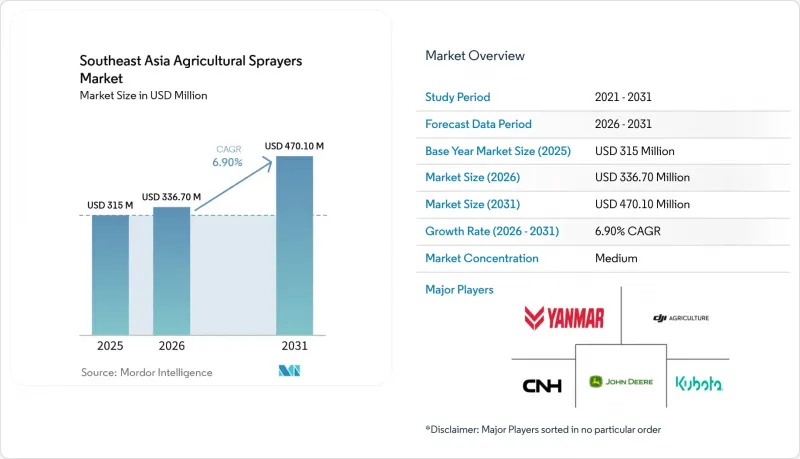
Mordor Intelligence에 의하면, 동남아시아 농업용 분무기 시장 규모는 2025년에 3억 1,500만 달러로 평가되었고 2026년 3억 3,670만 달러에서 2031년까지 4억 7,010만 달러에 이를 것으로 예측되며, 예측 기간(2026-2031년) CAGR은 6.9%를 나타낼 전망입니다.
본 보고서는 동력원별(수동식 등), 제품 유형별(휴대용 등), 용도별(밭작물 등), 분무 용량별(초저용량 시스템 등), 기술 수준별(기존 등), 펌프 구조별(다이어프램 펌프 등), 지역별(인도네시아, 베트남 등)로 분류되어 있습니다. 시장 규모는 달러(USD)로 표시되어 있습니다.
동남아시아 농업용 분무기 시장 동향과 인사이트
농업 인력 부족이 기계화 살포 수요를 끌어올리고 있습니다.
동남아시아의 농촌 노동력 이동은 단기적인 주기가 아니라 지속적인 변화로 나타나고 있으며, 이로 인해 농장 차원의 살포 방침이 바뀌고 있습니다. 일부 국가에서는 작물에 농약을 살포하기에 적합한 기간이 제한적인 가운데, 반복적인 살포 작업을 수행할 인력을 확보하는 것이 생산자들에게 점점 더 어려워지고 있습니다. 수동식 배낭형 분무기의 경우, 한 번의 살포 작업에 50헥타르당 3-5명의 작업자가 필요한 경우도 있어, 대규모 농장의 노동 부담이 급속히 증가하고 있습니다. 그 결과, 인력 부족으로 인해 기계식 분무기는 단순히 편의성을 목적으로 구매하던 것에서 경영상 필수 불가결한 설비로 그 위상이 변화하고 있습니다. 인도네시아와 필리핀의 유통업체에 따르면, 고부가가치 작물 재배 체계에서 동력식 분무기의 투자 회수 기간이 현재 18개월 미만으로 단축되면서, 과거에는 수년이 걸리던 구매 결정이 가속화되고 있습니다. 이에 따라 중규모 농장에서 트랙터 탑재형 붐식 분무기에 대한 수요가 증가하고 있을 뿐만 아니라, 지상에서 접근이 제한되는 분할된 토지나 험준한 지형에서는 드론을 활용한 서비스 계약에 대한 수요도 높아지고 있습니다. 따라서 동남아시아의 농업용 분무기 시장은 단순히 수확량 증가에 의해 주도되는 수요보다, 노동력 대체와 연계된 보다 안정적인 수요 기반의 혜택을 누리고 있습니다.
정부의 기계화 보조금 및 자금 조달
공적 자금을 통한 지원은 동남아시아의 농장과 협동조합이 분무기 구입을 어떻게 추진하는지에 영향을 미치고 있습니다. 2025년, 필리핀 농림부의 ‘Drones4Rice’ 프로그램은 헥타르 단위의 바우처를 통해 드론 살포 서비스 이용을 지원함과 동시에, 정밀 농업 도입을 돕기 위한 보다 광범위한 기계화 자금도 제공했습니다. 태국에서는 2025년에 시작된 ‘스마트 파머(Smart Farmer)’ 이니셔티브를 통해 현대화가 추진되고, GPS 유도식 분무기나 농업용 드론과 같은 정밀 기기의 활용이 촉진되었습니다. 마찬가지로, 2025년에 시작된 인도네시아의 KUR Pertanian 대출 프로그램은 기계화 살포 시스템을 포함한 농업 기계에 투자하는 소규모 농가와 협동조합의 재정적 부담을 줄이는 것을 목적으로 하고 있습니다. 이러한 프로그램은 초기 비용을 절감할 뿐만 아니라, 적격 기준을 통해 효율성, 제어성, 추적성이 향상된 고성능 장비를 우선적으로 선정하고 있습니다. 그 결과, 보조금 및 융자 정책은 선진적인 살포 기술에 대한 수요를 높임으로써 동남아시아 농업용 분무기 시장의 제품 구성에 변화를 가져오고 있습니다.
드론 및 동력식 분무기의 높은 초기 비용
높은 장비 비용은 동남아시아 농업용 분무기 시장에서 여전히 큰 과제로 남아 있습니다. 적재 용량이 20-30리터인 상업용 농업용 드론의 가격은 구성, 배터리, 부속품에 따라 다르지만, 8,000-2만 달러 사이입니다. 이러한 가격 책정 방식 때문에 소유주는 주로 플랜테이션, 상업 농장 및 재정적 여유가 있는 협동조합으로 한정되어 있습니다. 드론의 '서비스형 드론(Drone-as-a-Service)' 모델은 초기 투자 비용을 줄이는 데 도움이 되지만, 사업자는 여전히 장비, 교육, 유지보수와 관련된 막대한 비용을 부담해야 하므로, 그 결과 소규모 농가에게는 서비스 요금이 비싸게 느껴지게 됩니다. 그 결과, 조직화된 농업 경영에서는 첨단 살포 시스템이 더 신속하게 도입되고 있는 반면, 소규모 농장에서는 수동식이나 기본적인 동력식 분무기가 여전히 주류를 이루고 있습니다.
부문별 분석
2025년 기준, 동남아시아 농업용 분무기 시장에서 수동식 분무기가 44%를 차지했으나, 배터리 구동식 분무기는 2031년까지 연평균 성장률(CAGR) 11.3%를 기록하며 가장 빠르게 성장할 것으로 전망됩니다. 수동식 분무기는 특히 매우 소규모 농지를 보유한 농장에서 저렴한 가격 덕분에 여전히 널리 보급되어 있습니다. 게다가 수리가 용이하고 필요한 지원 인프라도 최소한으로 충분하기 때문에 판매점 네트워크가 제한적인 농촌 지역에서는 매우 중요합니다. 이러한 요인들로 인해, 첨단 제품이 점차 보급되고 있는 상황에서도 동남아시아 농업용 분무기 시장의 다양한 부문에서 수동식 분무기의 중요성은 앞으로도 지속될 것입니다.
리튬 이온 배터리의 비용 절감, 작동 시간 연장, 그리고 일부 국가의 농촌 지역 전력 공급 안정화에 힘입어 배터리식 분무기의 인기가 높아지고 있습니다. 이러한 추세는 공공 조달 이니셔티브나 저탄소 농업 프로그램을 통해 전동 공구의 도입이 촉진되고 있는 태국과 베트남에서 특히 두드러집니다. 한편, 소규모 산비탈이나 계단식 논에서 이루어지는 농업 작업을 위한 솔루션으로 태양광 발전식 분무기가 등장하고 있습니다. 연료 구동식 시스템은 더 긴 가동 시간과 큰 탱크 용량이 필수적인 농장이나 밭농사 현장에서 계속해서 활용되고 있습니다. 이러한 다양한 구성은 동남아시아의 농업용 분무기 시장이 기존의 동력 시스템에서 완전히 전환된 것은 아니며, 이미 정착된 수동식을 기반으로 하면서 새로운 동력 방식을 도입하고 있음을 보여줍니다.
휴대용 분무기는 분할된 농지에서 여전히 가장 저렴하고 실용적인 선택지이기 때문에 2025년에는 47%의 시장 점유율을 차지하며 제품 수요를 견인했습니다. 이러한 강점은 이 지역의 농업 대부분이 여전히 토지, 자금, 인프라의 제약 속에서 운영되고 있다는 현실을 반영하고 있습니다. 따라서, 보다 고도화된 시스템이 급속한 성장을 이루고 있는 상황에서도 휴대용 기기의 판매량은 안정적으로 유지될 것으로 전망됩니다. 따라서 동남아시아의 농업용 분무기 시장은 대규모의 저비용 기존 도입 기반에 힘입어 계속해서 성장하고 있습니다.
UAV(무인 항공기) 분무기는 2031년까지 연평균 성장률(CAGR) 14.2%를 기록하며 성장할 것으로 예상되며, 시장에서 가장 빠르게 성장하는 제품 유형이 될 전망입니다. 이러한 확장의 상당 부분은 소유 시 비용 대비 효과가 맞지 않는 농장들에게 항공 살포의 실질적인 비용을 절감해 주는 ‘Drone-as-a-Service’ 네트워크에 의해 주도되고 있습니다. 2026년 5월, DJI는 방콕에서 개최된 AGRITECHNICA Asia 2026에서 50리터의 적재 용량을 갖춘 Agras T55 및 Agras T100 듀얼 배터리 살포 시스템을 발표하며, 드론의 활용 사례를 광활한 농지와 농장까지 확대했습니다. 트랙터 탑재형, 견인형 및 자가주행식 분무기는 일관된 붐 살포 범위와 높은 일일 작업 효율이 요구되는 중·대규모 농장에서 계속해서 활용되고 있습니다. 앞으로 구매자들이 기계의 가격뿐만 아니라 인건비 절감, 작업 신속화, 서비스 이용 가능성 등도 비교 검토하게 됨에 따라, 첨단 지상 시스템과 무인항공기(UAV) 간의 중복 영역은 더욱 확대될 것으로 보입니다.
기타 혜택:
- 엑셀 형식 시장 예측(ME) 시트
- 3개월간의 애널리스트 지원
자주 묻는 질문
목차
제1장 서론
제2장 조사 방법
제3장 주요 요약
제4장 시장 구도
제5장 시장 규모와 성장 예측
제6장 경쟁 구도
제7장 시장 기회와 향후 전망
JHS 26.07.09According to Mordor Intelligence, the southeast asia agricultural sprayers market size was valued at USD 315 million in 2025 and estimated to grow from USD 336.7 million in 2026 to reach USD 470.1 million by 2031, at a CAGR of 6.9% during the forecast period (2026-2031).
This report is Segmented by Power Source (Manual, and More), by Product Type (Handheld and More), by Application (Field Crops and More), by Spray Volume Capacity ( Ultra-Low Volume Systems, and More), by Technology Level (Conventional, and More), by Pump Mechanism (Diaphragm Pumps, and More), and Geography (Indonesia, Vietnam, and More). The Market Values are Provided in USD.
Southeast Asia Agricultural Sprayers Market Trends and Insights
Farm Labor Shortages Raise Mechanized Spraying Demand
The rural labor movement in Southeast Asia has become a lasting shift rather than a short cycle, and that is changing spraying decisions at the farm level. In several countries, growers are finding it harder to secure workers for repeated spray passes during narrow crop windows. Manual backpack spraying can require 3 to 5 workers per 50 hectares in a single application round, quickly increasing the labor burden on large farms. As a result, labor scarcity is pushing mechanized sprayers from a convenience purchase into an operating need. Dealers in Indonesia and the Philippines have reported that payback periods for powered spraying equipment are now shortening to under 18 months in higher-value crop systems, which is speeding up purchase decisions that once took years. This is lifting demand for tractor-mounted boom sprayers on medium-scale farms and for drone service contracts on fragmented or difficult terrain where ground access is limited. The Southeast Asia agricultural sprayers market is therefore benefiting from a demand base tied to labor substitution, which is more stable than demand driven only by yield improvement.
Government Mechanization Subsidies and Financing
Public financing initiatives are influencing how farms and cooperatives in Southeast Asia approach sprayer purchases. During 2025, the Philippines' Department of Agriculture's Drones4Rice program offered subsidized access to drone spraying services through hectare-based vouchers, complemented by broader mechanization funding to support the adoption of precision agriculture. In Thailand, the Smart Farmer initiatives, launched in 2025, promoted modernization and the use of precision equipment, such as GPS-guided sprayers and agricultural drones. Similarly, Indonesia's KUR Pertanian financing programs launched in 2025 aim to ease the financial burden on smallholder farmers and cooperatives investing in agricultural machinery, including mechanized spraying systems. These programs not only reduce upfront costs but also prioritize higher-performing equipment with enhanced efficiency, control, and traceability through their eligibility criteria. Consequently, subsidy and financing policies are driving changes in the product mix of the Southeast Asia agricultural sprayers market by increasing demand for advanced spraying technologies.
High Upfront Cost Of Drones And Powered Sprayers
High equipment costs continue to be a significant challenge in the Southeast Asia agricultural sprayers market. Commercial agricultural drones with payload capacities of 20-30 liters are priced between USD 8,000 and USD 20,000, depending on configuration, batteries, and accessories. This pricing restricts ownership primarily to plantations, commercial farms, and well-funded cooperatives. While drone-as-a-service models help reduce upfront investment, operators still incur substantial costs related to equipment, training, and maintenance, leading to higher service prices for small-scale growers. Consequently, advanced spraying systems are being adopted more quickly in organized farming operations, whereas manual and basic powered sprayers remain prevalent on smaller farms.
Other drivers and restraints analyzed in the detailed report include:
- Precision Agriculture and Input-Efficiency Needs
- Palm Oil and Rice Crop Protection Drives Consistent Demand
- Fragmented Smallholder Land Limits Utilization
For complete list of drivers and restraints, kindly check the Table Of Contents.
Segment Analysis
Manual sprayers accounted for 44% of the Southeast Asia agricultural sprayers market in 2025, while battery-operated sprayers are projected to grow the fastest, with a CAGR of 11.3% through 2031. Manual sprayers remain prevalent due to their affordability, particularly for farms with very small landholdings. Additionally, they are easy to repair and require minimal supporting infrastructure, which is crucial in rural areas with limited dealer networks. These factors ensure their continued relevance in various segments of the Southeast Asia agricultural sprayers market, even as advanced products gain traction.
Battery-operated sprayers are increasingly popular as lithium-ion battery costs decline, runtimes improve, and rural electrification becomes more reliable in several countries. This trend is particularly evident in Thailand and Vietnam, where public procurement initiatives and low-emission farming programs are promoting the adoption of electrified tools. Meanwhile, solar-powered sprayers are emerging as a solution for smaller hillside and terraced farming operations. Fuel-powered systems continue to serve plantation and field-crop operations, where longer runtimes and larger tank capacities are essential. This diverse mix indicates that the Southeast Asia agricultural sprayers market is not entirely transitioning away from traditional power systems but is instead incorporating new power formats alongside the established manual base.
Handheld sprayers led product demand, with a 47% share in 2025, as they remain the cheapest and most practical option for fragmented plots. Their strength reflects the reality that a large part of regional agriculture still operates under land, cash, and infrastructure constraints. That gives handheld equipment durable volume even when more advanced systems post faster growth. The Southeast Asia agricultural sprayers market, therefore, continues to be led by a large, low-cost installed base.
UAV (Unmanned Aerial Vehicle) sprayers are projected to grow at a 14.2% CAGR through 2031, making them the fastest-growing product type in the market. Much of this expansion is being driven by drone-as-a-service networks that lower the effective cost of aerial spraying for farms that cannot justify ownership. In May 2026, DJI introduced the Agras T55 with a 50-liter payload and the Agras T100 Dual Battery Spraying System at AGRITECHNICA Asia 2026 in Bangkok, extending drone capability into larger field and plantation use cases. Tractor-mounted, trailed, and self-propelled sprayers continue to serve medium and large farms that require consistent boom coverage and higher daily work rates. Over time, the overlap between advanced ground systems and Unmanned Aerial Vehicle's is likely to intensify as buyers compare not only machine price, but also labor savings, turnaround speed, and service availability.
Complete Report Scope:
- By Power Source
- Manual
- Battery-Operated
- Solar-Powered
- Fuel-Operated
- By Product Type
- Handheld
- Tractor-Mounted
- Trailed
- Self-Propelled
- Unmanned Aerial Vehicle Sprayers
- By Application
- Field Crops
- Orchards and Vineyards
- Greenhouse Crops
- Turf and Gardening
- By Spray Volume Capacity
- Ultra-Low Volume Systems
- Low-Volume Systems
- High-Volume Systems
- By Technology Level
- Conventional
- Precision and GPS-Guided
- Artificial Intelligence-Enabled and Autonomous
- By Pump Mechanism
- Diaphragm Pumps
- Piston Pumps
- Centrifugal Pumps
- By Country
- Indonesia
- Vietnam
- Thailand
- Philippines
- Malaysia
- Cambodia
- Myanmar
- Singapore
- Rest of Southeast Asia
List of Companies Covered in this Report:
- KUBOTA Corporation
- Deere and Company
- CNH Industrial N.V.
- Yanmar Holdings Co., Ltd.
- DJI Agriculture
- XAG Co., Ltd.
- Terra Drone Corporation
- STIHL Holding AG & Co. KG
- AGCO Corporation
- Jacto Inc.
- HARDI International A/S
- EXEL Industries
- Micron Sprayers Ltd.
- ASPEE Agro Equipment Pvt. Ltd.
- Goizper Group
- Yamaho Industry Co., Ltd.
- Bucher Industries AG
- Mahindra & Mahindra Ltd.
- Maruyama Mfg. Co., Inc.
- SOLO Kleinmotoren GmbH
Additional Benefits:
- The market estimate (ME) sheet in Excel format
- 3 months of analyst support
TABLE OF CONTENTS
1 Introduction
- 1.1 Study Assumptions and Market Definition
- 1.2 Scope of the Study
2 Research Methodology
3 Executive Summary
4 Market Landscape
- 4.1 Market Overview
- 4.2 Market Drivers
- 4.2.1 Farm labor shortages raise mechanized spraying demand
- 4.2.2 Government mechanization subsidies and financing
- 4.2.3 Precision agriculture and input-efficiency needs
- 4.2.4 Palm oil and rice crop protection drives consistent demand
- 4.2.5 Low-emission rice programs favor precise spray scheduling
- 4.2.6 Expansion of contract drone service networks
- 4.3 Market Restraints
- 4.3.1 High upfront cost of drones and powered sprayers
- 4.3.2 Fragmented smallholder land limits utilization
- 4.3.3 Drone-compliant pesticide formulations remain limited
- 4.3.4 Flight permits and payload rules slow field operations
- 4.4 Value Chain Analysis
- 4.5 Regulatory Landscape
- 4.6 Technological Outlook
- 4.7 Porter's Five Forces
- 4.7.1 Bargaining Power of Suppliers
- 4.7.2 Bargaining Power of Buyers
- 4.7.3 Threat of New Entrants
- 4.7.4 Threat of Substitutes
- 4.7.5 Intensity of Competitive Rivalry
5 Market Size and Growth Forecasts (Value)
- 5.1 By Power Source
- 5.1.1 Manual
- 5.1.2 Battery-Operated
- 5.1.3 Solar-Powered
- 5.1.4 Fuel-Operated
- 5.2 By Product Type
- 5.2.1 Handheld
- 5.2.2 Tractor-Mounted
- 5.2.3 Trailed
- 5.2.4 Self-Propelled
- 5.2.5 Unmanned Aerial Vehicle Sprayers
- 5.3 By Application
- 5.3.1 Field Crops
- 5.3.2 Orchards and Vineyards
- 5.3.3 Greenhouse Crops
- 5.3.4 Turf and Gardening
- 5.4 By Spray Volume Capacity
- 5.4.1 Ultra-Low Volume Systems
- 5.4.2 Low-Volume Systems
- 5.4.3 High-Volume Systems
- 5.5 By Technology Level
- 5.5.1 Conventional
- 5.5.2 Precision and GPS-Guided
- 5.5.3 Artificial Intelligence-Enabled and Autonomous
- 5.6 By Pump Mechanism
- 5.6.1 Diaphragm Pumps
- 5.6.2 Piston Pumps
- 5.6.3 Centrifugal Pumps
- 5.7 By Country
- 5.7.1 Indonesia
- 5.7.2 Vietnam
- 5.7.3 Thailand
- 5.7.4 Philippines
- 5.7.5 Malaysia
- 5.7.6 Cambodia
- 5.7.7 Myanmar
- 5.7.8 Singapore
- 5.7.9 Rest of Southeast Asia
6 Competitive Landscape
- 6.1 Market Concentration
- 6.2 Strategic Moves
- 6.3 Market Share Analysis
- 6.4 Company Profiles (Includes Global Level Overview, Market Level Overview, Core Segments, Financials as Available, Strategic Information, Market Rank/Share for Key Companies, Products and Services, and Recent Developments)
- 6.4.1 KUBOTA Corporation
- 6.4.2 Deere and Company
- 6.4.3 CNH Industrial N.V.
- 6.4.4 Yanmar Holdings Co., Ltd.
- 6.4.5 DJI Agriculture
- 6.4.6 XAG Co., Ltd.
- 6.4.7 Terra Drone Corporation
- 6.4.8 STIHL Holding AG & Co. KG
- 6.4.9 AGCO Corporation
- 6.4.10 Jacto Inc.
- 6.4.11 HARDI International A/S
- 6.4.12 EXEL Industries
- 6.4.13 Micron Sprayers Ltd.
- 6.4.14 ASPEE Agro Equipment Pvt. Ltd.
- 6.4.15 Goizper Group
- 6.4.16 Yamaho Industry Co., Ltd.
- 6.4.17 Bucher Industries AG
- 6.4.18 Mahindra & Mahindra Ltd.
- 6.4.19 Maruyama Mfg. Co., Inc.
- 6.4.20 SOLO Kleinmotoren GmbH


