

|
시장보고서
상품코드
2114271
남미의 농업용 분무기 : 시장 점유율 분석, 업계 동향 및 통계, 성장 예측(2026-2031년)South America Agricultural Sprayers - Market Share Analysis, Industry Trends & Statistics, Growth Forecasts (2026 - 2031) |
||||||
 Mordor Intelligence
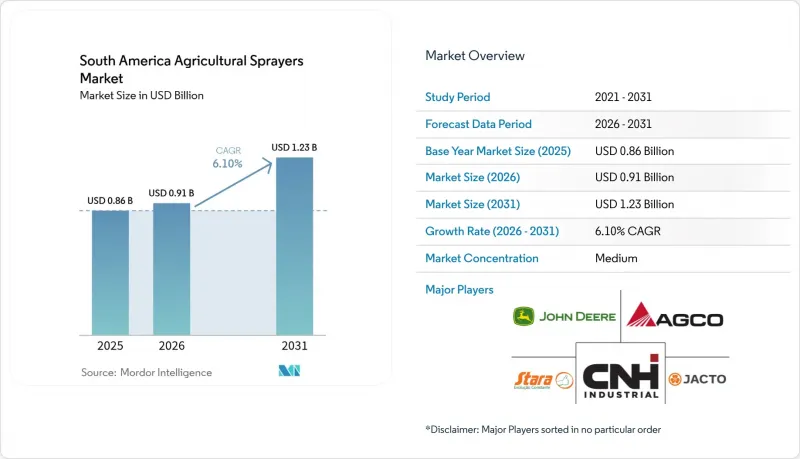
Mordor Intelligence에 의하면, 남미의 농업용 분무기 시장 규모는 2025년 8억 6,000만 달러로 평가되었습니다. 2026년에는 9억 1,000만 달러로 확대되어 2026년부터 2031년에 걸쳐 CAGR 6.10%로 성장을 지속하여, 2031년까지 12억 3,000만 달러에 이를 것으로 예측됩니다.
본 보고서는 동력원(수동식, 배터리식, 태양광 발전식, 연료식), 용도(밭용 분무기, 과수원용 분무기, 원예용 분무기), 용량별(초저용량, 저용량, 고용량),및 지역(브라질, 아르헨티나, 기타 남미 국가)별로 분류되어 있습니다. 시장 전망은 금액(미 달러) 기준으로 제시되어 있습니다.
남미의 농업용 분무기 시장 동향 및 인사이트
농촌 지역의 노동력 부족
남미의 농업 인력은 젊은 층이 도시로 이주하고 고령 농가가 은퇴함에 따라 계속 감소하고 있으며, 이는 복잡한 살포 작업을 수행할 숙련된 작업자 부족을 초래하고 있습니다. 이러한 노동력 감소로 인해 임금이 상승하고 살포 가능한 기간이 단축되면서, 생산자들은 장기간에 걸쳐 효율적인 작업을 수행하기 위해 자가 주행식 또는 자율 주행식 기계에 투자할 수밖에 없는 상황입니다. 정찰 기능과 살포 기능을 결합한 로봇 시스템의 도입이 진행되고 있으며, 이는 투입 비용 절감으로 이어지고 있습니다. 농업 자동화 분야에서 브라질이 이 지역을 선도하고 있으며, 아르헨티나가 그 뒤를 잇고 있습니다. 이러한 지역의 인력 구성 변화가 남미 전역의 농업용 분무기 시장 성장을 지속적으로 견인하고 있습니다.
대두 재배 면적 확대와 농약 사용량 증가
남미에서 대두 재배가 급속히 확대됨에 따라 작물 보호 장비에 대한 수요가 증가하고 있습니다. 아시아 대두 녹병 등의 병해가 발생함에 따라 생육기 동안 여러 차례의 살포가 필요해졌으며, 효율적이고 시기적절한 살포가 필수적입니다. 제한된 작업 기간 내에 광대한 농지를 관리해야 하는 농가들은 살포 커버율을 높이기 위해 대용량 분무기에 대한 투자를 확대되고 있습니다. 농산물 가격 변동 속에서 비용 절감을 모색하는 농가들에 의해 정밀 살포 기술의 도입이 진행되고 있습니다. 이러한 시스템은 살포 정밀도를 높이는 동시에 낭비를 줄여줍니다. 재배 면적 확대와 농약 수요 증가가 맞물려, 해당 지역의 농업용 분무기 시장 성장을 지속적으로 뒷받침하고 있습니다.
소프트 상품 가격에 좌우되는 불안정한 농업 소득
원자재 가격 변동은 남미 전역의 농가 소득에 영향을 미치며, 농업 기계 투자에 불확실성을 초래하고 있습니다. 세계 곡물 재고 증가는 종종 가격 하락으로 이어져, 농가들이 기계를 교체할 수 있는 이익률을 압박합니다. 이러한 재정적 압박으로 인해 구매 연기, 대출 재조달, 새로운 분무기 구매를 위한 대출 이용 제한이 발생하고 있습니다. 수익의 변동성으로 인해 수요가 활발한 시기에도 시장의 모멘텀이 둔화될 수 있습니다. 이러한 주기적인 침체는 농업용 분무기 시장의 성장에 영향을 미치며, 해당 시장은 농산물 가격 동향과 농촌 지역 생산자의 재정적 안정성에 좌우됩니다.
부문별 분석
2025년, 남미의 농업용 분무기 시장에서 연료 구동식 기기는 45.62%의 점유율을 유지했습니다. 이는 디젤 기술이 충분한 출력 밀도를 제공하며, 수천 헥타르에 달하는 대두 및 옥수수 밭에서 신속한 급유가 가능하기 때문입니다. 한편, 남미의 농업용 분무기 시장에서 배터리식 모델 시장 규모는 연평균 성장률(CAGR) 7.34%로 확대되고 있습니다. 이는 대규모 농가들이 연료비 절감과 저탄소 프리미엄 획득을 목적으로 태양광 발전으로 충전하는 차량군의 시범 도입을 추진하고 있기 때문입니다.
자율형 배터리식 분무기는 제초제 비용을 대폭 절감하고 작업자 부족을 완화하기 때문에 도입 비용은 높지만 투자 회수 기간이 단축되고 있습니다. Jacto사의 태양광 발전 지원 트레일러와 농장 규모의 충전 허브는 주행 거리에 대한 우려를 해소해 나가고 있습니다. 수동식이나 태양광 발전식 기종은 소규모 농가나 보호 재배를 하는 농가의 틈새 수요를 계속해서 충족시키고 있지만, 동력식 기종에 점차 시장 점유율을 내주고 있습니다. 이러한 동력원 구성은 남미의 농업용 분무기 시장이 더욱 친환경적이고 데이터 활용이 가능한 솔루션으로 진화하고 있음을 보여줍니다.
기타 혜택 :
- 엑셀 형식 시장 예측(ME) 시트
- 3개월간의 애널리스트 지원
자주 묻는 질문
목차
제1장 서론
제2장 조사 방법
제3장 주요 요약
제4장 시장 구도
제5장 시장 규모 및 성장 예측
제6장 경쟁 구도
제7장 시장 기회 및 향후 전망
KTH 26.08.28According to Mordor Intelligence, the South America agricultural sprayers market size is expected to grow from USD 0.86 billion in 2025 to USD 0.91 billion in 2026 and is forecast to reach USD 1.23 billion by 2031 at 6.10% CAGR over 2026-2031.
This report is Segmented by Source of Power (Manual, Battery-Operated, Solar, and Fuel-Operated), by Usage (Field Sprayers, Orchard Sprayers, and Gardening Sprayers), by Mode of Capacity (Ultra-Low Volume, Low Volume, and High Volume), and by Geography (Brazil, Argentina, and the Rest of South America). The Market Forecasts are Provided in Terms of Value (USD).
South America Agricultural Sprayers Market Trends and Insights
Shrinking Rural Labor Pool
South America's agricultural labor force continues to decline as younger generations move to urban areas and older farmers retire, creating a shortage of skilled operators for complex spraying operations. This workforce reduction has led to increased wages and shorter spraying windows, compelling growers to invest in self-propelled or autonomous machines for extended, efficient operations. Robotic systems that combine scouting and spraying functions are increasing in adoption, offering reduced input costs. Brazil leads the region in agricultural automation, with Argentina following closely. This shift in the regional workforce continues to drive growth in the agricultural sprayers market across South America.
Expansion of Soybean Acreage and Agrochemical Intensity
The rapid expansion of soybean cultivation in South America has intensified the need for crop protection equipment. The presence of diseases such as Asian Soybean Rust requires multiple applications during growing seasons, making efficient and timely spraying crucial. Farmers managing larger fields with limited operational windows are investing in high-capacity sprayers to increase coverage rates. Precision spraying technologies have gained adoption as farmers seek to control costs amid variable commodity prices. These systems enhance application accuracy while reducing waste. The combination of increased acreage and agrochemical requirements continues to support market growth for agricultural sprayers in the region.
Volatile Farm Income Tied to Soft-commodity Prices
Fluctuating commodity prices affect farm income across South America, creating uncertainty in agricultural equipment investments. Rising global grain stockpiles often lead to price decreases, reducing farmers' margins for machinery upgrades. This financial pressure results in delayed purchases, loan restructuring, and limited credit access for new sprayers. Market momentum can stall even during periods of strong demand due to revenue volatility. These cyclical downturns affect the agricultural sprayers market's growth, making it dependent on commodity trends and rural producers' financial stability.
Other drivers and restraints analyzed in the detailed report include:
- Government Subsidies for Crop-protection Mechanization
- Adoption of GPS-guided Precision Spraying
- High Upfront Cost of Self-propelled Units
For complete list of drivers and restraints, kindly check the Table Of Contents.
Segment Analysis
Fuel-operated equipment retained 45.62% of the South American agricultural sprayers market share in 2025 because diesel technology offers ample power density and rapid refueling over thousands of hectares of soy and corn. The South American agricultural sprayers market size for battery models, however, is climbing at 7.34% CAGR as large growers test solar-charged fleets to cut fuel costs and qualify for low-carbon premiums.
Autonomous battery sprayers slash herbicide bills and mitigate operator shortages, sharpening their payback profile despite higher acquisition costs. Solar support trailers from Jacto and field-scale charging hubs are addressing range concerns. Manual and solar units still fill niche needs among smallholders or protected-crop growers, but are gradually conceding share to powered alternatives. The power-source mix illustrates the South American agricultural sprayers market evolution toward greener, data-ready solutions.
Complete Report Scope:
- By Source of Power
- Manual
- Battery-operated
- Solar
- Fuel-operated
- By Usage
- Field Sprayers
- Orchard Sprayers
- Gardening Sprayers
- By Mode of Capacity
- Ultra-Low Volume
- Low Volume
- High Volume
- By Geography
- Brazil
- Argentina
- Rest of South America
List of Companies Covered in this Report:
- Deere & Company
- AGCO Corporation
- CNH Industrial N.V.
- Mahindra & Mahindra Limited
- Jacto S.A.
- Stara S/A
- LS Mtron Ltd.
- Sonalika International Tractors Ltd. (ITL)
- Kubota Corporation
- Bucher Industries AG (KUHN Group)
- EXEL Industries SA
- Guarany Industria Ltda.
- Implementos Agricolas Jan S.A.
- Baldan Implementos Agricolas S/A
- Andreas STIHL AG & Co. KG
Additional Benefits:
- The market estimate (ME) sheet in Excel format
- 3 months of analyst support
TABLE OF CONTENTS
1 Introduction
- 1.1 Study Assumptions and Market Definition
- 1.2 Scope of the Study
2 Research Methodology
3 Executive Summary
4 Market Landscape
- 4.1 Market Overview
- 4.2 Market Drivers
- 4.2.1 Shrinking Rural Labor Pool
- 4.2.2 Expansion of Soybean Acreage and Agrochemical Intensity
- 4.2.3 Government Subsidies for Crop-protection Mechanization
- 4.2.4 Adoption of GPS-guided Precision Spraying
- 4.2.5 Climate-linked Pests and Diseases Pressure Spikes
- 4.2.6 Carbon-credit Premiums for Input-efficient Farms
- 4.3 Market Restraints
- 4.3.1 Volatile Farm Income Tied to Soft-commodity Prices
- 4.3.2 High Upfront Cost of Self-propelled Units
- 4.3.3 Patchy Rural Broadband Hampers Telematics
- 4.3.4 Fuel Price Inflation Raising Operating Costs
- 4.4 Regulatory Landscape
- 4.5 Technological Outlook
- 4.6 Porter's Five Forces Analysis
- 4.6.1 Bargaining Power of Suppliers
- 4.6.2 Bargaining Power of Buyers
- 4.6.3 Threat of New Entrants
- 4.6.4 Threat of Substitute Products
- 4.6.5 Intensity of Competitive Rivalry
5 Market Size and Growth Forecasts (Value)
- 5.1 By Source of Power
- 5.1.1 Manual
- 5.1.2 Battery-operated
- 5.1.3 Solar
- 5.1.4 Fuel-operated
- 5.2 By Usage
- 5.2.1 Field Sprayers
- 5.2.2 Orchard Sprayers
- 5.2.3 Gardening Sprayers
- 5.3 By Mode of Capacity
- 5.3.1 Ultra-Low Volume
- 5.3.2 Low Volume
- 5.3.3 High Volume
- 5.4 By Geography
- 5.4.1 Brazil
- 5.4.2 Argentina
- 5.4.3 Rest of South America
6 Competitive Landscape
- 6.1 Market Concentration
- 6.2 Strategic Moves
- 6.3 Market Share Analysis
- 6.4 Company Profiles (Includes Global Level Overview, Market Level Overview, Core Segments, Financials as Available, Strategic Information, Market Rank/Share for Key Companies, Products and Services, and Recent Developments)
- 6.4.1 Deere & Company
- 6.4.2 AGCO Corporation
- 6.4.3 CNH Industrial N.V.
- 6.4.4 Mahindra & Mahindra Limited
- 6.4.5 Jacto S.A.
- 6.4.6 Stara S/A
- 6.4.7 LS Mtron Ltd.
- 6.4.8 Sonalika International Tractors Ltd. (ITL)
- 6.4.9 Kubota Corporation
- 6.4.10 Bucher Industries AG (KUHN Group)
- 6.4.11 EXEL Industries SA
- 6.4.12 Guarany Industria Ltda.
- 6.4.13 Implementos Agricolas Jan S.A.
- 6.4.14 Baldan Implementos Agricolas S/A
- 6.4.15 Andreas STIHL AG & Co. KG


