

|
시장보고서
상품코드
2099169
미국의 농업용 분무기 시장 : 점유율 분석, 업계 동향 및 통계, 성장 예측(2026-2031년)United States Agricultural Sprayers - Market Share Analysis, Industry Trends & Statistics, Growth Forecasts (2026 - 2031) |
||||||
 Mordor Intelligence
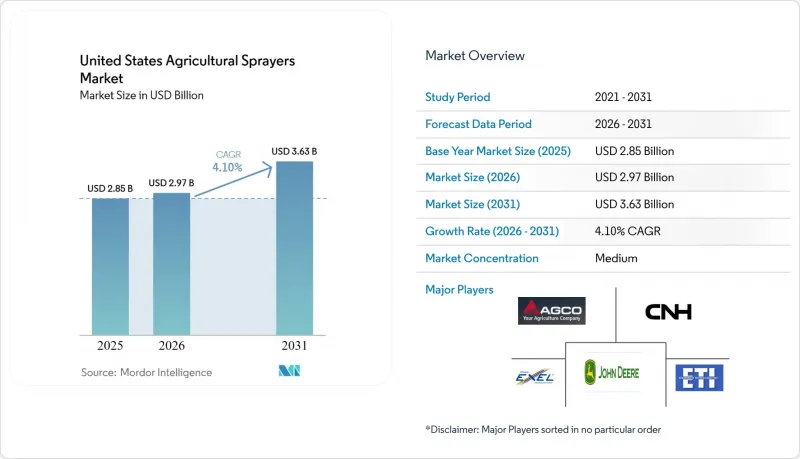
Mordor Intelligence에 의하면, 미국 농업용 분무기 시장 규모는 2025년에 28억 5,000만 달러로 평가되었고 2026년 29억 7,000만 달러에서 2031년까지 36억 3,000만 달러에 이를 것으로 예측되며, 예측 기간(2026-2031년) CAGR은 4.10%를 나타낼 전망입니다.
본 보고서는 동력원별(수동, 태양광 발전 등), 제품 유형별(트랙터 탑재형 등), 용도별(밭작물, 과수원·포도원 등), 살포 용량별(저용량 등), 기술 수준별(기존 등), 펌프 구조별(다이어프램 펌프 등)로 분류되어 있습니다. 시장 예측은 금액(달러) 기준으로 제시되어 있습니다.
미국 농업용 분무기 시장 동향 및 인사이트
광대한 농지에서 옥수수 및 대두의 살포 빈도
미국의 농업용 분무기 시장은 여전히 옥수수 및 대두의 생산 규모와 재배 밀도에 크게 의존하고 있습니다. 주요 농업 주에서 옥수수 재배 면적은 약 3,380만 헥타르, 대두 재배 면적은 약 3,510만 헥타르에 달하며, 광활하고 활발한 줄작물 기반이 살포 수요를 지속적으로 뒷받침하고 있습니다. 이러한 재배 면적 규모 덕분에 생육기 중 반복적인 살포가 가능해지며, 해당 기간에 사용되는 장비는 성수기에는 거의 풀가동 상태가 됩니다. 실제 수요를 나타내는 지표는 재배 면적뿐만이 아닙니다. 많은 농장에서는 잡초 피해 상황이나 작물 보호 일정에 따라 한 시즌에 여러 차례 살포를 실시하고 있기 때문입니다. 이로 인해 붐, 펌프, 제어 장치, 가이던스 시스템의 마모가 증가하며, 이것이 장비 교체 수요와 업그레이드 수요를 모두 뒷받침하고 있습니다. 게다가 내성 관리도 이러한 추세를 가속화하고 있습니다. 문제가 되는 잡초 증가로 인해 더욱 적절한 살포 시기와 살포 품질이 요구되기 때문입니다. 그 결과, 농가의 경기 심리가 저하된 시기라 하더라도 대용량 탱크를 갖춘 자가 주행식 및 견인식 분무기에 대한 시장 수요는 안정적으로 유지되고 있습니다.
정밀 시비를 통한 비용 절감과 선택적 살포의 투자 수익률(ROI)
선택적 살포는 미국 농업용 분무기 시장에서 가장 명확한 가치 창출 요인 중 하나입니다. 존 디어(John Deere)사의 보고서에 따르면, 2025년에는 농가들이 500만 에이커 이상의 농지에서 ‘See and Spray’ 기술을 채택하여 비잔류성 제초제 비용을 평균 약 50% 절감하는 동시에, 시즌 동안 3,100만 갤런의 제초제 혼합액 사용을 피할 수 있었습니다. 이러한 비용 절감은 구매 의사 결정에 변화를 가져오고 있습니다. 생산자들은 더 이상 단순히 인건비 절감이나 수확량 보호에만 의존하지 않고, 장비 업그레이드를 직접적인 운영 비용 절감과 연결 지을 수 있게 되었기 때문입니다. 또한, 정밀 농업 시스템은 일괄 살포의 효율이 낮은 불규칙한 농지 경계나 잡초 생육 상황이 복잡한 환경에서도 안정적인 살포 성능을 유지하는 데 도움이 됩니다. 라벨상의 제한이 엄격해지고 문서화 부담도 증가함에 따라, 이러한 이점은 더욱 커지고 있습니다. EPA의 디캄바 관련 지침은 드리프트 저감제와 살포 관리의 중요성을 강조하고 있으며, 노즐 단위 제어와 붐 자동화가 일상적인 농장 작업에서 더욱 가치 있는 요소로 자리 잡고 있습니다. 그 결과, 시장에서는 측정 가능한 투입 비용 절감과 더 깨끗한 규정 준수 기록을 모두 실현할 수 있는 기계 및 개조가 높이 평가받고 있습니다.
높은 초기 투자 비용의 기계 및 기술 비용
높은 구입 비용은 미국 농업용 분무기 시장에서 도입 가속화를 저해하는 큰 장벽이 되고 있습니다. 정밀 농업 기능을 갖춘 자가 주행 기계는 기본 사양에 비해 추가 비용이 드는 경우가 많으며, 특히 농장 수입이 압박받고 있는 상황에서는 많은 중규모 농가에게 그 비용 부담이 큽니다. 이 과제는 선택적 살포를 통해 큰 혜택을 얻을 수 있음에도 불구하고, 더 엄격한 재정적 제약에 직면해 있는 중소규모 농장에서 가장 두드러집니다. 게다가 센싱 시스템, 머신 비전, 소프트웨어 구독과 같은 첨단 기술의 비용이 총 소유 비용을 끌어올려 비용 문제를 더욱 심각하게 만들고 있습니다. 한 조사에 따르면, 딜러가 추적하고 있는 위탁 경작 면적 중 머신 비전을 통한 잡초 감지 기술이 도입된 곳은 극히 일부에 불과하며, 이는 딜러 측의 기술 도입 의향이 높음에도 불구하고 나타나는 현상입니다. 이는 농장 차원에서 가격에 대한 거부감이 여전히 큰 요인으로 작용하고 있음을 보여줍니다. 구독 모델이나 사후 장착 키트는 초기 비용 장벽을 낮추는 데 도움이 되지만, 이를 완전히 해소하는 것은 아닙니다. 그 결과, 투자 대비 효과(ROI) 전망은 높지만 초기 투자 부담이 여전히 과도한 경우, 시장의 도입 속도는 여전히 더딘 상태입니다.
부문 분석
2025년, 연료 구동식 분무기는 매출의 56.8%를 차지하며 미국 농업용 분무기 시장에서 최대 동력원으로서의 지위를 유지했습니다. 이러한 우위는 광대한 경작 면적을 가진 줄 재배 농업의 기본적인 요구에서 기인합니다. 이 분야에서는 연료비 절감보다 장거리 주행, 대용량 탱크, 그리고 중단 없는 가동 시간이 더 중요시되기 때문입니다. 콘벨트 지역의 대규모 자가 주행형 장비는 충전을 위해 정지하지 않고 광활한 밭 전체를 계속해서 커버해야 하기 때문에 여전히 디젤 동력에 의존하고 있습니다. 수동식이나 태양광 발전식 시스템도 계속 사용되고 있지만, 소규모 농장, 온실 환경 및 특수한 이용 사례에서만 훨씬 제한적인 역할만을 수행하고 있습니다.
배터리 구동 시스템은 미국 농업용 분무기 업계에서 2031년까지 연평균 성장률(CAGR) 17.9%로 확대되어 가장 빠르게 성장하는 동력원이 될 것으로 예측됩니다. 성장이 가장 두드러지는 분야는 무인 항공기(UAV) 분무기와 온실·과수원용 로봇입니다. 이러한 분야에서는 이동 거리가 짧고 소음 수준도 낮기 때문에 전동화가 현실적입니다. 스마트 배터리 구동식 백팩형 분무기의 등장은 휴대용 기기 분야에서도 공급업체들이 프리미엄 배터리 부문을 개발하고 있음을 여실히 보여주고 있습니다. 하지만 광활한 농지에서 전기화를 실현하는 데는 여전히 엄격한 제약이 존재합니다. 이는 사이클 타임이나 충전 제약이 줄지어 심는 작물에서 흔히 볼 수 있는 엄격한 살포 기간과 맞지 않기 때문입니다. 따라서 미국의 농업용 분무기 업계는 소형 고정밀 기종에서는 배터리 구동 방식의 성장이 두드러지는 반면, 농장 규모의 포장 살포에서는 연료 구동식 기계가 여전히 핵심적인 역할을 담당하는 양극화된 모델로 전환되고 있습니다.
2025년에는 자행식 분무기가 제품 유형별 매출의 55.0%를 차지하며, 미국 농업용 분무기 시장에서 주도적인 위치를 확립했습니다. 이러한 규모적 우위는 제한된 살포 기간 동안 광대한 농지를 신속하게 이동할 수 있는 지상고가 높고 대용량 탱크를 갖춘 기계를 선호하는 미국의 경향을 반영하고 있습니다. 이 부문은 중서부 및 평원 지대에서 여전히 중심적인 위치를 차지하고 있으며, 이 지역 농가들은 일일 살포 면적, 안정적인 주행 속도, 그리고 정밀 농업 시스템과의 호환성을 중요시하고 있습니다.
UAV 분무기는 미국 농업용 분무기 시장에서 2031년까지 연평균 성장률(CAGR)이 20.2%에 달하고, 가장 빠르게 성장하고 있는 제품 부문입니다. 이러한 성장은 기존 장비로는 효율이 낮다고 여겨지는 접근이 어려운 지형, 특수 작물 및 국소적인 스팟 처리 용도에서 UAV 분무기가 효과를 발휘하고 있기 때문입니다. 그러나 해외산 드론을 대상으로 한 최근의 규제 조치로 인해, 특히 미국 시장에서 특정 세계 브랜드가 큰 존재감을 드러내고 있어 공급업체의 동향에 불확실성이 발생하고 있습니다. 이러한 동향은 국내 제조업체나 대체 공급업체에게 기회를 제공하는 한편, 급속히 진화하는 이 부문에 위험 요소도 안겨주고 있습니다. 대조적으로, 트랙터 탑재형, 견인형 및 휴대형 분무기는 변화가 심한 UAV 카테고리에 비해 보다 안정적이고 비용 효율을 중시하는 용도에 대응하고 있어 여전히 필수적인 존재입니다.
기타 혜택:
- 엑셀 형식 시장 예측(ME) 시트
- 3개월간의 애널리스트 지원
자주 묻는 질문
목차
제1장 서론
제2장 조사 방법
제3장 주요 요약
제4장 시장 구도
제5장 시장 규모와 성장 예측
제6장 경쟁 구도
제7장 시장 기회와 향후 동향
JHS 26.08.07According to Mordor Intelligence, the United States agricultural sprayers market size was valued at USD 2.85 billion in 2025 and is estimated to grow from USD 2.97 billion in 2026 to reach USD 3.63 billion by 2031, at a CAGR of 4.10% during the forecast period (2026-2031).
This report is Segmented by Source of Power (Manual, Solar-Powered, and More), by Product Type (Tractor-Mounted, and More), by Application (Field Crops, Orchards and Vineyards, and More), by Spray Volume Capacity (Low Volume and More), by Technology Level (Conventional and More), and by Pump Mechanism (Diaphragm Pumps and More). The Market Forecasts are Provided in Terms of Value (USD).
United States Agricultural Sprayers Market Trends and Insights
Broad-Acre Corn and Soybean Spray Intensity
The United States agricultural sprayers market still depends heavily on the scale and intensity of corn and soybean production. A broad and active row-crop base continues to support spraying demand, with corn covering around 33.8 million hectares and soybean cultivation reaching about 35.1 million hectares across major farming states. That acreage base supports repeated in-season applications, and the equipment used in those windows often operates near full utilization during peak periods. The real demand signal is not acreage alone, because many farms still run multiple passes through a season as weed pressure and crop protection schedules require. That raises wear on booms, pumps, controls, and guidance systems, which supports both replacement demand and upgrade demand. Resistance management adds to this pattern because problem weeds increase the need for better timing and better application quality. Consequently, the market maintains a stable demand for large-tank self-propelled and trailed machines, even during periods of reduced grower confidence.
Precision Input Savings and Selective Spraying Return on Investment (ROI)
Selective spraying has become one of the clearest value drivers in the United States agricultural sprayers market. John Deere reported that growers used See and Spray technology across more than 5 million acres in 2025, with average savings of nearly 50% on non-residual herbicide costs and 31 million gallons of herbicide mix avoided during the season. Those savings change the purchase decision because growers can now tie equipment upgrades to direct operating cost reductions rather than relying solely on labor savings or yield protection. Precision systems also help maintain performance on irregular field boundaries and mixed-pressure weed environments where blanket application is less efficient. The benefit is growing because label restrictions are becoming stricter and more documentation-heavy. EPA's dicamba framework underscores the importance of drift-reduction agents and application discipline, making nozzle-level control and boom automation even more valuable in daily field practice. As a result, the market is rewarding machines and retrofits that can deliver both measurable input savings and cleaner compliance records.
High Upfront Machine and Technology Cost
High purchase costs remain a significant barrier to faster adoption in the United States agricultural sprayers market. Precision-equipped self-propelled machines often carry an additional cost compared to baseline configurations, which many mid-sized operations find challenging to afford, particularly when farm income is under pressure. This challenge is most pronounced among farms in acreage bands that could benefit substantially from selective spraying but face tighter financial constraints. The cost issue is further compounded by the expense of advanced technologies, such as sensing systems, machine vision, and software subscriptions, which increase the overall cost of ownership. A survey indicated that machine vision weed detection was implemented on only a small percentage of dealer-tracked custom acres, despite higher dealer intent to adopt the technology. This indicates that price resistance remains a significant factor at the farm level. While subscription models and retrofit kits help lower the initial cost barrier, they do not eliminate it. As a result, the market continues to experience a slower adoption rate in cases where the potential return on investment is strong, but the upfront capital requirement remains prohibitive.
Other drivers and restraints analyzed in the detailed report include:
- Farm Labor Scarcity and Operator Productivity Needs
- Environmental Protection Agency (EPA) Mitigation and Drift-Control Compliance
- Commodity-Margin Volatility Delaying Replacement Cycles
For complete list of drivers and restraints, kindly check the Table Of Contents.
Segment Analysis
Fuel-operated sprayers held 56.8% of revenue in 2025, which kept them as the largest power source in the United States agricultural sprayers market. Their lead comes from the basic needs of large-acre row-crop farming, where long range, high tank capacity, and uninterrupted operating windows matter more than fuel savings. Large self-propelled units in the Corn Belt still depend on diesel power because they must sustain coverage across large fields without stopping for recharge. Manual and solar-powered systems remain in place, but they serve much narrower roles on small holdings, in greenhouse settings, and in specialty use cases.
Battery-operated systems are projected to be the fastest-growing power source, advancing at a 17.9% CAGR through 2031 in the United States agricultural sprayers industry. Growth is strongest in Unmanned Aerial Vehicle (UAV) sprayers and in greenhouse or orchard robots, where short routes and lower noise levels make electrification practical. The emergence of smart battery-powered backpack sprayers highlights how suppliers are developing a premium battery segment even within handheld equipment. Even so, large-acre electrification still faces a hard limit because cycle time and charging constraints do not align with the tight spray windows common in row crops. The United States agricultural sprayers industry is therefore moving toward a split model where battery growth is strong in smaller and more precise formats, while fuel-powered machines remain the operating backbone for farm-scale field spraying.
Self-propelled sprayers accounted for 55.0% of product-type revenue in 2025, giving them the leading position in the United States agricultural sprayers market. Their scale advantage reflects the country's bias toward high-clearance, large-tank machines that can move quickly across broad-acre farms during narrow spray windows. The segment remains central in the Midwest and Plains, where farmers prioritize acres covered per day, consistent field speed, and compatibility with precision systems.
UAV sprayers are the fastest-growing product segment, with a 20.2% CAGR through 2031 in the United States agricultural sprayers market. Their growth is attributed to their effectiveness in hard-to-access terrain, specialty crops, and targeted spot-treatment applications, where conventional equipment proves less efficient. However, recent regulatory measures targeting foreign-manufactured drones have created uncertainty in supplier dynamics, particularly due to the significant presence of certain global brands in the United States market. This development presents opportunities for domestic manufacturers and alternative suppliers but also introduces risks to this rapidly evolving segment. In contrast, tractor-mounted, trailed, and handheld sprayers remain essential, catering to more stable and cost-sensitive applications compared to the dynamic UAV category.
Complete Report Scope:
- By Source of Power
- Manual
- Battery-Operated
- Solar-Powered
- Fuel-Operated
- By Product Type
- Handheld
- Tractor-Mounted
- Trailed
- Self-Propelled
- Unmanned Aerial Vehicle Sprayers
- By Application
- Field Crops
- Orchards and Vineyards
- Greenhouse Crops
- Turf and Gardening
- By Spray Volume Capacity
- Ultra-Low Volume
- Low Volume
- High Volume
- By Technology Level
- Conventional
- Precision and GPS-Guided
- Artificial Intelligence-Enabled and Autonomous
- By Pump Mechanism
- Diaphragm Pumps
- Piston Pumps
- Centrifugal Pumps
List of Companies Covered in this Report:
- Deere and Company
- CNH Industrial N.V.
- AGCO Corporation
- EXEL Industries
- Equipment Technologies, Inc.
- HORSCH Maschinen GmbH
- Jacto S.A.
- Kubota Corporation
- DJI
- Ecorobotix SA
- TeeJet Technologies
- Pentair Hypro
- Niqo Robotics
- Verdant Robotics, Inc.
- CapstanAG Systems, Inc. (Nordson Precision Agriculture)
Additional Benefits:
- The market estimate (ME) sheet in Excel format
- 3 months of analyst support
TABLE OF CONTENTS
1 Introduction
- 1.1 Study Assumptions and Market Definition
- 1.2 Scope of the Study
2 Research Methodology
3 Executive Summary
4 Market Landscape
- 4.1 Market Overview
- 4.2 Market Drivers
- 4.2.1 Broad-acre corn and soybean spray intensity
- 4.2.2 Precision input savings and selective spraying Return on Investment (ROI)
- 4.2.3 Farm labor scarcity and operator productivity needs
- 4.2.4 Environmental Protection Agency (EPA) mitigation and drift-control compliance
- 4.2.5 Orchard and vineyard autonomy adoption
- 4.2.6 Retrofit economics for installed sprayer fleets
- 4.3 Market Restraints
- 4.3.1 High upfront machine and technology cost
- 4.3.2 Commodity-margin volatility delaying replacement cycles
- 4.3.3 Tariff-driven component and steel cost inflation
- 4.3.4 Battery runtime and charging constraints
- 4.4 Regulatory Landscape
- 4.5 Technological Outlook
- 4.6 Porter's Five Forces
- 4.6.1 Bargaining Power of Buyers
- 4.6.2 Bargaining Power of Suppliers
- 4.6.3 Threat of New Entrants
- 4.6.4 Threat of Substitutes
- 4.6.5 Intensity of Competitive Rivalry
5 Market Size and Growth Forecasts (Value)
- 5.1 By Source of Power
- 5.1.1 Manual
- 5.1.2 Battery-Operated
- 5.1.3 Solar-Powered
- 5.1.4 Fuel-Operated
- 5.2 By Product Type
- 5.2.1 Handheld
- 5.2.2 Tractor-Mounted
- 5.2.3 Trailed
- 5.2.4 Self-Propelled
- 5.2.5 Unmanned Aerial Vehicle Sprayers
- 5.3 By Application
- 5.3.1 Field Crops
- 5.3.2 Orchards and Vineyards
- 5.3.3 Greenhouse Crops
- 5.3.4 Turf and Gardening
- 5.4 By Spray Volume Capacity
- 5.4.1 Ultra-Low Volume
- 5.4.2 Low Volume
- 5.4.3 High Volume
- 5.5 By Technology Level
- 5.5.1 Conventional
- 5.5.2 Precision and GPS-Guided
- 5.5.3 Artificial Intelligence-Enabled and Autonomous
- 5.6 By Pump Mechanism
- 5.6.1 Diaphragm Pumps
- 5.6.2 Piston Pumps
- 5.6.3 Centrifugal Pumps
6 Competitive Landscape
- 6.1 Market Concentration
- 6.2 Strategic Moves
- 6.3 Market Share Analysis
- 6.4 Company Profiles (Includes Global Level Overview, Market Level Overview, Core Segments, Financials as Available, Strategic Information, Market Rank/Share, Products and Services, and Recent Developments)
- 6.4.1 Deere and Company
- 6.4.2 CNH Industrial N.V.
- 6.4.3 AGCO Corporation
- 6.4.4 EXEL Industries
- 6.4.5 Equipment Technologies, Inc.
- 6.4.6 HORSCH Maschinen GmbH
- 6.4.7 Jacto S.A.
- 6.4.8 Kubota Corporation
- 6.4.9 DJI
- 6.4.10 Ecorobotix SA
- 6.4.11 TeeJet Technologies
- 6.4.12 Pentair Hypro
- 6.4.13 Niqo Robotics
- 6.4.14 Verdant Robotics, Inc.
- 6.4.15 CapstanAG Systems, Inc. (Nordson Precision Agriculture)


