

|
시장보고서
상품코드
2097145
영국의 방위 : 시장 점유율 분석, 업계 동향과 통계, 성장 예측(2026-2031년)United Kingdom Defense - Market Share Analysis, Industry Trends & Statistics, Growth Forecasts (2026 - 2031) |
||||||
 Mordor Intelligence
Mordor Intelligence에 의하면, 영국의 방위 시장 규모는 2026년에 267억 6,000만 달러에 이르고, 2031년까지 380억 5,000만 달러에 달할 것으로 예측되며, 같은 기간 CAGR은 7.29%를 나타낼 전망입니다.
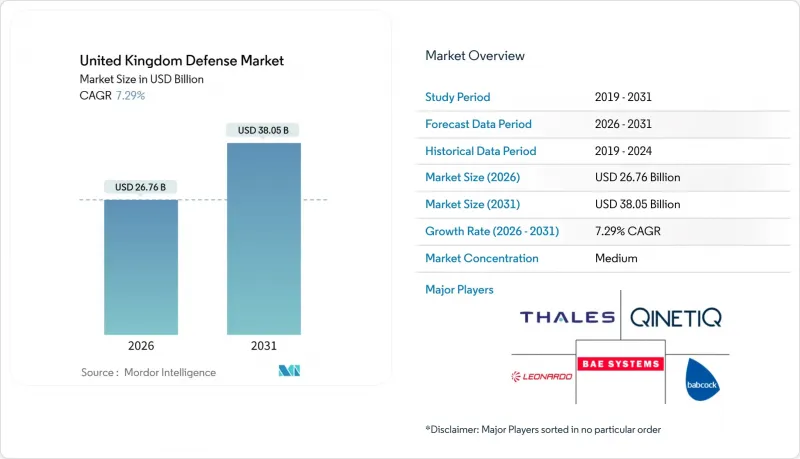
본 보고서는 군종(공군, 육군, 해군), 유형(인력 훈련·방호, C4ISR 및 전자전, 차량, 무기·탄약, 무인 시스템 등), 분야(육상, 항공, 해상, 우주 등), 조달 형태(국산 및 해외 조달)별로 분류되어 있습니다. 시장 전망은 금액(달러) 기준으로 제시되어 있습니다.
영국의 방위 시장 동향과 인사이트
GDP의 2.6%라는 목표를 향한 지속적인 예산 증가
국방비를 GDP의 2.6% 이상으로 유지하겠다는 의회의 법적 구속력 있는 공약에 따라, 장기적인 자본 계획을 뒷받침할 수 있는 예측 가능한 다년간의 현금 흐름이 확보되어 있습니다. 2025년 봄 예산안에서는 2025-26 회계연도에 50억 파운드(64억 7,000만 달러)의 추가 자금이 투입되며, 2029 -30 회계연도까지 부처별 자본 지출 상한선(DEL)이 332억 파운드(429억 4,000만 달러)로 상향 조정되어, 공급업체에 안정적인 수주 잔고가 보장되었습니다. 다만, 탄두 사업에 150억 파운드(202억 6,000만 달러), 탄약에 60억 파운드(81억 4,000만 달러)가 배정된 결과, 나머지 모든 자본 수요에 충당되는 연간 예산은 120억 파운드(162억 9,000만 달러) 미만이 되어, 해상, 육상, 항공 각 프로젝트 간에 우선순위를 조정할 수밖에 없는 상황입니다. 이와 병행하여, 국가군비국장이 관리하는 110억 파운드(148억 1,000만 달러) 규모의 ‘투자’ 예산은 긴급 조달을 가속화하는 한편, 장기적인 플랫폼 계획을 파편화시키고 있습니다. 기존의 경쟁 입찰과 신속한 능력 도입을 유연하게 전환할 수 있는 공급업체는 불균형할 정도로 큰 시장 점유율을 확보할 전망이지만, 반면 경직된 업무 분담 모델에 얽매인 주요 제조업체는 인플레이션율이 물가 지수 상승률을 상회할 경우 이익률 압박에 직면하게 될 것입니다.
전략적 메가 프로그램(드레드노트, GCAP, SSN-AUKUS)
310억 파운드(411억 6,000만 달러) 규모의 드레드노트 계획과 100억 파운드(132억 8,000만 달러)의 예비비는 2030년대를 통틀어 해군 지출의 기반이 되어, 영국의 방위 산업에 대한 장기적인 투자를 강화하고 있습니다. SSN-AUKUS에서는 최대 12척의 공격형 잠수함이 추가될 예정이며, 호주 국방부에 따르면 호주가 24억 파운드(30억 5,000만 달러)를 분담함으로써 배로우 조선소의 개조 공사가 사실상 지원받게 됩니다. GCAP에서는 설계 권한이 3개국으로 분산되므로 영국의 업무 분담은 줄어들겠지만, 국내 예산 범위를 초과하는 일본의 레이더 및 추진 시스템에 대한 자금 지원을 받을 수 있게 됩니다. 이러한 프로그램들을 합치면 장비 예산의 40% 이상을 차지하게 되며, 예산 초과가 발생할 경우 지상 배치형 방어 시스템이나 전술 수송기 등 중규모 요구 사항이 뒤로 밀리게 될 것입니다.
장비 계획의 심각한 자금 부족
국가감사원은 2023년부터 2033년에 걸쳐 재정적 여유가 부족함을 지적하고 있으며, 주력 프로그램은 계속 보호받는 반면 중규모 역량에 대한 투자는 압박을 받고 있습니다. 국방부는 현재 주요 프로젝트의 실행 순서를 조정하고 있으며, 26형 함정의 생산이 안정될 때까지 83형의 설계를 연기하고, 챌린저 3 전차의 생산 대수를 148대로 제한하고 있습니다. 이러한 순서 조정을 통해 병행 개발의 위험은 완화되겠지만, 2027년부터 2030년에 걸쳐 능력 면에서 ‘죽음의 계곡’이 발생할 것입니다. 이 기간 동안 워리어 보병전투차와 푸마 헬리콥터는 퇴역 기한이 지났음에도 후속 기종의 자금이 확보되지 않은 상황이 될 것입니다.
부문 분석
해군의 점유율은 현재 작지만, 2031년까지 연평균 성장률(CAGR)이 8.50%인 점을 고려할 때, 드레드노트급 및 AUKUS 협정에 따른 SSN 잠수함의 취역으로 인해 2025년 육군의 점유율 39.65%와의 격차는 좁혀질 전망입니다. 이러한 성장에 따라 영국의 방위 시장 내 해상 자산의 규모 하한선이 상향 조정될 것입니다. 수상 전투함의 성장세는 지속되고 있으며, 8척의 유형 26 호위함과 5척의 유형 31 호위함의 건조가 진행되는 한편, 유형 83 구축함의 설계는 2028년에 시작될 예정입니다.
유지보수 분야에서는 예산 재분배가 이루어지고 있습니다. ‘아약스’ 장갑차 프로그램의 지연은 주요 계약업체에 대한 위험 전가를 여실히 보여주고 있습니다. 진동 문제 수정을 거친 후 2025년 초까지 배치된 대수는 고작 26대에 그쳐, 지상 플랫폼 일정에 대한 신뢰를 훼손하고 있습니다. 대조적으로, 자율형 기뢰 제거정의 예정대로의 납품은 모듈식 기성 키트가 위험을 완화할 수 있음을 보여주고 있습니다. 해군의 우선순위는 초당적 지지를 얻고 있어 장비 계획 삭감의 영향을 덜 받는 반면, 지상 프로그램은 반복되는 비용 대비 효과 재검토에 직면해 있습니다. 따라서 장기적으로는 해양 분야의 성장이 영국의 방위 시장 점유율의 더 큰 부분을 지탱하게 될 것입니다.
C4ISR 및 전자전(EW)은 2025년 지출의 29.76%를 차지하며, 정보 우위 시스템 분야에서 영국의 방위 시장 규모의 기반을 형성하고 있습니다. 그러나 무인 시스템은 ‘프로텍터 RG Mk1’, 자율형 기뢰 제거(MCM) 함정, 소형 전술 드론에 힘입어 9.38%라는 가장 높은 성장률을 기록할 전망입니다. 반도체 공급 부족으로 인해 정밀 유도탄의 리드타임이 길어지고 있어, 비용 대비 성능 측면에서 드론과 센서를 통합한 패키지가 지지를 얻고 있습니다.
'아약스'의 불확실한 전망과 '챌린저 3'의 생산 대수 상한으로 인해 차량 분야는 성장세가 주춤하고 있습니다. 한편, 60억 파운드(80억 9,000만 달러) 규모의 탄약 예산 덕분에 폭발물 및 미사일 제조 공장이 활기를 되찾고 있습니다. 우주·사이버 분야는 ‘스카이넷 6A’ 및 ‘2025년 사이버 전략’을 중심으로 기세를 더하고 있으며, 다영역·통합 화력으로의 전환이 강조되고 있습니다. 시뮬레이션 기반 훈련은 정체 상태에 있는 개인 방호 예산을 보완하며, 국방부가 개인의 능력보다 집단의 능력을 중시하는 태도를 강화하고 있습니다.
기타 혜택:
- 엑셀 형식 시장 예측(ME) 시트
- 3개월간의 애널리스트 지원
자주 묻는 질문
목차
제1장 서론
제2장 조사 방법
제3장 주요 요약
제4장 시장 구도
제5장 시장 규모와 성장 예측
제6장 경쟁 구도
제7장 시장 기회와 향후 전망
KTH 26.08.06According to Mordor Intelligence, the United Kingdom defense market size reached USD 26.76 billion in 2026 and is forecasted to climb to USD 38.05 billion by 2031, registering a 7.29% CAGR over the period.
This report is Segmented by Armed Forces (Air Force, Army, and Navy), Type (Personnel Training and Protection, C4ISR and Electronic Warfare, Vehicles, Weapons and Ammunition, Unmanned Systems, and More), Domain (Land, Air, Naval, Space, and More), and Procurement Nature (Indigenous Production and Foreign Procurement). The Market Forecasts are Provided in Terms of Value (USD).
United Kingdom Defense Market Trends and Insights
Sustained Budget Growth to 2.6 % GDP Target
Parliament's binding commitment to a 2.6% of GDP defense floor delivers predictable multi-year cash flows that underpin long-lead capital programs. The Spring Budget 2025 injected an additional GBP 5 billion (USD 6.47 billion) for 2025-26 and lifted the Capital Departmental Expenditure Limits (DEL) to GBP 33.2 billion (USD 42.94 billion) by 2029-30, assuring suppliers of steady order books. Nevertheless, earmarking GBP 15 billion (USD 20.26 billion) for the warhead enterprise and GBP 6 billion (USD 8.14 billion) for munitions leaves less than GBP 12 billion (USD 16.29 billion) a year for all remaining capital needs, forcing trade-offs among maritime, land, and air projects. A parallel GBP 11 billion (USD 14.81 billion) "Invest" budget, managed by the National Armaments Director, accelerates urgent purchases but fragments long-range platform planning. Vendors able to toggle between conventional competitions and rapid-capability insertions stand to capture disproportionate share, while primes locked into rigid work-share models face margin pressure when inflation outpaces indexation.
Strategic Mega-Programmes (Dreadnought, GCAP, SSN-AUKUS)
The GBP 31 billion (USD 41.16 billion) Dreadnought program, along with a GBP 10 billion (USD 13.28 billion) contingency, anchors naval spending through the 2030s, reinforcing long-term investment in the UK Defense Industry. SSN-AUKUS involves the addition of up to 12 attack submarines, with Australia contributing GBP 2.4 billion (USD 3.05 billion) that effectively subsidizes the upgrades at the Barrow yard, as per the Australian Department of Defence. GCAP distributes design authority across three nations, reducing the UK's work share but providing access to Japanese radar and propulsion funding that exceeds domestic reach. Combined, these programs absorb more than 40% of the equipment budget, crowding out mid-tier needs such as land-based air defense and tactical transport when overruns occur.
Substantial Equipment Plan Funding Shortfall
The National Audit Office flags an affordability gap across 2023-33, squeezing mid-tier capabilities while flagship programs remain protected. The MoD now sequences major projects, delaying Type 83 design until Type 26 production stabilizes and capping Challenger 3 at 148 tanks. This sequencing reduces concurrency risk but leaves a capability "valley of death" between 2027 and 2030, during which Warrior IFVs and Puma helicopters exceed out-of-service dates with no funded replacements.
Other drivers and restraints analyzed in the detailed report include:
- Post-Ukraine Munitions Surge and Stockpile Rebuild
- NATO Integration and Export-Lead Deals
- Shipyard and Energetics Inflation/Capacity Constraints
For complete list of drivers and restraints, kindly check the Table Of Contents.
Segment Analysis
The Navy accounts for a smaller slice today, yet its 8.50% CAGR through 2031 will narrow the gap with the Army's 39.65% 2025 share, thanks to Dreadnought and SSN-AUKUS boats entering service. This lift places a rising floor under the United Kingdom defense market size for maritime assets. Surface-combatant momentum continues as eight Type 26 and five Type 31 frigates progress in build, while Type 83 destroyer design starts in 2028.
Sustainment reshuffles budgets. The Ajax vehicle program's delays illustrate risk transfer to primes; only 26 units were fielded by early 2025 after vibration fixes, denting confidence in land-platform timelines. Conversely, the on-time delivery of autonomous minehunters demonstrates how modular, off-the-shelf kits can mitigate risk. Naval priorities enjoy cross-party backing, insulating them from cuts to the Equipment Plan, while land programs face recurring affordability reviews. As such, maritime growth underwrites a larger portion of the United Kingdom defense market share in the out-years.
C4ISR and EW retained 29.76% of 2025 spending, anchoring the United Kingdom defense market size for information-dominance systems. Yet, unmanned systems will register the fastest growth rate of 9.38%, propelled by the Protector RG Mk1, autonomous mine-countermeasure (MCM) vessels, and small tactical drones. Lead times for precision munitions are widening as the semiconductor supply tightens, so integrated drone-sensor packages are gaining favor due to their cost-per-effect metrics.
Vehicles lag, constrained by Ajax uncertainty and capped Challenger 3 numbers, while GBP 6 billion (USD 8.09 billion) in munitions cash revives energetics and missile plants. Space and Cyber lines gain momentum around Skynet 6A and the 2025 Cyber Strategy, underscoring a pivot toward multi-domain, integrated fires. Simulation-based training offsets flat personal-protection budgets, reinforcing the MoD's preference for collective over individual capability.
Complete Report Scope:
- By Armed Forces
- Air Force
- Army
- Navy
- By Type
- Personnel Training and Protection
- C4ISR and Electronic Warfare (EW)
- Vehicles
- Weapons and Ammunition
- Unmanned Systems
- Space and Cyber Systems
- By Domain
- Land
- Air
- Naval
- Space
- Cyber and Electromagnetic Spectrum
- By Procurement Nature
- Indigenous Production
- Foreign Procurement
List of Companies Covered in this Report:
- BAE Systems plc
- Babcock International Group PLC
- Leonardo S.p.A.
- QinetiQ Limited
- MBDA
- Thales Group
- Airbus SE
- Lockheed Martin Corporation
- RTX Corporation
- Northrop Grumman Corporation
- The Boeing Company
- General Dynamics Corporation
- HENSOLDT AG
- Saab AB
- Rheinmetall BAE Systems Land
- Elbit Systems Ltd.
Additional Benefits:
- The market estimate (ME) sheet in Excel format
- 3 months of analyst support
TABLE OF CONTENTS
1 INTRODUCTION
- 1.1 Study Assumptions and Market Definition
- 1.2 Scope of the Study
2 RESEARCH METHODOLOGY
3 EXECUTIVE SUMMARY
4 MARKET LANDSCAPE
- 4.1 Market Overview
- 4.2 Market Drivers
- 4.2.1 Sustained budget growth to 2.6 % GDP target
- 4.2.2 Strategic mega-programs (Dreadnought, GCAP, SSN-AUKUS)
- 4.2.3 Post-Ukraine munitions surge and stockpile rebuild
- 4.2.4 NATO integration and export-lead deals
- 4.2.5 Procurement Act 2023 fast-track contracting
- 4.2.6 National Wealth Fund co-investment in defense clusters
- 4.3 Market Restraints
- 4.3.1 Substantial Equipment Plan funding shortfall
- 4.3.2 Shipyard and energetics inflation/capacity constraints
- 4.3.3 Net-Zero compliance costs on legacy platforms
- 4.3.4 Acute digital and nuclear skills shortages
- 4.4 Value Chain Analysis
- 4.5 Regulatory Landscape
- 4.6 Technological Outlook
- 4.7 Porter's Five Forces Analysis
- 4.7.1 Threat of New Entrants
- 4.7.2 Bargaining Power of Buyers
- 4.7.3 Bargaining Power of Suppliers
- 4.7.4 Threat of Substitutes
- 4.7.5 Intensity of Competitive Rivalry
5 MARKET SIZE AND GROWTH FORECASTS (VALUE)
- 5.1 By Armed Forces
- 5.1.1 Air Force
- 5.1.2 Army
- 5.1.3 Navy
- 5.2 By Type
- 5.2.1 Personnel Training and Protection
- 5.2.2 C4ISR and Electronic Warfare (EW)
- 5.2.3 Vehicles
- 5.2.4 Weapons and Ammunition
- 5.2.5 Unmanned Systems
- 5.2.6 Space and Cyber Systems
- 5.3 By Domain
- 5.3.1 Land
- 5.3.2 Air
- 5.3.3 Naval
- 5.3.4 Space
- 5.3.5 Cyber and Electromagnetic Spectrum
- 5.4 By Procurement Nature
- 5.4.1 Indigenous Production
- 5.4.2 Foreign Procurement
6 COMPETITIVE LANDSCAPE
- 6.1 Market Concentration
- 6.2 Strategic Moves
- 6.3 Market Share Analysis
- 6.4 Company Profiles (includes Global-level Overview, Market-level Overview, Core Segments, Financials, Strategic Information, Market Rank/Share, Products and Services, and Recent Developments)
- 6.4.1 BAE Systems plc
- 6.4.2 Babcock International Group PLC
- 6.4.3 Leonardo S.p.A.
- 6.4.4 QinetiQ Limited
- 6.4.5 MBDA
- 6.4.6 Thales Group
- 6.4.7 Airbus SE
- 6.4.8 Lockheed Martin Corporation
- 6.4.9 RTX Corporation
- 6.4.10 Northrop Grumman Corporation
- 6.4.11 The Boeing Company
- 6.4.12 General Dynamics Corporation
- 6.4.13 HENSOLDT AG
- 6.4.14 Saab AB
- 6.4.15 Rheinmetall BAE Systems Land
- 6.4.16 Elbit Systems Ltd.
7 MARKET OPPORTUNITIES AND FUTURE OUTLOOK
- 7.1 White-space and Unmet-Need Assessment


