

|
시장보고서
상품코드
2097148
미국의 방위 : 시장 점유율 분석, 업계 동향과 통계, 성장 예측(2026-2031년)United States Defense - Market Share Analysis, Industry Trends & Statistics, Growth Forecasts (2026 - 2031) |
||||||
 Mordor Intelligence
Mordor Intelligence에 의하면, 미국의 방위 시장 규모는 2026년에 3,544억 8,000만 달러에서 2031년까지 4,238억 7,000만 달러에 이를 것으로 예측되며, 예측 기간 중 연평균 복합 성장률(CAGR)은 3.64%를 나타낼 전망입니다.
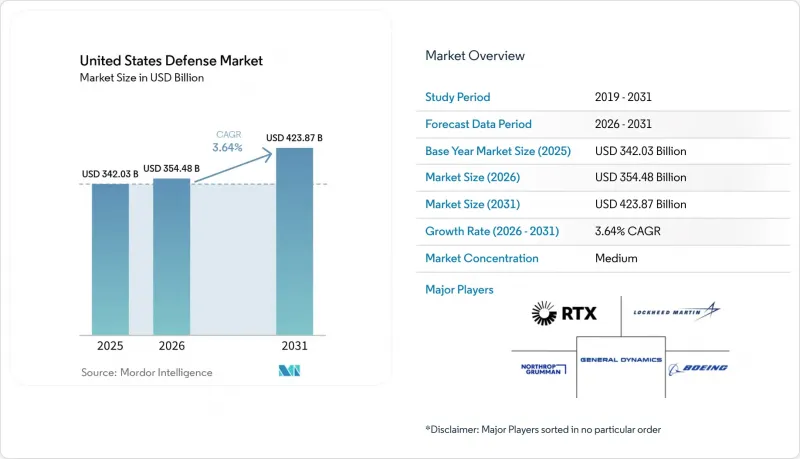
본 보고서는 군종(공군, 육군, 해군, 우주군), 유형(인력 훈련·방호, C4ISR 및 전자전, 차량, 무기·탄약, 무인 시스템 등), 분야(육상, 항공, 해상, 우주 등), 그리고 조달 형태(국산 및 해외 조달)별로 분류되어 있습니다. 시장 예측은 금액(달러) 기준으로 제시되어 있습니다.
미국의 방위 시장 동향과 인사이트
냉전 시대의 레거시 플랫폼 갱신 및 현대화 가속화
평균 운용 기간이 30-40년에 달하는 노후화된 항공, 해상, 육상 장비군은 유지 비용의 급증으로 이어지고 있으며, 이는 미국의 방위 산업 전반의 신규 조달을 압박하고 있습니다. KC-135 급유기나 DDG-51형 구축함의 사례는 장비 갱신을 미루는 것이 즉각 대응 태세와 예산에 어떤 부담을 주고 있는지를 여실히 보여주고 있습니다. 2025년 2월 노스롭 그루먼사가 통합 전투 지휘 시스템(IBCS) 소프트웨어 확장 계약으로 13억 8,100만 달러 규모의 수주를 확보한 것은 동맹국 간의 상호 운용성이 미국의 현대화 일정을 얼마나 가속화하고 있는지를 여실히 드러내고 있습니다. 단가 상승이나 생산 속도가 퇴역 일정을 따라가지 못하는 상황에서도, 재자본화에 대한 지속적인 수요가 안정적인 조달량을 뒷받침하고 있습니다.
대국 간의 경쟁이 ‘다중 영역 지배(Multi-Domain Dominance)’의 우선순위를 재정의
제1열도선 전역에 걸친 중국의 ‘접근 거부·영역 거부(A2/AD)’ 태도로 인해, 단거리 구형 플랫폼은 점점 더 취약해지고 있으며, 미국 국방부(DoD)는 적진 깊숙이 침투하는 대공 전력과 전선 배치 부대의 배치를 강요받고 있습니다. 2024년, 미국 국방장관은 중국이 '현재의 위협'이라고 경고하며, 분쟁 상황의 전자기 환경을 견딜 수 있는 시스템의 시급성을 강조했습니다. 2025년 3월 보잉사에 발주된 공군의 F-47 차세대 공중우세(NGAD) 전투기는 1,000해리를 넘는 전투 반경과 강화된 스텔스 성능을 갖추고 있어, 이러한 정책 전환을 상징합니다.
계속 결의에 따른 예산 상한선
지난 10개 회계연도 중 8개 회계연도는 계속 결의 하에 시작되었습니다. 이에 따라 예산은 전년도 수준으로 동결되었으며, 신규 프로그램의 시작이 금지되고 있습니다. 2025 회계연도 운영 계획에서 F-47 개발 예산 중 5억 5,710만 달러가 다른 ‘공동 전투기’ 라인으로 재배정된 사실은 입법상의 불확실성이 자금 배분을 세분화하여 단가를 상승시키고 있는 실태를 여실히 보여줍니다. 공급업체들은 현금 흐름의 압박에 직면해 있으며, 이는 급증하는 수요에 대응하는 능력을 약화시키고 있습니다. 그 결과, 불안정성이 비효율성을 초래하고, 나아가 의회의 회의적인 태도를 부추기는 악순환이 반복되고 있습니다.
부문 분석
2025년, 육군은 미국의 방위 시장의 40.55%를 차지하며, 이는 광범위한 지상 차량, 항공 및 병사용 시스템 포트폴리오를 반영합니다. 한편, 공군은 6세대 전투기 개발, 적응형 사이클 추진 시스템, 그리고 ‘로얄 윙맨’ 파생형의 통합에 힘입어 2031년까지 연평균 성장률(CAGR) 4.98%로 확대될 것으로 예상되며, 이는 각 군 중에서 가장 빠른 속도입니다. 해군의 컬럼비아급 잠수함과 DDG-51 플라이트 III형 구축함은 해양 분야에서의 점유율을 유지하고 있지만, 조선소의 인력 부족으로 인해 단기적인 납품은 제한되고 있습니다.
공군은 2025년 3월 보잉사와 185대 이상의 F-47 전투기를 조달하는 NGAD 계약을 체결했으며, 이는 확장 전략의 핵심 축이 되고 있습니다. 또한, 2025년 5월 앤드릴(Anduril)사의 YFQ-44A 공동 전투기가 선정된 것은 인간과 기계의 협업에 대한 미 공군의 노력을 뒷받침하는 것입니다. 대조적으로, 차세대 전투 차량(NGCV) 및 장사거리 포병 시스템(ERCA)을 포함한 육군의 현대화 우선 과제는 신규 조달과 기존 장비 유지 사이에서 예산상의 상충 관계에 직면해 있어, 이것이 성장을 억제하고 있습니다.
C4ISR 및 전자전(EW)이 시장을 주도하며, 2025년 미국의 방위 시장 매출 점유율의 31.25%를 차지했습니다. 이는 통합 전영역 지휘통제(JADC2) 및 차세대 레이더 프로그램에 대한 투자에 힘입은 결과입니다. 우주 및 사이버 시스템은 규모는 작지만 연평균 성장률(CAGR) 6.12%를 나타낼 것으로 예측되며, 이는 내결함성이 높은 미사일 경보 아키텍처와 AI를 활용한 사이버 방어에 대한 수요를 반영한 것입니다. 무기 및 탄약 분야는 우크라이나 분쟁에 따른 비축량 감소와 인도-태평양 지역의 비상사태 대응 계획과 관련된 비축 보충 요청의 혜택을 받고 있습니다.
BAE 시스템즈가 수주한 12억 달러 규모의 MEO 미사일 경보 시스템 계약은 우주 분야의 성장세를 여실히 보여주고 있습니다. 사이버 분야의 성장은 미국 사이버사령부의 ‘머신 스피드(Machine Speed)’ 위협 대응 이니셔티브가 주도하고 있습니다. 하드웨어 중심 플랫폼에서 소프트웨어 정의 아키텍처로의 전환을 통해 무선 업그레이드가 가능해지며, 이는 수명 주기 비용 절감과 지속적인 현대화를 촉진합니다.
기타 혜택:
- 엑셀 형식 시장 예측(ME) 시트
- 3개월간의 애널리스트 지원
자주 묻는 질문
목차
제1장 서론
제2장 조사 방법
제3장 주요 요약
제4장 시장 구도
제5장 시장 규모와 성장 예측
제6장 경쟁 구도
제7장 시장 기회와 향후 전망
KTH 26.08.06According to Mordor Intelligence, the United States defense market size stood at USD 354.48 billion in 2026 and is projected to reach USD 423.87 billion by 2031, registering a 3.64% CAGR over the forecast period.
This report is Segmented by Armed Forces (Air Force, Army, Navy, and Space Force), Type (Personnel Training and Protection, C4ISR and Electronic Warfare, Vehicles, Weapons and Ammunition, Unmanned Systems, and More), Domain (Land, Air, Naval, Space, and More), and Procurement Nature (Indigenous Production and Foreign Procurement). The Market Forecasts are Provided in Terms of Value (USD).
United States Defense Market Trends and Insights
Accelerated Replacement and Modernization of Legacy Cold War-Era Platforms
Aging air, sea, and ground fleets averaging three to four decades in service drive escalating sustainment costs that crowd out new procurement across the US Defense Industry. The KC-135 tanker and DDG-51 destroyer classes illustrate how deferred recapitalization strains readiness and budgets. Northrop Grumman's USD 1.381 billion award in February 2025 to expand the Integrated Battle Command System (IBCS) software underscores how allied interoperability accelerates US modernization timelines. Sustained demand for recapitalization underpins steady procurement volumes, even as unit costs rise and production rates lag behind retirement schedules.
Great-Power Competition Re-Prioritizing Multi-Domain Dominance
China's anti-access/area-denial posture across the First Island Chain has rendered short-range legacy platforms increasingly vulnerable, compelling the Department of Defense (DoD) to field penetrating counter-air and stand-in forces. In 2024, the US Secretary of Defense issued a warning that China poses a "present threat," underscoring the urgency of systems capable of withstanding contested electromagnetic environments. The Air Force's F-47 Next Generation Air Dominance (NGAD) fighter, awarded to Boeing in March 2025, exemplifies this pivot with a greater than 1,000-nautical-mile combat radius and enhanced stealth.
Continuing-Resolution Budget Ceilings
Eight of the past ten fiscal years opened under continuing resolutions that freeze funding at prior-year levels and bar new-start programs. The FY2025 operating plan's USD 557.10 million transfer from F-47 development to a distinct collaborative-combat-aircraft line illustrates how legislative uncertainty fragments funding and inflates unit costs. Suppliers face cash-flow squeezes that erode surge capacity, perpetuating a cycle in which instability begets inefficiency and congressional skepticism.
Other drivers and restraints analyzed in the detailed report include:
- Rapid Fielding Pathways Under FY24 National Defense Authorization Act
- Digital-Engineering Mandates Compressing Design-to-Deployment Cycle
- MRO Labor Shortages in Naval and Air Depots
For complete list of drivers and restraints, kindly check the Table Of Contents.
Segment Analysis
The Army captured 40.55% of the United States defense market in 2025, reflecting its extensive ground-vehicle, aviation, and soldier-systems portfolios. The Air Force, however, is projected to expand at a 4.98% CAGR through 2031, the fastest among the armed forces, propelled by sixth-generation fighter development, adaptive-cycle propulsion, and integration of loyal-wingman variants. The Navy's Columbia-class submarines and DDG-51 Flight III destroyers sustain maritime share, though shipyard labor shortages temper near-term deliveries.
The Air Force's March 2025 NGAD contract to Boeing for more than 185 F-47 fighters anchors its expansion strategy, while the May 2025 designation of Anduril's YFQ-44A collaborative combat aircraft underscores its commitment to human-machine teaming. By contrast, the Army's modernization priorities, including the Next-Generation Combat Vehicle (NGCV) and Extended Range Cannon Artillery (ERCA), face budget trade-offs between new procurement and the sustainment of legacy fleets, which moderates growth.
C4ISR and EW dominated the market, accounting for a 31.25% revenue share of the United States defense market in 2025, driven by investments in joint all-domain command and control (JADC2) and next-generation radar programs. Space and cyber systems, though smaller, are forecasted to grow at a 6.12% CAGR, reflecting demand for resilient missile-warning architectures and AI-enabled cyber defense. Weapons and ammunition benefit from stockpile-replenishment mandates linked to Ukraine drawdowns and contingency planning in the Indo-Pacific.
BAE Systems' USD 1.20 billion MEO missile-warning award exemplifies momentum in the space segment. Cyber growth is led by US Cyber Command's machine-speed threat-response initiatives. The shift from hardware-centric platforms to software-defined architectures enables over-the-air upgrades that compress lifecycle costs and enhance continuous modernization.
Complete Report Scope:
- By Armed Forces
- Air Force
- Army
- Navy
- Space Force
- By Type
- Personnel Training and Protection
- C4ISR and Electronic Warfare (EW)
- Vehicles
- Weapons and Ammunition
- Unmanned Systems
- Space and Cyber Systems
- By Domain
- Land
- Air
- Naval
- Space
- Cyber and Electromagnetic Spectrum
- By Procurement Nature
- Indigenous Production
- Foreign Procurement
List of Companies Covered in this Report:
- Lockheed Martin Corporation
- RTX Corporation
- The Boeing Company
- General Dynamics Corporation
- Northrop Grumman Corporation
- L3Harris Technologies, Inc.
- BAE Systems plc
- Huntington Ingalls Industries, Inc.
- Textron Inc.
- CACI International Inc
- Kongsberg Gruppen ASA
- Airbus SE
- General Atomics
- Teledyne Technologies Incorporated
- AeroVironment Inc.
- Leidos, Inc.
Additional Benefits:
- The market estimate (ME) sheet in Excel format
- 3 months of analyst support
TABLE OF CONTENTS
1 INTRODUCTION
- 1.1 Study Assumptions and Market Definition
- 1.2 Scope of the Study
2 RESEARCH METHODOLOGY
3 EXECUTIVE SUMMARY
4 MARKET LANDSCAPE
- 4.1 Market Overview
- 4.2 Market Drivers
- 4.2.1 Accelerated replacement and modernization of legacy Cold War-era platforms
- 4.2.2 Great-power competition re-prioritizing multi-domain dominance
- 4.2.3 Rapid fielding pathways under FY24 National Defense Authorization Act
- 4.2.4 Digital-engineering mandates compressing design-to-deployment cycle
- 4.2.5 Commercial-space cost curves enabling proliferated LEO constellations
- 4.2.6 Silicon Valley venture funding for dual-use start-ups
- 4.3 Market Restraints
- 4.3.1 Continuing-resolution budget ceilings
- 4.3.2 MRO labor shortages in naval and air depots
- 4.3.3 Inflation pass-through clauses delaying contract awards
- 4.3.4 ITAR/EAR compliance burdens for emerging tech vendors
- 4.4 Value Chain Analysis
- 4.5 Regulatory Landscape
- 4.6 Technological Outlook
- 4.7 Porter's Five Forces Analysis
- 4.7.1 Threat of New Entrants
- 4.7.2 Bargaining Power of Buyers
- 4.7.3 Bargaining Power of Suppliers
- 4.7.4 Threat of Substitutes
- 4.7.5 Intensity of Competitive Rivalry
5 MARKET SIZE AND GROWTH FORECASTS (VALUE)
- 5.1 By Armed Forces
- 5.1.1 Air Force
- 5.1.2 Army
- 5.1.3 Navy
- 5.1.4 Space Force
- 5.2 By Type
- 5.2.1 Personnel Training and Protection
- 5.2.2 C4ISR and Electronic Warfare (EW)
- 5.2.3 Vehicles
- 5.2.4 Weapons and Ammunition
- 5.2.5 Unmanned Systems
- 5.2.6 Space and Cyber Systems
- 5.3 By Domain
- 5.3.1 Land
- 5.3.2 Air
- 5.3.3 Naval
- 5.3.4 Space
- 5.3.5 Cyber and Electromagnetic Spectrum
- 5.4 By Procurement Nature
- 5.4.1 Indigenous Production
- 5.4.2 Foreign Procurement
6 COMPETITIVE LANDSCAPE
- 6.1 Market Concentration
- 6.2 Strategic Moves
- 6.3 Market Share Analysis
- 6.4 Company Profiles (includes Global-level Overview, Market-level Overview, Core Segments, Financials, Strategic Information, Market Rank/Share, Products and Services, and Recent Developments)
- 6.4.1 Lockheed Martin Corporation
- 6.4.2 RTX Corporation
- 6.4.3 The Boeing Company
- 6.4.4 General Dynamics Corporation
- 6.4.5 Northrop Grumman Corporation
- 6.4.6 L3Harris Technologies, Inc.
- 6.4.7 BAE Systems plc
- 6.4.8 Huntington Ingalls Industries, Inc.
- 6.4.9 Textron Inc.
- 6.4.10 CACI International Inc
- 6.4.11 Kongsberg Gruppen ASA
- 6.4.12 Airbus SE
- 6.4.13 General Atomics
- 6.4.14 Teledyne Technologies Incorporated
- 6.4.15 AeroVironment Inc.
- 6.4.16 Leidos, Inc.
7 MARKET OPPORTUNITIES AND FUTURE OUTLOOK
- 7.1 White-space and Unmet-Need Assessment


