

|
시장보고서
상품코드
2097219
중국의 전자상거래 물류 시장 : 시장 점유율 분석, 업계 동향 및 통계, 성장 예측(2026-2031년)China E-commerce Logistics - Market Share Analysis, Industry Trends & Statistics, Growth Forecasts (2026 - 2031) |
||||||
 Mordor Intelligence
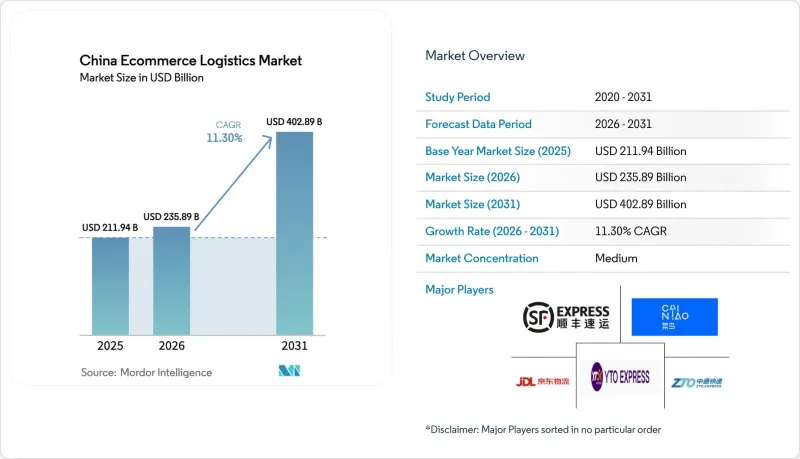
Mordor Intelligence에 의하면, 2026년 중국의 전자상거래 물류 시장 규모는 2,358억 9,000만 달러로 추정되고, 2025년 2,119억 4,000만 달러에서 확대해, 2031년에는 4,028억 9,000만 달러에 이를 것으로 예측됩니다.
2026-2031년 연평균 성장률(CAGR)은 11.30%를 나타낼 전망입니다.
본 보고서에서는 서비스별(운송(도로 운송 등), 창고·풀필먼트), 비즈니스 모델별(B2C, B2B 등), 배송지별(국내 등), 배송 속도별(당일 배송 등), 상품 카테고리별(식품 및 음료 등), 도시 등급별(1급 도시 등), 지역별(화동 및 기타)로 분류되어 있습니다. 시장 예측은 금액(달러) 기준으로 제시되어 있습니다.
중국의 전자상거래 물류 시장 동향 및 인사이트
2급·3급 도시의 가처분 소득 증가로 인해 전자상거래 GMV는 1급 도시의 허브를 넘어 확대되고 있습니다.
현재 지방 도시가 국내 온라인 소매 총액에서 차지하는 비중은 주요 대도시를 상회하고 있으며, 이에 따라 물류 네트워크 재설계 및 새로운 물류 센터에 대한 투자가 진행되고 있습니다. 충칭시만 해도 물류 프로젝트에 400억 위안(55억 6,000만 달러)을 투자하여, 이를 통해 현지 화물 운송 비용을 3.5% 절감했습니다. 한편, 농촌 지역의 전자상거래 이용 확대는 가구의 경제적 회복력을 9.63% 향상시켰으며, 주문 처리 범위 확대가 가져오는 사회경제적 이점을 부각시키고 있습니다.
라이브 스트리밍이나 숏폼 동영상을 통한 쇼핑이 충동 구매의 성사율을 끌어올리고 있습니다.
바이럴 컨텐츠로 인한 충동 구매는 수요의 급증을 초래하여 기존의 재고 계획 범위를 넘어섰습니다. 이에 대응해 각 물류 업체들은 예측 분석과 클라우드 기반 컨트롤 타워를 활용해 안전 재고를 인구 밀집 도시 지역의 마이크로 풀필먼트 거점으로 재배치하고 있습니다. 소매업체들이 ‘1시간 배송’ 약속을 무기로 고객 확보에 나서는 가운데, 중국 전자상거래 물류 시장에서 이러한 민첩성이 이익 창출의 원동력이 되고 있습니다.
자동화가 진행되고 있음에도 불구하고, 1급 도시의 허브에서는 라스트 마일 인건비가 상승하고 있습니다.
인구 밀도가 높은 도시 지역에서 문 앞 배송을 수행하기 위해 사업자들이 인재 확보 경쟁을 벌이는 가운데, 택배 기사의 임금은 상승하고 있습니다. 무인 트럭의 시범 운영이나 자동 분류기가 도입되고 있음에도 불구하고, 높은 수준의 서비스가 요구되는 주문의 경우 여전히 인간 택배 기사가 필수적이며, 중국 전자상거래 물류 시장에서 비용 절감의 가능성은 제한적입니다.
부문 분석
2025년, 중국 전자상거래 물류 시장에서 운송 부문은 60.12%를 차지했습니다. 이는 생산 지역과 소비 거점을 연결하는 총 길이 16만 9,000km의 고속도로망에 힘입은 결과입니다. '일대일로'를 따라 조성된 철도 회랑은 유럽행 수출 소포를 수송하며, 항공 화물은 고급 전자제품의 수송을 뒷받침하고 있습니다. 사업자들이 독자적인 포장, 역물류 처리, 규정 준수 라벨 부착을 요구하는 가운데, 부가가치 서비스는 연평균 성장률(CAGR) 13.86%로 확대되고 있습니다. SF 익스프레스의 '펑즈이윈(Fengzhiyun)' 플랫폼은 데이터 분석, 재고 조정, 실시간 가시화를 통해 기본적인 운송 계약이 통합된 공급망 파트너십으로 전환되는 모습을 보여주고 있습니다.
소비자 인근에서는 창고 및 마이크로 풀필먼트 네트워크가 확대되어 당일 배송 마감 시간을 실현하고 있습니다. 로봇 기술을 통해 입고 및 피킹이 자동화되어, 임금 상승이 지속되는 상황에서도 단위 비용 절감이 이루어지고 있습니다. SF 익스프레스와 에티하드 카고의 합작 사업과 같은 항공 화물 제휴는 중동으로의 사업 범위를 확대되고 있습니다. 특히 선전이나 닝보를 경유하는 해상 e-패킷 항로는 세금 환급 프로그램을 활용하려는 크로스보더 판매업자에게 유익합니다. 경쟁 우위는 더 이상 개별 운송 수단의 탁월함에 있는 것이 아니라, 이러한 서비스 라인 전반에 걸친 종단 간 조정 능력에 달려 있으며, 이는 중국 전자상거래 물류 시장에서 공급업체 선정 기준을 재구성하고 있습니다.
2025년, 중국 전자상거래 물류 시장 점유율의 71.86%를 B2C가 차지했으며, 이는 판매자 수요를 집약하고 주문 처리 업무를 표준화하는 플랫폼 생태계가 기반이 되고 있습니다. 브랜드 기업들은 입고 화물부터 집 앞 반품에 이르기까지 모든 업무를 외부에 위탁하고 있으며, 운송업체의 API를 활용하여 프런트엔드 주문 채널을 연동하고 있습니다. 연평균 성장률(CAGR) 13.12%로 확대되고 있는 C2C 부문은 Z세대 소비자들이 중고 패션 아이템이나 수집품을 거래하는 과정에서 소셜 커머스의 성장세를 활용하고 있습니다. 스타트업 기업들은 정액제 소포 키트나 미니 프로그램을 통해 배송 라벨을 생성하는 스마트폰 앱을 출시하여, 개인에 의한 비정기적인 발송을 간소화하고 있습니다.
B2C 스토어와 C2C 재판매 마켓플레이스 간의 크로스 리스팅으로 인해 경계가 모호해지면서, 판매자들은 미판매 재고를 P2P 채널로 이전하고 있습니다. 이러한 흐름에 따라 소포 발송처가 다양화되면서 운송업체에게는 전국 규모의 수거 서비스 제공이 요구되고 있으며, 그 결과 중국의 전자상거래 물류 시장이 확대되고 있습니다. 한편, B2B 디지털 조달 플랫폼에서는 이익률을 안정화하기 위한 대량 운송 계약이 도입되고 있으나, 여기에는 다중 운송 수단 간의 조정이 필요하기 때문에 중국 전자상거래 물류 업계 전반에서 각 운송사는 기업용 및 소비자용 화물에 대해 각각 다른 가격 체계를 유지하도록 권장받고 있습니다.
기타 혜택 :
- 엑셀 형식 시장 예측(ME) 시트
- 3개월간의 애널리스트 지원
자주 묻는 질문
목차
제1장 서론
제2장 조사 방법
제3장 주요 요약
제4장 시장 구도
제5장 시장 규모 및 성장 예측(금액, 10억 위안)
제6장 경쟁 구도
제7장 시장 기회 및 향후 전망
AJY 26.08.11According to Mordor Intelligence, China e-commerce logistics market size in 2026 is estimated at USD 235.89 billion, growing from 2025 value of USD 211.94 billion with 2031 projections showing USD 402.89 billion, growing at 11.30% CAGR over 2026-2031.
This report Segments by Service (Transportation (Road and More), Warehousing and Fulfilment), by Business Model (B2C, B2B and More), by Destination (Domestic and More), by Delivery Speed (Same-Day and More), by Product Category (Foods and Beverages and More), by City-Tier (Tier 1 and More) and by Geography (East China and More). The Market Forecasts are Provided in Terms of Value (USD).
China E-commerce Logistics Market Trends and Insights
Rising tier-2 / tier-3 disposable incomes shifting e-commerce GMV beyond tier-1 hubs
Secondary cities now deliver a larger share of national online retail value than premier metros, prompting network redesign and fresh distribution-center investments. Chongqing alone committed RMB 40 billion (USD 5.56 billion) to logistics projects that lowered local freight costs by 3.5%. Rural e-commerce participation, meanwhile, improved household financial resilience by 9.63%, highlighting the socioeconomic benefit of broader fulfillment coverage.
Livestream and short-video shopping are elevating impulse-buy conversion rates
Impulse purchases triggered by viral broadcasts generate demand spikes that stretch traditional inventory planning. Providers respond with predictive analytics and cloud-based control towers that redeploy safety stock to micro-fulfillment sites inside dense urban trade areas. Agility becomes a profit driver within the China e-commerce logistics market as retailers lean on one-hour delivery promises to lock in shoppers.
Escalating last-mile labor costs in tier-1 hubs despite automation
Courier wages rise as operators compete for talent to execute doorstep delivery in densely populated towers. Even with driverless truck pilots and automated sorters, human couriers remain indispensable for high-service-level orders, limiting cost-down potential in the Chinese e-commerce logistics market.
Other drivers and restraints analyzed in the detailed report include:
- Community group-buying normalizes high-frequency online grocery purchases
- Silver-economy adoption of simplified apps is expanding the senior shopper base
- Persistent rural address data-quality gaps are raising failed-delivery ratios
For complete list of drivers and restraints, kindly check the Table Of Contents.
Segment Analysis
Transportation dominated 60.12% of the China e-commerce logistics market in 2025, underpinned by a 169,000-km expressway grid that connects production zones with consumption hubs. Rail corridors along the Belt and Road funnel export parcels to Europe, while airfreight supports premium electronics. Value-added services are scaling at a 13.86% CAGR as merchants seek unique packaging, reverse-logistics handling, and compliance-ready labeling. SF Express' "Fengzhiyun" platform shows how data analytics, inventory orchestration, and real-time visibility convert basic haulage contracts into integrated supply-chain partnerships.
Warehousing and micro-fulfillment networks multiply near consumers to enable same-day cut-off times. Robotics automates put-away and picking, trimming unit costs even as wage inflation persists. Air-cargo alliances such as the SF Express-Etihad Cargo joint venture extend reach into the Middle East. Maritime e-packet lanes, especially via Shenzhen and Ningbo, benefit cross-border sellers chasing tax-rebate programs. Competitive advantage now hinges on end-to-end orchestration across these service lines rather than isolated modal excellence, reshaping supplier criteria in the China e-commerce logistics market.
B2C held 71.86% of the China e-commerce logistics market share in 2025, anchored by platform ecosystems that aggregate merchant demand and standardize fulfillment practices. Brands outsource everything from inbound freight to doorstep returns, relying on carrier APIs to sync front-end ordering channels. The C2C segment, expanding at 13.12% CAGR, taps social-commerce momentum as Gen-Z consumers trade secondhand fashion and collectibles. Start-ups launch flat-rate parcel kits and smartphone apps that generate labels through mini-programs, simplifying sporadic shipping for individuals.
Cross-listing between B2C storefronts and C2C resale marketplaces blurs boundaries, with sellers shifting unsold inventory to peer-to-peer channels. That flow diversifies parcel origination points and pushes carriers to offer nationwide pick-up, thereby enlarging the China e-commerce logistics market. Meanwhile, B2B digital procurement platforms deploy bulk rate contracts that stabilize margins yet require multimodal coordination, encouraging carriers to maintain distinct pricing ladders for enterprise versus consumer traffic within the wider China e-commerce logistics industry.
Complete Report Scope:
- By Service
- Transportation
- Road
- Air
- Rail
- Maritime
- Warehousing and Fulfilment
- Value-Added (Labelling, Packaging, Kitting)
- Transportation
- By Business Model
- B2C
- B2B
- C2C
- By Destination
- Domestic
- Cross-Border - Inbound
- Cross-Border - Outbound
- By Delivery Speed
- Same-day (less than 24 h)
- Next-day (24-48 h)
- Standard (3-5 days)
- Economy (more than 5 days)
- Others
- By Product Category
- Foods and Beverages
- Personal and Household Care
- Fashion and Lifestyle (accessories, apparel, footwear)
- Furniture
- Electronics and Household Appliances
- Other Products
- By City-Tier
- Tier 1
- Tier 2
- Tier 3 and Below
- By Geography
- East China
- South China
- North China
- Central China
- Northeast China
- Northwest China
- Southwest China
List of Companies Covered in this Report:
- SF Express
- JD Logistics
- Cainiao Network (Alibaba)
- ZTO Express
- YTO Express
- Yunda Express
- STO Express
- Best Inc.
- China Post EMS
- Deppon Logistics
- Suning Logistics
- J&T Express China
- Dada Group (JDDJ)
- DHL eCommerce China
- FedEx Express China
- UPS China
- Kerry SCM
- CTS International Logistics
- Sinotrans
- 4PX Express
- YunExpress
- Zongteng Group (Winsync, EWE)
- FlashEx
- Meituan Delivery
- YDH Express
- CNE Express
Additional Benefits:
- The market estimate (ME) sheet in Excel format
- 3 months of analyst support
TABLE OF CONTENTS
1 Introduction
- 1.1 Study Assumptions and Market Definition
- 1.2 Scope of the Study
2 Research Methodology
3 Executive Summary
4 Market Landscape
- 4.1 Market Overview
- 4.2 Market Drivers
- 4.2.1 Rising Tier-2/3 Disposable Incomes Shifting E-commerce GMV Beyond Tier-1 Hubs
- 4.2.2 Livestream and Short-Video Shopping Elevating Impulse-Buy Conversion Rates
- 4.2.3 Community Group-Buying Normalising High-Frequency Online Grocery Purchases
- 4.2.4 Silver-Economy Adoption of Simplified Apps Expanding Senior Shopper Base
- 4.2.5 Duty-Free Cross-Border Pilot Zones Fueling Appetite for Premium Imports
- 4.2.6 30-Minute Micro-Fulfilment Creating Instant-Gratification Purchase Expectations
- 4.3 Market Restraints
- 4.3.1 Escalating last-mile labour costs in Tier-1 hubs despite automation
- 4.3.2 Persistent rural address data-quality gaps raising failed-delivery ratio
- 4.3.3 Tightened cross-border data-compliance rules delaying customs clearance
- 4.3.4 Environmental targets raising fleet electrification costs
- 4.4 Value / Supply-Chain Analysis
- 4.5 Government Policies and Regulations
- 4.6 Technological Developments in the Market
- 4.7 Impact of Geopolitical Events on the Market
- 4.8 Porter's Five Forces
- 4.8.1 Threat of New Entrants
- 4.8.2 Bargaining Power of Buyers
- 4.8.3 Bargaining Power of Suppliers
- 4.8.4 Threat of Substitutes
- 4.8.5 Competitive Rivalry
5 Market Size and Growth Forecasts (Value, CNY bn)
- 5.1 By Service
- 5.1.1 Transportation
- 5.1.1.1 Road
- 5.1.1.2 Air
- 5.1.1.3 Rail
- 5.1.1.4 Maritime
- 5.1.2 Warehousing and Fulfilment
- 5.1.3 Value-Added (Labelling, Packaging, Kitting)
- 5.1.1 Transportation
- 5.2 By Business Model
- 5.2.1 B2C
- 5.2.2 B2B
- 5.2.3 C2C
- 5.3 By Destination
- 5.3.1 Domestic
- 5.3.2 Cross-Border - Inbound
- 5.3.3 Cross-Border - Outbound
- 5.4 By Delivery Speed
- 5.4.1 Same-day (less than 24 h)
- 5.4.2 Next-day (24-48 h)
- 5.4.3 Standard (3-5 days)
- 5.4.4 Economy (more than 5 days)
- 5.4.5 Others
- 5.5 By Product Category
- 5.5.1 Foods and Beverages
- 5.5.2 Personal and Household Care
- 5.5.3 Fashion and Lifestyle (accessories, apparel, footwear)
- 5.5.4 Furniture
- 5.5.5 Electronics and Household Appliances
- 5.5.6 Other Products
- 5.6 By City-Tier
- 5.6.1 Tier 1
- 5.6.2 Tier 2
- 5.6.3 Tier 3 and Below
- 5.7 By Geography
- 5.7.1 East China
- 5.7.2 South China
- 5.7.3 North China
- 5.7.4 Central China
- 5.7.5 Northeast China
- 5.7.6 Northwest China
- 5.7.7 Southwest China
6 Competitive Landscape
- 6.1 Market Concentration
- 6.2 Strategic Moves
- 6.3 Market Share Analysis
- 6.4 Company Profiles (includes Global-level Overview, Market-level Overview, Core Segments, Financials, Strategic Info, Market Rank/Share, Products and Services, Recent Developments)
- 6.4.1 SF Express
- 6.4.2 JD Logistics
- 6.4.3 Cainiao Network (Alibaba)
- 6.4.4 ZTO Express
- 6.4.5 YTO Express
- 6.4.6 Yunda Express
- 6.4.7 STO Express
- 6.4.8 Best Inc.
- 6.4.9 China Post EMS
- 6.4.10 Deppon Logistics
- 6.4.11 Suning Logistics
- 6.4.12 J&T Express China
- 6.4.13 Dada Group (JDDJ)
- 6.4.14 DHL eCommerce China
- 6.4.15 FedEx Express China
- 6.4.16 UPS China
- 6.4.17 Kerry SCM
- 6.4.18 CTS International Logistics
- 6.4.19 Sinotrans
- 6.4.20 4PX Express
- 6.4.21 YunExpress
- 6.4.22 Zongteng Group (Winsync, EWE)
- 6.4.23 FlashEx
- 6.4.24 Meituan Delivery
- 6.4.25 YDH Express
- 6.4.26 CNE Express


