

|
시장보고서
상품코드
2125408
인도의 E-Commerce 물류 : 시장 점유율 분석, 업계 동향 및 통계, 성장 예측(2026-2031년)India E-commerce Logistics - Market Share Analysis, Industry Trends & Statistics, Growth Forecasts (2026 - 2031) |
||||||
 Mordor Intelligence
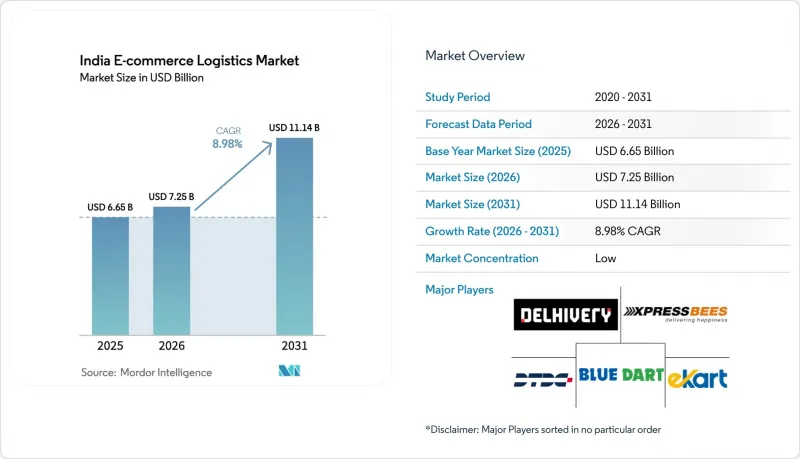
Mordor Intelligence에 의하면, 인도의 E-Commerce 물류 시장 규모는 2025년에 66억 5,000만 달러로 평가되었습니다. 2026년 72억 5,000만 달러에서 2031년까지 111억 4,000만 달러에 이를 것으로 추정되고 예측 기간(2026-2031년) CAGR은 8.98%를 나타낼 전망입니다.
본 보고서는 서비스별(운송, 창고·풀필먼트, 부가가치 서비스), 비즈니스 모델별(B2C, B2B, C2C),배송지별(국내 및 국경 간), 배송 속도별(당일 배송 등), 상품 카테고리별(식품 및 음료 등), 도시 등급(Tier 1, 2, 기타), 지역(북부, 남부, 기타)별로 분류되어 있습니다. 시장 예측은 금액 기준(달러)으로 제시되어 있습니다.
인도의 E-Commerce 물류 시장 동향 및 인사이트
ONDC 주도의 MSME 진입
ONDC는 플랫폼 간의 사일로화를 해소하고, 표준화된 API를 통해 물류 기업이 여러 판매자 생태계에 대응할 수 있도록 합니다. 이를 통해 통합 비용이 절감되고 자산 활용률이 향상됩니다. 이 모델은 기존 전자상거래의 도달 범위가 제한적이었던 2차 및 3차 시장에 특히 혜택을 주며, 새로운 수익 채널을 창출하는 동시에 기존 기업들에게 투명성과 서비스 품질을 바탕으로 한 경쟁을 촉진하고 있습니다. ONDC상의 거래량은 전국적으로 확대되고 있으며, 이는 물류 접근성을 민주화하는 데 있어 ONDC의 역할이 입증되고 있음을 보여줍니다.
D2C 브랜드의 급증
D2C(Direct-to-Consumer) 브랜드는 통합 재고 관리, 맞춤형 포장, 유연한 반품 처리를 요구하며, 공급업체로 하여금 자동화 및 예측 분석에 투자하도록 촉진하고 있습니다. SKU 증가와 계절적 수요 급증이 복잡성을 더하고 있지만, 소비자 경험에 중점을 둠으로써 전문적인 부가가치 서비스를 통해 더 높은 이익률을 실현할 수 있습니다. 이러한 추세는 다중 노드 주문 이행을 동기화하고 차별화된 가격 책정을 지원하는 창고 관리 시스템의 도입을 촉진하고 있습니다.
부족한 지방 도로 및 창고 인프라
지방 시장에서는 인프라 미비로 인해 출하당 비용이 증가하고 배송 리드타임이 길어지고 있습니다. 창고 부족으로 인해 온도 관리가 필요한 상품이나 대형 상품의 취급이 제한되어 SKU의 다양성이 저해되고 있습니다. 정부의 도로 정비 노력으로 격차는 점차 줄어들고 있지만, 인프라 개발은 여전히 전자상거래 수요를 따라가지 못하고 있습니다. 운송 수단이 제한된 지역에서는 역물류(반품 물류)의 복잡성으로 인해 비용이 더욱 상승하고 있습니다.
부문별 분석
2025년, 인도의 E-Commerce 물류 시장에서 운송 부문은 시장 점유율의 71.42%를 차지했으며, 부가가치 서비스 부문의 연평균 성장률(CAGR)은 2031년까지 7.11%를 유지할 것으로 전망됩니다. 브랜드 포장, 키트 구성, 검사를 제공하는 사업자들은 강력한 가격 결정력을 보유하고 있습니다. 운송 분야는 상품화 압력에 직면해 있지만, 도로 운송은 여전히 인도의 E-Commerce 물류 시장의 운송량 기반을 형성하고 있습니다. 철도 인프라 확충으로 대량 화물의 운송 시간이 단축되고 있으며, 시간 엄수가 요구되는 국경을 넘는 소포 운송에서는 항공 화물이 여전히 필수적입니다.
창고 업무에서의 기술 주도형 자동화는 오류율을 낮추고 규모 확대를 뒷받침하고 있습니다. 또한, AI를 활용한 품질 관리를 통해 사업자는 비용의 비례적 증가를 초래하지 않으면서 사업을 확장할 수 있게 되었습니다. 이러한 역량은 고객 유지 전략을 뒷받침하며 경쟁적 진입 장벽을 구축하고 있습니다.
B2C 부문은 2025년 인도의 E-Commerce 물류 시장 규모의 62.58%를 차지하며, 서비스 수준의 기준을 지속적으로 확립했습니다. 소셜 커머스 활동에 힘입은 C2C 분야는 연평균 성장률(CAGR) 6.42%(2026-2031년)로 확대되고 있으며, 개인 사업자를 위한 전문적인 추적 서비스, 보험, 지원이 요구되고 있습니다. B2B 운송은 안정성을 제공하지만, 기술적 측면에서 차별화할 기회는 제한적입니다.
B2C의 성장은 퀵 커머스에 대한 기대감의 고조 및 스마트폰 보급과 궤를 같이 하고 있으며, 공급업체들은 라스트 마일 네트워크와 고객 커뮤니케이션 도구의 개선을 서둘러야 하는 상황에 놓여 있습니다. 소셜 커머스의 확대에 따라 개별 판매자의 요구 사항을 충족하는 확장성이 뛰어난 마이크로 풀필먼트 솔루션에 대한 수요가 증가하고 있습니다.
기타 혜택 :
- 엑셀 형식 시장 예측(ME) 시트
- 3개월간의 애널리스트 지원
자주 묻는 질문
목차
제1장 서론
제2장 조사 방법
제3장 주요 요약
제4장 시장 구도
제5장 시장 규모 및 성장 예측
제6장 경쟁 구도
제7장 시장 기회 및 향후 전망
제8장 부록
KTH 26.09.14According to Mordor Intelligence, the India e-commerce logistics market size was valued at USD 6.65 billion in 2025 and estimated to grow from USD 7.25 billion in 2026 to reach USD 11.14 billion by 2031, at a CAGR of 8.98% during the forecast period (2026-2031).
This report is Segmented by Service (Transportation, Warehousing & Fulfilment, and Value-Added Services), Business Model (B2C, B2B, and C2C), Destination (Domestic and Cross-Border), Delivery Speed (Same-Day, and More), Product Category (Foods & Beverages, and More), City Tier (Tier 1, 2, and More), and Region (North, South, and More). Market Forecasts are Provided in Terms of Value (USD).
India E-commerce Logistics Market Trends and Insights
ONDC-Driven MSME Onboarding
ONDC removes platform silos, enabling logistics firms to serve multiple seller ecosystems through standardized APIs that cut integration costs and elevate asset utilization. The model especially benefits tier 2 and tier 3 markets where traditional e-commerce reach was limited, spurring fresh revenue channels while forcing incumbents to compete on transparency and service quality. Transaction volumes on ONDC have scaled nationwide, confirming its role in democratizing logistics access.
D2C Brand Proliferation
Direct-to-consumer labels demand integrated inventory management, personalized packaging, and agile returns, pushing providers to invest in automation and predictive analytics. SKU proliferation coupled with seasonal surges raises complexity, yet the premium on consumer experience allows higher margins through specialized value-added services. This trend strengthens the adoption of warehouse management systems that synchronize multi-node fulfillment and support differentiated pricing.
Sub-Optimal Rural Road & Warehousing Infrastructure
Connectivity gaps increase per-shipment costs and elongate delivery windows in rural markets. Warehousing shortages restrict temperature-sensitive and bulky product categories, limiting SKU variety. Government road initiatives continue to narrow the gap, yet infrastructure development trails e-commerce demand. Reverse logistics complexities further raise costs where transport options remain sparse.
Other drivers and restraints analyzed in the detailed report include:
- Same-Day / Quick-Commerce Boom
- UPI and Digital-Payments Ubiquity
- High Product-Return / COD Ratio
For complete list of drivers and restraints, kindly check the Table Of Contents.
Segment Analysis
Transportation generated 71.42% of the India e-commerce logistics market share in 2025, and the Value-Added Services segment CAGR stands at 7.11% to 2031. Providers offering branded packaging, kitting, and inspection enjoy strong pricing power. Transportation faces commoditization, but road haulage still offers the volume backbone for the India e-commerce logistics market. Rail improvements shorten transit times for bulk shipments, and air freight remains critical for time-sensitive cross-border parcels.
Technology-driven automation in warehousing cuts error rates and supports scale, while AI-enabled quality control allows providers to expand without proportional cost escalation. These capabilities sustain customer-retention strategies and create competitive barriers.
The B2C segment contributed 62.58% to the India e-commerce logistics market size in 2025 and continues to set service-level benchmarks. The C2C corridor, propelled by social-commerce activity, is advancing at a 6.42% CAGR (2026-2031) and demands professional tracking, insurance, and support for individual entrepreneurs. B2B shipments offer stability but yield lower technology differentiation opportunities.
B2C growth aligns with rising quick-commerce expectations and widespread smartphone adoption, compelling providers to refine last-mile networks and customer-communication tools. Social-commerce expansion amplifies the need for scalable micro-fulfillment solutions that meet individualized seller requirements.
Complete Report Scope:
- By Service
- Transportation
- Road
- Rail
- Air
- Sea
- Warehousing & Fulfilment
- Value-Added Services (Labelling, Packaging, Kitting)
- Transportation
- By Business Model
- B2C
- B2B
- C2C
- By Destination
- Domestic
- Cross-border (international)
- By Delivery Speed
- Same-day (less than 24 h)
- Next-day (24-48 h)
- Standard (3-5 days)
- Others (more than 5 days)
- By Product Category
- Foods & Beverages
- Personal & Household Care
- Fashion & Lifestyle (accessories, apparel, footwear)
- Furniture
- Consumer Electronics & Household Appliances
- Other Products
- By City Tier
- Tier 1
- Tier 2
- Tier 3 and Below
- By Region (India)
- North
- South
- East
- West
- Central
List of Companies Covered in this Report:
- Delhivery
- Ekart Logistics
- XpressBees
- Blue Dart Express
- DTDC
- TVS Supply Chain Solutions
- FedEx India
- DHL Express India
- Gati-KWE
- Shadowfax
- Mahindra Logistics
- Shiprocket
- Wow Express
- Pickrr
- AAJ Supply Chain Management
- ARK India
- Borzo
- NimbusPost
- Godamwale
- Emiza
Additional Benefits:
- The market estimate (ME) sheet in Excel format
- 3 months of analyst support
TABLE OF CONTENTS
1 Introduction
- 1.1 Study Assumptions & Market Definition
- 1.2 Scope of the Study
2 Research Methodology
3 Executive Summary
4 Market Landscape
- 4.1 Market Overview
- 4.2 Market Drivers
- 4.2.1 ONDC-driven MSME onboarding
- 4.2.2 D2C brand proliferation
- 4.2.3 Same-day/quick-commerce boom (hyperlocal fulfilment)
- 4.2.4 UPI & digital-payments ubiquity
- 4.2.5 Rail-based express cargo corridors (Gati Shakti, DFC)
- 4.2.6 Growth of social-commerce platforms
- 4.3 Market Restraints
- 4.3.1 Sub-optimal rural road & warehousing infra
- 4.3.2 High product-return / COD ratio
- 4.3.3 Draft e-commerce rules & data-localisation costs
- 4.3.4 Stricter ESG & decarbonisation compliance
- 4.4 Value / Supply-Chain Analysis
- 4.5 Regulatory Landscape
- 4.6 Technological Outlook
- 4.7 Demand & Supply Analysis
- 4.8 Industry Attractiveness - Porter's Five Forces
- 4.8.1 Threat of New Entrants
- 4.8.2 Bargaining Power of Buyers
- 4.8.3 Bargaining Power of Suppliers
- 4.8.4 Threat of Substitutes
- 4.8.5 Competitive Rivalry
- 4.9 Impact of Geo-Political Events on Supply Chain Shifts
- 4.10 Reverse / Return Logistics Insights
5 Market Size & Growth Forecasts
- 5.1 By Service
- 5.1.1 Transportation
- 5.1.1.1 Road
- 5.1.1.2 Rail
- 5.1.1.3 Air
- 5.1.1.4 Sea
- 5.1.2 Warehousing & Fulfilment
- 5.1.3 Value-Added Services (Labelling, Packaging, Kitting)
- 5.1.1 Transportation
- 5.2 By Business Model
- 5.2.1 B2C
- 5.2.2 B2B
- 5.2.3 C2C
- 5.3 By Destination
- 5.3.1 Domestic
- 5.3.2 Cross-border (international)
- 5.4 By Delivery Speed
- 5.4.1 Same-day (less than 24 h)
- 5.4.2 Next-day (24-48 h)
- 5.4.3 Standard (3-5 days)
- 5.4.4 Others (more than 5 days)
- 5.5 By Product Category
- 5.5.1 Foods & Beverages
- 5.5.2 Personal & Household Care
- 5.5.3 Fashion & Lifestyle (accessories, apparel, footwear)
- 5.5.4 Furniture
- 5.5.5 Consumer Electronics & Household Appliances
- 5.5.6 Other Products
- 5.6 By City Tier
- 5.6.1 Tier 1
- 5.6.2 Tier 2
- 5.6.3 Tier 3 and Below
- 5.7 By Region (India)
- 5.7.1 North
- 5.7.2 South
- 5.7.3 East
- 5.7.4 West
- 5.7.5 Central
6 Competitive Landscape
- 6.1 Market Concentration
- 6.2 Strategic Moves
- 6.3 Market Share Analysis
- 6.4 Company Profiles (includes Global level Overview, Market level overview, Core Segments, Financials as available, Strategic Information, Market Rank/Share for key companies, Products & Services, and Recent Developments)
- 6.4.1 Delhivery
- 6.4.2 Ekart Logistics
- 6.4.3 XpressBees
- 6.4.4 Blue Dart Express
- 6.4.5 DTDC
- 6.4.6 TVS Supply Chain Solutions
- 6.4.7 FedEx India
- 6.4.8 DHL Express India
- 6.4.9 Gati-KWE
- 6.4.10 Shadowfax
- 6.4.11 Mahindra Logistics
- 6.4.12 Shiprocket
- 6.4.13 Wow Express
- 6.4.14 Pickrr
- 6.4.15 AAJ Supply Chain Management
- 6.4.16 ARK India
- 6.4.17 Borzo
- 6.4.18 NimbusPost
- 6.4.19 Godamwale
- 6.4.20 Emiza
7 Market Opportunities & Future Outlook
- 7.1 White-space & Unmet-need Assessment
8 Appendix
- 8.1 Macroeconomic Indicators
- 8.2 Capital-flow Insights
- 8.3 E-commerce & Consumer-spend Statistics
- 8.4 External Trade Statistics


