|
시장보고서
상품코드
2098559
GPU 메모리 : 시장 점유율 분석, 업계 동향과 통계, 성장 예측(2026-2031년)GPU Memory - Market Share Analysis, Industry Trends & Statistics, Growth Forecasts (2026 - 2031) |
||||||
 Mordor Intelligence
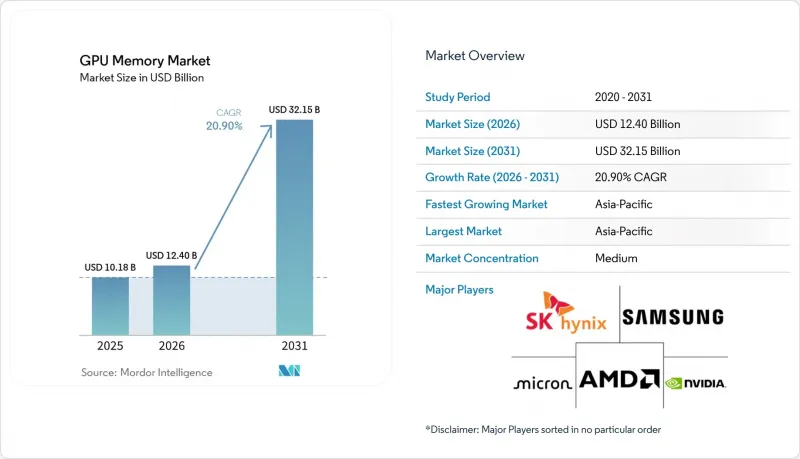
Mordor Intelligence에 의하면, GPU 메모리 시장 규모는 2025년 101억 8,000만 달러에서 2026년에는 124억 달러로 확대되고, 2031년까지 321억 5,000만 달러에 이를 것으로 예측되며, 2026-2031년 CAGR 20.90%를 기록할 전망입니다.
본 보고서는 메모리 유형(HBM, GDDR 등), 메모리 용량(8 GB 이하, 8 GB-16GB, 16GB-32 GB, 32 GB-64GB, 64GB 이상), 용도(전문가를 위한 시각화 및 컨텐츠 제작, 엣지 AI 및 임베디드 가속화, 고성능 컴퓨팅, 클라우드 GPU 및 데이터센터 가속화 등), 그리고 지역별로 분류되어 있습니다. 시장 전망은 금액(달러) 기준으로 제시되어 있습니다.
전 세계 GPU 메모리 시장 동향 및 인사이트
AI 훈련 클러스터의 확장이 HBM 소비를 증가시키고 있습니다.
AI 인프라 확충에 따라 HBM은 단순한 프리미엄 메모리 옵션에서 GPU 메모리 시장의 주요 공급원 중 하나로 변모했습니다. NVIDIA는 Blackwell B200 GPU 1개당 192GB의 HBM3E를 규정하고 있으며, GB300 Blackwell Ultra에서는 이 요구 사항이 GPU 1개당 288GB로 상향 조정되어, 이에 따라 가속기 세대별 메모리 탑재량이 급격히 증가하고 있습니다. 또한 NVIDIA는 단일 GB200 NVL72 랙에 13.4 TB가 넘는 HBM3E가 탑재될 것이라고 밝혔으며, 이는 조달 정책이 칩 수준 결정에서 랙 수준 계약으로 전환된 이유를 보여줍니다. 이러한 변화는 GPU 메모리 시장이 가속기의 출하 대수가 증가할 뿐만 아니라, 각 도입 사례에서 이전 시스템 설계보다 훨씬 더 많은 메모리가 소비되게 됨에 따라 성장하고 있음을 의미합니다. 단기적인 영향으로 공급 부족이 더욱 심화될 것으로 예측됩니다. 이는 웨이퍼 생산 시작 수량을 늘리는 것만으로는 GPU 메모리 시장 전체의 적층, 패키징 및 인증 제한을 해결할 수 없기 때문입니다.
NVIDIA의 Blackwell 및 후속 플랫폼의 출시가 인증 수요를 증가시키고 있습니다.
플랫폼 전환은 현재 GPU 메모리 시장에서 가장 중요한 시기적 요인 중 하나입니다. 이는 메모리 공급업체들이 주요 고객으로부터 대량 수주가 시작되기 전에 각 신세대 제품에 대한 인증을 획득해야 하기 때문입니다. 블룸버그는 2026년 6월, 삼성, SK하이닉스, 마이크론이 NVIDIA의 ‘Vera Rubin’용 HBM4 인증을 획득했다고 보도했습니다. 이에 따라 인증 획득은 다음 공급 주기로 진입하는 관문이 되었습니다. 그 후, SK하이닉스는 HBM4, 베라 루빈 시스템, RTX 스파크 탑재 PC, 그리고 제트슨 토르(Jetson Thor) 로봇 공학 플랫폼을 아우르는 엔비디아와의 다년간 기술 제휴를 통해 그 입지를 더욱 공고히 했습니다. 이러한 플랫폼의 전개로 인해 공급업체들은 HBM3E, HBM4 및 차세대 파생 제품의 중복되는 로드맵을 동시에 지원해야만 하게 되었으며, GPU 메모리 시장 전반에 걸쳐 개발에 대한 압박이 커지고 있습니다. 그 결과, 인증을 조기에 획득하는 것이 제조 규모만큼이나 중요한 경우가 많습니다. 인증된 공급량만이 고객이 지연 없이 도입할 수 있는 양이기 때문입니다.
인증 공급업체의 집중이 공급량의 유연성을 제한
공급업체의 집중은 GPU 메모리 시장에서 여전히 가장 명백한 제약 요소 중 하나입니다. 인증된 HBM을 대규모로 공급할 수 있는 제조업체는 극소수에 불과하기 때문입니다. 블룸버그는 2026년 삼성, SK하이닉스, 마이크론 등 3개사가 엔비디아의 HBM4 사이클용으로 인증받은 메모리 제조업체임을 확인했으며, 이는 인증 공급업체 기반이 얼마나 제한적인지를 여실히 보여줍니다. 『서울경제일보』의 보도에 따르면, 세계 주요 기술 기업들은 SK하이닉스의 생산 라인이나 설비에 대한 직접 자금 지원까지 제안한 것으로 알려졌습니다. 이는 일반적인 조달 경로를 통해 공급량을 늘리는 것이 얼마나 어려운지를 보여줍니다. 이러한 집중화로 인해 GPU 메모리 시장 전체공급 유연성이 저하되고 있습니다. 수요가 계획된 생산 능력을 상회하는 속도로 증가할 경우, 신규 고객이 대체 공급원으로 신속하게 전환할 수 없기 때문입니다. 또한 이는 조달 시기가 최종 수요나 GPU 웨이퍼의 확보 가능성뿐만 아니라, 할당 계약 및 인증 획득 여부에 따라 결정되는 경향이 강해지고 있음을 의미합니다.
부문 분석
2025년 기준, HBM은 GPU 메모리 시장 점유율의 42.11%를 차지하며 가장 큰 메모리 유형이 되었습니다. 이 GPU 메모리 시장 규모는 2031년까지 연평균 성장률(CAGR) 21.52%로 확대될 것으로 예측됩니다. HBM이 이러한 우위를 유지하고 있는 이유는 대규모 AI 훈련 및 추론 시스템이 현재 높은 대역폭, 고밀도 패키징, 그리고 각 플랫폼 주기별 GPU당 메모리 사양의 향상에 의존하고 있기 때문입니다. NVIDIA의 현재 데이터센터용 로드맵은 요구 사항이 얼마나 빠르게 높아지고 있는지를 이미 보여주고 있으며, Blackwell 및 그 후속 시스템에서는 가속기 단위 및 랙 단위당 HBM 탑재량이 대폭 증가할 전망입니다. 또한 블룸버그는 삼성, SK하이닉스, 마이크론이 2026년 NVIDIA의 HBM4 사이클에 대한 인증을 획득했음을 확인했으며, 이는 HBM 매출 확대의 다음 단계를 뒷받침할 것입니다.
HBM의 성장 전망은 2026년 공급업체들의 적극적인 로드맵을 통해서도 뒷받침되고 있으며, 삼성과 SK하이닉스는 12층 HBM4E 및 관련 차세대 제품을 고객에게 도입하기 위해 추진 중입니다. SK하이닉스는 2026년 6월 HBM4E 샘플 출하량이 스택당 48GB에 달했다고 발표했으며, 이는 향후 AI 가속기에서 메모리 용량의 대폭적인 확대를 향한 움직임을 뒷받침하는 것입니다. GDDR은 최대 대역폭보다 시스템 경제성이 중시되는 저비용 추론, 게임, 시각화 및 워크스테이션 도입을 지원하기 때문에 GPU 메모리 시장에서 여전히 HBM을 보완하는 주요 존재입니다. 램버스와 NVIDIA는 모두 GDDR7이 현재 주류 제품 라인에 도입되고 있음을 보여주고 있으며, 이를 통해 시장에는 HBM이 주류를 이루는 서버 클러스터 이외의 광범위한 제2의 성장 기반이 마련되고 있습니다. 다른 메모리 유형도 여전히 중요하지만, 그 역할은 보다 제한적이며, 피크 대역폭을 희생하여 저비용이나 달러당 대용량을 실현하는 아키텍처와 연결되어 있습니다.
지역별 분석
2025년, 아시아태평양은 GPU 메모리 시장 점유율의 48.34%를 차지하며, 공급과 수익 양면에서 가장 규모가 큰 지역 거점이 되었습니다. 이 지역이 이러한 위상을 유지하고 있는 이유는 한국이 삼성과 SK하이닉스를 통해 HBM 제조의 거점이 되고 있는 한편, 대만이 AI 가속기에서 HBM 도입에 필수적인 첨단 패키징의 중심지로 자리 잡고 있기 때문입니다. 『한국중앙일보』 보도에 따르면, 삼성과 SK하이닉스는 HBM 관련 생산을 확대하고 있으며, 이를 통해 아시아태평양이 GPU 메모리 시장의 핵심 생산 거점으로서의 역할을 더욱 공고히 하고 있습니다. 일본은 반도체 제조 장비, 테스트 시스템, 메모리 조사 지원을 통해 시장에 깊이를 더하고, 제조의 지속성을 뒷받침하는 지역 생태계를 강화하고 있습니다. 또한 클라우드 사업자들이 싱가포르, 말레이시아, 인도네시아에서 데이터센터 거점 확장을 추진함에 따라 인도와 동남아시아도 GPU 메모리 시장에서 점점 더 중요한 존재가 되고 있습니다.
북미는 여전히 GPU 메모리 시장의 주요 수요 거점으로 자리 잡고 있습니다. 이는 최대 규모의 AI 인프라 프로그램이 여전히 미국의 클라우드 기업 및 플랫폼 기업에 집중되어 있기 때문입니다. Mordor Intelligence사는 북미의 대규모 훈련 및 데이터센터용 GPU 도입이 계속해서 하드웨어 조달 패턴을 형성하고 있으며, 이것이 HBM 및 GDDR 각 카테고리에 걸친 메모리 수요를 직접 뒷받침하고 있다고 밝혔습니다. 또한, 보다 광범위한 지리적 조달 기반을 원하는 고객들로부터 미국과 관련된 메모리 생산 능력의 가치가 점점 더 높이 평가되고 있기 때문에 이 지역은 공급망 다각화 노력의 혜택도 받고 있습니다. 이로 인해 제조 집중도가 여전히 아시아태평양이 가장 높음에도 불구하고, 북미는 GPU 메모리 시장에서 중요한 위치를 계속 차지하고 있습니다.
하이퍼스케일러와 기업들이 더욱 엄격한 거버넌스 및 규정 준수 요건 하에서 AI 대응 용량을 확대함에 따라, 유럽은 GPU 메모리 시장에서 더욱 중요한 소비 지역으로 부상하고 있습니다. AWS는 2033년까지 스페인의 GPU 용량을 확대하기 위해 337억 유로(357억 달러)를 투자하겠다고 약속했으며, 구글은 2025년 12월, 하르나우와 프랑크푸르트 지역의 GPU 및 TPU 확장에 55억 유로(58억 3,000만 달러)를 투자하겠다고 발표했습니다. 또한, EU AI법은 프라이빗 클라우드 및 On-Premise AI 인프라에 대한 수요도 촉진하고 있으며, 이로 인해 고성능 메모리 구성에 의존하는 기업의 하드웨어 수요가 증가하고 있습니다. 남미, 중동 및 아프리카는 현재로서는 규모가 작은 편이지만, 예측 기간 동안 각국의 AI 프로젝트와 디지털 인프라 프로그램이 진전됨에 따라 이 지역들의 GPU 메모리 시장은 더욱 확대될 여지가 있습니다.
기타 혜택:
- 엑셀 형식 시장 예측(ME) 시트
- 3개월간의 애널리스트 지원
자주 묻는 질문
목차
제1장 서론
제2장 조사 방법
제3장 주요 요약
제4장 시장 구도
제5장 시장 규모와 성장 예측
제6장 경쟁 구도
제7장 시장 기회와 향후 전망
KTH 26.08.06According to Mordor Intelligence, the GPU memory market size is expected to increase from USD 10.18 billion in 2025 to USD 12.40 billion in 2026 and reach USD 32.15 billion by 2031, growing at a CAGR of 20.90% over 2026-2031.
This report is Segmented by Memory Type (HBM, GDDR, and More), Memory Capacity (Up To 8 GB, 8 GB To 16 GB, 16 GB To 32 GB, 32 GB To 64 GB, and Above 64 GB), Application (Professional Visualization and Content Creation, Edge AI and Embedded Acceleration, High-Performance Computing, Cloud GPU and Data Center Acceleration, and More), and Geography. The Market Forecasts are Provided in Terms of Value (USD).
Global GPU Memory Market Trends and Insights
AI Training Cluster Expansion Increasing HBM Consumption
AI infrastructure buildouts have turned HBM from a premium memory option into one of the main supply gates for the GPU memory market. NVIDIA specified 192 GB of HBM3E for each Blackwell B200 GPU, and the GB300 Blackwell Ultra raises that requirement to 288 GB per GPU, which sharply lifts memory content per accelerator generation. NVIDIA also stated that a single GB200 NVL72 rack carries more than 13.4 TB of HBM3E, which shows why procurement has shifted from chip-level decisions to rack-level commitments. This change means the GPU memory market grows not only because more accelerators are shipped, but also because each deployment now absorbs far more memory than earlier system designs. The near-term effect is tighter supply utilization, since additional wafer starts alone do not solve limits in stacking, packaging, and qualification across the GPU memory market.
NVIDIA Blackwell and Successor Platform Rollouts Increasing Qualification Demand
Platform transitions are now one of the strongest timing factors in the GPU memory market because memory suppliers need to qualify each new generation before large customer volumes begin. Bloomberg reported in June 2026 that Samsung, SK hynix, and Micron all cleared HBM4 certification for NVIDIA Vera Rubin, making qualification the gateway to the next supply cycle. SK hynix then deepened that position with a multi-year technology partnership with NVIDIA covering HBM4, Vera Rubin systems, RTX Spark-powered PCs, and Jetson Thor robotics platforms. These platform rollouts force suppliers to support overlapping roadmaps for HBM3E, HBM4, and next-generation derivatives at the same time, which raises development pressure across the GPU memory market. The practical result is that early certification often matters as much as manufacturing scale, because qualified volume is what customers can deploy without delay.
Qualified Supplier Concentration Limiting Volume Flexibility
Supplier concentration remains one of the clearest constraints on the GPU memory market because only a very small group of manufacturers can deliver qualified HBM at scale. Bloomberg confirmed in 2026 that Samsung, SK hynix, and Micron were the three memory makers certified for NVIDIA's HBM4 cycle, which underlines how limited the qualified supplier base remains. Seoul Economic Daily reported that global large technology companies even proposed direct funding for SK hynix production lines and equipment, which shows how difficult it is to secure incremental supply through normal purchasing channels. This concentration reduces volume flexibility across the GPU memory market because new customers cannot quickly diversify to alternative sources when demand rises faster than planned capacity. It also means procurement timing is increasingly set by allocation agreements and qualification access, not only by end demand or GPU wafer availability.
Other drivers and restraints analyzed in the detailed report include:
- Cloud Gaming and AI Workstation Upgrades Increasing GDDR7 Adoption
- Advanced Packaging Capacity Buildout Unlocking New GPU Memory Supply
- Yield Sensitivity In 3D Stacking and TSV Processing
For complete list of drivers and restraints, kindly check the Table Of Contents.
Segment Analysis
HBM held 42.11% of the GPU memory market share in 2025, making it the largest memory type, and this part of the GPU memory market size is projected to rise at a 21.52% CAGR through 2031. HBM keeps that lead because large AI training and inference systems now depend on high bandwidth, dense packaging, and rising memory-per-GPU specifications across each platform cycle. NVIDIA's current data center roadmap already shows how fast requirements are increasing, with Blackwell and successor systems moving to much higher HBM loads per accelerator and per rack. Bloomberg also confirmed that Samsung, SK hynix, and Micron all qualified for NVIDIA's HBM4 cycle in 2026, which supports the next phase of HBM revenue expansion.
The growth profile of HBM is also reinforced by active supplier roadmaps in 2026, with Samsung and SK hynix moving 12-layer HBM4E and related next-generation products toward customer deployment. SK hynix stated that its June 2026 HBM4E sample shipments reached 48 GB per stack, which supports the move toward much larger memory footprints in future AI accelerators. GDDR remains the main complement to HBM in the GPU memory market because it supports lower-cost inference, gaming, visualization, and workstation deployments where system economics matter more than maximum bandwidth. Rambus and NVIDIA both showed that GDDR7 is now moving into mainstream product lines, which gives the market a broad second growth base outside HBM-heavy server clusters. Other memory types still matter, but their role remains more selective and is tied to architectures that trade peak bandwidth for lower cost or higher capacity per dollar.
Complete Report Scope:
- By Memory Type
- HBM
- GDDR
- Other GPU Memory Types
- By Memory Capacity
- Up to 8 GB
- 8 GB to 16 GB
- 16 GB to 32 GB
- 32 GB to 64 GB
- Above 64 GB
- By Application
- Professional Visualization and Content Creation
- AI Training and Inference
- High-Performance Computing
- Cloud GPU and Data Center Acceleration
- Gaming and Consumer Graphics
- Edge AI and Embedded Acceleration
- By Geography
- North America
- United States
- Canada
- Mexico
- Europe
- Germany
- United Kingdom
- France
- Italy
- Rest of Europe
- Asia Pacific
- China
- Japan
- South Korea
- India
- Southeast Asia
- Rest of Asia-Pacific
- South America
- Middle East and Africa
- North America
Geography Analysis
Asia-Pacific accounted for 48.34% of the GPU memory market share in 2025, which made it the largest regional base for both supply and revenue. The region holds that position because South Korea anchors HBM manufacturing through Samsung and SK hynix, while Taiwan remains central to advanced packaging that is required for HBM deployment in AI accelerators. Korea JoongAng Daily reported that Samsung and SK hynix are scaling HBM-related production, which reinforces Asia-Pacific's role as the core production center for the GPU memory market. Japan adds depth through semiconductor equipment, testing systems, and memory research support, which strengthens the regional ecosystem around manufacturing continuity. India and Southeast Asia are also becoming more relevant to the GPU memory market as cloud operators expand data center footprints in Singapore, Malaysia, and Indonesia.
North America remains the main demand center in the GPU memory market because the largest AI infrastructure programs are still concentrated among U.S. cloud and platform companies. Mordor Intelligence stated that large-scale training and data center GPU deployments in North America continue to shape hardware procurement patterns, which directly supports memory demand across HBM and GDDR categories. The region also benefits from supply-chain diversification efforts, since U.S.-linked memory capacity is increasingly valued by customers that want a broader geographic sourcing base. This keeps North America important to the GPU memory market even though the heaviest manufacturing concentration remains in Asia-Pacific.
Europe is becoming a more meaningful consumption geography for the GPU memory market as hyperscalers and enterprises add AI-ready capacity under stricter governance and compliance needs. AWS committed EUR 33.7 billion (USD 35.7 billion), to expand GPU capacity in Spain through 2033, and Google announced EUR 5.5 billion (USD 5.83 billion), for GPU and TPU buildout in Hanau and Frankfurt in December 2025. The EU AI Act is also supporting demand for private cloud and on-premise AI infrastructure, which lifts enterprise hardware demand that depends on advanced memory content. South America and Middle East and Africa remain smaller in current scale, but the GPU memory market has room to deepen there as sovereign AI projects and digital infrastructure programs advance through the forecast period.
- Samsung Electronics Co., Ltd.
- SK hynix Inc.
- Micron Technology, Inc.
- NVIDIA Corporation
- Advanced Micro Devices, Inc.
- Intel Corporation
- Broadcom Inc.
- Marvell Technology, Inc.
- Taiwan Semiconductor Manufacturing Company Limited
- Amkor Technology, Inc.
- ASE Technology Holding Co., Ltd.
- Powertech Technology Inc.
- United Microelectronics Corporation
- Cadence Design Systems, Inc.
- Synopsys, Inc.
- Rambus Inc.
- Applied Materials, Inc.
- GlobalFoundries Inc.
- Chipbond Technology Corporation
- JCET Group Co., Ltd.
- Siliconware Precision Industries Co., Ltd.
Additional Benefits:
- The market estimate (ME) sheet in Excel format
- 3 months of analyst support
TABLE OF CONTENTS
1 INTRODUCTION
- 1.1 Study Assumptions and Market Definition
- 1.2 Scope of the Study
2 RESEARCH METHODOLOGY
3 EXECUTIVE SUMMARY
4 MARKET LANDSCAPE
- 4.1 Market Overview
- 4.2 Impact of Macroeconomic Factors on the Market
- 4.3 Market Drivers
- 4.3.1 AI Training Cluster Expansion Increasing HBM Consumption
- 4.3.2 NVIDIA Blackwell and Successor Platform Rollouts Increasing Qualification Demand
- 4.3.3 Cloud Gaming and AI Workstation Upgrades Increasing GDDR7 Adoption
- 4.3.4 Advanced Packaging Capacity Buildout Unlocking New GPU Memory Supply
- 4.3.5 OEM Preference for Higher Bandwidth Per Watt in Data Center GPUs
- 4.3.6 Rising Demand for High-Capacity Modules in Inference Accelerators
- 4.4 Market Restraints
- 4.4.1 Qualified Supplier Concentration Limiting Volume Flexibility
- 4.4.2 Yield Sensitivity in 3D Stacking and TSV Processing
- 4.4.3 Allocation Tension Between HBM and GDDR Wafer Starts
- 4.4.4 Thermal and Power-Delivery Limits in Compact GPU Platforms
- 4.5 Industry Value Chain Analysis
- 4.6 Regulatory Landscape
- 4.7 Technological Outlook
- 4.8 Porter's Five Forces Analysis
- 4.8.1 Threat of New Entrants
- 4.8.2 Bargaining Power of Suppliers
- 4.8.3 Bargaining Power of Buyers
- 4.8.4 Threat of Substitutes
- 4.8.5 Competitive Rivalry
5 MARKET SIZE AND GROWTH FORECASTS
- 5.1 By Memory Type
- 5.1.1 HBM
- 5.1.2 GDDR
- 5.1.3 Other GPU Memory Types
- 5.2 By Memory Capacity
- 5.2.1 Up to 8 GB
- 5.2.2 8 GB to 16 GB
- 5.2.3 16 GB to 32 GB
- 5.2.4 32 GB to 64 GB
- 5.2.5 Above 64 GB
- 5.3 By Application
- 5.3.1 Professional Visualization and Content Creation
- 5.3.2 AI Training and Inference
- 5.3.3 High-Performance Computing
- 5.3.4 Cloud GPU and Data Center Acceleration
- 5.3.5 Gaming and Consumer Graphics
- 5.3.6 Edge AI and Embedded Acceleration
- 5.4 By Geography
- 5.4.1 North America
- 5.4.1.1 United States
- 5.4.1.2 Canada
- 5.4.1.3 Mexico
- 5.4.2 Europe
- 5.4.2.1 Germany
- 5.4.2.2 United Kingdom
- 5.4.2.3 France
- 5.4.2.4 Italy
- 5.4.2.5 Rest of Europe
- 5.4.3 Asia Pacific
- 5.4.3.1 China
- 5.4.3.2 Japan
- 5.4.3.3 South Korea
- 5.4.3.4 India
- 5.4.3.5 Southeast Asia
- 5.4.3.6 Rest of Asia-Pacific
- 5.4.4 South America
- 5.4.5 Middle East and Africa
- 5.4.1 North America
6 COMPETITIVE LANDSCAPE
- 6.1 Market Concentration
- 6.2 Strategic Moves
- 6.3 Market Share Analysis
- 6.4 Company Profiles (includes Global Level Overview, Market Level Overview, Core Segments, Financials as available, Strategic Information, Market Rank/Share, Products and Services, Recent Developments)
- 6.4.1 Samsung Electronics Co., Ltd.
- 6.4.2 SK hynix Inc.
- 6.4.3 Micron Technology, Inc.
- 6.4.4 NVIDIA Corporation
- 6.4.5 Advanced Micro Devices, Inc.
- 6.4.6 Intel Corporation
- 6.4.7 Broadcom Inc.
- 6.4.8 Marvell Technology, Inc.
- 6.4.9 Taiwan Semiconductor Manufacturing Company Limited
- 6.4.10 Amkor Technology, Inc.
- 6.4.11 ASE Technology Holding Co., Ltd.
- 6.4.12 Powertech Technology Inc.
- 6.4.13 United Microelectronics Corporation
- 6.4.14 Cadence Design Systems, Inc.
- 6.4.15 Synopsys, Inc.
- 6.4.16 Rambus Inc.
- 6.4.17 Applied Materials, Inc.
- 6.4.18 GlobalFoundries Inc.
- 6.4.19 Chipbond Technology Corporation
- 6.4.20 JCET Group Co., Ltd.
- 6.4.21 Siliconware Precision Industries Co., Ltd.
7 MARKET OPPORTUNITIES AND FUTURE OUTLOOK
- 7.1 White-Space and Unmet-Need Assessment