

|
시장보고서
상품코드
2099054
이슬람의 핀테크 시장 : 시장 점유율 분석, 업계 동향 및 통계, 성장 예측(2026-2031년)Islamic Fintech - Market Share Analysis, Industry Trends & Statistics, Growth Forecasts (2026 - 2031) |
||||||
 Mordor Intelligence
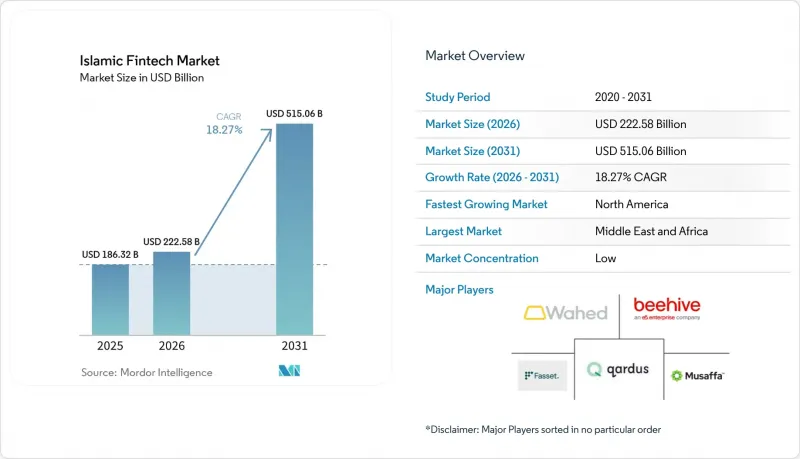
Mordor Intelligence에 의하면, 이슬람의 핀테크 시장 규모는 2025년에 1,863억 2,000만 달러로 평가되었고, 2026년에 2,225억 8,000만 달러로 추정되고, 2031년까지 5,150억 6,000만 달러에 이를 것으로 예측되며, 2026-2031년 CAGR 18.27%로 성장할 전망입니다.
본 보고서는 서비스 유형별(디지털 결제, 지갑 및 송금, 디지털 금융 및 대출 등), 배포 방식별(클라우드, 온프레미스, 하이브리드), 최종 사용자별(개인, 중소기업 등), 지역별(북미, 남미 등)로 분류되어 있습니다. 시장 전망은 금액(달러)으로 표시되어 있습니다.
세계의 이슬람 핀테크 시장 동향 및 인사이트
샤리아(Sharia) 준수 디지털 금융 서비스에 대한 수요 증가
이슬람 핀테크 시장 수요는 단기적인 자금 조달 주기보다는 장기적인 인구 동향 및 행동 양식의 변화와 밀접하게 관련되어 있습니다. 전 세계 무슬림 인구는 18억 명을 넘어섰으며, 그 대부분은 모바일 우선 은행 서비스를 당연한 것으로 여기는 젊은 연령층으로 구성되어 있습니다. 또한 투명성, 자산 담보, 위험 분담과 같은 이슬람 금융의 원칙은 감독 체계에서 인정되는 보다 광범위한 윤리적 금융 지향과 일치하기 때문에 대상 고객층은 신앙에 기반한 수요에만 국한되지 않습니다. 인도네시아에서는 인도네시아 중앙은행이 2030년까지 성인 금융 포용률을 90%로 끌어올리겠다는 목표와 샤리아 준수 상품의 보급을 연계하고 있어, 소비자 수요가 정책에 힘입어 상당한 규모로 확대될 수 있음을 시사하고 있습니다. 이러한 정책적 지원에 힘입어 이슬람 핀테크 시장은 틈새 시장의 위치에서 벗어나, 무슬림이 다수를 차지하는 주요 경제권 내 디지털 금융 유통에서 더욱 중심적인 역할을 수행해 나가고 있습니다.
결제, 자산 운용, 자금 조달 분야에서 할랄 경제의 확대
이슬람 핀테크 시장은 결제, 대출, 자산 배분과 같은 분야에서 할랄 경제가 광범위하게 확대되는 것에서도 혜택을 받고 있습니다. 여기서 중요한 점은 거래량 증가뿐만 아니라, 샤리아에 부합하는 결제 시스템이 동일한 고객 경험 속에서 대출이나 투자 상품으로 직접 연결되게 되었습니다는 사실입니다. 『QFC 세계 이슬람 핀테크 보고서 2025/26』은 이러한 기회의 확대를 지적하며, 기업들이 단일 기능의 앱으로 운영하기보다는 보다 광범위한 제품 생태계를 구축하는 경향이 강해지고 있음을 보여줍니다. 이러한 경향은 자산 운용 분야에서 특히 두드러지며, 디지털 채널을 통해 그동안 충분한 서비스를 받지 못했던 고객층에게도 샤리아 준수 투자 기회가 제공되고 있습니다. 2026년 4월, Wahed Invest는 미국의 비공인 개인 투자자를 대상으로 완전히 샤리아를 준수하는 단독주택 부동산 펀드를 출시했습니다. 이는 할랄 경제가 디아스포라 시장에서도 일반 투자자가 이용할 수 있는 자산 운용 상품으로 확대되고 있음을 보여줍니다.
관할 구역별로 분열된 샤리아 해석
샤리아 해석이 관할 구역별로 분열되어 있는 것은 이슬람 핀테크 시장 규모 확대에 있어 여전히 가장 심각한 구조적 제약 중 하나입니다. 한 관할 구역에서 승인된 상품 구조도 다른 관할 구역에서는 전면적인 재평가가 필요한 경우가 많아, 이로 인해 여러 시장에서 라이선스 취득을 목표로 하는 기업의 국경을 초월한 사업 확장이 저해되고 있습니다. IFSB-31은 감독의 일관성을 높이기 위한 현행 자료 중 가장 체계적인 노력으로, 규제 당국과 금융 기관을 위해 보다 명확한 거버넌스 체계를 구축하고 있습니다. 하지만 이 기준이 모든 국가의 제도에서 구속력을 갖는 것은 아니기 때문에 피크후(이슬람 법학)의 해석이나 현지 규제 실무상의 차이는 당분간 실무상의 장벽으로 남아 있을 것입니다. 따라서 한 번에 단일 승인 경로에 의존하기보다는 여러 국가의 프레임워크에 부합할 수 있을 만큼 유연한 거버넌스 아키텍처를 구축할 수 있는 플랫폼은 지속적인 우위를 점하게 될 것입니다.
부문 분석
2025년에는 디지털 결제, 지갑, 송금이 수익의 54.8%를 차지했으며, 이 카테고리는 이슬람 핀테크 시장의 중심적인 위치를 계속 차지하고 있습니다. 이는 거래 인프라가 상업적 규모에 도달하고 규제 당국의 승인을 받은 최초의 분야였기 때문입니다. 이슬람 핀테크 시장은 여전히 사용자 확보 측면에서 이 부문에 의존하고 있습니다. 결제 활동이야말로 향후 대출, 투자 및 기타 서비스를 뒷받침할 수 있는 최초의 규정 준수 관계를 형성하기 때문입니다. RegTech, 샤리아 거버넌스 및 규정 준수 도구는 2031년까지 연평균 성장률(CAGR) 24.6%로 확대될 것으로 예상되며, 이에 따라 이 분야는 이슬람 핀테크 시장에서 가장 빠르게 성장하는 서비스 부문이 될 것입니다. 이러한 성장은 컴플라이언스 이행 방식의 변화를 반영한 것으로, 임시방편적이고 수작업이 많은 심사 프로세스 대신 반복적인 소프트웨어 로직이 도입되고 있습니다. 감독 프레임워크에 따라 금융 기관들이 컴플라이언스 시스템을 일회성 자문 비용이 아닌 지속적인 운영 인프라로 예산에 반영해야 할 더 강력한 근거가 주어짐에 따라, 이러한 변화는 더욱 심화될 것으로 보입니다.
RegTech는 수익 부문으로서 중요할 뿐만 아니라, 샤리아에 기반한 승인, 보고 또는 감사 워크플로우에 의존하는 다른 모든 서비스 라인의 경제성을 향상시킨다는 점에서도 중요합니다. 이러한 효과는 디지털 기술을 활용한 발행 및 거버넌스 도구를 통해 프로세스 주기를 단축하고 참여 범위를 확대할 수 있는 이슬람 자본 시장에서 특히 두드러집니다. 2026년 4월, 카자나 나시오날과 말레이시아 증권위원회는 와카라 비 알 이스티스마르에 따라 말레이시아 최초의 토큰화된 수쿠크를 1억 말레이시아 링깃(2,500만 달러)에 가격을 책정했습니다. 메이뱅크가 공동 주간사, 수탁자 및 주요 가입자 역할을 맡았습니다. 이 거래가 중요한 이유는 디지털 인프라가 실용적인 규모에서 정부 보증이 적용된 이슬람 자본 시장 상품을 뒷받침할 수 있음을 보여주기 때문입니다. 또한 이는 더 광범위한 시장 동향과도 부합합니다. 2024년 전 세계 수쿠크 발행액이 2,050억 달러에 달했고, 2025년 3분기에는 수쿠크 잔액이 1조 달러를 돌파한 것으로 나타나, 향후 디지털 네이티브 자본 시장 활동을 위한 상당한 기반이 마련되었음을 뒷받침하고 있습니다.
지역별 분석
2025년 수익 중 중동 및 아프리카가 51.6%를 차지했으며, 이슬람 핀테크 시장에서 가장 큰 기여를 한 지역이 되었습니다. 이는 단기적인 자금 조달 주기가 아닌 구조적인 강점을 반영한 것입니다. 이 지역은 오랜 기간에 걸쳐 정비되어 온 이슬람 금융 규제, 금융 포용 노력, 그리고 샤리아 준수를 기반으로 한 디지털 금융을 뒷받침하는 ‘인내심 있는 자본’의 혜택을 누리고 있습니다. 사우디아라비아 및 GCC 국가들은 이미 기초 도입 단계를 넘어, 현재는 샤리아 준수를 기반으로 한 디지털 뱅킹, 대출, 자본 시장을 향한, 타 지역으로 확장 가능한 모델 구축을 추진하고 있습니다. 이와 유사한 지역적 강점은 거버넌스 및 인프라 구축의 우선순위에서도 뚜렷이 드러나며, 규제 당국과 금융 기관은 보다 엄격한 컴플라이언스 관리를 유지하면서도 폭넓은 상품 출시를 지원할 수 있는 솔루션을 뒷받침하고 있습니다. 이것이 다른 지역에서 성장 기회가 확대되고 있음에도 불구하고, 이슬람 핀테크 시장이 여전히 MEA에 뿌리를 두고 있는 이유를 설명해 줍니다.
아시아태평양은 대규모 무슬림 인구, 견고한 자본 시장 인프라, 그리고 적극적인 정책 방향성에서 비롯된 규모라는 점에서 다른 성장 패턴을 보이고 있습니다. 말레이시아는 여전히 그 중심에 자리 잡고 있습니다. 이 나라의 이슬람 자본 시장 규모는 2조 7,000억 링깃(6,600억 달러)으로 평가되며, 이는 말레이시아 전체 자본 시장의 64%를 차지하고 있으며, 또한 ICD-LSEG 이슬람 금융 개발 지표에서 13년 연속 1위를 차지하고 있기 때문입니다. 또한 말레이시아는 이슬람 핀테크 시장을 더욱 고도화된 디지털화로 추진하고 있습니다. '자본 시장 마스터플랜 2026-2031'에서는 AI를 활용한 디지털 샤리아 심사의 도입과, 시장 개발에서 '마카시드 알 샤리아(샤리아의 목적)'에 대한 더욱 강력한 중시가 요구되고 있기 때문입니다. 2026년 4월에는 말레이시아 최초의 토큰화 수쿠크 시범 사업이 실시되어, 디지털 기술을 활용한 이슬람 자본 시장에서의 발행을 위한 실용적인 모델이 확립되었습니다. 또한 인도네시아도 여전히 중요한 시장으로 남아 있습니다. 인도네시아의 포용 전략에 따라 샤리아 준수 금융이 국민 전체에 대한 접근성 확대에 있어 직접적인 정책적 역할을 담당하고 있기 때문입니다.
북미는 2031년까지 연평균 성장률(CAGR) 22.5%를 나타낼 것으로 예측되며, 이슬람 핀테크 시장에서 가장 빠르게 성장하는 지역 부문이 될 전망입니다. 이러한 성장은 현지에서 인가받은 샤리아 준수 디지털 금융 상품이 제한적이었던 디아스포라 시장의 미충족 수요를 반영한 것입니다. 2026년 4월, 와헤드(Wahid)사는 미국에서 일반 투자자를 대상으로 한 샤리아 준수 주택 부동산 펀드를 출시했습니다. 이는 이슬람계 자산 운용 상품이 부유층을 대상으로 한 틀을 넘어, 보다 폭넓은 일반 투자자층으로 확대되고 있음을 보여줍니다. 유럽은 특히 영국을 중심으로 확립된 이슬람 금융 기반을 바탕으로 성장을 이어가고 있습니다. 한편, 남미는 여전히 규모는 작지만 할랄 경제와의 연계 및 디아스포라(해외 거주 동포) 수요가 확대되는 가운데, 장기적인 시장 진입의 길을 열어주고 있습니다.
기타 혜택 :
- 엑셀 형식 시장 예측(ME) 시트
- 3개월간의 애널리스트 지원
자주 묻는 질문
목차
제1장 서론
제2장 조사 방법
제3장 주요 요약
제4장 시장 구도
제5장 시장 규모 및 성장 예측
제6장 경쟁 구도
제7장 시장 기회 및 향후 전망
AJY 26.08.07According to Mordor Intelligence, the islamic fintech market size is projected to be USD 186.32 billion in 2025, USD 222.58 billion in 2026, and reach USD 515.06 billion by 2031, growing at a CAGR of 18.27% from 2026 to 2031.
This report is Segmented by Service Type (Digital Payments, Wallets & Remittances, Digital Financing & Lending, and More), by Deployment (Cloud, On-Premise, Hybrid), by End-User (Individuals, Small and Medium Enterprises, and More), and by Geography (North America, South America, and More). The Market Forecasts are Provided in Terms of Value (USD).
Global Islamic Fintech Market Trends and Insights
Rising Demand for Shariah-Compliant Digital Financial Services
Demand in the Islamic fintech market is tied to long-term demographic and behavioral shifts rather than to short-term funding cycles. The global Muslim population exceeded 1.8 billion, and a large share of that population sits in younger age groups that treat mobile-first banking as a standard expectation. The addressable base also extends beyond faith-based demand because Islamic finance principles such as transparency, asset backing, and risk sharing overlap with broader ethical finance preferences recognized in supervisory frameworks. Indonesia shows how consumer demand can move into policy-backed volume, as Bank Indonesia links Shariah-compliant product penetration to a 90% adult financial inclusion target by 2030. That policy support is helping the Islamic fintech market move from a niche position to a more central role in digital financial distribution across major Muslim-majority economies.
Halal Economy Expansion Across Payments, Wealth, and Financing
The Islamic fintech market is also benefiting from the wider expansion of the halal economy across payments, financing, and asset allocation. What matters here is not only higher transaction volume, but also the fact that compliant payment relationships can now feed directly into financing and investment products inside the same customer journey. The QFC Global Islamic Fintech Report 2025/26 points to this broadening opportunity set and shows that firms are increasingly building broader product ecosystems rather than operating as single-function apps. That pattern is especially relevant in wealth management, where digital channels are opening Shariah-compliant investing to customer groups that were historically underserved. In April 2026, Wahed Invest launched a fully Shariah-compliant single-family residential real estate fund for non-accredited retail investors in the United States, showing that the halal economy is expanding into retail-accessible wealth products in diaspora markets as well.
Fragmented Shariah Interpretation Across Jurisdictions
Fragmented Shariah interpretation remains one of the deepest structural limits on scale in the Islamic fintech market. Product structures approved in one jurisdiction often require a full re-evaluation in another, which slows cross-border expansion for firms seeking multi-market licenses. IFSB-31 is the most systematic effort in the current material to improve supervisory consistency, and it creates a clearer governance framework for regulators and institutions. Still, the standard is not binding across all national systems, so differences in fiqh interpretation and local regulatory practice will remain a practical barrier in the near term. That leaves a durable advantage for platforms that can build governance architectures flexible enough to align with multiple national frameworks, rather than relying on a single approval path at a time.
Other drivers and restraints analyzed in the detailed report include:
- Rapid Digitization of Islamic Banking and Fintech Delivery
- Venture Funding and Ecosystem Support for Islamic Fintech Startups
- High Compliance and Shariah Governance Costs for Early-Stage Firms
For complete list of drivers and restraints, kindly check the Table Of Contents.
Segment Analysis
Digital payments, wallets, and remittances accounted for 54.8% of revenue in 2025, keeping this category at the center of the Islamic fintech market, as transaction infrastructure was the first area to reach commercial scale and regulatory acceptance. The Islamic fintech market still depends on this layer for user acquisition, because payment activity creates the first compliant relationship that can later support financing, investment, and other services. RegTech, Shariah governance, and compliance tools are projected to expand at a 24.6% CAGR through 2031, which makes this the fastest-growing service category in the Islamic fintech market. That growth reflects a change in how compliance is delivered, with recurring software logic replacing more ad hoc and manually intensive review processes. The shift is likely to deepen as supervisory frameworks give institutions a stronger reason to budget for compliance systems as ongoing operating infrastructure rather than occasional advisory spend.
RegTech is important not only as a revenue segment, but also because it improves the economics of every other service line that depends on Shariah approval, reporting, or audit workflows. The effect is especially visible in Islamic capital markets, where digitally enabled issuance and governance tools can shorten process cycles and widen participation. In April 2026, Khazanah Nasional and the Securities Commission Malaysia priced Malaysia's first tokenized sukuk at MYR 100 million (USD 25 million) under Wakalah bi al-Istithmar, with Maybank acting as joint lead manager, custodian, and primary subscriber. That transaction matters because it shows that digital infrastructure can support sovereign-backed Islamic capital market instruments at a practical scale. It also aligns with the broader market backdrop, where global sukuk issuance reached USD 205 billion in 2024, and outstanding sukuk crossed USD 1 trillion in Q3 2025, confirming a sizable base for future digitally native capital market activity.
Complete Report Scope:
- By Service Type
- Digital Payments, Wallets & Remittances
- Digital Financing & Lending
- Sukuk & Islamic Capital Markets
- Takaful & Islamic InsurTech
- Wealth Management, Robo-Advisory & Digital Investment
- RegTech, Shariah Governance & Compliance
- Others (Alternative Finance, Crowdfunding, etc.)
- By Deployment
- Cloud
- On-Premise
- Hybrid
- By End-User
- Individuals
- Small and Medium Enterprises
- Large Corporates & Institutional Investors
- Government, Public Sector & Development Institutions
- By Geography
- North America
- United States
- Canada
- South America
- Brazil
- Rest of South America
- Europe
- Germany
- United Kingdom
- France
- Russia
- Rest of Europe
- Asia-Pacific
- China
- India
- Indonesia
- Malaysia
- Japan
- Rest of Asia-Pacific
- Middle East and Africa
- Saudi Arabia
- United Arab Emirates
- Qatar
- Bahrain
- Turkey
- South Africa
- Rest of Middle East and Africa
- North America
Geography Analysis
The Middle East and Africa accounted for 51.6% of revenue in 2025, making it the largest regional contributor to the Islamic fintech market and reflecting structural strengths rather than a short-term funding cycle. The region benefits from long-developed Islamic finance regulation, financial inclusion mandates, and patient capital that supports Shariah-compliant digital finance. Saudi Arabia and the wider GCC have moved beyond basic adoption and are now shaping exportable models for compliant digital banking, lending, and capital markets. The same regional strength is evident in governance and infrastructure priorities, where regulators and institutions are backing solutions that can support wider product distribution while maintaining tighter compliance controls. This explains why the Islamic fintech market remains anchored in MEA even as growth opportunities broaden elsewhere.
Asia-Pacific offers a different growth profile, with scale coming from large Muslim populations, strong capital market infrastructure, and active policy direction. Malaysia remains central to that picture because its Islamic Capital Market was valued at MYR 2.7 trillion (USD 0.66 trillion), representing 64% of the country's total capital market, and the country also ranked first on the ICD-LSEG Islamic Finance Development Indicator for 13 consecutive years. Malaysia is also pushing the Islamic fintech market toward more advanced forms of digitalization, as its Capital Market Masterplan 2026-2031 calls for AI-powered digital Shariah screening and a stronger Maqasid al-Shariah orientation in market development. In April 2026, the country's first tokenized sukuk pilot added a practical template for digitally enabled Islamic capital market issuance. Indonesia also remains important because its inclusion strategy gives Shariah-compliant finance a direct policy role in expanding access across the population.
North America is projected to grow at a 22.5% CAGR through 2031, making it the fastest-growing regional segment in the Islamic fintech market. That growth reflects unmet demand in diaspora markets where locally licensed Shariah-compliant digital options have been limited. Wahed's April 2026 launch of a retail-accessible Shariah-compliant residential real estate fund in the United States showed how Islamic wealth products are moving beyond high-net-worth positioning into wider retail access. Europe continues to grow from its established Islamic finance base, especially in the United Kingdom. At the same time, South America remains small but offers a longer-term entry path where halal economy links and diaspora demand expand.
- Wahed Invest Limited
- Fasset
- Qardus
- Beehive P2P Limited
- Musaffa
- NymCaro
- Raqamyah
- Codebase Technologies
- PayHalal
- ShariaPortfolio
- Tabby
- PayTabs
- Sarwa
- CoinMENA
- Rain
- Ruya Bank
- SmartCrowd
- Haball
- Mal
- NymCard
Additional Benefits:
- The market estimate (ME) sheet in Excel format
- 3 months of analyst support
TABLE OF CONTENTS
1 INTRODUCTION
- 1.1 Study Assumptions and Market Definition
- 1.2 Scope of the Study
2 RESEARCH METHODOLOGY
3 EXECUTIVE SUMMARY
4 MARKET LANDSCAPE
- 4.1 Market Overview
- 4.2 Market Drivers
- 4.2.1 Rising Demand for Shariah-Compliant Digital Financial Services
- 4.2.2 Halal Economy Expansion Across Payments, Wealth, and Financing
- 4.2.3 Rapid Digitization of Islamic Banking and Fintech Delivery
- 4.2.4 Venture Funding and Ecosystem Support for Islamic Fintech Startups
- 4.2.5 Embedded Finance and API-Based Shariah-Compliant Product Distribution
- 4.2.6 Zakat Digitization and Waqf Modernization Creating New Transaction Flows
- 4.3 Market Restraints
- 4.3.1 Fragmented Shariah Interpretation Across Jurisdictions
- 4.3.2 Limited Consumer Trust in New-Format Islamic Financial Products
- 4.3.3 High Compliance and Shariah Governance Costs for Early-Stage Firms
- 4.3.4 Cross-Border Licensing and Data Localization Friction
- 4.4 Value Chain Analysis
- 4.5 Regulatory Landscape
- 4.6 Technological Outlook
- 4.7 Porter's Five Forces Analysis
- 4.7.1 Bargaining Power of Suppliers
- 4.7.2 Bargaining Power of Buyers
- 4.7.3 Threat of New Entrants
- 4.7.4 Threat of Substitutes
- 4.7.5 Competitive Rivalry
5 MARKET SIZE AND GROWTH FORECASTS
- 5.1 By Service Type
- 5.1.1 Digital Payments, Wallets & Remittances
- 5.1.2 Digital Financing & Lending
- 5.1.3 Sukuk & Islamic Capital Markets
- 5.1.4 Takaful & Islamic InsurTech
- 5.1.5 Wealth Management, Robo-Advisory & Digital Investment
- 5.1.6 RegTech, Shariah Governance & Compliance
- 5.1.7 Others (Alternative Finance, Crowdfunding, etc.)
- 5.2 By Deployment
- 5.2.1 Cloud
- 5.2.2 On-Premise
- 5.2.3 Hybrid
- 5.3 By End-User
- 5.3.1 Individuals
- 5.3.2 Small and Medium Enterprises
- 5.3.3 Large Corporates & Institutional Investors
- 5.3.4 Government, Public Sector & Development Institutions
- 5.4 By Geography
- 5.4.1 North America
- 5.4.1.1 United States
- 5.4.1.2 Canada
- 5.4.2 South America
- 5.4.2.1 Brazil
- 5.4.2.2 Rest of South America
- 5.4.3 Europe
- 5.4.3.1 Germany
- 5.4.3.2 United Kingdom
- 5.4.3.3 France
- 5.4.3.4 Russia
- 5.4.3.5 Rest of Europe
- 5.4.4 Asia-Pacific
- 5.4.4.1 China
- 5.4.4.2 India
- 5.4.4.3 Indonesia
- 5.4.4.4 Malaysia
- 5.4.4.5 Japan
- 5.4.4.6 Rest of Asia-Pacific
- 5.4.5 Middle East and Africa
- 5.4.5.1 Saudi Arabia
- 5.4.5.2 United Arab Emirates
- 5.4.5.3 Qatar
- 5.4.5.4 Bahrain
- 5.4.5.5 Turkey
- 5.4.5.6 South Africa
- 5.4.5.7 Rest of Middle East and Africa
- 5.4.1 North America
6 COMPETITIVE LANDSCAPE
- 6.1 Market Concentration
- 6.2 Strategic Moves
- 6.3 Market Share Analysis
- 6.4 Company Profiles (includes Global Level Overview, Market Level Overview, Core Segments, Financials as available, Strategic Information, Market Rank/Share, Products and Services, Recent Developments)
- 6.4.1 Wahed Invest Limited
- 6.4.2 Fasset
- 6.4.3 Qardus
- 6.4.4 Beehive P2P Limited
- 6.4.5 Musaffa
- 6.4.6 NymCaro
- 6.4.7 Raqamyah
- 6.4.8 Codebase Technologies
- 6.4.9 PayHalal
- 6.4.10 ShariaPortfolio
- 6.4.11 Tabby
- 6.4.12 PayTabs
- 6.4.13 Sarwa
- 6.4.14 CoinMENA
- 6.4.15 Rain
- 6.4.16 Ruya Bank
- 6.4.17 SmartCrowd
- 6.4.18 Haball
- 6.4.19 Mal
- 6.4.20 NymCard
7 MARKET OPPORTUNITIES AND FUTURE OUTLOOK
- 7.1 White-Space and Unmet-Need Assessment


