

|
시장보고서
상품코드
2099074
자동차 핀테크 시장 : 점유율 분석, 업계 동향 및 통계, 성장 예측(2026-2031년)Automotive Fintech - Market Share Analysis, Industry Trends & Statistics, Growth Forecasts (2026 - 2031) |
||||||
 Mordor Intelligence
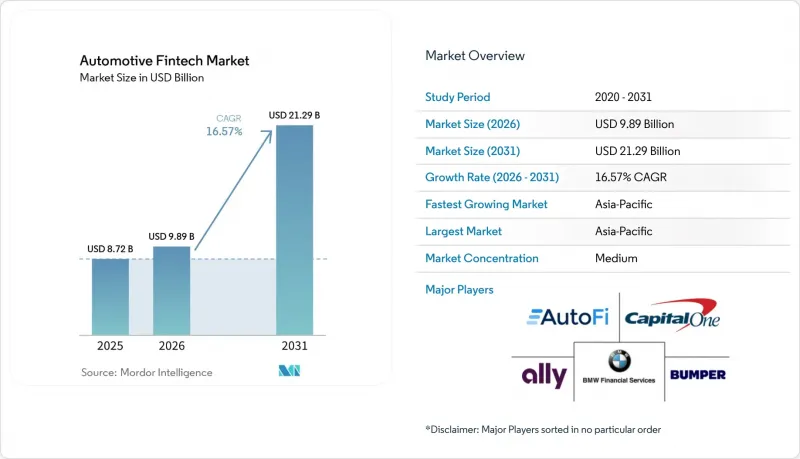
Mordor Intelligence에 의하면, 자동차 핀테크 시장 규모는 2025년에 87억 2,000만 달러로 평가되었고 2026년 98억 9,000만 달러에서 2031년까지 212억 9,000만 달러에 이를 것으로 예측되며, 예측 기간(2026-2031년) CAGR은 16.57%를 나타낼 전망입니다.
본 보고서는 용도별(결제, 신용·대출, 기타), 차종별(승용차, 상용차, 기타), 비즈니스 모델별(Banking-As-A-Service, 핀테크 제휴, 기타), 최종 사용자별(일반 소비자, 자동차 제조업체, 기타), 지역별(북미, 남미, 기타)로 분류되어 있습니다. 시장 예측은 금액(달러) 기준으로 제시되어 있습니다.
세계 자동차 핀테크 시장 동향 및 인사이트
내장형 자동차 금융에 대한 수요 증가
자동차 핀테크 시장에서는 금융 서비스가 딜러에서의 독립적인 단계에서 더 광범위한 디지털 차량 구매 프로세스로 전환되고 있습니다. 사전 승인된 제안이 OEM의 구성 도구, 딜러의 모바일 앱, 커넥티드 모빌리티 인터페이스 내에 통합되는 사례가 증가하고 있으며, 이로 인해 초기 신용 승인 결정이 이루어지는 장소가 변화하고 있습니다. 이것이 중요한 이유는 고객이 기존 금융 부서가 주된 영향력을 행사하기 전인 구매 프로세스의 초기 단계에서 조건을 확인할 수 있게 되었기 때문입니다. 이러한 변화로 인해 여전히 딜러 주도의 대출 확보에 의존하고 있는 대출 기관의 가격 결정력은 약화되고, 구매 의향의 첫 징후가 나타난 시점에서 소비자에게 접근할 수 있는 플랫폼이 우위를 점하고 있습니다. 따라서 자동차 핀테크 시장에서는 단순히 대출 잔액을 관리하는 기업이 아닌, 디지털 접점을 장악하는 기업으로 유통 가치가 이동하고 있습니다.
디지털 딜러 및 OEM 금융 생태계의 확대
자동차 핀테크 시장은 딜러 및 브랜드 플랫폼을 중심으로, 보다 광범위한 디지털 금융 생태계를 구축하고 있는 OEM 및 은행으로부터 지지를 얻고 있습니다. 폭스바겐 그룹 모빌리티는 2025년에 금융, 리스, 서비스, 보험 분야의 신규 계약을 1,150만 건 체결했으며, 그 침투율은 2024년 34.1%에서 37.2%로 상승했습니다. 이는 디지털 금융의 통합이 소유 주기 전반에 걸쳐 전환율을 끌어올리고 있음을 보여줍니다. 혼다와 크레디 아그리콜 퍼스널 파이낸스 & 모빌리티는 2026년 2월, 화이트 라벨 방식의 ‘혼다 파이낸셜 서비스’ 모델을 기반으로 8개국을 아우르는 범유럽 금융 제휴를 발표했습니다. 이는 전용 금융 자회사를 보유하지 않은 OEM이라도 여러 시장에서 내장형 금융 서비스를 확대할 수 있음을 보여줍니다. 이러한 제휴를 통해 브랜드는 각 채널에 걸쳐 신용, 리스, 서비스, 보험 제공 내용을 표준화하는 능력을 향상시킬 수 있습니다. 따라서 자동차 핀테크 시장은 점점 더 플랫폼 주도형으로 전환되고 있으며, 지점이나 딜러의 거점 수 자체보다 데이터 소유권이나 인터페이스 관리가 전략적으로 더 중요한 위치를 차지하게 되었습니다.
대출, 보험, 결제에 걸친 규제의 복잡성
자동차 핀테크 시장은 대출, 보험, 결제 각 분야에 걸쳐 점점 더 세분화되고 있는 규제 부담에 직면해 있습니다. 미국에서는 CFPB(소비자금융보호국)가 2025년 8월, 자동차 금융 분야의 ‘대규모 사업자’ 기준을 연간 총 대출 실행 건수 105만 건으로 상향 조정할 것을 제안했습니다. 이로 인해 많은 제공업체의 경우 연방 정부의 감독 범위가 재정의될 가능성이 있습니다. 동시에 주 차원의 공시 요건 및 대출 요건의 통일성이 점차 상실되고 있어, 대출 기관, 딜러 및 내장형 플랫폼을 위한 단일한 전국적 규정 준수 모델을 구축하는 데 드는 비용이 증가하고 있습니다. 유럽에서도 PSD3 및 PSR 프레임워크를 통해 결제 규제가 강화되고 있으며, 규제가 시행됨에 따라 자동차 업계의 결제 계층에는 더욱 강력한 인증, API 성능 및 관리 기준이 요구될 것입니다. 따라서 자동차 핀테크 시장에서는 중규모 플랫폼보다 법적·운영적·감사 비용을 더 쉽게 흡수할 수 있는 대규모 금융 기관이 우위를 점하고 있습니다.
부문 분석
2025년, 자동차 핀테크 시장에서 ‘신용 및 대출’이 57.6%를 차지하며 가장 큰 응용 분야가 되었습니다. 이러한 선두 위상은 자동차 금융 거래의 높은 가치와 선진국 및 신흥 시장을 불문하고 차량 구매에서 대출이 수행하는 핵심적인 역할을 반영합니다. 또한, 신용 상품은 이미 딜러의 판매 프로세스, OEM 프로그램 및 소비자의 구매 결정에 밀접하게 연관되어 있기 때문에 핀테크 통합을 위한 가장 접근하기 쉬운 출발점으로 계속 자리 잡고 있습니다. AI를 활용한 신용 심사를 통해 대출 기관은 니어프라임 계층이나 신용 이력이 부족한 차주 계층에 대한 접근성을 확대하고 있으며, 이에 따라 오프라인 지점망을 확장하지 않고도 대출 실행 건수 증가에 기여하고 있습니다. 자동차 핀테크 시장은 여전히 대출이 최대 거래량을 차지하며, 보험 및 서비스 상품의 교차 판매로 이어지는 가장 명확한 경로를 제공하기 때문에 계속해서 신용을 주요 수익원으로 의존하고 있습니다.
결제는 가장 빠르게 성장하는 분야로, 2026년부터 2031년까지 연평균 성장률(CAGR) 21.1%가 예상됩니다. 이는 자동차 핀테크 시장의 다음 단계가 금융을 넘어 거래 인프라로 전환되고 있음을 보여줍니다. Element Fleet Management는 2025년 12월, 차량 주도형으로 카드 없이 결제가 가능한 대규모 플랫폼을 구축하기 위해 Car IQ를 인수한다고 발표했습니다. 이후 Element는 2026년 1분기에 전년 동기 대비 17% 증가한 3억 2,400만 달러의 사상 최대 매출을 기록했습니다. 이러한 방향성이 중요한 이유는 오픈 루프 방식, 토큰화, 그리고 차량 내 결제 기능을 통해 연료, 충전, 통행료, 주차료, 정비 비용을 동일한 거래 계층으로 통합할 수 있기 때문입니다. 보험은 여전히 3위 응용 분야이며, 제공업체들이 보험을 광범위한 모빌리티 금융 서비스에 통합함에 따라 신용 및 결제와의 연계가 더욱 강화되고 있습니다. 따라서 자동차 핀테크 업계는 단일 상품 제공에서 벗어나, 대출, 보험, 결제가 하나의 소유 경험 안에서 서로 보완하는 연계된 금융 스택으로 전환되고 있습니다.
2025년, 승용차는 자동차 핀테크 시장의 68.3%를 차지하며, 금융, 보험, 차량 내 결제 등 각 분야에서 거래량을 주도하고 있습니다. 이러한 위상은 개인용 자동차 대출 수요 규모와 소비자 채널에서의 디지털 판매, 사전 심사, 보험 번들링이 널리 확산되고 있음을 반영합니다. 또한 승용차는 OEM 주도 금융에 있어 여전히 가장 중요한 기반으로 남아 있습니다. 이는 이 부문에서 브랜드 계열 금융사, 딜러 네트워크, 커넥티드카 서비스가 이미 충분히 구축되어 있기 때문입니다. 시장 점유율 선두가 제품 혁신이 이곳에만 집중되어 있음을 의미하는 것은 아니지만, 오늘날에도 가장 큰 수익원이 어디에 있는지를 보여줍니다. 자동차 핀테크 시장은 더 광범위한 플랫폼 확장의 경제성을 뒷받침하기 위해 계속해서 승용차 금융 거래량에 의존하고 있습니다.
상용차는 2026년부터 2031년까지 연평균 성장률(CAGR) 19.4%를 나타낼 것으로 예측되며, 자동차 핀테크 시장의 다음 제품 주기의 중심에 자리 잡고 있습니다. 플릿 자산은 이용 현황, 주행 경로, 안전성, 가동 중단 시간에 관한 더 풍부한 데이터 스트림을 생성하며, 이를 통해 대출 기관과 보험사는 동적 가격 책정 및 상환 모델을 구축하기 위한 더 나은 정보를 얻을 수 있습니다. Roadzen사의 ‘DrivebuddyAI’는 2024년 12월에 AIS184 인증을 획득했으며, 2026년 4월부터 인도에서 의무화될 상용차 안전 시스템에 따라 플릿용 금융 상품을 활용할 수 있는 데이터 환경이 확대되고 있습니다. 이륜차 시장은 금액 기준으로는 여전히 소규모이지만, 전기차 금융, 딜러 주도 판매, 소액 대출 구조가 중요한 신흥 시장에서 활발한 상품 개발이 이어지고 있습니다. 따라서 자동차 핀테크 업계에서는 승용차가 여전히 최대의 수익원이지만, 상용 차량 플릿이 텔레매틱스 연동형 신용 심사 속도를 주도해 나갈 것으로 보입니다.
지역별 분석
2025년, 북미는 자동차 핀테크 시장에서 큰 점유율을 차지했습니다. 이는 탄탄한 자동차 신용 인프라, 강력한 디지털 대출 실무, 그리고 성숙한 딜러용 소프트웨어 생태계에 힘입은 결과입니다. 앨리 파이낸셜(Ally Financial)의 보고서에 따르면, 2025년 2분기 자동차 대출 취급액은 전년 동기 대비 12.2% 증가한 110억 달러에 달했으며, 2025년 연간 보험 인수 보험료는 15억 달러로, 이 회사의 상장 이후 연간 최고치를 기록했습니다. 캐피탈 원(Capital One)도 2026년 ‘챗 컨시어지’를 도입해 디지털 프론트엔드를 확충했습니다. 이를 통해 비교, 예약, 대출 사전 심사가 딜러 웹사이트에서 일원화되어 이루어질 수 있게 되었습니다. 캐나다와 멕시코는 특히 국경을 넘는 사업에 의존하는 차량 및 물류 결제 이용 사례에서 지역적 깊이를 더하고 있습니다. 규정 준수 의무가 강화되고 있음에도 불구하고, 규모, 데이터 접근성, 고객 수용도가 높기 때문에 북미 자동차 핀테크 시장은 여전히 매력적인 시장으로 남아 있습니다.
아시아태평양은 2025년에 자동차 핀테크 시장 점유율의 37.5%를 차지하고, 2031년까지 연평균 성장률(CAGR) 18.9%를 기록하며 가장 빠르게 성장하는 지역 시장이 될 전망입니다. 중국은 대규모 디지털 대출 및 플랫폼 금융 기반을 갖추고 있어 여전히 중요한 위치를 차지하고 있는 반면, 인도는 전기차(EV) 대출, 비은행 금융회사(NBFC)의 활동, 그리고 대도시권 외 지역으로의 침투 확대를 통해 성장을 가속화하고 있습니다. AMU는 2024-2025 회계연도 및 2025-2026 회계연도에 평균 60%의 매출 성장과 운용자산(AUM) 45% 증가를 보고했으며, 이는 전기차(EV) 금융에 대한 수요가 인도의 주요 도시를 넘어 확산되고 있음을 보여줍니다. 한국, 일본, 호주에서는 디지털 리스 및 구독형 금융을 중심으로 한 전개가 계속되고 있는 반면, 아세안(ASEAN) 시장에서는 OEM과 은행의 연계 및 디지털 신용에 대한 접근성 확대를 통해 시장이 성숙해 가고 있습니다. 따라서 아시아태평양의 자동차 핀테크 시장은 각기 다른 출발점에서 확대되고 있지만, 모두 디지털 금융의 통합이 더욱 진전되는 방향으로 나아가고 있습니다.
유럽은 OEM 내장형 금융 및 플랫폼 주도형 서비스 통합에서 강력한 성장세를 보이는 확립된 자동차 핀테크 시장입니다. 폭스바겐 그룹 모빌리티는 2025년 침투율이 37.2%에 달하고 약 3,000만 건의 유효 계약을 보유하고 있다고 보고했는데, 이는 해당 지역 전체에서 이미 전개되고 있는 내장형 금융의 규모를 보여줍니다. 혼다가 2026년 2월 크레디 아그리콜 퍼스널 파이낸스 앤 모빌리티와 체결한 계약은 자체 전용 인프라를 보유하지 않은 자동차 제조업체(OEM)에게 금융 서비스 제공의 표준화에 도움이 되는 국경을 초월한 화이트 라벨 모델을 추가하는 것입니다. 남미에서는 특히 기존 은행 서비스의 보급 범위가 제한된 지역에서 비은행권 신용 및 디지털 결제 인프라에 대한 수요가 계속해서 나타나고 있습니다. 중동 및 아프리카에서는 BaaS 샌드박스 및 규제 대상 핀테크 인프라를 통해 중기적인 파이프라인을 구축하고 있으며, 자동차 금융 및 결제 영역이 더욱 심층적으로 현지화된다면 자동차 핀테크 시장은 추가적인 확장의 기반을 마련하게 될 것입니다.
기타 혜택:
- 엑셀 형식 시장 예측(ME) 시트
- 3개월간의 애널리스트 지원
자주 묻는 질문
목차
제1장 서론
제2장 조사 방법
제3장 주요 요약
제4장 시장 구도
제5장 시장 규모와 성장 예측
제6장 경쟁 구도
제7장 시장 기회와 향후 전망
JHS 26.08.05According to Mordor Intelligence, the automotive fintech market size was valued at USD 8.72 billion in 2025 and is estimated to grow from USD 9.89 billion in 2026 to reach USD 21.29 billion by 2031, at a CAGR of 16.57% during the forecast period (2026-2031).
This report is Segmented by Application (Payments, Credit and Lending, and More), by Vehicle Type (Passenger Cars, Commercial Vehicles, and More), by Business Model (Banking-As-A-Service, Fintech Partnerships, and More), by End-User (Retail Consumers, Automotive Manufacturers, and More), and by Geography (North America, South America, and More). The Market Forecasts are Provided in Terms of Value (USD).
Global Automotive Fintech Market Trends and Insights
Rising Demand for Embedded Vehicle Finance
The automotive fintech market is moving financing from a separate dealership step into the wider digital vehicle journey. Pre-approved offers are increasingly being placed inside OEM configurators, dealer mobile apps, and connected mobility interfaces, which changes where the first credit decision is made. This matters because the customer can now see terms earlier in the purchase path, before the traditional finance office becomes the main point of influence. That shift reduces pricing power for lenders that still depend on dealership-led origination and rewards platforms that can reach consumers at the first sign of purchase intent. The automotive fintech market is therefore seeing distribution value shift toward firms that control digital touchpoints rather than those that control only loan books.
Expansion of Digital Dealer and OEM Financing Ecosystems
The automotive fintech market is gaining support from OEMs and banks that are building wider digital financing ecosystems around dealership and brand platforms. Volkswagen Group Mobility signed 11.5 million new financing, leasing, service, and insurance contracts in 2025, and its penetration rate rose to 37.2% from 34.1% in 2024, showing that digital finance integration is boosting conversion across the ownership cycle. Honda and Credit Agricole Personal Finance & Mobility announced a pan-European financing partnership in February 2026 covering 8 countries under a white-label Honda Financial Services model, which shows how OEMs without a captive can still scale embedded finance across multiple markets. These arrangements improve brands' ability to standardize credit, leasing, service, and insurance offers across channels. The automotive fintech market is therefore becoming more platform-led, with data ownership and interface control carrying more strategic weight than branch or dealer presence alone.
Regulatory Complexity Across Lending, Insurance, and Payments
The automotive fintech market faces a regulatory burden that is becoming more fragmented across lending, insurance, and payments. In the United States, the CFPB proposed in August 2025 to raise the larger-participant threshold in automobile financing to as many as 1.05 million aggregate annual originations, which could reshape the federal supervision perimeter for many providers. At the same time, state-level disclosure and financing requirements are becoming less uniform, which increases the cost of building a single national compliance model for lenders, dealers, and embedded platforms. Europe is also moving toward tighter payment rules through the PSD3 and PSR framework, which means automotive payment layers will need stronger authentication, API performance, and control standards as rules are implemented. The automotive fintech market is, therefore, rewarding larger institutions that can more easily absorb legal, operational, and audit costs than mid-sized platforms.
Other drivers and restraints analyzed in the detailed report include:
- Growth of Usage-Based Insurance and Telematics-Priced Products
- AI-Led Credit Underwriting and Fraud Reduction
- Integration Friction with Legacy Dealer Management Systems
For complete list of drivers and restraints, kindly check the Table Of Contents.
Segment Analysis
Credit and Lending accounted for 57.6% of the Automotive fintech market in 2025, making it the largest application. This lead reflects the high value of auto financing transactions and the central role of loans in vehicle acquisition across both developed and emerging markets. Credit products also remain the easiest starting point for fintech integration because they already sit close to dealer sales processes, OEM programs, and consumer purchase decisions. AI-based underwriting is broadening lenders' reach into near-prime and thin-file borrower groups, helping raise origination volumes without requiring a matching increase in physical distribution. The automotive fintech market continues to rely on credit as its main revenue source because loans still account for the highest transaction volume and offer the clearest path to cross-selling insurance and service products.
Payments is the fastest-growing application, with a projected 21.1% CAGR from 2026 to 2031, which shows that the next phase of the automotive fintech market is moving beyond financing into transaction infrastructure. Element Fleet Management announced its acquisition of Car IQ in December 2025 to create a scaled platform for vehicle-initiated, card-free payments, and Element then reported record Q1 2026 revenue of USD 324 million, up 17% year on year. This direction matters because open-loop, tokenized, and vehicle-native payments can link fuel, charging, tolling, parking, and maintenance into the same transaction layer. Insurance remains the third-largest application and is becoming more tightly connected with credit and payments as providers bundle protection into broader mobility finance offers. The automotive fintech industry is therefore shifting from single-product delivery toward connected financial stacks where lending, insurance, and payments reinforce each other inside one ownership experience.
Passenger Cars accounted for 68.3% of the automotive fintech market in 2025, making them the volume driver across financing, insurance, and in-vehicle payments. This position reflects the scale of personal auto loan demand and the broad reach of digital sales, pre-qualification, and insurance bundling in consumer channels. Passenger cars also remain the most important base for OEM-led finance, as brand captives, dealer networks, and connected vehicle services are already well developed in this category. The share lead does not mean product innovation is concentrated only here, but it does show where the largest revenue pool still sits today. The automotive fintech market continues to depend on passenger car financing volumes to support the economics of broader platform expansion.
Commercial Vehicles are forecast to grow at a 19.4% CAGR from 2026 to 2031, positioning them at the center of the next product cycle in the automotive fintech market. Fleet assets generate richer streams of data on utilization, route behavior, safety, and downtime, which gives lenders and insurers better inputs for dynamic pricing and repayment models. Roadzen's DrivebuddyAI received certification under AIS184 in December 2024, and the April 2026 mandate for commercial vehicle safety systems in India is expanding the data environment that fleet finance products can use. Two-Wheelers remain smaller by value, but they continue to show strong product experimentation in emerging markets where EV financing, dealer-led distribution, and lower-ticket loan structures are important. The automotive fintech industry is therefore likely to see commercial fleets set the pace for telematics-linked underwriting even while passenger cars remain the largest revenue contributor.
Complete Report Scope:
- By Application
- Payments
- Credit and Lending
- Insurance
- Other Applications
- By Vehicle Type
- Passenger Cars
- Commercial Vehicles
- Two-Wheelers
- By Business Model
- Banking-as-a-Service (BaaS)
- Fintech Partnerships
- In-House Fintech Development
- Third-Party Integration
- By End User
- Retail Consumers
- Automotive Manufacturers
- Fleet Operators and Logistics Companies
- Insurance Companies
- Mobility Service Providers
- Dealers and Distributors
- By Geography
- North America
- United States
- Canada
- Mexico
- South America
- Brazil
- Argentina
- Rest of South America
- Europe
- United Kingdom
- Germany
- France
- Italy
- Spain
- Rest of Europe
- Asia-Pacific
- India
- China
- Japan
- Australia
- South Korea
- South East Asia (Singapore, Malaysia, Thailand, Indonesia, Vietnam, and Philippines)
- Rest of Asia-Pacific
- Middle East and Africa
- United Arab Emirates
- Saudi Arabia
- South Africa
- Nigeria
- Rest of Middle East and Africa
- North America
Geography Analysis
North America accounted for a substantial share of the automotive fintech market in 2025, supported by deep auto credit infrastructure, strong digital origination practices, and mature dealer software ecosystems. Ally Financial reported that Q2 2025 auto loan originations rose 12.2% year on year to USD 11 billion, while full-year 2025 insurance written premiums reached USD 1.5 billion, the highest annual figure since its IPO. Capital One also expanded the digital front end in 2026 with Chat Concierge, which brings comparison, scheduling, and financing pre-qualification into a single dealer website experience. Canada and Mexico add regional depth, especially in fleet and logistics payment use cases that depend on cross-border operations. The automotive fintech market in North America remains attractive because scale, data access, and customer readiness are strong, even as compliance obligations are becoming more stringent.
Asia-Pacific held 37.5% of the Automotive fintech market share in 2025 and is also the fastest-growing regional automotive fintech market at 18.9% CAGR through 2031. China remains important because of its large digital lending and platform finance base, while India is accelerating through EV lending, NBFC activity, and deeper reach into non-metro locations. AMU reported average 60% revenue growth across FY24-25 and FY25-26 and a 45% increase in managed AUM, showing how EV finance demand is widening beyond major Indian cities. South Korea, Japan, and Australia continue to build around digital leasing and subscription finance, while ASEAN markets are maturing through OEM-bank cooperation and broader digital credit access. The automotive fintech market in Asia-Pacific is therefore expanding from several different starting points, but all are moving toward stronger digital finance integration.
Europe represented an established automotive fintech market with strong momentum in OEM-embedded finance and platform-led service integration. Volkswagen Group Mobility reported a higher 2025 penetration rate of 37.2% and a portfolio of around 30 million active contracts, which shows the scale of embedded finance already operating across the region. Honda's February 2026 agreement with Credit Agricole Personal Finance & Mobility adds a cross-country white-label model that can help standardize financing delivery for an OEM without its own captive infrastructure. South America continues to show demand for non-bank credit and digital payment infrastructure, especially where traditional banking reach is more limited. Middle East and Africa are building a medium-term pipeline through BaaS sandboxes and regulated fintech infrastructure, which positions the automotive fintech market for broader expansion once vehicle finance and payment layers become more deeply localized.
- Ally Financial Inc.
- AutoFi, Inc.
- BMW Financial Services
- Bumper International Limited
- Capital One Financial Corporation
- Carvana Co.
- CDK Global, LLC
- Clearcover, Inc.
- Cox Automotive, Inc.
- Credit Acceptance Corporation
- Ford Motor Credit Company LLC
- General Motors Financial Company, Inc.
- Honda Financial Services
- Lendbuzz, Inc.
- RouteOne LLC
- Santander Consumer USA Holdings Inc.
- Toyota Financial Services
- TrueCar, Inc.
- Volkswagen Financial Services AG
- Wells Fargo and Company
Additional Benefits:
- The market estimate (ME) sheet in Excel format
- 3 months of analyst support
TABLE OF CONTENTS
1 INTRODUCTION
- 1.1 Study Assumptions and Market Definition
- 1.2 Scope of the Study
2 RESEARCH METHODOLOGY
3 EXECUTIVE SUMMARY
4 MARKET LANDSCAPE
- 4.1 Market Overview
- 4.2 Market Drivers
- 4.2.1 Rising Demand for Embedded Vehicle Finance
- 4.2.2 Expansion of Digital Dealer and OEM Financing Ecosystems
- 4.2.3 Growth of Usage-Based Insurance and Telematics-Priced Products
- 4.2.4 AI-Led Credit Underwriting and Fraud Reduction
- 4.2.5 EV-Centric Financing and Subscription Bundling
- 4.2.6 Cross-Platform Identity, KYC, and Consent Architecture Fragmentation
- 4.3 Market Restraints
- 4.3.1 Regulatory Complexity Across Lending, Insurance, and Payments
- 4.3.2 Integration Friction With Legacy Dealer Management Systems
- 4.3.3 Thin Monetization in Low-Margin, Low-Ticket Service-Payment Use Cases
- 4.3.4 Data Rights and Liability Risk Around Vehicle, Driver, and Telematics Data
- 4.4 Value Chain Analysis
- 4.5 Regulatory Landscape
- 4.6 Technological Outlook
- 4.7 Porter's Five Forces Analysis
- 4.7.1 Threat of New Entrants
- 4.7.2 Bargaining Power of Suppliers
- 4.7.3 Bargaining Power of Buyers
- 4.7.4 Threat of Substitutes
- 4.7.5 Industry Rivalry
5 MARKET SIZE AND GROWTH FORECASTS
- 5.1 By Application
- 5.1.1 Payments
- 5.1.2 Credit and Lending
- 5.1.3 Insurance
- 5.1.4 Other Applications
- 5.2 By Vehicle Type
- 5.2.1 Passenger Cars
- 5.2.2 Commercial Vehicles
- 5.2.3 Two-Wheelers
- 5.3 By Business Model
- 5.3.1 Banking-as-a-Service (BaaS)
- 5.3.2 Fintech Partnerships
- 5.3.3 In-House Fintech Development
- 5.3.4 Third-Party Integration
- 5.4 By End User
- 5.4.1 Retail Consumers
- 5.4.2 Automotive Manufacturers
- 5.4.3 Fleet Operators and Logistics Companies
- 5.4.4 Insurance Companies
- 5.4.5 Mobility Service Providers
- 5.4.6 Dealers and Distributors
- 5.5 By Geography
- 5.5.1 North America
- 5.5.1.1 United States
- 5.5.1.2 Canada
- 5.5.1.3 Mexico
- 5.5.2 South America
- 5.5.2.1 Brazil
- 5.5.2.2 Argentina
- 5.5.2.3 Rest of South America
- 5.5.3 Europe
- 5.5.3.1 United Kingdom
- 5.5.3.2 Germany
- 5.5.3.3 France
- 5.5.3.4 Italy
- 5.5.3.5 Spain
- 5.5.3.6 Rest of Europe
- 5.5.4 Asia-Pacific
- 5.5.4.1 India
- 5.5.4.2 China
- 5.5.4.3 Japan
- 5.5.4.4 Australia
- 5.5.4.5 South Korea
- 5.5.4.6 South East Asia (Singapore, Malaysia, Thailand, Indonesia, Vietnam, and Philippines)
- 5.5.4.7 Rest of Asia-Pacific
- 5.5.5 Middle East and Africa
- 5.5.5.1 United Arab Emirates
- 5.5.5.2 Saudi Arabia
- 5.5.5.3 South Africa
- 5.5.5.4 Nigeria
- 5.5.5.5 Rest of Middle East and Africa
- 5.5.1 North America
6 COMPETITIVE LANDSCAPE
- 6.1 Market Concentration
- 6.2 Strategic Moves
- 6.3 Market Share Analysis
- 6.4 Company Profiles (includes Global Level Overview, Market Level Overview, Core Segments, Financials as available, Strategic Information, Market Rank/Share, Products and Services, Recent Developments)
- 6.4.1 Ally Financial Inc.
- 6.4.2 AutoFi, Inc.
- 6.4.3 BMW Financial Services
- 6.4.4 Bumper International Limited
- 6.4.5 Capital One Financial Corporation
- 6.4.6 Carvana Co.
- 6.4.7 CDK Global, LLC
- 6.4.8 Clearcover, Inc.
- 6.4.9 Cox Automotive, Inc.
- 6.4.10 Credit Acceptance Corporation
- 6.4.11 Ford Motor Credit Company LLC
- 6.4.12 General Motors Financial Company, Inc.
- 6.4.13 Honda Financial Services
- 6.4.14 Lendbuzz, Inc.
- 6.4.15 RouteOne LLC
- 6.4.16 Santander Consumer USA Holdings Inc.
- 6.4.17 Toyota Financial Services
- 6.4.18 TrueCar, Inc.
- 6.4.19 Volkswagen Financial Services AG
- 6.4.20 Wells Fargo and Company
7 MARKET OPPORTUNITIES AND FUTURE OUTLOOK
- 7.1 White-Space and Unmet-Need Assessment


