

|
시장보고서
상품코드
2099148
중동 및 아프리카의 ITSM 시장 : 점유율 분석, 업계 동향 및 통계, 성장 예측(2026-2031년)Middle East and Africa ITSM - Market Share Analysis, Industry Trends & Statistics, Growth Forecasts (2026 - 2031) |
||||||
 Mordor Intelligence
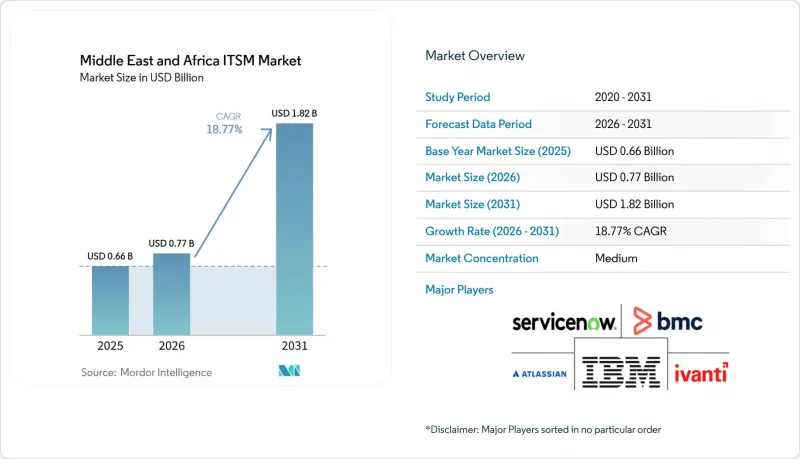
Mordor Intelligence에 의하면, 중동 및 아프리카 ITSM 시장 규모는 2025년에 6억 6,000만 달러로 평가되었고 2026년 7억 7,000만 달러에서 2031년까지 18억 2,000만 달러에 이를 것으로 예측되며, 예측 기간(2026-2031년) CAGR은 18.77%를 나타낼 전망입니다.
본 보고서는 구성 요소(솔루션 및 서비스), 배포 방식(클라우드, On-Premise, 하이브리드), 용도(서비스 데스크 및 인시던트 관리, 지식 관리 등), 최종 사용 산업(은행, 금융서비스 및 보험(BFSI), 제조업 등), 기업 규모(대기업 및 중소기업(SME)), 국가별로 분류되어 있습니다. 시장 전망은 금액(달러) 기준으로 제시되어 있습니다.
중동 및 아프리카 ITSM 시장 동향과 인사이트
'클라우드 퍼스트'를 통한 기업의 현대화가 플랫폼 통합을 촉진
GCC 전역의 기업들은 구식 On-Premise형 ITSM 환경을 단계적으로 폐지하고, AI 워크로드, API 주도형 통합 및 실시간 운영 가시성을 지원할 수 있는 클라우드 네이티브 플랫폼으로 전환하고 있습니다. 이러한 변화는 중동 및 아프리카 ITSM 시장에 중요한 의미를 지닙니다. 클라우드 기반 제공 방식이 확장성 요구사항뿐만 아니라, 보다 광범위한 디지털 운영에 필요한 속도와 유연성 문제도 해결해 주기 때문입니다. ServiceNow가 발표한 5억 달러 규모의 지역 투자(2026년에 예정된 사우디아라비아 데이터센터 인프라 포함)는 주요 벤더들이 더 이상 원격 프로비저닝에만 의존하지 않고, 현지 내 확장을 위한 체제를 구축하고 있음을 보여줍니다. 이러한 변화로 인해 정부 및 규제 대상 구매자에게 있어 주요 조달 장벽이 낮아질 뿐만 아니라, 여전히 부분적인 현지 호스팅이 필요한 조직에게도 하이브리드 서비스 관리 모델이 더욱 실용적인 대안이 될 것입니다. 중견 기업들은 이에 대응하여 파편화된 단일 기능 도구를 합리화하고, 여러 워크플로우에 걸쳐 확장, 지원 및 거버넌스가 용이한 통합 플랫폼으로 전환하고 있습니다. 그 결과, 중동 및 아프리카의 ITSM 시장에서는 일시적인 업그레이드 주기가 아닌, 보다 심층적인 구조적 전환이 진행되고 있습니다.
AI를 활용한 서비스 데스크 자동화가 IT 운영을 혁신
2025년부터 2026년까지 에이전트형 AI는 파일럿 프로그램에서 실제 운영 환경으로 전환되고 있으며, 이러한 변화로 인해 구매자들이 중동 및 아프리카의 ITSM 시장을 평가하는 방식도 변화하고 있습니다. Freshworks는 2026년 5월, Freshservice 내에 도메인별 AI 에이전트를 구축 및 배포하기 위한 노코드 환경인 'Freddy AI Agent Studio'를 출시했습니다. 한편, Ivanti도 자율형 ITSM 기능으로 'Neurons AI Self-Service Agent'를 출시했습니다. Freshworks에 따르면, 독립적인 분석 결과 레거시 플랫폼에서 전환하는 기업의 경우 3년 동안 168%의 ROI가 기대된다고 하며, 이를 통해 조달 팀은 자동화 주도형 현대화를 위한 직접적인 운영 비용의 근거를 확보할 수 있습니다. 또한, AI 도입으로 지식 기반 관리 체계도 개선되고 있습니다. 자율형 에이전트는 기존 서비스 데스크에서는 용인되었던 문서의 미비, 구식 워크플로우, 해결 로직의 부재 등을 신속하게 파악해내기 때문입니다. 이를 통해 컨텐츠의 질이 향상됨에 따라, 자동화된 서비스 해결과 사람이 직접 지원하는 서비스 해결 양쪽 모두 개선되는 선순환이 만들어집니다. AI 대응 아키텍처 도입을 미루는 조직은 티켓 건수 증가와 서비스 제공 시간 확대에 따라 자동화의 효과가 시너지 효과를 발휘함에 따라, 성과와 비용 간의 격차가 확대될 우려가 있습니다.
데이터 거주지 요건과 규정 준수의 복잡성이 아키텍처 비용을 상승시킨다.
중동 및 아프리카의 ITSM 시장에서 규정 준수는 여전히 가장 어려운 확장 과제 중 하나입니다. 이는 법규 및 정책 요건이 관할 구역마다 여전히 크게 다르기 때문입니다. 나이지리아의 ‘국가 클라우드 정책 2025’에서는 중요도가 높은 주권 데이터에 대해 현지화 의무화가 도입되었습니다. 반면, 케냐의 ‘클라우드 정책 2025’에서는 부문별 데이터 거주 요건이 규정되어, 이로 인해 여러 국가에 걸친 플랫폼 설계 비용이 증가하고 표준화가 저해되고 있습니다. 남아프리카공화국의 ‘국가 데이터·클라우드 정책’은 기밀 데이터에 대한 주권적 처리에 관한 추가 요건을 도입하여, 이로 인해 지역별 배포 템플릿의 비용이 더욱 증가하고 있습니다. 이러한 요건들은 수요 자체를 감소시키지는 않지만, 도입 일정을 지연시키고 계약 설계를 복잡하게 만들며, 현지 호스팅, 강력한 거버넌스 관리, 그리고 검증된 규정 준수 문서를 갖춘 공급업체의 가치를 높이고 있습니다. 또한, 구매자가 조달을 진행하기 전에 클라우드, 개인정보 보호 및 운영 보안 기준 준수를 기대할 경우, 자격 요건의 문턱도 높아집니다. 그 결과, 중동 및 아프리카의 ITSM 시장에서 복잡한 공공 부문이나 규제 대상 부문의 거래에서는 대형 기존 기업들이 구조적으로 유리한 입지를 유지하게 됩니다.
부문 분석
2025년, 솔루션은 구성 요소별 매출의 62.35%를 차지하며, 이 부문은 중동 및 아프리카 ITSM 시장에서 중심적인 위치를 유지했습니다. 이러한 우위는 인시던트 관리, 변경 관리, 자산 추적 및 서비스 카탈로그 워크플로우와 관련된 플랫폼 라이선싱에 기인한 것으로, 이는 기업 IT 운영 전반에 걸쳐 여전히 핵심적인 요건으로 남아 있습니다. 또한, 이 부문은 거버넌스 주도형 구매의 중요성을 반영합니다. 이는 규제 대상이나 대규모 환경에 있는 조직에서 플랫폼 소유권 및 서비스 카탈로그 구조가 여전히 기초적인 관리 수단으로 간주되기 때문입니다. 많은 도입 사례에서 솔루션 선정은 운영 모델뿐만 아니라 향후 AI 활용, 워크플로우 확장, 벤더 종속성에 관한 선택에도 영향을 미칩니다. 따라서 중동 및 아프리카 ITSM 업계의 구매 담당자들은 먼저 솔루션 계층을 평가하고, 이를 바탕으로 서비스 및 통합에 대한 지출을 계획하는 경우가 많습니다.
서비스 분야는 2031년까지 연평균 성장률(CAGR) 16.85%를 나타낼 것으로 예측되며, 중동 및 아프리카 ITSM 시장에서 가장 두드러진 성장을 보이는 구성 요소 카테고리입니다. 수요를 견인하는 요인은 도입 작업, 매니지드 ITSM 운영, AI 설정 및 워크플로우 맞춤화이며, 이 지역의 많은 IT 팀은 여전히 이러한 업무를 외부에 위탁하는 것을 선호합니다. 아틀라시안이 ‘Team ’26’에서 ‘Service Collection’을 발표한 것도 플랫폼의 가치가 라이선스 비용뿐만 아니라 도입, 온보딩, 그리고 부서 간 전개 지원과 점점 더 밀접하게 연결되어 있음을 반영합니다. 2025년 9월 NextEra와의 합작 투자를 통해 설립된 담맘의 근접 센터는 현지 서비스 제공 역량이 단순한 부가 기능이 아니라 핵심적인 차별화 요소로 자리 잡고 있음을 보여줍니다. 이는 중요한 점입니다. 공공 부문이나 대기업에서 프로젝트 가동 지연은 플랫폼 기능 자체 때문이 아니라, 해당 지역 내 도입 노하우 부족에서 기인하는 경우가 많기 때문입니다.
2025년 중동 및 아프리카 ITSM 시장 규모에서 클라우드는 64.50%의 점유율을 차지하고 있으며, 2031년까지 연평균 성장률(CAGR) 17.10%를 나타낼 것으로 예측됩니다. 이러한 규모와 속도의 조합은 클라우드가 단순히 신규 프로젝트를 확보하고 있을 뿐만 아니라, 기존의 하이브리드 환경이나 On-Premise 환경에서 수요도 끌어들이고 있음을 보여줍니다. 구매자들이 클라우드로 전환하는 배경에는 클라우드를 통한 서비스 제공이 업그레이드의 장벽을 낮추고, AI 기능에 대한 접근성을 개선하며, 분산된 운영 환경 전반에 걸쳐 서비스 관리 워크플로우를 연계하기 쉽게 만든다는 점이 있습니다. GCC 전역에서 하이퍼스케일러와 벤더에 의한 인프라 확장이 이루어짐에 따라, 그동안 완전한 전환을 지연시켰던 주권 관련 우려의 일부가 해소되면서 이러한 전환은 가속화되고 있습니다. 그 결과, 중동 및 아프리카의 ITSM 시장에서는 특히 신속한 도입과 관리 오버헤드 감소를 추구하는 조직을 중심으로 클라우드가 해당 지역의 기본 선택지로 자리 잡고 있습니다.
ServiceNow가 5억 달러 규모의 광범위한 지역 투자와 함께 발표한 사우디아라비아 인프라 계획은 일부 정부 기관 및 규제 대상 부문의 전환을 제한해 왔던 ‘주권 호스팅’이라는 장벽을 직접적으로 해결하기 위한 것이었습니다. 기밀 분류 및 관리 요건이 여전히 절대적인 조건인 국방, 정보 기관, 중요 인프라 분야에서는 On-Premise 구축이 여전히 중요하게 여겨지고 있습니다. 또한, 많은 대기업에서는 운영 위험을 수반하지 않고 기존 서비스 관리 환경을 일괄적으로 교체할 수 없기 때문에 하이브리드 환경의 중요성도 여전히 유지되고 있습니다. 대신, 이러한 기업들은 단일 거버넌스 구조 하에서 레거시 시스템과 새로운 SaaS 및 소버린 클라우드 환경을 공존시키는 전환 아키텍처로서 하이브리드 환경을 활용하고 있습니다. 그 결과, 프라이빗 클라우드, On-Premise, SaaS 각 계층을 아우르며 오케스트레이션할 수 있는 벤더는 다층형 인프라가 여전히 일반적인 중동 및 아프리카의 ITSM 시장에서 꾸준히 입지를 다지고 있습니다.
기타 혜택:
- 엑셀 형식 시장 예측(ME) 시트
- 3개월간의 애널리스트 지원
자주 묻는 질문
목차
제1장 서론
제2장 조사 방법
제3장 주요 요약
제4장 시장 구도
제5장 시장 규모와 성장 예측
제6장 경쟁 구도
제7장 시장 기회와 향후 전망
JHS 26.08.07According to Mordor Intelligence, the Middle East and Africa ITSM market size was valued at USD 0.66 billion in 2025 and is estimated to grow from USD 0.77 billion in 2026 to reach USD 1.82 billion by 2031, at a CAGR of 18.77% during the forecast period (2026-2031).
This report is Segmented by Component (Solutions and Services), Deployment (Cloud, On-Premise, and Hybrid), Application (Service Desk and Incident Management, Knowledge Management, and More), End-User Industry (BFSI, Manufacturing, and More), Enterprise Size (Large Enterprises and Small and Mid-Size Enterprises (SME)), and Country. The Market Forecasts are Provided in Terms of Value (USD).
Middle East and Africa ITSM Market Trends and Insights
Cloud-First Enterprise Modernization Fuels Platform Consolidation
Enterprises across the GCC are retiring older on-premise ITSM estates and moving toward cloud-native platforms that can support AI workloads, API-led integrations, and real-time operational visibility. This shift matters for the Middle East and Africa ITSM market because cloud delivery now solves not only scalability needs, but also the speed and flexibility required for broader digital operations. ServiceNow's announced USD 500 million regional investment, including Saudi data center infrastructure scheduled for 2026, showed that large vendors are now building for in-country deployment rather than relying only on remote provisioning. That change lowers a major procurement barrier for government and regulated buyers, and it also makes hybrid service-management models more practical for organizations that still need partial local hosting. Mid-market firms are responding by rationalizing fragmented point tools and shifting toward unified platforms that are easier to scale, support, and govern across multiple workflows. The result is that the Middle East and Africa ITSM market is seeing a deeper structural migration, not a short-lived upgrade cycle.
AI-Enabled Service Desk Automation Transforms IT Operations
Agentic AI moved from pilot programs into real production environments during 2025 and 2026, and that shift is changing how buyers evaluate the Middle East and Africa ITSM market. Freshworks launched Freddy AI Agent Studio in Freshservice in May 2026 as a no-code environment for building and deploying domain-specific AI agents, while Ivanti also released its Neurons AI Self-Service Agent as an autonomous ITSM capability. Freshworks stated that independent analysis pointed to a 168% ROI over 3 years for enterprises migrating from legacy platforms, which gives procurement teams a direct operating-cost case for automation-led modernization. AI deployment is also improving knowledge-base discipline because autonomous agents quickly expose documentation gaps, obsolete workflows, and missing resolution logic that older service desks could tolerate. This creates a self-reinforcing cycle in which better content improves both automated and human-assisted service resolution. Organizations that delay AI-ready architecture are likely to face a widening performance and cost gap as automation effects compound across higher ticket volumes and broader service windows.
Data Residency and Compliance Complexity Raise Architecture Costs
Compliance remains one of the most difficult scaling issues in the Middle East and Africa ITSM market because legal and policy requirements still differ sharply across jurisdictions. Nigeria's National Cloud Policy 2025 introduced mandatory localization requirements for higher categories of sovereign data, while Kenya's Cloud Policy 2025 established sector-specific residency rules that make multi-country platform design more expensive and less standardized. South Africa's National Data and Cloud Policy adds another layer of sovereign handling expectations for sensitive data, which further increases the cost of regional deployment templates. These requirements do not remove demand, but they do slow rollout timelines, complicate contract design, and raise the value of vendors with local hosting, stronger governance controls, and proven compliance documentation. Qualification thresholds also rise when buyers expect alignment with cloud, privacy, and operational security standards before procurement can proceed. The net effect is that larger incumbents remain structurally advantaged in complex public-sector and regulated-sector deals across the Middle East and Africa ITSM market.
Other drivers and restraints analyzed in the detailed report include:
- Government Digital Service Programs Create Structural ITSM Demand
- Expansion of Remote and Hybrid Workflows Elevates Platform Requirements
- Budget Constraints Among Mid-Market Buyers Slow Platform Rollout Velocity
For complete list of drivers and restraints, kindly check the Table Of Contents.
Segment Analysis
Solutions held 62.35% of component revenue in 2025, which kept this segment at the center of the Middle East and Africa ITSM market. That lead came from platform licensing tied to incident management, change management, asset tracking, and service catalog workflows that remain core requirements across enterprise IT operations. The segment also reflects the weight of governance-led buying, because organizations in regulated and large-scale environments still view platform ownership and service catalog structure as foundational controls. In many deployments, solution selection shapes not only the operating model but also later choices around AI enablement, workflow extension, and vendor lock-in. For that reason, buyers in the Middle East and Africa ITSM industry often assess the solution layer first, and then build services and integration spending around it.
Services are projected to grow at a 16.85% CAGR through 2031, which makes them the fastest-moving component category within the Middle East and Africa ITSM market. Demand is being driven by implementation work, managed ITSM operations, AI configuration, and workflow tailoring that many regional IT teams still prefer to source externally. Atlassian's Team '26 launch of the Service Collection also reflected how platform value is increasingly tied to delivery, onboarding, and cross-functional rollout support rather than license cost alone. The Dammam proximity center established through the NextEra joint venture in September 2025 showed that local services capacity is becoming a core differentiator rather than a supporting feature. That matters because delayed go-lives in public-sector and large-enterprise projects often trace back to limited in-region implementation depth, not to platform functionality itself.
Cloud held 64.50% share of the Middle East and Africa ITSM market size in 2025, and it is also projected to grow at a 17.10% CAGR through 2031. That combination of scale and speed shows that cloud is not simply winning new projects; it is also pulling demand away from existing hybrid and on-premise estates. Buyers are moving because cloud delivery reduces upgrade friction, improves AI feature access, and makes it easier to connect service-management workflows across distributed operations. The shift has accelerated as hyperscaler and vendor infrastructure expansion across the GCC reduced some of the sovereignty concerns that had previously delayed full migration. The Middle East and Africa ITSM market is therefore seeing cloud become the regional default, especially in organizations that want faster deployment and lower administration overhead.
ServiceNow's Saudi infrastructure plan, announced with a broader USD 500 million regional investment, directly addressed the sovereign hosting barrier that had limited some government and regulated-sector migrations. On-premise deployment still matters in defense, intelligence, and critical-infrastructure settings where classification and control requirements remain non-negotiable. Hybrid environments are also retaining importance because many large enterprises cannot replace older service-management estates in a single step without operational risk. Instead, they are using hybrid as a transition architecture that lets legacy systems coexist with new SaaS or sovereign-cloud environments under one governance structure. Vendors that can orchestrate across private cloud, on-premise, and SaaS layers are therefore gaining ground in the Middle East and Africa ITSM market where multi-tier infrastructure remains common.
Complete Report Scope:
- By Component
- Solutions
- Services
- By Deployment
- Cloud
- On-premise
- Hybrid
- By Application
- Service Desk and Incident Management
- Asset and Configuration Management
- Change and Release Management
- Service Request Management
- Knowledge Management
- Other Applications
- By End-user Industry
- BFSI
- Manufacturing
- Government and Public Sector
- IT and Telecommunications
- Retail and E-commerce
- Healthcare
- Travel and Hospitality
- Other End-user Industries
- By Enterprise Size
- Large Enterprises
- Small and Mid-size Enterprises (SME)
- By Country
- Saudi Arabia
- United Arab Emirates
- South Africa
- Egypt
- Rest of Middle East and Africa
List of Companies Covered in this Report:
- ServiceNow Inc.
- BMC Software, Inc.
- Atlassian Corporation Plc
- Ivanti, Inc.
- IBM Corporation
- ManageEngine (Zoho Corporation Pvt. Ltd.)
- Freshworks Inc.
- Open Text Corporation
- Broadcom Inc.
- Hewlett Packard Enterprise Company
- SolarWinds Corporation
- TOPdesk Nederland B.V.
- EasyVista SA
- SysAid Technologies Ltd.
- Hornbill Service Management Limited
- InvGate S.R.L.
- 4me, Inc.
- Efecte Plc
- Matrix42 AG
- TeamDynamix, Inc.
Additional Benefits:
- The market estimate (ME) sheet in Excel format
- 3 months of analyst support
TABLE OF CONTENTS
1 INTRODUCTION
- 1.1 Study Assumptions and Market Definition
- 1.2 Scope of the Study
2 RESEARCH METHODOLOGY
3 EXECUTIVE SUMMARY
4 MARKET LANDSCAPE
- 4.1 Market Overview
- 4.2 Market Drivers
- 4.2.1 Cloud-First Enterprise Modernization
- 4.2.2 Expansion of Remote and Hybrid Workflows
- 4.2.3 AI-Enabled Service Desk Automation
- 4.2.4 Government Digital Service Programs
- 4.2.5 Growth of Managed IT and Outsourced Service Operations
- 4.2.6 Increased Demand for Cross-Functional Enterprise Service Management
- 4.3 Market Restraints
- 4.3.1 Budget Constraints Among Mid-Market Buyers
- 4.3.2 Data Residency and Compliance Complexity
- 4.3.3 Legacy Tool Fragmentation and Migration Risk
- 4.3.4 Shortage of ITSM and Process Automation Skills
- 4.4 Industry Value Chain Analysis
- 4.5 Regulatory Landscape
- 4.6 Technological Outlook
- 4.7 Porter's Five Forces Analysis
- 4.7.1 Bargaining Power of Suppliers
- 4.7.2 Bargaining Power of Buyers
- 4.7.3 Threat of New Entrants
- 4.7.4 Threat of Substitutes
- 4.7.5 Intensity of Competitive Rivalry
- 4.8 Impact of Macroeconomic Factors on the Market
5 MARKET SIZE AND GROWTH FORECASTS (VALUE)
- 5.1 By Component
- 5.1.1 Solutions
- 5.1.2 Services
- 5.2 By Deployment
- 5.2.1 Cloud
- 5.2.2 On-premise
- 5.2.3 Hybrid
- 5.3 By Application
- 5.3.1 Service Desk and Incident Management
- 5.3.2 Asset and Configuration Management
- 5.3.3 Change and Release Management
- 5.3.4 Service Request Management
- 5.3.5 Knowledge Management
- 5.3.6 Other Applications
- 5.4 By End-user Industry
- 5.4.1 BFSI
- 5.4.2 Manufacturing
- 5.4.3 Government and Public Sector
- 5.4.4 IT and Telecommunications
- 5.4.5 Retail and E-commerce
- 5.4.6 Healthcare
- 5.4.7 Travel and Hospitality
- 5.4.8 Other End-user Industries
- 5.5 By Enterprise Size
- 5.5.1 Large Enterprises
- 5.5.2 Small and Mid-size Enterprises (SME)
- 5.6 By Country
- 5.6.1 Saudi Arabia
- 5.6.2 United Arab Emirates
- 5.6.3 South Africa
- 5.6.4 Egypt
- 5.6.5 Rest of Middle East and Africa
6 COMPETITIVE LANDSCAPE
- 6.1 Market Concentration
- 6.2 Strategic Moves
- 6.3 Market Share Analysis
- 6.4 Company Profiles (includes Global Level Overview, Market Level Overview, Core Segments, Financials as available, Strategic Information, Market Rank/Share, Products and Services, Recent Developments)
- 6.4.1 ServiceNow Inc.
- 6.4.2 BMC Software, Inc.
- 6.4.3 Atlassian Corporation Plc
- 6.4.4 Ivanti, Inc.
- 6.4.5 IBM Corporation
- 6.4.6 ManageEngine (Zoho Corporation Pvt. Ltd.)
- 6.4.7 Freshworks Inc.
- 6.4.8 Open Text Corporation
- 6.4.9 Broadcom Inc.
- 6.4.10 Hewlett Packard Enterprise Company
- 6.4.11 SolarWinds Corporation
- 6.4.12 TOPdesk Nederland B.V.
- 6.4.13 EasyVista SA
- 6.4.14 SysAid Technologies Ltd.
- 6.4.15 Hornbill Service Management Limited
- 6.4.16 InvGate S.R.L.
- 6.4.17 4me, Inc.
- 6.4.18 Efecte Plc
- 6.4.19 Matrix42 AG
- 6.4.20 TeamDynamix, Inc.
7 MARKET OPPORTUNITIES AND FUTURE OUTLOOK
- 7.1 White-Space and Unmet-Need Assessment


