

|
시장보고서
상품코드
2099150
중국의 ITSM 시장 : 점유율 분석, 업계 동향 및 통계, 성장 예측(2026-2031년)China ITSM - Market Share Analysis, Industry Trends & Statistics, Growth Forecasts (2026 - 2031) |
||||||
 Mordor Intelligence
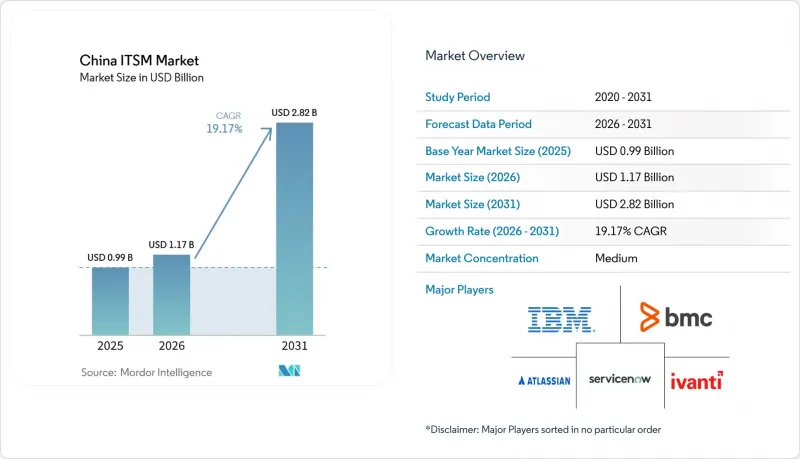
Mordor Intelligence에 의하면, 중국 ITSM 시장 규모는 2025년에 9억 9,000만 달러, 2026년에 11억 7,000만 달러가 되고, 2031년까지 28억 2,000만 달러에 이를 것으로 예측되며, 2026년부터 2031년까지 CAGR 19.17%로 성장할 전망입니다.
본 보고서는 구성 요소(솔루션 및 서비스), 배포 방식(클라우드, On-Premise, 하이브리드), 용도(서비스 데스크 및 인시던트 관리, 자산 및 구성 관리 등), 최종 사용 산업(은행, 금융서비스 및 보험(BFSI), 제조업 등), 기업 규모(대기업, 중소기업)별로 분류되어 있습니다. 시장 전망은 금액(달러) 기준으로 제시되어 있습니다.
중국 ITSM 시장 동향 및 인사이트
중국 본토에서의 클라우드 네이티브 ITSM 플랫폼으로의 전환
중국의 ITSM 시장은 클라우드 기반 기업 운영으로의 광범위한 전환의 혜택을 받고 있습니다. 중국의 2026년을 향한 정책 조합은 혁신, 디지털화 및 국가적 ‘AI 플러스’ 의제를 지속적으로 지원하고 있으며, 이에 따라 기업의 기술 업그레이드는 경영진의 최우선 과제로 자리 잡고 있습니다. 한 다국적 기업의 중국 본사 사례를 보면, 엄격한 규정 준수 일정을 준수하면서 현지화된 ITSM으로의 전환을 완료할 수 있었음이 드러나며, 이를 통해 클라우드 기반의 현지화된 제공 모델이 현재 대기업에게 더 현실적인 선택지가 되고 있음을 알 수 있습니다. 기업들이 확장 가능한 디지털 인프라 위에 비즈니스 시스템을 더욱 도입함에 따라, 번거로운 수동 설정 과정 없이 해당 환경에 연결할 수 있는 서비스 플랫폼이 요구되고 있습니다. 이로 인해 구식 On-Premise형 도구의 교체 기간이 단축되고, 구독형 도입의 매력이 높아지고 있습니다. 또한 신속한 도입, 현지 언어 지원, 국내 기업용 도구와의 손쉬운 통합을 실현할 수 있는 벤더가 유리한 입지를 점하고 있습니다.
기업 전반에 걸친 AI 기반 서비스 자동화
중국의 ITSM 시장에서 AI는 ITSM의 역할을 워크플로우 관리에서 보다 자동화된 운영 지원으로 변화시키고 있습니다. 화웨이는 MWC 2026에서 인간 엔지니어와 '디지털 직원'을 연계하여, 보다 선제적인 운영을 지원하는 AI 네이티브 지능형 운영 솔루션 'AUTINOps'를 발표했습니다. 중국건설은행의 2025년 연차 보고서에는 업무 기능 전반에 걸친 398개의 AI 활용 시나리오가 제시되어 있으며, 이는 AI가 기업의 일상 업무의 일부가 됨에 따라 요구되는 서비스 거버넌스의 규모를 반영하고 있습니다. 중국의 ITSM 시장에서 이는 구매자가 더 이상 티켓 처리의 효율성만을 추구하지 않는다는 것을 의미합니다. 그들은 또한 운영 지식을 흡수하고, 보다 신속한 문제 해결을 지원하며, 대규모 지원 팀 전체의 일관성을 향상시킬 수 있는 플랫폼을 원하고 있습니다. 따라서 기업 고유의 프로세스 모델을 보다 견고하게 구축하는 벤더는 범용적인 AI 기능을 단순히 추가하는 벤더보다 고객을 장기적으로 유지할 가능성이 더 높을 것으로 보입니다.
레거시 시스템 전환에 수반되는 복잡성과 높은 전환 비용
레거시 시스템의 전환은 여전히 중국 ITSM 시장에 큰 걸림돌이 되고 있습니다. 많은 대기업은 ERP, 인사, 자산 관리 시스템과 연동된 고도로 맞춤화된 티켓 관리 환경이나 기존의 프로세스 구조에 여전히 의존하고 있습니다. 중국 ITSM 시장에서 진정한 난관은 소프트웨어 교체뿐만 아니라, 오랜 기간 동안 기존 시스템을 중심으로 형성되어 온 내재화된 프로세스의 재설계에도 있습니다. 이로 인해 도입 기간이 장기화되고, 복잡한 거버넌스 구조를 가진 구매 기업의 경우 소유 비용이 증가합니다. 또한 대규모 기업 고객의 신규 계약 전환도 지연되는 경향이 있습니다. 이러한 고객에게는 제품의 포지셔닝 그 자체보다, 업무에 미치는 영향을 최소화하면서 전환이 가능하다는 실증이 더 중요하게 여겨지기 때문입니다.
부문 분석
2025년, 솔루션은 중국 ITSM 시장 점유율의 61.62%를 차지했으며, 이에 따라 수익 기반은 순수한 서비스 제공이 아닌 통합 소프트웨어 제품군에 계속 집중되었습니다. 이러한 플랫폼은 일반적으로 인시던트 관리, 변경 관리, 서비스 카탈로그 기능 및 구성 가시성을 단일 환경으로 통합하고 있으며, 이것이 기업들이 여전히 지출의 상당 부분을 소프트웨어 주도형 도입에 할당하고 있는 이유를 설명해 줍니다. 또한, 중국 ITSM 시장에서는 구매자가 워크플로우 설계, 정책 일관성, 장기적인 프로세스 표준화에 대한 더 큰 통제권을 요구하고 있기 때문에 공급업체가 유리한 입장에 있습니다. 이러한 경향은 서비스 운영이 감사 대응 및 사업 연속성 대책과 밀접하게 연관된 대규모 고객사에서 가장 두드러집니다. 이러한 상황에서는 서비스 구매에 포함된 경우에도 소프트웨어가 여전히 핵심을 이루고 있습니다.
그러나 서비스 분야는 2031년까지 연평균 성장률(CAGR) 21.62%로 확대될 것으로 예측되며, 중국 ITSM 시장에서 가장 두드러진 성장을 보일 것으로 전망됩니다. 이러한 변화는 도입 지원, 관리형 운영, AI 관련 자문 업무, 그리고 도입 후 최적화에 대한 수요 증가를 반영하고 있습니다. 이는 특히 구매자가 더 빠른 가치 실현(Time-to-Value)을 원하거나, 자사 단독으로 완전한 도입을 관리할 수 있는 충분한 내부 ITSM 체제가 아직 갖춰지지 않은 경우에 해당합니다. 아틀라시안이 2025년 10월에 ‘Service Collection’을 출시한 것은 제품 벤더들이 엔터프라이즈 서비스 제공에서의 역할을 확대하고 있음을 보여주며, 이로 인해 소프트웨어 및 서비스의 가치 경계가 더욱 모호해지고 있습니다. 그 결과, 중국의 ITSM 업계에서는 핵심 플랫폼 도입 후 서비스가 고객 유지 및 사업 확장을 점점 더 뒷받침하는 지속적인 수익 구조가 두드러지고 있습니다.
2025년 기준, 클라우드 도입은 중국 ITSM 시장 규모의 58.62%를 차지하고 있으며, 2031년까지 연평균 성장률(CAGR) 21.34%라는 가장 높은 성장률을 나타낼 것으로 예측됩니다. 이러한 조합은 주요 도입 모델이 성숙기에 도달한 것이 아니라 여전히 성장세를 이어가고 있음을 보여줍니다. 중국 ITSM 시장에서 클라우드 도입은 보다 신속한 배포, 손쉬운 업데이트, On-Premise 인프라 관리에 대한 의존도 감소를 원하는 기업들에게 매력적입니다. 또한, 여러 거점이나 사용자 그룹에 걸쳐 서비스 프로세스를 표준화하려는 조직에도 적합합니다. 이것이 바로 클라우드 도입이 신규 구매자에 그치지 않고 기존 기업의 교체 주기로까지 확대되고 있는 이유입니다.
On-Premise 배포는 물리적 관리와 엄격한 인증이 여전히 중요시되는 국방 관련 환경, 기밀 처리 대상인 정부 네트워크, 그리고 일부 금융 기관에서 여전히 중요한 역할을 수행하고 있습니다. 하이브리드 모델은 업무상 중요한 환경을 On-Premise로 운영하면서, 기밀성이 낮은 워크플로를 클라우드 기반 시스템으로 이전하는 기업에서 계속해서 활용되고 있습니다. Freshworks는 2026년 4월, 클라우드, 하이브리드, On-Premise 환경에 걸친 지속적인 감지 및 의존성 매핑을 통해 Freshservice를 확장함으로써, 하이브리드 서비스 관리에는 단순한 도입의 유연성뿐만 아니라 여전히 적극적인 제품 개발이 필요함을 보여주었습니다. 실용적인 관점에서 볼 때, 중국의 ITSM 시장에서는 구매자에게 완전한 일괄 전환을 강요하기보다는 혼합 환경 관리를 지원할 수 있는 벤더가 높이 평가받고 있습니다. 따라서 중국의 ITSM 업계는 클라우드 중심의 도입으로 전환되고 있지만, 이는 레거시 환경과의 완전한 단절이 아니라 단계적인 운영 통합을 통해 이루어지고 있습니다.
기타 혜택:
- 엑셀 형식 시장 예측(ME) 시트
- 3개월간의 애널리스트 지원
자주 묻는 질문
목차
제1장 서론
제2장 조사 방법
제3장 주요 요약
제4장 시장 구도
제5장 시장 규모와 성장 예측
제6장 경쟁 구도
제7장 시장 기회와 향후 전망
JHS 26.08.07According to Mordor Intelligence, the China iT service management market size is projected to be USD 0.99 billion in 2025, USD 1.17 billion in 2026, and reach USD 2.82 billion by 2031, growing at a CAGR of 19.17% from 2026 to 2031.
This report is Segmented by Component (Solutions and Services), Deployment (Cloud, On-Premise, and Hybrid), Application (Service Desk and Incident Management, Asset and Configuration Management, and More), End-User Industry (BFSI, Manufacturing, and More), and Enterprise Size (Large Enterprises, and Small and Medium Enterprises). The Market Forecasts are Provided in Terms of Value (USD).
China ITSM Market Trends and Insights
Shift To Cloud-Native ITSM Platforms In Mainland China
The China IT service management market is benefiting from a broad move toward cloud-ready enterprise operations. China's 2026 policy mix continues to support innovation, digitalization, and the national AI Plus agenda, which keeps enterprise technology upgrades high on management agendas. A documented case from a multinational company's China headquarters showed that a localized ITSM migration could be completed within a strict compliance timeline, indicating that cloud-ready, locally adapted delivery models are now more practical for large organizations. As enterprises deploy more business systems on scalable digital infrastructure, they want service platforms that can connect to those environments without lengthy manual configuration cycles. That shortens the replacement window for older on-premise tools and increases the appeal of subscription-based deployment. It also favors vendors that can deliver fast implementation, local language support, and easier integration with domestic enterprise tools.
AI-Driven Service Automation Across Enterprises
AI is changing the role of IT service management from workflow administration to more automated operational support in the China IT service management market. Huawei introduced AUTINOps at MWC 2026 as an AI-native intelligent operations solution that places digital employees beside human engineers and supports more proactive operations. China Construction Bank's 2025 annual report also showed 398 AI application scenarios across business functions, reflecting the scale of service governance needed as AI becomes part of everyday enterprise activity. In the China IT service management market, this means buyers are no longer looking only for ticket handling efficiency. They are also looking for platforms that can absorb operational knowledge, support faster resolution, and improve consistency across large support teams. Vendors that build stronger enterprise-specific process models are therefore likely to hold customers longer than vendors that only add generic AI features.
Legacy Migration Complexity and High Switching Costs
Legacy migration remains a meaningful drag on the China IT service management market. Many large organizations still rely on deeply customized ticketing environments and older process structures that are tied to ERP, HR, and asset systems. In the China IT service management market, the real difficulty is not only software replacement but also redesigning embedded processes that have grown up around old systems over the years. This lengthens implementation timelines and increases ownership costs for buyers with complex governance structures. It also slows new contract conversion in the largest enterprise accounts, where proof of low-disruption migration matters more than product positioning alone.
Other drivers and restraints analyzed in the detailed report include:
- Unified Service Management For Hybrid and Multi-Cloud Environments
- Rise Of Low-Code and No-Code ITSM Orchestration
- Shortage of Skilled ITSM And ITOM Professionals
For complete list of drivers and restraints, kindly check the Table Of Contents.
Segment Analysis
Solutions commanded 61.62% of the China IT service management market share in 2025, which kept the revenue base centered on integrated software suites rather than pure service delivery. These platforms usually combine incident management, change management, service catalog functions, and configuration visibility in a single environment, which explains why enterprises still allocate most spending to software-led rollouts. The China IT service management market has also favored solution vendors, as buyers seek greater control over workflow design, policy alignment, and long-term process standardization. That pattern remains strongest in large accounts where service operations are tied to audit readiness and business continuity practices. In that setting, software remains the anchor, even when services are included in the purchase.
Services, however, are projected to expand at a 21.62% CAGR through 2031, making them the fastest-growing component of the China IT service management market. The shift reflects rising demand for implementation support, managed operations, AI advisory work, and post-deployment optimization. This is especially relevant when buyers want faster time-to-value but do not yet have sufficient internal ITSM depth to manage a full rollout on their own. Atlassian's October 2025 launch of Service Collection showed how product vendors are broadening their role around enterprise service delivery, which further blurs the line between software and service value. The China IT service management industry is therefore seeing a more recurring revenue mix, where services increasingly support retention and expansion after the core platform is deployed.
Cloud deployment held 58.62% of the China IT service management market size in 2025, and it is also projected to record the fastest 21.34% CAGR through 2031. That combination shows that the leading deployment model is still gaining strength rather than reaching maturity. In the China IT service management market, cloud deployment appeals to enterprises seeking faster rollouts, easier updates, and reduced reliance on local infrastructure management. It also suits organizations that are trying to standardize service processes across multiple offices and user groups. This is why cloud adoption is moving beyond new buyers and into replacement cycles among established enterprises.
On-premise deployment still matters in defense-linked environments, classified government networks, and selected financial institutions where physical control and strict certification remain important. The hybrid model continues to serve enterprises that run production-critical environments on-site while moving less sensitive workflows to cloud-based systems. Freshworks expanded Freshservice in April 2026 through continuous discovery and dependency mapping across cloud, hybrid, and on-premises environments, demonstrating that hybrid service management still needs active product development rather than just simple deployment flexibility. In practical terms, the China IT service management market is rewarding vendors that can help buyers manage mixed estates rather than force a full one-step migration path. The China IT service management industry is therefore moving toward cloud-centered deployment, but it is doing so through staged operational convergence rather than a clean break from legacy environments.
Complete Report Scope:
- By Component
- Solutions
- Services
- By Deployment
- Cloud
- On-Premise
- Hybrid
- By Application
- Service Desk and Incident Management
- Asset and Configuration Management
- Change and Release Management
- Service Request Management
- Knowledge Management
- Other ITSM Applications
- By End-User Industry
- BFSI
- Manufacturing
- Government and Public Sector
- IT and Telecommunications
- Retail and E-Commerce
- Healthcare
- Travel and Hospitality
- Other End-User Industries
- By Enterprise Size
- Large Enterprises
- Small and Mid-Size Enterprises (SME)
List of Companies Covered in this Report:
- ServiceNow, Inc.
- International Business Machines Corporation
- BMC Software, Inc.
- Atlassian Corporation Plc
- Ivanti, Inc.
- Freshworks Inc.
- Zoho Corporation Private Limited
- Broadcom Inc.
- OpenText Corporation
- SolarWinds Corporation
- Hewlett Packard Enterprise Company
- TopDesk B.V.
- EasyVista S.A.
- SysAid Technologies Ltd.
- Hornbill Service Management Limited
- Matrix42 AG
- InvGate S.R.L.
- Cloudwise Technology Co., Ltd.
- Shenzhen Uniware Technology Co., Ltd.
- Huawei Technologies Co., Ltd.
- Lenovo Group Limited
- BCC Group Co., Ltd.
- Yonyou Network Technology Co., Ltd.
Additional Benefits:
- The market estimate (ME) sheet in Excel format
- 3 months of analyst support
TABLE OF CONTENTS
1 INTRODUCTION
- 1.1 Study Assumptions and Market Definition
- 1.2 Scope of the Study
2 RESEARCH METHODOLOGY
3 EXECUTIVE SUMMARY
4 MARKET LANDSCAPE
- 4.1 Market Overview
- 4.2 Market Drivers
- 4.2.1 Shift to Cloud-Native ITSM Platforms in Mainland China
- 4.2.2 AI-Driven Service Automation Across Enterprise IT Operations
- 4.2.3 Unified Service Management for Hybrid and Multi-Cloud Environments
- 4.2.4 Rise of Low-Code and No-Code Orchestration for Faster Workflow Design
- 4.2.5 FinOps and GreenOps Reporting Embedded in ITSM Workflows
- 4.2.6 Growing Adoption of ITSM for Edge Computing and 5G Operations
- 4.3 Market Restraints
- 4.3.1 Legacy Migration Complexity and High Switching Costs
- 4.3.2 Shortage of Skilled ITSM and ITOM Professionals
- 4.3.3 Data Residency, Security, and Compliance Friction
- 4.3.4 Rising Observability Data Costs Causing Tool Sprawl
- 4.4 Industry Value Chain Analysis
- 4.5 Impact of Macroeconomic Factors
- 4.6 Regulatory Landscape
- 4.7 Technological Outlook
- 4.8 Porter's Five Forces Analysis
- 4.8.1 Bargaining Power of Suppliers
- 4.8.2 Bargaining Power of Buyers
- 4.8.3 Threat of New Entrants
- 4.8.4 Threat of Substitutes
- 4.8.5 Intensity of Competitive Rivalry
5 MARKET SIZE AND GROWTH FORECASTS (VALUE)
- 5.1 By Component
- 5.1.1 Solutions
- 5.1.2 Services
- 5.2 By Deployment
- 5.2.1 Cloud
- 5.2.2 On-Premise
- 5.2.3 Hybrid
- 5.3 By Application
- 5.3.1 Service Desk and Incident Management
- 5.3.2 Asset and Configuration Management
- 5.3.3 Change and Release Management
- 5.3.4 Service Request Management
- 5.3.5 Knowledge Management
- 5.3.6 Other ITSM Applications
- 5.4 By End-User Industry
- 5.4.1 BFSI
- 5.4.2 Manufacturing
- 5.4.3 Government and Public Sector
- 5.4.4 IT and Telecommunications
- 5.4.5 Retail and E-Commerce
- 5.4.6 Healthcare
- 5.4.7 Travel and Hospitality
- 5.4.8 Other End-User Industries
- 5.5 By Enterprise Size
- 5.5.1 Large Enterprises
- 5.5.2 Small and Mid-Size Enterprises (SME)
6 COMPETITIVE LANDSCAPE
- 6.1 Market Concentration
- 6.2 Strategic Moves
- 6.3 Market Share Analysis
- 6.4 Company Profiles (includes Global Level Overview, Market Level Overview, Core Segments, Financials as available, Strategic Information, Market Rank/Share, Products and Services, Recent Developments)
- 6.4.1 ServiceNow, Inc.
- 6.4.2 International Business Machines Corporation
- 6.4.3 BMC Software, Inc.
- 6.4.4 Atlassian Corporation Plc
- 6.4.5 Ivanti, Inc.
- 6.4.6 Freshworks Inc.
- 6.4.7 Zoho Corporation Private Limited
- 6.4.8 Broadcom Inc.
- 6.4.9 OpenText Corporation
- 6.4.10 SolarWinds Corporation
- 6.4.11 Hewlett Packard Enterprise Company
- 6.4.12 TopDesk B.V.
- 6.4.13 EasyVista S.A.
- 6.4.14 SysAid Technologies Ltd.
- 6.4.15 Hornbill Service Management Limited
- 6.4.16 Matrix42 AG
- 6.4.17 InvGate S.R.L.
- 6.4.18 Cloudwise Technology Co., Ltd.
- 6.4.19 Shenzhen Uniware Technology Co., Ltd.
- 6.4.20 Huawei Technologies Co., Ltd.
- 6.4.21 Lenovo Group Limited
- 6.4.22 BCC Group Co., Ltd.
- 6.4.23 Yonyou Network Technology Co., Ltd.
7 MARKET OPPORTUNITIES AND FUTURE OUTLOOK
- 7.1 White-Space and Unmet-Need Assessment


