

|
시장보고서
상품코드
2118131
영국의 플라스틱 폐기물 관리 서비스 시장 : 시장 점유율 분석, 업계 동향 및 통계, 성장 예측(2026-2031년)United Kingdom Plastic Waste Management Services - Market Share Analysis, Industry Trends & Statistics, Growth Forecasts (2026 - 2031) |
||||||
 Mordor Intelligence
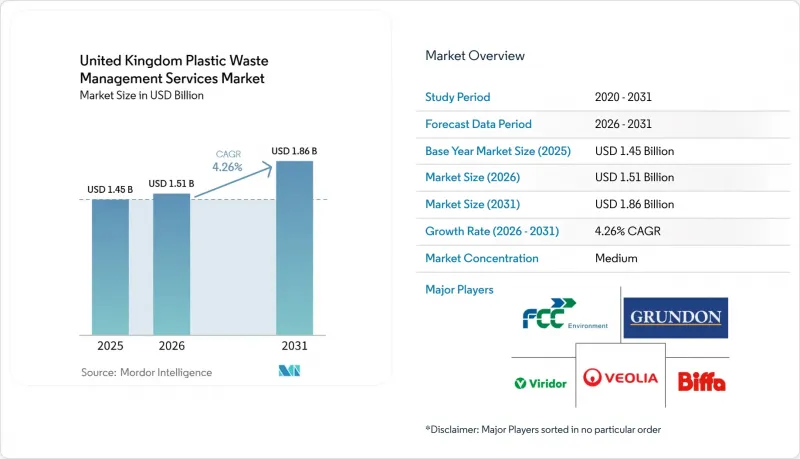
Mordor Intelligence에 의하면, 영국의 플라스틱 폐기물 관리 서비스 시장 규모는 2025년 14억 5,000만 달러로 평가되었고, 2026년 15억 1,000만 달러에서 2031년까지 18억 6,000만 달러로 확대될 것으로 예측되며, 2026-2031년 연평균 성장률(CAGR)은 4.26%를 나타낼 전망입니다.
본 보고서는 발생원별(주거, 상업시설, 산업 시설, 기타), 서비스 제공업체별(공공/지자체, 민간 폐기물 관리 기업, 기타), 서비스 유형별(수집, 운송, 선별·분리, 처분/처리, 기타)로 분류되어 있습니다. 시장 전망은 금액(달러) 및 수량(톤) 단위로 제시되어 있습니다.
영국의 플라스틱 폐기물 관리 서비스 시장 동향 및 인사이트
잉글랜드 전역에 걸친 ‘Simpler Recycling’ 도입
‘Simpler Recycling’은 2026년 3월 31일 잉글랜드 전역의 일반 가정에서 시행되었으며, 현재는 음식물 쓰레기 및 일반 쓰레기와 별도로 플라스틱을 포함한 건조한 재활용 가능 물품의 분리 수거가 의무화되어 있습니다. 직장 내 재활용 규정은 직원 10명 이상의 잉글랜드 기업 및 관련 비주거 시설을 대상으로 이미 2025년 3월 31일에 시행되었기 때문에 일반 가정을 대상으로 한 시행 기한이 도래하기 전부터 서비스 모델의 전환은 이미 시작되었습니다. 2027년 3월 31일부터는 플라스틱 필름과 비닐봉지도 분리수거 대상에 포함되게 되어, 이에 따라 영국의 플라스틱 폐기물 관리 서비스 시장의 처리 대상 범위가 확대되는 동시에, 일상적인 수거 시스템에 있어 처리하기 더 어려운 폐기물 흐름이 추가될 것입니다. 이 정책을 통해 시행 기간 동안 118억 파운드(155억 달러) 상당의 온실가스 감축 효과가 기대되며, 본 프로그램이 단기적인 규정 준수 대책이 아닌 장기적인 인프라 개혁으로 설계되었음을 알 수 있습니다. 베올리아(Veolia)사는 가정용 서비스 확대를 통해 자사 네트워크의 연간 플라스틱 수거량이 4만 톤 이상 증가할 것이라고 밝혔으며, 비파(Bifa)사도 전환에 대비해 약 250명의 현장 수거 직원을 채용했습니다. 이는 규제 변경이 이미 사업 규모와 인력 계획에 영향을 미치고 있음을 보여줍니다. 그 결과, 세대별 수거 커버리지가 더욱 일관성 있게 됨에 따라 원료가 되는 폐기물의 양이 증가하고, 자원 회수 시설에는 더 높은 처리 능력과 더 우수한 혼입물 관리가 요구되고 있으며, 이는 영국 전역의 플라스틱 폐기물 관리 서비스 시장에서 단기적인 수요를 뒷받침하고 있습니다.
포장재에 대한 확대 생산자 책임(pEPR) 수수료 조정
영국의 주요 포장재 제조업체들은 2025년 10월부터 처리비를 납부하고 있으며, 플라스틱 포장의 기본 요금은 톤당 423파운드(557.3달러)로 설정되어 있습니다. 2026/27 회계연도부터는 재활용이 불가능하다고 평가된 ‘레드’ 등급 포장재에 대해 첫 해에는 1.2배의 배수가 적용되고, 그 후에는 1.6배, 나아가 2.0배로 인상됩니다. 이를 통해 제조업체에게는 포장재 재설계 및 재활용성 향상을 위한 직접적인 금전적 인센티브가 제공됩니다. PackUK는 2026년 4월 1일 운영을 시작했으며, 검증된 폐기물 관리 비용 데이터를 기반으로 수익을 분배하는 생산자 자금 지원 조직으로 공식 출범했습니다. 이에 따라 영국 플라스틱 폐기물 관리 서비스 시장 전체에서 서비스의 경제성을 측정하는 방식이 변화하게 될 것입니다. 또한, 요금 조정에 따라 보고, PRO(생산자 책임 조직) 가입, 감사 및 재활용 가능성 평가 서비스에 대한 수요도 발생하고 있습니다. 이는 더 이상 자발적인 지속가능성 노력이 아니라 규제된 비용 체계의 대상이 되기 때문입니다. 이로 인해 규정 준수 서비스는 영국의 플라스틱 폐기물 관리 서비스 시장에서 더욱 지속 가능한 역할을 담당하게 될 것입니다. 특히, 수집 데이터, 소재 검증 및 생산자에 대한 보고를 단일 서비스 라인으로 통합할 수 있는 사업자의 경우, 이러한 경향이 두드러집니다.
지방 자치단체 간 일관성 없는 폐기물 수거 모델
잉글랜드에는 317개 이상의 폐기물 수거 관할 기관이 존재하지만, 각 기관은 여전히 서로 다른 계약, 차량, 수거 빈도, 선별 방법에 따라 운영되고 있어 표준화를 저해하고, 하류 처리 업체에 공급되는 원료의 일관성을 떨어뜨리고 있습니다. 영국 정부는 잉글랜드 지방 자치단체의 3분의 2 이상이 2026년 3월 31일 가정 쓰레기 수거 마감 기한에 대비하고 있다고 발표했으나, 이는 상당수의 자치단체가 예정대로 완전한 도입을 완료하지 못했음을 시사합니다. WRAP 보고서에 따르면, MRF(분리 선별 시설) 계약 전체의 36%가 2025년 말까지, 65%가 2026년까지 만료될 예정이며, 많은 계약 조건이 재검토되는 가운데 시장이 서비스 범위를 확대하고 있는 것으로 나타났습니다. 이러한 분절화는 분리수거 공정에 유입되는 플라스틱이 통일된 형태로 전달되지 않아 혼입 위험을 높일 뿐만 아니라, 여러 지자체 관할 구역을 포괄하는 사업자에게는 작업자 교육 및 노선 계획에 드는 비용도 증가시키고 있습니다. 전환 지원을 통해 지방 자치단체는 새로운 모델에 대한 준비를 진행할 수 있었습니다. 그러나 인구 밀도가 높은 도시 지역이나 주택 배치가 복잡한 지역에서는 서비스의 복잡성이 본질적으로 높기 때문에 예산 여력은 여전히 빠듯한 상황입니다. 계약 구조가 더욱 통일될 때까지는 이것이 영국 플라스틱 폐기물 관리 서비스 시장에서 가장 두드러진 운영상의 제약 중 하나로 남아 있을 것입니다.
부문 분석
2025년, 산업 폐기물은 영국 플라스틱 폐기물 관리 서비스 시장 점유율의 37.5%를 차지했으며, 현재 수요 구조에서 가장 큰 발생원 부문이 되고 있습니다. 이러한 위상은 플라스틱 포장재 및 보호재가 대량으로 유통되는 제조, 물류, 가공 거점에서 폴리에틸렌, 폴리프로필렌 및 이와 유사한 범용 폴리머가 대량으로 안정적으로 배출되고 있음을 반영합니다. 또한, 산업계 배출자는 정기적인 수거를 규정한 공식 서비스 계약에 따라 사업을 운영하는 경향이 있어, 이에 따라 사업자에게는 대부분의 가정용 채널에 비해 수거 경로가 촘촘하고 반입량을 예측하기가 더 쉬워졌습니다. 2024년 이후, 대규모 산업용 포장 제조업체는 ‘생산자 책임 규정’에 따라 등록 및 보고 의무를 지게 되었으며, 2025년 10월부터는 처리 수수료가 적용되고 있습니다. 이러한 규정 준수 부담으로 인해, 영국의 플라스틱 폐기물 관리 서비스 시장 전반에서 재활용 적합성 평가를 향상시키고 향후 처리 비용 부담을 경감할 수 있는 전문 서비스 제공업체에 대한 수요가 증가하고 있습니다.
주거 부문은 현재 보다 구조적인 기반 위에서 확대되고 있습니다. 이는 2026년 이전에는 이러한 형태로 존재하지 않았던, 잉글랜드의 모든 가구를 대상으로 한 최소 수거 기준이 ‘Simpler Recycling’을 통해 확립되었기 때문입니다. 2027년 3월부터 플라스틱 필름 수거가 시작됨에 따라 첫해에 주거 부문 폐기물 흐름에 15만 톤이 추가될 것으로 예상되며, 이로 인해 수거 계획과 하류 분리 수거 요건 모두 변화하게 될 것입니다. 소매, 사무실, 접객업 부문에서 발생하는 사업장 폐기물은 2025년 3월에 시행된 직장 내 재활용 규정과 생산자의 규정 준수 및 기업의 지속가능성 보고와 더욱 밀접하게 연계됨에 따라, 양적으로 가장 빠르게 성장하고 있는 발생원입니다. ‘기타’로 분류되는 공공기관 및 농업 유래 폐기물 흐름도, 폐기물 분리 배출 규제로 인해 면제 범위가 좁아지고 비가정용 공공시설에 대한 요건이 공식적으로 정해짐에 따라 그 존재감이 커지고 있습니다. 모든 발생원에 걸쳐 영국의 플라스틱 폐기물 관리 서비스 업계는 발생 시점에서의 보다 적절한 분리수거에 크게 의존하고 있습니다. 그 이유는 이후의 재활용 수율이나 혼입 상황과 같은 성과가 그 시점에서 거의 결정되기 때문입니다.
기타 혜택 :
- 엑셀 형식 시장 예측(ME) 시트
- 3개월간의 애널리스트 지원
자주 묻는 질문
목차
제1장 서론
제2장 조사 방법
제3장 개요
제4장 시장 구도
제5장 시장 규모 및 성장 예측
제6장 경쟁 구도
제7장 시장 기회 및 향후 전망
AJY 26.09.01According to Mordor Intelligence, the United Kingdom plastic waste management services market size is projected to expand from USD 1.45 billion in 2025 and USD 1.51 billion in 2026 to USD 1.86 billion by 2031, registering a CAGR of 4.26% between 2026 to 2031.
This report is Segmented by Source (Residential, Commercial, Industrial, and Others), by Service Provider (Public/Municipal, Private Waste Management Companies, and Others), and by Service Type (Collection, Transportation, Sorting & Segregation, Disposal / Treatment, and Others). The Market Forecasts are Provided in Terms of Value (USD) and Volume (Tons).
United Kingdom Plastic Waste Management Services Market Trends and Insights
Implementation of Simpler Recycling Across England
Simpler Recycling came into force across English households on March 31, 2026, and it now requires the separate collection of dry recyclables, including plastics, alongside food and residual waste. Workplace recycling rules already took effect on March 31, 2025, for businesses and relevant non-domestic premises in England with 10 or more employees, so the service model had already started shifting before the household deadline arrived. Plastic films and plastic bags are due to be included in the required collection stream from March 31, 2027, broadening the material scope for the United Kingdom plastic waste management services market and adding a more challenging waste stream to everyday collection systems. The policy is expected to deliver GBP 11.8 billion (USD 15.5 billion) in greenhouse gas savings over its lifetime, indicating that the program is being designed as long-term infrastructure reform rather than a short-term compliance exercise. Veolia stated that the household rollout adds more than 40,000 tons of annual plastic collection volumes to its network, and Biffa recruited around 250 frontline collection staff to prepare for the transition, indicating that the rule change is already affecting operating scale and labor planning. As a result, more consistent kerbside coverage is lifting feedstock volumes and pushing materials recovery facilities to manage higher throughput with better contamination control, which reinforces near-term demand across the United Kingdom plastic waste management services market.
Packaging Extended Producer Responsibility (pEPR) Fee Modulation
Large packaging producers in the United Kingdom have been paying disposal fees since October 2025, with a base fee for plastic packaging set at GBP 423 (USD 557.3) per ton. From the 2026/27 assessment year, red-rated packaging assessed as non-recyclable is subject to a 1.2x multiplier in year 1, rising to 1.6x and then 2.0x, providing producers with a direct financial incentive to redesign packaging and improve recyclability. PackUK became operational on April 1, 2026, formalizing a producer-funded body that distributes revenues based on verified waste management cost data, which changes how service economics are measured across the United Kingdom's plastic waste management services market. Fee modulation also creates demand for reporting, PRO membership, auditing, and recyclability assessment services, as those tasks now fall within a regulated cost framework rather than a voluntary sustainability process. This makes compliance services a more durable part of the United Kingdom plastic waste management services market, especially for operators that can combine collection data, material verification, and producer reporting into a single service line.
Inconsistent Waste Collection Models Across Local Authorities
England has more than 317 waste collection authorities, and they still operate under different contracts, fleets, frequencies, and sorting methods, which weakens standardization and lowers feedstock consistency for downstream processors. The Government of the United Kingdom stated that more than two-thirds of English councils were ready for the March 31, 2026, household deadline, indicating that a meaningful minority did not complete the full rollout on schedule. WRAP reported that 36% of all MRF contracts were due to expire by the end of 2025 and 65% by 2026, indicating that the market is expanding service coverage while many contract terms are being reset. This fragmentation raises contamination risks because plastics entering the sortation stream do not arrive in a uniform format, and it also increases crew training and route planning costs for operators serving multiple authority areas. Transitional support has helped councils prepare for the new model. Still, the funding envelope remains tight in dense urban areas and in difficult housing layouts, where service complexity is inherently higher. Until contract structures become more uniform, this remains one of the clearest operating restraints on the United Kingdom plastic waste management services market.
Other drivers and restraints analyzed in the detailed report include:
- Growing Investment in Domestic Plastic Reprocessing Capacity
- Expansion of Plastic Film Collection Infrastructure
- Escalating Collection and Transportation Costs
For complete list of drivers and restraints, kindly check the Table Of Contents.
Segment Analysis
Industrial streams accounted for 37.5% of the United Kingdom plastic waste management services market share in 2025, making them the largest source segment in the current demand structure. This position reflects the high and steady output of polyethylene, polypropylene, and similar commodity polymers across manufacturing, logistics, and processing sites where plastic packaging and protective materials move in large volumes. Industrial generators also tend to work under formal service contracts with scheduled collections, which gives operators denser routes and more predictable inbound volumes than most household channels. Since 2024, large industrial packaging producers have had registration and reporting obligations under the Producer Responsibility rules, and disposal fees have applied since October 2025. That compliance burden is increasing demand for specialist service providers that can improve recyclability ratings and lower future fee exposure across the United Kingdom plastic waste management services market.
The residential segment is now expanding on a more structural basis because Simpler Recycling established a minimum collection standard across English households that did not exist in this form before 2026. The addition of plastic film collection from March 2027 is expected to add 150,000 tons to the residential stream in the first year, which changes both collection planning and downstream sorting requirements. Commercial waste from retail, offices, and hospitality is the fastest-growing source by volume, driven by workplace recycling rules that took effect in March 2025 and by corporate sustainability reporting now more closely tied to producer compliance. Institutional and agricultural streams grouped under others are also becoming more visible as the Separation of Waste regulations narrow exemptions and formalize requirements for non-household municipal premises. Across all source streams, the United Kingdom plastic waste management services industry depends heavily on better segregation at the point of generation, because that is where later recycling yield and contamination performance are largely decided.
Complete Report Scope:
- By Source
- Residential
- Commercial (Retail, office, etc.)
- Industrial
- Others (Institutional, Agricultural, etc)
- By Service Provider
- Public/Municipal
- Private Waste Management Companies
- Others - Producer Responsibility Organizations (PROs), etc.
- By Service Type
- Collection, Transportation, Sorting & Segregation
- Disposal / Treatment
- Landfill
- Recycling & Resource Recovery
- Incineration & Waste-to-Energy
- Others (Chemical Treatment, etc.)
- Others (Consulting, Audit & Training, etc.)
List of Companies Covered in this Report:
- Veolia
- Biffa
- Viridor
- FCC Environment UK
- Grundon Waste Management Ltd.
- Renewi plc
- Enva
- DS Smith
- WasteCare Group Ltd.
- MyGroup
- Mobius Environmental Limited
- HIPPO
- J&G Environmental Limited
- EF Plastics UK Ltd.
- Jayplas Ltd.
- Recycle for Future Ltd.
- Ward Recycling Ltd.
- Scott Waste Ltd.
- TerraCycle
- Remondis UK Ltd.
Additional Benefits:
- The market estimate (ME) sheet in Excel format
- 3 months of analyst support
TABLE OF CONTENTS
1 Introduction
- 1.1 Study Assumptions & Market Definition
- 1.2 Scope of the Study
2 Research Methodology
3 Executive Summary
4 Market Landscape
- 4.1 Market Overview
- 4.2 Market Drivers
- 4.2.1 Implementation of Simpler Recycling Across England
- 4.2.2 Packaging Extended Producer Responsibility (pEPR) Fee Modulation
- 4.2.3 Growing Investment in Domestic Plastic Reprocessing Capacity
- 4.2.4 Expansion of Plastic Film Collection Infrastructure
- 4.2.5 Increasing Commercial Demand for Recycling Compliance Services
- 4.2.6 Rising Adoption of Closed-Loop Packaging Supply Chains
- 4.3 Market Restraints
- 4.3.1 Inconsistent Waste Collection Models Across Local Authorities
- 4.3.2 Escalating Collection and Transportation Costs
- 4.3.3 Shortage of Skilled Waste Collection Workforce
- 4.3.4 Limited Land Availability for New Waste Transfer and Sorting Facilities
- 4.4 Value / Supply-Chain Analysis
- 4.5 Regulatory Landscape
- 4.6 Technological Outlook
- 4.7 Porter's Five Forces - Industry Attractiveness
- 4.7.1 Threat of New Entrants
- 4.7.2 Bargaining Power of Suppliers
- 4.7.3 Bargaining Power of Buyers
- 4.7.4 Threat of Substitutes
- 4.7.5 Industry Rivalry
- 4.8 Startup Ecosystem Analysis
- 4.9 Analysis of Recycled Plastics on Virgin Plastics
- 4.10 Global Trade Flows & Import Restrictions (Waste Plastics)
5 Market Size and Growth Forecasts
- 5.1 By Source
- 5.1.1 Residential
- 5.1.2 Commercial (Retail, office, etc.)
- 5.1.3 Industrial
- 5.1.4 Others (Institutional, Agricultural, etc)
- 5.2 By Service Provider
- 5.2.1 Public/Municipal
- 5.2.2 Private Waste Management Companies
- 5.2.3 Others - Producer Responsibility Organizations (PROs), etc.
- 5.3 By Service Type
- 5.3.1 Collection, Transportation, Sorting & Segregation
- 5.3.2 Disposal / Treatment
- 5.3.2.1 Landfill
- 5.3.2.2 Recycling & Resource Recovery
- 5.3.2.3 Incineration & Waste-to-Energy
- 5.3.2.4 Others (Chemical Treatment, etc.)
- 5.3.3 Others (Consulting, Audit & Training, etc.)
6 Competitive Landscape
- 6.1 Market Concentration
- 6.2 Strategic Moves
- 6.3 Market Share Analysis
- 6.4 Company Profiles {(Includes Global Level Overview, Market Level Overview, Core Segments, Financials as Available, Strategic Information, Products & Services, and Recent Developments)}
- 6.4.1 Veolia
- 6.4.2 Biffa
- 6.4.3 Viridor
- 6.4.4 FCC Environment UK
- 6.4.5 Grundon Waste Management Ltd.
- 6.4.6 Renewi plc
- 6.4.7 Enva
- 6.4.8 DS Smith
- 6.4.9 WasteCare Group Ltd.
- 6.4.10 MyGroup
- 6.4.11 Mobius Environmental Limited
- 6.4.12 HIPPO
- 6.4.13 J&G Environmental Limited
- 6.4.14 EF Plastics UK Ltd.
- 6.4.15 Jayplas Ltd.
- 6.4.16 Recycle for Future Ltd.
- 6.4.17 Ward Recycling Ltd.
- 6.4.18 Scott Waste Ltd.
- 6.4.19 TerraCycle
- 6.4.20 Remondis UK Ltd.
7 Market Opportunities & Future Outlook
- 7.1 White-space & Unmet-need assessment


