

|
시장보고서
상품코드
2099406
CXL 연결형 DRAM 모듈 : 시장 점유율 분석, 업계 동향 및 통계, 성장 예측(2026-2031년)CXL Attached DRAM Module - Market Share Analysis, Industry Trends & Statistics, Growth Forecasts (2026 - 2031) |
||||||
 Mordor Intelligence
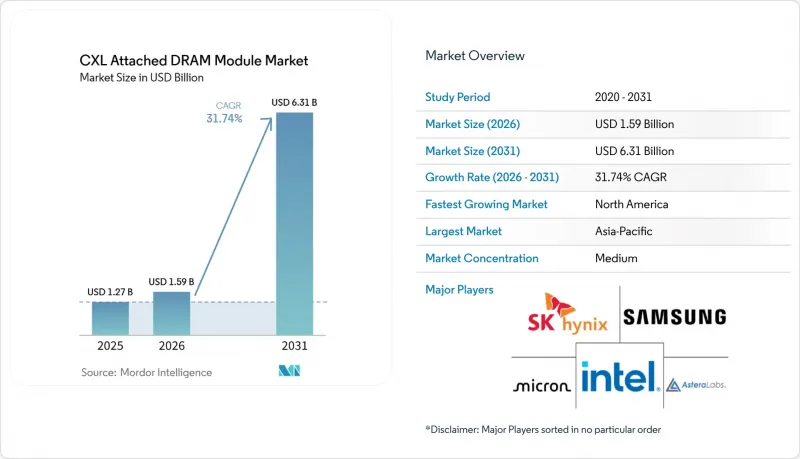
Mordor Intelligence에 의하면, CXL 연결형 DRAM 모듈 시장 규모는 2025년에 12억 7,000만 달러로 평가되었습니다. 2026년 15억 9,000만 달러, 2031년 63억 1,000만 달러에 이를 것으로 예측되며, 2026년부터 2031년에 걸쳐 CAGR 31.74%로 성장할 전망입니다.
본 보고서는 제품 유형(CXL DRAM 메모리 확장 모듈 등), 폼 팩터(EDSFF 기반 CXL DRAM 모듈 등), DRAM 기술(DDR5 기반 CXL DRAM 모듈 등), 용량(최대 256GB, 1 TB 이상 등), 용도(AI 인프라, 클라우드 데이터센터, 엔터프라이즈 서버 등) 및 지역별로 분류되어 있습니다. 시장 전망은 금액(달러) 기준으로 제시되어 있습니다.
세계의 CXL 연결형 DRAM 모듈 시장 동향 및 인사이트
AI 인프라의 메모리 밀도 요구 사항 급증
AI 훈련 및 추론 워크로드로 인해 GPU의 규모와 노드당 DRAM 가용성 사이에 직접적인 격차가 드러나고 있으며, 이는 CXL 연결형 DRAM 모듈 시장에서 지속적인 수요를 창출하고 있습니다. 긴 문맥을 처리하는 대규모 언어 모델의 추론에는 문맥 길이에 비례하여 증가하는 키-값 캐시 용량이 필요하기 때문에 많은 실제 운영 중인 AI 클러스터에서 메모리 용량이 운영상의 병목 현상이 되고 있습니다. Astera Labs는 GTC 2026에서 Leo 기반 CXL 도입을 통해 고대역폭 메모리만을 사용하는 대신 키-값 캐시를 DDR5에 유지함으로써 메모리 용량을 3.6배 확장하고 GPU 활용도를 향상시켰음을 보여주었습니다. 또한, Alibaba Cloud의 Beluga 아키텍처에서는 스위치 패브릭을 통해 GPU의 키-값 캐시 액세스를 CXL 풀 메모리로 라우팅함으로써, RDMA 기반 풀링에 비해 응답성이 향상된다는 사실이 입증되었습니다. 이는 운영 담당자가 컴퓨팅 스택 전체를 재설계하지 않고도 더 대규모의 모델이나 더 지속적인 세션을 지원할 수 있다는 점에서 중요합니다. 또한, 다중 모델의 동시 실행성을 높임으로써 활용도가 향상되어, CXL 연결형 DRAM 모듈 시장 전체의 단기적인 수요를 촉진하고 있습니다.
여유 용량을 줄이기 위한 하이퍼스케일 메모리 풀링
서버 수준의 정적 메모리 할당 방식에서는 여전히 탑재된 DRAM의 상당 부분이 미사용 상태로 남아 있어, 이는 CXL 연결형 DRAM 모듈 시장에서 풀링의 매력을 높이고 있습니다. 랙스케일 공유 메모리 패브릭을 통해 운영자는 피크 수요에 맞추어 각 노드의 용량을 조정하는 대신, 필요한 곳에 실시간으로 용량을 할당할 수 있습니다. 마이크로소프트 리서치는 ‘Octopus’ 프로젝트를 통해, 희소 CXL 토폴로지를 사용하면 고가의 풀 메쉬 스위치 설계 없이도 풀링 포드를 확장할 수 있음을 입증했습니다. 이 아키텍처는 도입 비용을 절감하고, 하이퍼스케일 환경에서 메모리 풀링의 경제적 이점을 높여줍니다. 2025년과 2026년에는 DRAM 공급 부족과 HBM 주도 할당 압박으로 인해 사업자들이 기존 플랫폼의 수명을 연장할 수밖에 없게 되면서, 이러한 이점은 더욱 강화되었습니다. 실용화에 대한 관심이 실험실 내 파일럿 단계를 넘어 확산됨에 따라, 메모리 풀링은 CXL 연결형 DRAM 모듈 시장에서 표준 인프라 옵션으로 자리 잡아가고 있습니다.
네이티브 DDR5 메모리와 비교한 레이턴시 증가
CXL 연결 메모리의 경우, 로컬 연결 DDR5가 75-85나노초인 데 반해 여전히 200-400나노초의 왕복 지연이 발생합니다. 이는 CXL 연결형 DRAM 모듈 시장의 일부 이용 사례에 있어 여전히 직접적인 제약 요인으로 작용하고 있습니다. ASPLOS 2025에서 발표된 연구에 따르면, 높은 부하가 걸린 동시 액세스 상황에서 불공평한 큐잉 동작과 최대 81%에 달하는 DDR 대역폭 저하도 확인되었습니다. Microsoft Research는 플랫 메모리 모드에서 하드웨어 관리형 계층화를 통해 워크로드의 82% 이상에서 성능 저하를 5% 이내로 억제할 수 있음을 보여주었지만, 일부 예외적인 경우에는 여전히 최대 34%의 성능 저하가 나타났습니다. 이는 엔터프라이즈용 인증에서 평균 지연 시간과 마찬가지로 서비스 수준의 예측 가능성도 중요함을 의미합니다. 현재의 대책으로는 핫 페이지를 로컬 DDR5에 유지하고, 콜드 페이지를 CXL 계층으로 이동시키는 방법이 있습니다. 이는 일부 데이터베이스나 AI 추론 패턴에서는 효과적이지만, 용도 수준프로파일링이 필요하기 때문에 CXL 연결형 DRAM 모듈 시장 전체로의 도입을 지연시키고 있습니다.
부문 분석
2025년, CXL DRAM 메모리 확장 모듈은 CXL 연결형 DRAM 모듈 시장의 54.55%를 차지하며 최대 제품 카테고리가 되었습니다. 이러한 우위는 단일 호스트 확장을 지원하고, 스위치 패브릭이 필요 없으며, 기존 PCIe 5.0 서버 인프라에 호환된다는 점 등 간단한 도입 경로에 기인합니다. 하드웨어의 복잡성이 낮다는 점도 서버 OEM 제조업체에게 더 친숙한 검증 프로세스를 가능하게 합니다. CXL Type 3 모델 및 JEDEC 라벨링 표준에 기반한 상호 운용성 노력 덕분에, CXL 연결형 DRAM 모듈 시장의 이 분야에서의 도입 장벽은 더욱 낮아졌습니다. 또한, 이 부문은 서버 전체를 교체하지 않고도 메모리 여유 용량을 늘릴 수 있어 비용 측면에서도 이점을 누리고 있습니다.
CXL DRAM 메모리 풀링 모듈은 2031년까지 연평균 성장률(CAGR) 32.11%를 나타낼 것으로 예측되며, CXL 연결형 DRAM 모듈 시장에서 가장 빠르게 성장하는 제품 유형이 될 것입니다. 이러한 매력 덕분에 구매자들의 관심은 단일 서버의 용량 확장에서 여러 컴퓨팅 노드에 서비스를 제공하는 공유 메모리 패브릭으로 점차 이동하고 있습니다. 삼성은 CMM-B 풀링 어플라이언스를 통해 이러한 방향성을 제시했습니다. 이 어플라이언스는 AI, 인메모리 데이터베이스 및 분석 이용 사례를 위해 최대 60 GB/s의 대역폭으로 최대 2 TB의 공유 CXL 용량을 제공합니다. 애드인 카드 제품은 레거시 플랫폼과의 가교 역할로서 여전히 중요하지만, 통합이 진행되고 구매자들이 CXL 연결형 DRAM 모듈 업계 전반에 걸쳐 중앙 집중식으로 관리되는 메모리 풀을 요구함에 따라, 컨트롤러 기반 모듈 및 확장 어플라이언스 시장 점유율이 확대될 전망입니다.
EDSFF 기반 CXL 연결형 DRAM 모듈은 2025년에 CXL 연결형 DRAM 모듈 시장 규모의 46.43%를 차지하며, EDSFF가 주요 폼 팩터로 자리 잡았습니다. 이러한 우위는 표준 서버의 드라이브 베이, 특히 섀시의 대대적인 재설계가 필요하지 않은 E3.S 및 E3.L 레이아웃과의 높은 호환성을 반영합니다. 또한 운영 담당자들은 시스템을 완전히 중단하지 않고 가동 중인 데이터센터 환경을 관리하기를 원하기 때문에 핫 플러그를 통한 유지보수성도 중요합니다. E3.S 2T 포맷은 듀얼 포트 연결을 지원하며, 프로덕션 시스템에서의 페일오버 및 고가용성 구성을 지원합니다. 마이크론의 CZ120과 SK하이닉스의 CMM-DDR5는 상용화 과정에서 이 폼 팩터의 유효성을 입증한 현재의 제품 사례입니다.
랙 레벨 CXL DRAM 확장 시스템은 2031년까지 연평균 성장률(CAGR) 32.76%를 나타낼 것으로 예측되며, CXL 연결형 DRAM 모듈 시장에서 가장 높은 성장률을 보이고 있습니다. 구매자들은 단일 랙 규모의 풀에서 다수의 컴퓨팅 노드에 서비스를 제공할 수 있는 중앙 집중형 메모리 어플라이언스에 점점 더 많은 관심을 보이고 있습니다. PCIe 애드인 카드 모듈은 기존의 구형 시스템에서는 여전히 유용하지만, 신규 조달 주기에서 EDSFF 지원 플랫폼이 표준화됨에 따라 그 상대적 중요성은 감소할 전망입니다. 또한, CMM-D 포맷은 DRAM 칩과 전용 CXL 컨트롤러를 하나의 기판에 통합하고 있어, CXL 연결형 DRAM 모듈 업계에서 대규모 하이퍼스케일 프로그램의 원활한 전개를 위해 그 존재감을 높이고 있습니다.
지역별 분석
2025년, 아시아태평양은 CXL 연결형 DRAM 모듈 시장 점유율의 43.44%를 차지하며 최대 지역 부문이 되었습니다. 이 지역은 DRAM 제조에 있어 공급 역량과 AI 인프라 확충에 따른 수요 증가를 모두 갖추고 있습니다. 한국은 여전히 중심적인 위치를 차지하고 있으며, Samsung Electronics 및 SK하이닉스가 상용 CXL 모듈 프로그램의 대부분에 사용되는 DDR5 메모리를 공급하고 있을 뿐만 아니라, 양사 모두 전용 CXL 제품 라인 개발을 지속하고 있습니다. 또한 시장이 단순한 확장에서 풀형 아키텍처로 전환됨에 따라 컨트롤러용 실리콘이 중요한 차별화 요소로 부상하고 있어, 대만도 중요한 역할을 수행하고 있습니다. 2025년 9월 몽타주 테크놀로지(Montage Technology)가 CXL 3.1 Memory eXpander Controller의 샘플 제공을 시작한 것은 아시아태평양에서 모듈 수요 증가에 따라 컨트롤러 준비도 진행되고 있음을 보여줍니다.
북미는 연평균 성장률(CAGR) 32.73%를 나타낼 것으로 예측되며, CXL 연결형 DRAM 모듈 시장에서 가장 빠른 성장 궤도를 그릴 것으로 전망됩니다. 이 지역은 새로운 메모리 아키텍처를 대규모로 도입할 수 있는 최초의 구매자인 최대 규모의 하이퍼스케일 클라우드 사업자가 존재한다는 이점을 누리고 있습니다. Astera Labs가 Microsoft Azure M 시리즈 가상 머신에 CXL 메모리 확장 기술을 프로덕션 환경에 도입한 사례는 CXL 메모리 확장을 퍼블릭 클라우드의 프로덕션 환경으로 이관했다는 점에서 강력한 참고 사례가 되고 있습니다. PNNL의 Crete 테스트베드는 과학적 AI 시스템이 하이 메모리 컴퓨팅 환경에서 Micron의 메모리와 맞춤형 CXL 컨트롤러 보드를 어떻게 활용할 수 있는지 보여줌으로써, 상용 클라우드 이외의 분야로 수요를 확대되고 있습니다. 또한 이 지역은 인텔(Intel)과 AMD의 표준화 과정에 대한 적극적인 참여, 그리고 마벨(Marvell) 및 아스테라 랩스(Astera Labs)와 같은 현지 스위치·컨트롤러 공급업체들의 지원을 받고 있으며, 이러한 요소들이 CXL 연결형 DRAM 모듈 시장이 검증 단계에서 실제 가동 단계로 더 신속하게 전환되는 데 기여하고 있습니다.
유럽은 CXL 연결형 DRAM 모듈 시장에서 3위의 규모를 차지하고 있으며, 그 수요는 아일랜드, 네덜란드, 독일에서의 하이퍼스케일 확장 및 각국의 슈퍼컴퓨팅 센터에서의 HPC 조달에 기인합니다. 이 지역이 중시하는 전력 효율과 총 소유 비용(TCO) 관리는 메모리 풀링 개념과 잘 부합합니다. 이는 공유 패브릭을 활용함으로써 시스템군 전체에 걸친 중복된 DRAM 배치를 줄일 수 있기 때문입니다. 따라서 인증 장벽이 낮아짐에 따라, 유럽은 컴포저블 랙 아키텍처에 있어 장기적으로 적합한 시장이 될 것입니다. 세계 기타 지역들은 CXL 연결형 DRAM 모듈 시장에서 여전히 초기 단계의 기회에 머물러 있지만, 걸프 국가들의 국가 주도형 AI 인프라 구축으로 인해 대용량 메모리 도입을 위한 현실적인 단기적 경로가 마련되고 있습니다.
기타 혜택 :
- 엑셀 형식 시장 예측(ME) 시트
- 3개월간의 애널리스트 지원
자주 묻는 질문
목차
제1장 서론
제2장 조사 방법
제3장 주요 요약
제4장 시장 구도
제5장 시장 규모 및 성장 예측
제6장 경쟁 구도
제7장 시장 기회 및 향후 전망
KTH 26.08.10According to Mordor Intelligence, the CXL attached DRAM module market size is projected to be USD 1.27 billion in 2025, USD 1.59 billion in 2026, and reach USD 6.31 billion by 2031, growing at a CAGR of 31.74% from 2026 to 2031.
This report is Segmented by Product Type (CXL DRAM Memory Expansion Modules, and More), Form Factor (EDSFF-Based CXL DRAM Modules, and More), DRAM Technology (DDR5-Based CXL DRAM Modules, and More), Capacity (Up To 256 GB, Above 1 TB, and More), Application (AI Infrastructure, Cloud Data Centers, Enterprise Servers, and More), and Geography. The Market Forecasts are Provided in Terms of Value (USD).
Global CXL Attached DRAM Module Market Trends and Insights
Surging AI Infrastructure Memory Density Requirements
AI training and inference workloads are exposing a direct gap between GPU scale and per-node DRAM availability, which is creating sustained demand in the CXL attached DRAM module market. Long-context large language model inference requires key-value cache capacity that rises with context length, so memory capacity is becoming the operational limit in many production AI clusters. Astera Labs showed at GTC 2026 that Leo-based CXL deployments delivered 3.6x memory expansion and improved GPU utilization by keeping key-value cache on DDR5 instead of using only high-bandwidth memory. Alibaba Cloud's Beluga architecture also showed that routing GPU key-value cache access to CXL-pooled memory through a switch fabric improved response behavior versus RDMA-based pooling. That matters because operators can support larger models and more persistent sessions without redesigning the full compute stack. It also supports higher multi-model concurrency, which improves utilization and strengthens near-term demand across the CXL attached DRAM module market.
Hyperscale Memory Pooling to Reduce Stranded Capacity
Static memory allocation at the server level still leaves a meaningful share of installed DRAM unused, and that is making pooling more attractive in the CXL attached DRAM module market. A rack-scale shared memory fabric lets operators assign capacity where it is needed in real time instead of sizing every node for peak demand. Microsoft Research showed through its Octopus work that sparse CXL topologies can scale pooling pods without requiring expensive full-mesh switch designs. That architecture lowers deployment cost and improves the economic case for pooled memory at hyperscale. The case became stronger in 2025 and 2026 as tight DRAM supply and HBM-led allocation pressure pushed operators to extend the useful life of existing platforms. As production interest broadened beyond lab pilots, memory pooling moved closer to a standard infrastructure decision within the CXL attached DRAM module market.
Higher Latency Versus Native DDR5 Memory
CXL attached memory still introduces round-trip latency of 200-400 nanoseconds versus 75-85 nanoseconds for locally attached DDR5, and that remains a direct limit on some use cases in the CXL attached DRAM module market. Research presented at ASPLOS 2025 also found unfair queuing behavior and DDR bandwidth degradation of up to 81% under heavy concurrent loads. Microsoft Research showed that hardware-managed tiering in Flat Memory Mode held degradation within 5% for more than 82% of workloads, but some outlier cases still saw performance fall by up to 34%. That means service-level predictability matters as much as average latency in enterprise qualification. The current mitigation is to keep hot pages in local DDR5 and move colder pages to the CXL tier. That works for several database and AI inference patterns, but it requires application-level profiling and slows deployment across the CXL attached DRAM module market.
Other drivers and restraints analyzed in the detailed report include:
- Standardization Around CXL 2.0, CXL 3.0, And CXL 3.1 Ecosystem Readiness
- Rack-Scale Composability for Cloud and Enterprise Server Modernization
- Software Orchestration and Tiering Complexity
For complete list of drivers and restraints, kindly check the Table Of Contents.
Segment Analysis
CXL DRAM Memory Expansion Modules held 54.55% of the CXL attached DRAM module market in 2025, which made them the largest product category. Their lead came from a simple adoption path because they support single-host expansion, require no switch fabric, and fit existing PCIe 5.0 server infrastructure. That lower hardware complexity also gives server OEMs a more familiar qualification path. Interoperability work under the CXL Type 3 model and JEDEC labeling standards has further reduced adoption friction for this part of the CXL attached DRAM module market. The segment also benefits from a direct cost case because it lets buyers increase memory headroom without replacing the full server.
CXL DRAM Memory Pooling Modules are projected to grow at a 32.11% CAGR through 2031, which makes them the fastest-growing product type in the CXL attached DRAM module market. Their appeal is shifting buyer attention from one-server capacity expansion to shared memory fabrics that serve multiple compute nodes. Samsung demonstrated this direction through the CMM-B pooling appliance, which delivered up to 2 TB of shared CXL capacity at up to 60 GB/s bandwidth for AI, in-memory database, and analytics use cases. Add-in card products still matter as a bridge for legacy platforms, while controller-based modules and expansion appliances are likely to gain share as integration improves and buyers seek centrally managed memory pools across the broader CXL attached DRAM module industry.
EDSFF-based CXL DRAM modules captured 46.43% of the CXL attached DRAM module market size in 2025, which made EDSFF the leading form factor. Their lead reflects strong fit with standard server drive bays, especially E3.S and E3.L layouts that avoid major chassis redesign. Hot-plug serviceability also matters because operators want to manage live data center environments without full system shutdowns. The E3.S 2T format adds support for dual-port connectivity, which supports failover and higher-availability configurations in production systems. Micron's CZ120 and SK Hynix's CMM-DDR5 are current product examples that validate this form factor in commercial deployments.
Rack-Level CXL DRAM Expansion Systems are projected to grow at a 32.76% CAGR through 2031, giving them the fastest growth profile in the CXL attached DRAM module market. Buyers are increasingly looking at centralized memory appliances that can serve many compute nodes from one rack-scale pool. PCIe add-in card modules remain useful for older installed systems, but they are likely to lose relative weight as EDSFF-ready platforms become standard in new procurement cycles. The CMM-D format is also gaining ground because it combines DRAM chips and a dedicated CXL controller on one board, which supports cleaner deployment paths for large-scale hyperscale programs in the CXL attached DRAM module industry.
Complete Report Scope:
- By Product Type
- CXL DRAM Memory Expansion Modules
- CXL DRAM Memory Pooling Modules
- CXL DRAM Add-in Cards
- CXL DRAM Expansion Appliances / Systems
- CXL DRAM Controller-Based Memory Modules
- By Form Factor
- EDSFF-Based CXL DRAM Modules
- PCIe Add-in Card CXL DRAM Modules
- CXL Memory Module - DRAM / CMM-D Type Modules
- Rack-Level CXL DRAM Expansion Systems
- By DRAM Technology
- DDR5-Based CXL DRAM Modules
- DDR4-Based CXL DRAM Modules
- Advanced / Next-Generation DRAM-Based CXL Modules
- By Capacity Class
- Up to 256 GB
- 256 GB-512 GB
- 512 GB-1 TB
- Above 1 TB
- By Application
- AI Infrastructure
- Cloud Data Centers
- Hyperscale Data Centers
- High-Performance Computing
- Enterprise Servers
- Other Applications, In-Memory Databases and Analytics, Memory-Intensive Virtualization Workloads
- By Geography
- North America
- Europe
- Asia Pacific
- China
- Japan
- South Korea
- Taiwan
- Rest of Asia Pacific
- Rest of the World
Geography Analysis
Asia-Pacific held 43.44% of the CXL attached DRAM module market share in 2025, which made it the largest regional segment. The region combines supply strength in DRAM manufacturing with growing demand from AI infrastructure buildouts. South Korea remains central because Samsung Electronics and SK Hynix supply the DDR5 memory used across a large share of commercial CXL module programs, and both companies continue to advance dedicated CXL product lines. Taiwan also matters because controller silicon is becoming a key differentiator as the market moves from simple expansion to pooled architectures. Montage Technology's sampling of its CXL 3.1 Memory eXpander Controller in September 2025 showed that controller readiness in Asia-Pacific is advancing alongside module demand.
North America is projected to grow at a 32.73% CAGR, which gives it the fastest regional trajectory in the CXL attached DRAM module market. The region benefits from the presence of the largest hyperscale cloud operators, which are the first buyers able to absorb new memory architectures at scale. Astera Labs' production deployment on Microsoft Azure M-series virtual machines is a strong reference point because it moved CXL memory expansion into a public cloud production setting. PNNL's Crete testbed broadens demand beyond commercial cloud by showing how scientific AI systems can use Micron memory and custom CXL controller boards in high-memory computing environments. The region is also supported by strong standards involvement from Intel and AMD and by local switch and controller suppliers such as Marvell and Astera Labs, which helps the CXL attached DRAM module market move faster from validation into production.
Europe held the third-largest position in the CXL attached DRAM module market, with demand tied to hyperscale expansion in Ireland, the Netherlands, and Germany and to HPC procurement at national supercomputing centers. The region's focus on power efficiency and total cost control fits well with the logic of memory pooling because shared fabrics can reduce redundant DRAM provisioning across fleets. That makes Europe a good long-term fit for composable rack architectures as qualification barriers fall. Rest of the World remains an earlier-stage opportunity in the CXL attached DRAM module market, but sovereign AI buildouts in the Gulf are creating a credible near-term path for high-capacity memory deployments.
- Samsung Electronics Co., Ltd.
- SK hynix Inc.
- Micron Technology, Inc.
- Intel Corporation
- Marvell Technology, Inc.
- Astera Labs, Inc.
- Advanced Micro Devices, Inc.
- NVIDIA Corporation
- Google LLC
- Amazon.com, Inc.
- Microsoft Corporation
- Meta Platforms, Inc.
- Dell Technologies Inc.
- Super Micro Computer, Inc.
- Montage Technology Co., Ltd.
- OPENEDGES Technology, Inc.
- Panmnesia Co., Ltd.
- FADU, Inc.
- TLB Co., Ltd.
- Korea Circuit Co., Ltd.
- OKins Electronics Co., Ltd.
Additional Benefits:
- The market estimate (ME) sheet in Excel format
- 3 months of analyst support
TABLE OF CONTENTS
1 INTRODUCTION
- 1.1 Study Assumptions and Market Definition
- 1.2 Scope of the Study
2 RESEARCH METHODOLOGY
3 EXECUTIVE SUMMARY
4 MARKET LANDSCAPE
- 4.1 Market Overview
- 4.2 Impact of Macroeconomic Factors on the Market
- 4.3 Market Drivers
- 4.3.1 Surging AI Infrastructure Memory Density Requirements
- 4.3.2 Hyperscale Memory Pooling to Reduce Stranded Capacity
- 4.3.3 Standardization Around CXL 2.0, CXL 3.0, and CXL 3.1 Ecosystem Readiness
- 4.3.4 Rack-Scale Composability for Cloud and Enterprise Server Modernization
- 4.3.5 Accelerating HPC and Scientific Computing Memory Expansion Needs
- 4.3.6 Rising Demand for In-Memory Databases and Memory-Intensive Virtualization
- 4.4 Market Restraints
- 4.4.1 Higher Latency Versus Native DDR5 Memory
- 4.4.2 Software Orchestration and Tiering Complexity
- 4.4.3 Elevated Platform and Integration Cost for Early Deployments
- 4.4.4 Ecosystem Qualification Delays Across CPU, Memory, Switch, and Software Stacks
- 4.5 Industry Value Chain Analysis
- 4.6 Regulatory Landscape
- 4.7 Technological Outlook
- 4.8 Porter's Five Forces Analysis
- 4.8.1 Bargaining Power of Suppliers
- 4.8.2 Bargaining Power of Buyers
- 4.8.3 Threat of New Entrants
- 4.8.4 Threat of Substitutes
- 4.8.5 Competitive Rivalry
5 MARKET SIZE AND GROWTH FORECASTS (VALUE)
- 5.1 By Product Type
- 5.1.1 CXL DRAM Memory Expansion Modules
- 5.1.2 CXL DRAM Memory Pooling Modules
- 5.1.3 CXL DRAM Add-in Cards
- 5.1.4 CXL DRAM Expansion Appliances / Systems
- 5.1.5 CXL DRAM Controller-Based Memory Modules
- 5.2 By Form Factor
- 5.2.1 EDSFF-Based CXL DRAM Modules
- 5.2.2 PCIe Add-in Card CXL DRAM Modules
- 5.2.3 CXL Memory Module - DRAM / CMM-D Type Modules
- 5.2.4 Rack-Level CXL DRAM Expansion Systems
- 5.3 By DRAM Technology
- 5.3.1 DDR5-Based CXL DRAM Modules
- 5.3.2 DDR4-Based CXL DRAM Modules
- 5.3.3 Advanced / Next-Generation DRAM-Based CXL Modules
- 5.4 By Capacity Class
- 5.4.1 Up to 256 GB
- 5.4.2 256 GB-512 GB
- 5.4.3 512 GB-1 TB
- 5.4.4 Above 1 TB
- 5.5 By Application
- 5.5.1 AI Infrastructure
- 5.5.2 Cloud Data Centers
- 5.5.3 Hyperscale Data Centers
- 5.5.4 High-Performance Computing
- 5.5.5 Enterprise Servers
- 5.5.6 Other Applications, In-Memory Databases and Analytics, Memory-Intensive Virtualization Workloads
- 5.6 By Geography
- 5.6.1 North America
- 5.6.2 Europe
- 5.6.3 Asia Pacific
- 5.6.3.1 China
- 5.6.3.2 Japan
- 5.6.3.3 South Korea
- 5.6.3.4 Taiwan
- 5.6.3.5 Rest of Asia Pacific
- 5.6.4 Rest of the World
6 COMPETITIVE LANDSCAPE
- 6.1 Market Concentration
- 6.2 Strategic Moves
- 6.3 Market Share Analysis
- 6.4 Company Profiles (includes Global Level Overview, Market Level Overview, Core Segments, Financials as available, Strategic Information, Market Rank/Share, Products and Services, Recent Developments)
- 6.4.1 Samsung Electronics Co., Ltd.
- 6.4.2 SK hynix Inc.
- 6.4.3 Micron Technology, Inc.
- 6.4.4 Intel Corporation
- 6.4.5 Marvell Technology, Inc.
- 6.4.6 Astera Labs, Inc.
- 6.4.7 Advanced Micro Devices, Inc.
- 6.4.8 NVIDIA Corporation
- 6.4.9 Google LLC
- 6.4.10 Amazon.com, Inc.
- 6.4.11 Microsoft Corporation
- 6.4.12 Meta Platforms, Inc.
- 6.4.13 Dell Technologies Inc.
- 6.4.14 Super Micro Computer, Inc.
- 6.4.15 Montage Technology Co., Ltd.
- 6.4.16 OPENEDGES Technology, Inc.
- 6.4.17 Panmnesia Co., Ltd.
- 6.4.18 FADU, Inc.
- 6.4.19 TLB Co., Ltd.
- 6.4.20 Korea Circuit Co., Ltd.
- 6.4.21 OKins Electronics Co., Ltd.
7 MARKET OPPORTUNITIES AND FUTURE OUTLOOK
- 7.1 White-space and Unmet-Need Assessment


