

|
시장보고서
상품코드
2100556
인도의 풍력에너지 시장 : 시장 점유율 분석, 업계 동향 및 통계, 성장 예측(2026-2031년)India Wind Energy - Market Share Analysis, Industry Trends & Statistics, Growth Forecasts (2026 - 2031) |
||||||
 Mordor Intelligence
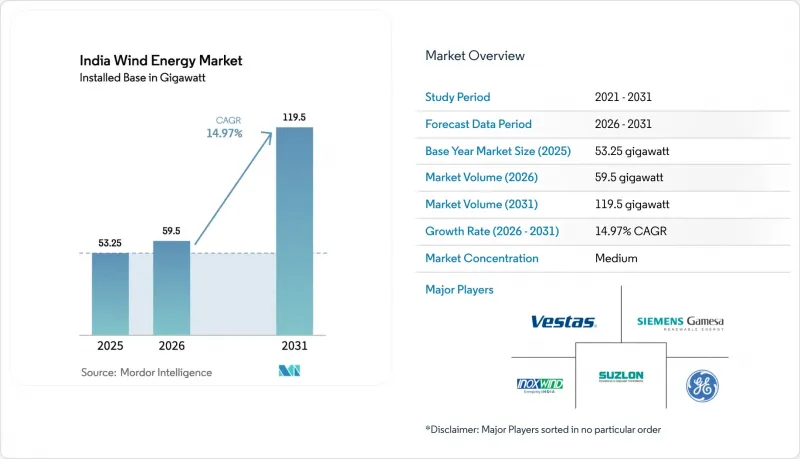
Mordor Intelligence에 의하면, 인도의 풍력에너지 시장 규모(설치용량 기반)는 2025년에 53.25기가와트로 평가되었고, 2026년 59.5기가와트에서 2031년까지 119.5기가와트에 이를 것으로 예측되며, 2026-2031년 CAGR 14.97%로 성장할 전망입니다.
본 보고서는 입지별(육상 및 해상), 터빈 출력별(3MW 이하, 3-6MW, 6MW 이상), 용도별(유틸리티 규모, 상업 및 산업용, 커뮤니티 프로젝트)로 분류되어 있습니다. 시장 규모 및 전망은 설치 용량(GW) 기준으로 제시되어 있습니다.
인도의 풍력에너지 시장 동향 및 인사이트
하이브리드 재생에너지 입찰이 설비 이용률 가속화
2025 회계연도, 타밀나두주 및 구자라트주에서 하이브리드 입찰을 통해 1,200 MW가 낙찰되었습니다. 이로 인해 발전소의 종합 부하율이 35%를 상회하게 되었고, 개발사가 단독 풍력에너지의 벤치마크 금리보다 150베이시스포인트 낮은 9.5%의 금리로 자금을 조달할 수 있게 됨에 따라 인도의 풍력에너지 시장이 강화되었습니다. 인도 태양에너지공사(SECI)의 제8회 ISTS 하이브리드 입찰은 1kWh당 2.99루피에서 3.04루피(1kWh당 0.036-0.037달러)의 가격대에서 성사되었으며, 풍력과 태양광을 병설함으로써 계통 연계 비용을 대폭 절감할 수 있음이 확인되었습니다. 타밀나두주의 34.75 MW 레파워링에서 하이브리드로의 전환 시범 사업에서는 15기의 1.5 MW 터빈을 같은 부지 내에 설치된 5기의 3 MW 터빈과 10 MW 태양광 발전 설비로 대체함으로써 연간 발전량을 2배로 늘렸습니다. 구자라트주 카치 지역에서는 야간 풍력에너지의 피크가 평균 5.5 kWh/m²/일의 강한 주간 일사량과 맞물려 발전 제한 위험을 낮추고 있어, 더 큰 혜택을 보고 있습니다. 또한, 하이브리드 구조를 채택함으로써 일반적으로 몬순 시즌에 발전 사업자에게 출력 억제를 강요하는 주 차원의 에너지 뱅킹 상한선을 회피할 수 있어 수익원을 보호할 수 있습니다.
실현 가능성 격차 자금(Viability Gap Funding)이 해상 풍력 공급망 확장을 뒷받침
신·재생에너지부는 최초의 1기가와트 해상 풍력에너지 용량의 위험을 완화하기 위해 685억 3,000만 루피(8억 2,000만 달러)를 배정했습니다. 이 자금은 구자라트주의 캄바트 만과 타밀나두주의 만나르 만에 균등하게 배분되며, 전기 요금은 1kWh당 4.5루피(0.054달러)로 고정되어 있습니다. 이 보조금을 통해 지멘스 가메사와 베스타스는 2028년까지 4기가와트 규모의 입찰 프로젝트를 염두에 두고 구자라트 주에 새로운 블레이드 및 나셀 공장을 건설할 것이라고 발표했습니다. 국립풍력에너지연구소의 해저 조사에 따르면 수심 30미터에서 60미터 해역에 70기가와트의 기술적 잠재력이 있는 것으로 나타났으나, 송전망 연결은 여전히 중요한 과제로 남아 있습니다. 인도 전력 송전 공사(PGC)는 캄바트 만에서 사우라스트라까지 이어지는 2,000 MW 규모의 HVDC(고전압 직류) 송전선로 설계를 진행 중이지만, 변전소 부지 확보가 지연되고 있어 가동 시작은 2027년 하반기로 연기될 전망입니다. 이 송전 회랑이 구축되지 않으면, 개발사가 이미 해저 임대권을 보유하고 있음에도 불구하고 500 MW 규모의 구자라트주 시범 프로젝트는 금융 마감(financial close)에 도달할 수 없습니다. 이는 송전망이 가진 ‘게이트키퍼’로서의 역할을 여실히 드러내고 있습니다.
카르나타카주 및 마하라슈트라주의 부지 확보 제약
카르나타카주와 마하라슈트라주는 2024년 신규 설비 용량의 2.1GW를 차지했으나, 인도의 풍력에너지 시장은 현재 산림 벌채 허가 처리 지연에 직면해 있어, 이로 인해 프로젝트 일정이 18-24개월 연장되고 있습니다. 카르나타카주 산림청은 용도 변경 면적의 2배에 해당하는 면적에 대한 보상 조림을 요구하고 있으며, 이로 인해 1메가와트당 토지 비용이 최대 100만 루피(1만 2,000달러)까지 치솟고 있습니다. 마하라슈트라주에서는 원주민 공동체와의 토지 소유권을 둘러싼 분쟁으로 인해 약 800MW의 용량이 동결됨에 따라, 사타라 현의 5개 타르카에 대한 승인 절차가 중단되었습니다. 개발업자들은 라자스탄주와 구자라트주로 거점을 옮기고 있지만, 허브 높이 100m 지점의 풍속이 6.5m/s로 낮아, 카르나타카주의 7.2m/s와 비교했을 때 설비 이용률이 8-10% 하락하고 있습니다. 또한, 140m 로터를 설치할 수 있을 만큼 충분히 넓은 연속된 구획이 여러 소규모 토지 소유자에게 분산되어 있어 거래의 복잡성이 가중되고, 리파워링 프로젝트도 정체되고 있습니다.
부문 분석
2025년, 인도의 풍력에너지 시장은 육상 풍력에너지이 전체를 차지할 것이며, 같은 해 3.4GW 규모로 확대될 전망입니다. 또한 주 정부의 견조한 PPA 수요에 힘입어 2031년까지 연평균 성장률(CAGR) 14.9%를 나타낼 것으로 예측됩니다. 2024년 설치 용량 기준으로는 구자라트주가 1,250 MW로 1위를 차지했으며, 이어 카르나타카주가 1,135 MW, 타밀나두주가 980 MW를 기록했습니다. 이는 해당 주에서 부지 확보 및 송전망 연결 절차가 명확하게 정비되어 있었기 때문입니다. 현재 해상 풍력에너지의 도입 실적 비중은 0%이지만, 구자라트주와 타밀나두주에서 각각 500MW씩, 총 1GW 규모의 자금 조달이 완료된 시범 프로젝트가 송전망 회선이 가동되는 대로 2028년까지 가동을 목표로 하고 있습니다. 전국적인 해저 조사에 따르면, 중간 수심에서 70GW의 기술적 잠재력이 있는 것으로 나타났습니다.
구자라트 주의 블레이드 제조부터 히마찰프라데시 주의 나셀 조립에 이르기까지, 육상 풍력에너지 공급망은 국내 OEM이 주도하고 있으며, 이를 통해 6개월의 납기 주기가 가능해졌습니다. 라자스탄주 및 안드라프라데시주의 프로젝트는 현재 전용 그린 수소 복합 시설에 전력을 공급하고 있으며, 2,400MW의 풍력에너지를 태양광 발전 및 에너지 저장 설비와 결합함으로써 연간 70%의 가동률을 보장하고, 인도의 풍력에너지 시장을 더욱 뒷받침하고 있습니다. 해상 풍력의 발전 이용률은 45-50%로, 육상 풍력의 25-30%에 비해 높으며, 송전망의 병목 현상이 해소된다면 높은 임베디드 가격을 적용할 수 있을 가능성이 있습니다. 그러나 개발업체들은 40%에 달하는 높은 설비 투자 비용과 설치용 선박공급 부족을 여전히 우려하고 있습니다. 그 결과, 2027년까지는 자본의 대부분이 계속해서 육상 풍력 리파워링 및 하이브리드 자산에 집중될 전망입니다.
기타 혜택 :
- 엑셀 형식 시장 예측(ME) 시트
- 3개월간의 애널리스트 지원
자주 묻는 질문
목차
제1장 서론
제2장 조사 방법
제3장 주요 요약
제4장 시장 구도
제5장 시장 규모 및 성장 예측
제6장 경쟁 구도
제7장 시장 기회 및 향후 전망
AJY 26.08.07According to Mordor Intelligence, the India wind energy market size in terms of installed base is projected to be 53.25 gigawatt in 2025, 59.5 gigawatt in 2026, and reach 119.5 gigawatt by 2031, growing at a CAGR of 14.97% from 2026 to 2031.
This report is Segmented by Location (Onshore and Offshore), Turbine Capacity (Up To 3 MW, 3 To 6 MW, and Above 6 MW), and Application (Utility-Scale, Commercial and Industrial, and Community Projects). The Market Sizes and Forecasts are Provided in Terms of Installed Capacity (GW).
India Wind Energy Market Trends and Insights
Hybrid Renewable Auctions Accelerate Capacity Utilization
Hybrid tenders awarded 1,200 MW in Tamil Nadu and Gujarat in fiscal 2025, strengthening the India wind energy market by lifting combined plant-load factors above 35% and permitting developers to secure debt at 9.5% interest, 150 basis points below standalone wind benchmarks. The Solar Energy Corporation of India's eighth ISTS hybrid tranche cleared at tariffs between Rs 2.99 and Rs 3.04 per kWh (USD 0.036-0.037 per kWh), confirming that colocating wind and solar slashes balancing-of-system costs. Tamil Nadu's 34.75 MW repowering-to-hybrid pilot doubled annual generation by replacing fifteen 1.5 MW turbines with five 3 MW machines paired with 10 MW of solar on the same site. Gujarat's Kutch region benefits further because nocturnal wind peaks dovetail with strong daytime solar irradiation, which averages 5.5 kWh/m2/day, reducing curtailment risk. Moreover, hybrid structures sidestep state-level energy-banking caps that typically force generators to curtail during monsoon months, protecting revenue streams.
Viability-Gap Funding Unlocks Offshore Supply Chains
The Ministry of New and Renewable Energy earmarked Rs 6,853 crore (USD 820 million) to de-risk the first 1 GW of offshore capacity, split evenly between Gujarat's Gulf of Khambhat and Tamil Nadu's Gulf of Mannar, by fixing tariffs at Rs 4.5 per kWh (USD 0.054 per kWh). This subsidy persuaded Siemens Gamesa and Vestas to announce new blade and nacelle factories in Gujarat aimed at a 4 GW tender pipeline through 2028. Seabed surveys by the National Institute of Wind Energy indicate 70 GW of technical potential in 30 m-60 m depths, but evacuation remains critical. Power Grid Corporation of India is designing a 2,000 MW HVDC link from the Gulf of Khambhat to Saurashtra, yet land acquisition for converter stations delays commissioning until late 2027. Without that corridor, the 500 MW Gujarat pilot cannot reach financial close even though developers already hold seabed leases, underscoring the grid's gatekeeper role.
Land Allotment Constraints in Karnataka and Maharashtra
Karnataka and Maharashtra contributed 2.1 GW of 2024 installations, but the India wind energy market now faces forest-clearance backlogs that extend project schedules by 18-24 months. Karnataka's Forest Department demands compensatory afforestation at double the diverted acreage, inflating per-megawatt land cost by up to Rs 10 lakh (USD 12,000). Maharashtra halted approvals in five talukas of Satara after title disputes with tribal communities froze roughly 800 MW of capacity. Developers pivot to Rajasthan and Gujarat, but lower wind speeds of 6.5 m/s at a 100 m hub height shave capacity-utilization factors by 8-10% compared with Karnataka's 7.2 m/s profile. Repowering projects also stall because contiguous plots large enough for 140 m rotors are fragmented across multiple smallholders, elevating transaction complexity.
Other drivers and restraints analyzed in the detailed report include:
- Repowering Scheme Targets 5 GW-15 GW of Ageing Assets
- Green Hydrogen Policy Drives Industrial Wind Demand
- Grid Evacuation Delays for Offshore Wind
For complete list of drivers and restraints, kindly check the Table Of Contents.
Segment Analysis
Onshore capacity accounted for the entire India wind energy market in 2025, expanding by 3.4 GW that year and heading toward a 14.9% CAGR through 2031, underpinned by robust state PPA demand. Gujarat led 2024 installations with 1,250 MW, followed by Karnataka at 1,135 MW and Tamil Nadu at 980 MW, as these states maintained clear land and grid processes. Offshore contributes none of the installed base today, yet a 1 GW funded pilot, 500 MW each in Gujarat and Tamil Nadu, targets commissioning by 2028 once the Power Grid evacuation link activates. National seabed surveys suggest 70 GW of technical potential at moderate depths.
Domestic OEMs dominate the onshore supply chain from blade fabrication in Gujarat to nacelle assembly in Himachal Pradesh, enabling six-month delivery cycles. Projects in Rajasthan and Andhra Pradesh now serve dedicated green-hydrogen complexes, pairing 2,400 MW of wind with solar and storage to guarantee 70% annual availability, further supporting the India wind energy market. Offshore's higher capacity factors, 45-50% compared with 25-30% onshore, could unlock premium tariffs once grid bottlenecks clear, but developers remain wary of the 40% capex premium and limited installation vessel availability. Consequently, most capital will continue to favor onshore repowering and hybrid assets until 2027.
Complete Report Scope:
- By Location
- Onshore
- Offshore
- By Turbine Capacity
- Up to 3 MW
- 3 to 6 MW
- Above 6 MW
- By Application
- Utility-scale
- Commercial and Industrial
- Community Projects
- By Component (Qualitative Analysis)
- Nacelle/Turbine
- Blade
- Tower
- Generator and Gearbox
- Balance-of-System
List of Companies Covered in this Report:
- Inox Wind Limited
- Suzlon Energy Limited
- Siemens Gamesa Renewable Energy SA
- Vestas Wind Systems A/S
- General Electric Company
- Envision Energy
- Wind World (India) Ltd
- Tata Power Renewable Energy Ltd
- Enercon GmbH
- Senvion India
- ReNew Power (ReNew Energy Global PLC)
- Adani Green Energy Ltd
- JSW Energy - Mytrah Cluster
- Amp Energy India Pvt Ltd
- Greenko Group
- Siemens Energy AG
- Mingyang Smart Energy
- Nordex SE
- Leitwind Shriram Manufacturing Ltd
- GE T&D India Ltd
- SKF India
- Hitachi Energy India Ltd
- Bharat Heavy Electricals Ltd
- LM Wind Power (India)
Additional Benefits:
- The market estimate (ME) sheet in Excel format
- 3 months of analyst support
TABLE OF CONTENTS
1 Introduction
- 1.1 Study Assumptions & Market Definition
- 1.2 Scope of the Study
2 Research Methodology
3 Executive Summary
4 Market Landscape
- 4.1 Market Overview
- 4.2 Market Drivers
- 4.2.1 Accelerated Hybrid Renewable Auctions Bundling Wind with Solar Enhancing Capacity Utilisation in Tamil Nadu & Gujarat
- 4.2.2 Viability-Gap Funding for Initial 4 GW Offshore Wind Round in Gujarat Catalyst for Supply-Chain Investments
- 4.2.3 Repowering Scheme Opening 5-15 GW of Ageing Wind Farms for High-Capacity Turbines
- 4.2.4 Green Hydrogen Policy Driving Demand for High-Load-Factor Wind Power in Industrial Clusters
- 4.2.5 ISTS Charge Waivers Boosting Wind Project IRRs in Resource-Rich Western States
- 4.2.6 Corporate PPAs Surge from Data-centre Operators Seeking RTC Wind-Solar Mix
- 4.3 Market Restraints
- 4.3.1 Land Allotment Freeze in Karnataka & Maharashtra Slowing Onshore Pipeline
- 4.3.2 Delayed Grid Evacuation Corridors for Offshore Wind at Gulf of Khambhat
- 4.3.3 Rising GST on Turbine Components Eroding Cost Competitiveness vs Solar
- 4.3.4 Banking Restrictions (above 30% Energy) by State DISCOMs Increasing Curtailment Risk
- 4.4 Supply-Chain Analysis
- 4.5 Regulatory Outlook
- 4.6 Technological Outlook
- 4.7 Porter's Five Forces
- 4.7.1 Bargaining Power of Suppliers
- 4.7.2 Bargaining Power of Buyers
- 4.7.3 Threat of New Entrants
- 4.7.4 Threat of Substitutes
- 4.7.5 Competitive Rivalry
- 4.8 PESTLE Analysis
5 Market Size & Growth Forecasts
- 5.1 By Location
- 5.1.1 Onshore
- 5.1.2 Offshore
- 5.2 By Turbine Capacity
- 5.2.1 Up to 3 MW
- 5.2.2 3 to 6 MW
- 5.2.3 Above 6 MW
- 5.3 By Application
- 5.3.1 Utility-scale
- 5.3.2 Commercial and Industrial
- 5.3.3 Community Projects
- 5.4 By Component (Qualitative Analysis)
- 5.4.1 Nacelle/Turbine
- 5.4.2 Blade
- 5.4.3 Tower
- 5.4.4 Generator and Gearbox
- 5.4.5 Balance-of-System
6 Competitive Landscape
- 6.1 Market Concentration
- 6.2 Strategic Moves (M&A, Partnerships, PPAs)
- 6.3 Market Share Analysis (Market Rank/Share for key companies)
- 6.4 Company Profiles (includes Global level Overview, Market level overview, Core Segments, Financials as available, Strategic Information, Products & Services, and Recent Developments)
- 6.4.1 Inox Wind Limited
- 6.4.2 Suzlon Energy Limited
- 6.4.3 Siemens Gamesa Renewable Energy SA
- 6.4.4 Vestas Wind Systems A/S
- 6.4.5 General Electric Company
- 6.4.6 Envision Energy
- 6.4.7 Wind World (India) Ltd
- 6.4.8 Tata Power Renewable Energy Ltd
- 6.4.9 Enercon GmbH
- 6.4.10 Senvion India
- 6.4.11 ReNew Power (ReNew Energy Global PLC)
- 6.4.12 Adani Green Energy Ltd
- 6.4.13 JSW Energy - Mytrah Cluster
- 6.4.14 Amp Energy India Pvt Ltd
- 6.4.15 Greenko Group
- 6.4.16 Siemens Energy AG
- 6.4.17 Mingyang Smart Energy
- 6.4.18 Nordex SE
- 6.4.19 Leitwind Shriram Manufacturing Ltd
- 6.4.20 GE T&D India Ltd
- 6.4.21 SKF India
- 6.4.22 Hitachi Energy India Ltd
- 6.4.23 Bharat Heavy Electricals Ltd
- 6.4.24 LM Wind Power (India)
7 Market Opportunities & Future Outlook
- 7.1 White-space & Unmet-Need Assessment


