

|
시장보고서
상품코드
2116059
유럽의 POS 단말기 : 시장 점유율 분석, 업계 동향과 통계, 성장 예측(2026-2031년)Europe POS Terminal - Market Share Analysis, Industry Trends & Statistics, Growth Forecasts (2026 - 2031) |
||||||
 Mordor Intelligence
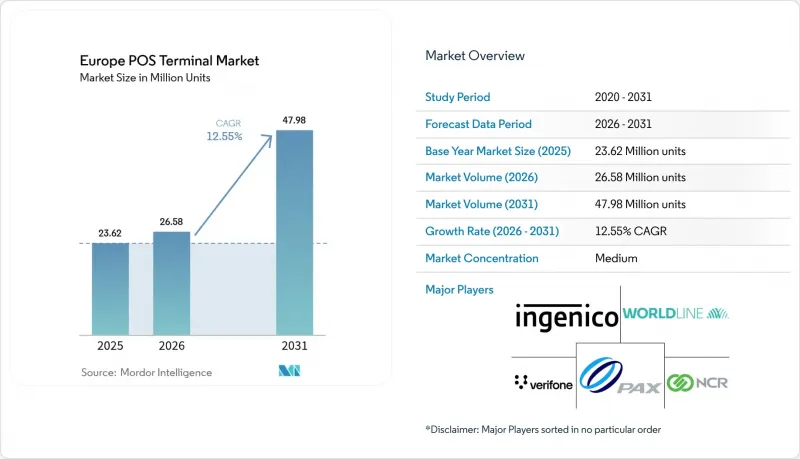
Mordor Intelligence에 따르면 유럽의 POS 단말기 시장 규모는 2025년에 2,362만 달러로 평가되며, 2026년 2,658만 달러에서 2031년까지 4,798만 달러에 달할 것으로 예측되며, 예측 기간(2026-2031년) 동안 CAGR은 12.55%가 될 전망입니다.
본 보고서는 결제 방식(접촉식 및 비접촉식), POS 유형(고정형 POS 시스템 및 모바일/휴대용 POS 시스템), 최종사용자 산업(소매, 호스피탈리티, 의료, 운송·물류, 기타), 국가(독일, 영국, 프랑스, 이탈리아, 스페인, 기타)별로 분류되어 있습니다. 시장 전망은 금액(단위) 기준으로 제시되어 있습니다.
유럽 POS 단말기 시장의 동향 및 인사이트
PIDF 보조금으로 인해 Tier 3-Tier 6 지역으로의 확장이 가속화
결제 인프라 개발 기금(PIDF) 프로그램을 통해 가맹점 등록 비용이 절감되어, 그동안 서비스가 미치지 못했던 지방 지역으로의 출하가 촉진되었습니다. 월드라인(Worldline) 한 회사만 해도 2024년 상반기에 ‘Tap on Mobile’ 플랫폼에 6,300개의 소규모 가맹점을 등록했으며, 이는 보조금을 적절히 활용함으로써 잠재적 수요를 얼마나 신속하게 실제 거래량으로 전환할 수 있는지를 보여줍니다. 이 보조금 제도를 통해 새롭게 디지털화된 가맹점들이 분석 및 재고 관리 모듈 등의 부가가치 서비스를 필요로 하게 되면서, 새로운 지속적인 수익원이 창출되었습니다.
신용카드 기반의 급속한 확장이 카드 결제 처리액을 끌어올리다
2024년, 유럽의 카드 보유 수는 1억 장의 활성 카드를 돌파했으며, 이로 인해 대면 결제 처리액이 증가함과 동시에 가맹점이 POS 단말기를 업그레이드할 경제적 이점이 강화되었습니다. 결제 처리 밀도의 향상은 아퀴어러의 이익률을 개선하고 로열티 프로그램의 통합을 촉진하는 동시에, 비접촉 결제 한도 확대를 위한 비즈니스 사례를 강화했습니다.
MDR 제로인 UPI가 소규모 가맹점의 수익성을 저해
규제 당국이 즉시결제에 대한 가맹점 할인율을 0으로 제한함에 따라, 소규모 가맹점은 수수료가 없는 QR코드 결제로 전환하여 하드웨어 임대 비용을 대폭 절감했습니다. 이에 따라 아쿠아이어러는 서비스 수수료 압박에 직면했고, POS 벤더는 카페나 키오스크 분야에서 초기 도입 판매 기회를 잃었습니다. 그러나 대형 체인점은 더 풍부한 데이터 수집과 차지백 관리가 가능하기 때문에 계속해서 카드 결제에 의존하고 있어, 그 영향은 완화되었습니다.
부문 분석
2025년에는 접촉형 단말기가 유럽 POS 단말기 시장에서 53.90%의 점유율을 차지했으나, 비접촉형 단말기는 2031년까지 연평균 성장률(CAGR) 12.65%를 기록했습니다. 유럽 경제 지역(EEA)에서 PIN이 필요 없는 탭 투 페이(Tap-to-Pay)의 한도 상향으로 결제 시의 번거로움이 줄어들었으며, 브뤼셀의 STIB 등 대중교통 기관에서는 2024년에 단일 승차 시 비접촉 결제 채택률이 57%에 달했습니다. 이 부문에서 유럽 POS 단말기 시장의 규모 확대는 Apple Pay나 Google Pay와 같은 전자지갑 제공업체들이 포인트 영수증 발송 기능을 추가하여 가맹점의 도입 인센티브를 높인 데 힘입어 더욱 가속화되었습니다.
고액 거래나 구형 은행 카드가 사용되는 시장에서는 여전히 기존의 접촉식 단말기가 필수적이었습니다. 하지만 Verifone사의 P400과 같은 멀티 인터페이스 단말기를 통해 가맹점은 두 대의 하드웨어를 하나의 통합형 PIN 패드로 대체할 수 있게 되어, 기존 시장의 잠식률을 완화했습니다. 2028년까지 결제 보안 업그레이드가 생체 인증으로 전환됨에 따라, 비접촉 결제의 점유율은 60%를 소폭 상회할 것으로 예상되며, 이는 유럽 POS 단말기 시장에서 비접촉 결제가 주요 성장 동력으로서의 입지를 공고히 할 것입니다.
기타 혜택:
- 엑셀 형식의 시장 예측(ME) 시트
- 3개월간의 애널리스트 지원
자주 묻는 질문
목차
제1장 소개
제2장 조사 방법
제3장 주요 요약
제4장 시장 구도
제5장 시장 규모와 성장 예측
제6장 경쟁 구도
제7장 시장 기회와 향후 전망
KSM 26.08.26According to Mordor Intelligence, the Europe POS terminal market size was valued at USD 23.62 million units in 2025 and estimated to grow from USD 26.58 million units in 2026 to reach USD 47.98 million units by 2031, at a CAGR of 12.55% during the forecast period (2026-2031).
This report is Segmented by Mode of Payment Acceptance (Contact-Based, and Contactless), POS Type (Fixed Point-Of-Sale Systems, and Mobile/Portable Point-Of-Sale Systems), End-User Industry (Retail, Hospitality, Healthcare, Transportation and Logistics, and More), and Country (Germany, United Kingdom, France, Italy, Spain, and More). The Market Forecasts are Provided in Terms of Value (Units).
Europe POS Terminal Market Trends and Insights
PIDF subsidies accelerating Tier-3-Tier-6 roll-outs
Payment Infrastructure Development Fund programs lowered merchant on-boarding cost and spurred shipments into previously under-served rural districts. Worldline alone enrolled 6,300 micro-merchants on its Tap on Mobile platform during H1 2024, signaling how subsidy alignment quickly converts latent demand into active transaction volumes. The subsidy window created a new recurring revenue stream as newly digitized merchants required value-added services such as analytics and inventory modules.
Surging credit-card base lifts card-swipe volumes
The European card base surpassed 100 million active cards in 2024, feeding higher card-present volumes and reinforcing merchant economics for upgrading POS estates. Higher swipe density improved acquirer margins, encouraged loyalty-program integration, and strengthened the business case for contactless limits expansion.
Zero-MDR UPI erodes small-merchant economics
When regulators capped merchant discount at zero for instant payments, micro-merchants pivoted toward fee-free QR alternatives, slashing hardware rentals. Acquirers saw service fee compression, and POS suppliers lost first-unit sales in the cafe and kiosk segment. Larger chains, however, continued to rely on card rails because of richer data capture and chargeback management, tempering the downside.
Other drivers and restraints analyzed in the detailed report include:
- Omni-payment Android POS integration
- GST e-invoice compliance driving real-time POS upgrades
- QR-code ubiquity dampens new POS demand
For complete list of drivers and restraints, kindly check the Table Of Contents.
Segment Analysis
Contactless units delivered 12.65% CAGR through 2031 even though contact-based devices held a 53.90% Europe POS terminal market share in 2025. The higher limit for tap-to-pay without PIN in the EEA trimmed checkout friction, and transit systems such as Brussels STIB recorded 57% contactless adoption for single rides in 2024. Europe POS terminal market size expansion within this segment was further propelled by wallet providers like Apple Pay and Google Pay adding loyalty receipt delivery, raising merchant acceptance incentives.
Legacy contact-based terminals remained indispensable for high-ticket transactions and markets with older banking cards. Nonetheless, multi-interface devices such as Verifone's P400 allowed merchants to replace dual hardware with one converged pinpad, moderating the cannibalization rate. As payment security upgrades migrate toward biometric user verification by 2028, contactless share is projected to edge past the 60% threshold, cementing its role as the principal growth engine of the Europe POS terminal market.
Complete Report Scope:
- By Mode of Payment Acceptance
- Contact-based
- Contactless
- By POS Type
- Fixed Point-of-Sale Systems
- Mobile / Portable Point-of-Sale Systems
- By End-User Industry
- Retail
- Hospitality
- Healthcare
- Transportation and Logistics
- Other End-user Industries
- By Country
- Germany
- United Kingdom
- France
- Italy
- Spain
- Rest of Europe
List of Companies Covered in this Report:
- Ingenico S.A.
- Worldline S.A.
- Verifone Systems, Inc.
- PAX Technology Limited
- NCR Corporation
- Diebold Nixdorf Incorporated
- Toshiba Corporation
- HP Inc.
- Castles Technology Co., Ltd.
- Adyen N.V.
- Stripe, Inc.
- SumUp Payments Limited
- Block, Inc. (Square)
- Fiserv, Inc. (Clover Network, LLC)
- Elavon, Inc.
- EVO Payments, Inc.
- Nexi S.p.A.
- myPOS Europe Ltd.
- Yavin SAS
- PayPal Holdings, Inc. (Zettle)
Additional Benefits:
- The market estimate (ME) sheet in Excel format
- 3 months of analyst support
TABLE OF CONTENTS
1 INTRODUCTION
- 1.1 Study Assumptions and Market Definition
- 1.2 Scope of the Study
2 RESEARCH METHODOLOGY
3 EXECUTIVE SUMMARY
4 MARKET LANDSCAPE
- 4.1 Market Overview
- 4.2 Market Drivers
- 4.2.1 Surge in contactless card penetration
- 4.2.2 Omnichannel retail demand for integrated POS
- 4.2.3 EU MPoC-certified SoftPOS roll-outs
- 4.2.4 Hybrid debit (girocard + scheme) upgrade cycle
- 4.2.5 EU Green Deal energy-efficient hardware push
- 4.2.6 Cashless-compliant unattended vending growth
- 4.3 Market Restraints
- 4.3.1 High TCO for SMEs and compliance costs
- 4.3.2 Fragmented fiscal/fiscalisation rules
- 4.3.3 Rural technician shortage extends downtime
- 4.3.4 Higher cyber-insurance premiums for legacy POS
- 4.4 Industry Value Chain Analysis
- 4.5 Regulatory Landscape
- 4.6 Technological Outlook
- 4.7 Porter's Five Forces Analysis
- 4.7.1 Threat of New Entrants
- 4.7.2 Bargaining Power of Buyers
- 4.7.3 Bargaining Power of Suppliers
- 4.7.4 Threat of Substitutes
- 4.7.5 Competitive Rivalry
5 MARKET SIZE AND GROWTH FORECASTS (UNITS)
- 5.1 By Mode of Payment Acceptance
- 5.1.1 Contact-based
- 5.1.2 Contactless
- 5.2 By POS Type
- 5.2.1 Fixed Point-of-Sale Systems
- 5.2.2 Mobile / Portable Point-of-Sale Systems
- 5.3 By End-User Industry
- 5.3.1 Retail
- 5.3.2 Hospitality
- 5.3.3 Healthcare
- 5.3.4 Transportation and Logistics
- 5.3.5 Other End-user Industries
- 5.4 By Country
- 5.4.1 Germany
- 5.4.2 United Kingdom
- 5.4.3 France
- 5.4.4 Italy
- 5.4.5 Spain
- 5.4.6 Rest of Europe
6 COMPETITIVE LANDSCAPE
- 6.1 Market Concentration
- 6.2 Strategic Moves
- 6.3 Market Share Analysis
- 6.4 Company Profiles {(includes Global level Overview, Market level overview, Core Segments, Financials as available, Strategic Information, Market Rank/Share for key companies, Products and Services, and Recent Developments)}
- 6.4.1 Ingenico S.A.
- 6.4.2 Worldline S.A.
- 6.4.3 Verifone Systems, Inc.
- 6.4.4 PAX Technology Limited
- 6.4.5 NCR Corporation
- 6.4.6 Diebold Nixdorf Incorporated
- 6.4.7 Toshiba Corporation
- 6.4.8 HP Inc.
- 6.4.9 Castles Technology Co., Ltd.
- 6.4.10 Adyen N.V.
- 6.4.11 Stripe, Inc.
- 6.4.12 SumUp Payments Limited
- 6.4.13 Block, Inc. (Square)
- 6.4.14 Fiserv, Inc. (Clover Network, LLC)
- 6.4.15 Elavon, Inc.
- 6.4.16 EVO Payments, Inc.
- 6.4.17 Nexi S.p.A.
- 6.4.18 myPOS Europe Ltd.
- 6.4.19 Yavin SAS
- 6.4.20 PayPal Holdings, Inc. (Zettle)
7 MARKET OPPORTUNITIES AND FUTURE OUTLOOK
- 7.1 White-space and Unmet-need Assessment


