

|
시장보고서
상품코드
2116845
이탈리아의 POS 단말기 시장 : 시장 점유율 분석, 업계 동향 및 통계, 성장 예측(2026-2031년)Italy POS Terminals - Market Share Analysis, Industry Trends & Statistics, Growth Forecasts (2026 - 2031) |
||||||
 Mordor Intelligence
이탈리아의 POS 단말기 시장 규모는 2025년 33억 4,000만 달러로 평가되었고, 2026년에는 36억 1,000만 달러로 추정되고, 2031년까지 47억 6,000만 달러에 이를 것으로 예상되며, 2026-2031년 CAGR 5.69%로 성장할 전망입니다.
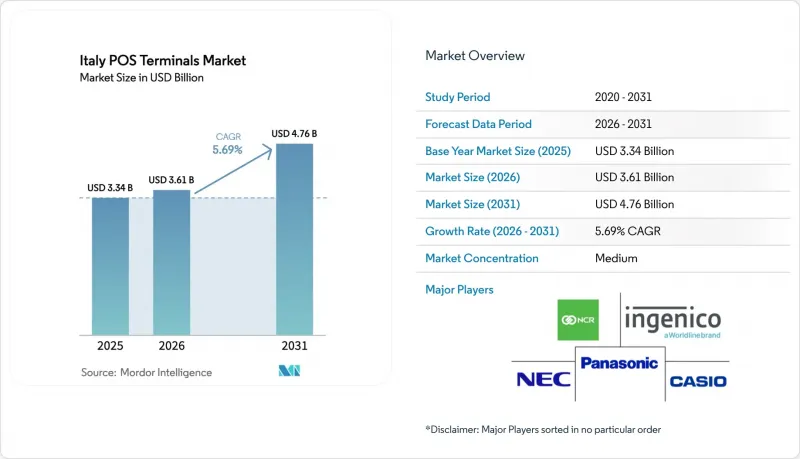
본 보고서는 결제 방식별(접촉식 및 비접촉식), POS 유형별(고정형 POS 시스템, 모바일 및 휴대용 POS 시스템), 최종 사용자 산업별(소매, 호스피탈리티, 의료, 운송 및 물류, 기타) 및 지역별로 분류되어 있습니다. 시장 전망은 금액(달러) 기준으로 제시되어 있습니다.
이탈리아 POS 단말기 시장 동향 및 인사이트
이탈리아의 중소기업 대상 세제 혜택으로 mPOS 도입 가속화
이탈리아의 결제 수수료에 대한 30% 세액 공제로 인해 국내 150만 명의 개인 사업자의 본인 부담금이 경감되었으며, 모바일 카드 리더기의 투자 회수 기간이 18개월에서 1년 미만으로 단축되었습니다. SumUp 및 myPOS와 같은 단말기 공급업체들은 정액 요금제와 당일 결제를 결합하여 이러한 세제 혜택을 활용하고 있으며, 이러한 접근 방식을 통해 기존 인수업체들 사이에서 일반적인 단계적 MDR(가맹점 수수료) 체계를 회피하고 있습니다. 캄파니아주, 칼라브리아주, 시칠리아주와 같은 남부 지역에서는 2022년에 75% 이상을 차지했던 현금 이용률이 2025년까지 북부 지역과 거의 동일한 수준으로 떨어졌으며, 지역 간 디지털 결제 격차가 8포인트 축소되었습니다. 그러나 2026년에 예정된 보조금 만료 조항으로 인해 가격에 가장 민감한 소규모 사업자의 도입이 정체될 우려가 있어, 보조금 갱신이 중요한 정책적 변수로 대두되고 있습니다. 이에 대응해 하드웨어 제조업체들은 재고 스캐너 기능도 갖춘 저비용 안드로이드 기반 단말기를 적극 홍보하고 있으며, 이를 통해 가격 탄력성으로 인한 도입 진척의 후퇴를 방지하고 있습니다.
전자 청구서 및 회계 영수증 의무화에 관한 법률
2026년에 도입될 모든 매출 영수증을 ‘Sistema di Interscambio(SDI)’를 통해 전송해야 한다는 요건으로 인해, 기업들은 327만 대의 단말기를 업그레이드하거나 개조해야 하지만, 그 중 상당수는 실시간 데이터 교환에 필요한 API를 갖추고 있지 않습니다. 각 벤더사는 현재 SDI 모듈과 클라우드 커넥터를 사전 설치하여 POS 단말기를 VAT 데이터 및 청구서 이미지를 자동으로 보관하는 규정 준수 게이트웨이로 전환하고 있습니다. 소매 및 호스피탈리티 업계의 체인점들은 벌금을 피하기 위해 2024년에 조기 도입을 시작하고 있으며, 이로 인해 여러 매장에 펌웨어 업데이트를 배포하는 자동 패치 관리 서비스에 대한 2차 수요가 발생하고 있습니다. 엡손, 커스텀, 올리베티의 영수증 프린터는 독자적인 프로토콜을 채택하고 있어 통합상의 과제가 여전히 남아 있으며, 소프트웨어 브리지 구축에 레인당 100-200유로(119-237달러)의 추가 비용이 듭니다. 그러나 결제 데이터와 세무 보고의 연동을 통해 현금 흐름의 투명성이 향상되었으며, 이러한 이점은 중소기업에 대한 대출 및 보험 인수를 담당하는 금융 기관과 보험 회사에 큰 매력으로 작용하고 있습니다.
소액 거래에 부과되는 높은 인터체인지 수수료와 MDR 수수료
EU 규정 2015/751에서는 인터체인지 수수료 상한선을 직불카드의 경우 0.2%, 신용카드의 경우 0.3%로 정하고 있지만, 아퀴어러의 마진과 단말기 임대료를 고려하면 이탈리아 가맹점은 여전히 1.5-2.5%의 총 처리 비용을 부담하고 있습니다. 2유로(2.37달러)짜리 에스프레소를 판매하는 카페의 경우, 거래당 0.10유로(0.12달러)에 달하는 고정 수수료로 인해 이익이 완전히 사라지기 때문에 소비자를 현금 결제로 유도하는 최소 구매 금액 규정을 마련하게 되었습니다. 카드 결제를 거부할 경우 부과되는 정부의 30유로(35.6달러) 벌금에 더해, 청구 금액의 4%에 해당하는 과징금은 경제적 개선이라기보다는 가시성을 높이는 결과로 이어져, 소액 거래를 하는 사업자들 사이에서 불만을 야기하고 있습니다. Visa나 Mastercard의 네트워크 이용료 산정에는 협상 여지가 없기 때문에 아퀴어러는 수수료 추가 인하에 고심하고 있으며, 그 압박은 Nexi와 같은 수직 통합형 사업자가 흡수할 수 있는 하드웨어 보조금으로 옮겨가고 있습니다. 비용 절감 메커니즘이 없다면, 세액 공제가 사라질 경우 수수료에 대한 민감도가 mPOS의 보급을 둔화시킬 가능성이 있습니다.
부문 분석
2025년에는 비접촉식 거래가 총 결제 처리액의 76.72%를 차지한 것으로 평가되었으며, 이는 마찰 없는 ‘카드 온 파일(Card on File)’ 경험을 원하는 소비자 수요를 반영한 것입니다. 이 점유율은 플라스틱 카드 이외의 분야로 NFC의 적용 범위를 넓히는 지갑 기반 인증 정보 및 웨어러블 단말기에 힘입어 2031년까지 연평균 성장률(CAGR) 5.81%로 꾸준히 상승할 것으로 예측됩니다. 이 부문에서 이탈리아 POS 단말기 시장 규모의 확대는 로마 대중교통의 현대화와 밀접한 관련이 있습니다. 로마에서는 비접촉식 개찰기 도입으로 종이 승차권이 필요 없어지면서, 통근자들이 소매점에서도 유사한 행동 양식을 보이게 되었습니다. 팬데믹 이후 기록적인 수로 방문하는 ‘모바일 퍼스트’ 관광객들은 이 유서 깊은 도시 수요 정점을 견인하고 있습니다. 한편, 유럽중앙은행이 정한 50유로(59.4달러)의 비접촉 결제 한도 덕분에 일상 지출의 대부분에서 PIN 코드 없이 결제가 가능해졌습니다. 기존의 접촉식 결제 방식이 남아 있는 경우는 비접촉 결제 한도를 초과하는 거래나, 보석류 및 규제 대상 상품 등 연령 확인이 의무화된 경우에 국한됩니다. 시장이 포화 상태에 가까워짐에 따라, 아퀴어러는 거래량에서 비접촉 결제의 행동 분석을 수익화하는 고부가가치 데이터 서비스로 초점을 옮기고 있습니다. 이 전략은 2025년 계약에 포함된 Nexi의 지출 분석 대시보드에서도 드러납니다. 가맹점의 인센티브는 기본적인 보안 대책에서 근무 시간당 구매 건수로 측정되는 대기 시간 단축으로 전환되고 있으며, 이는 수익성과 직결됩니다.
남아 있는 접촉형 결제 부문은 더 이상 성장 동력이라기보다는 규정 준수상의 안전 장치 역할을 하고 있습니다. 칩 및 PIN 결제에 연계된 AML(자금 세탁 방지) 및 KYC(고객 신원 확인) 검사는 고액 결제나 국경을 넘는 환불 시 여전히 필수적이지만, 기기 제조업체들은 듀얼 인터페이스 칩을 탑재하고 있으며, NFC를 지원하지 않는 카운터형 단말기는 출하되지 않고 있습니다. 2024년과 2025년에 은행이 주도하는 소비자 인식 제고 캠페인으로 인해 고령층의 거부감은 더욱 줄어들 것이며, 한편 사회 복지 프로그램에서는 선불식 비접촉식 카드를 통해 복지 급여금이 지급되게 되어 지방에서의 이용이 확대될 것입니다. 그 결과, 이탈리아의 POS 단말기 시장에서는 비접촉 기능이 표준 사양으로 탑재되며, 스와이프 전용이었던 구형 하드웨어는 물리적 수명이 다하기 훨씬 전에 구식이 될 것입니다.
기타 혜택 :
- 엑셀 형식 시장 예측(ME) 시트
- 3개월간의 애널리스트 지원
자주 묻는 질문
목차
제1장 서론
제2장 조사 방법
제3장 개요
제4장 시장 구도
제5장 시장 규모 및 성장 예측
제6장 경쟁 구도
제7장 시장 기회 및 향후 전망
AJY 26.09.01According to Mordor Intelligence, the Italy POS terminals market size is expected to increase from USD 3.34 billion in 2025 to USD 3.61 billion in 2026 and reach USD 4.76 billion by 2031, growing at a CAGR of 5.69% over 2026-2031.
This report is Segmented by Mode of Payment Acceptance (Contact-Based, and Contactless), POS Type (Fixed Point-Of-Sale Systems, and Mobile and Portable Point-Of-Sale Systems), End-User Industry (Retail, Hospitality, Healthcare, Transportation and Logistics, and Mores), and Geography. The Market Forecasts are Provided in Terms of Value (USD).
Italy POS Terminals Market Trends and Insights
mPOS Adoption Accelerated by Italy's Small-Merchant Tax Incentives
Italy's 30% tax credit on acquiring fees lowers out-of-pocket costs for the nation's 1.5 million sole proprietors, compressing the pay-back period for mobile card readers from 18 months to less than a year. Device vendors such as SumUp and myPOS harness the incentive by bundling flat-rate pricing with same-day settlement, an approach that sidesteps the tiered MDR grids prevalent among incumbent acquirers. Southern regions, Campania, Calabria, and Sicily, shifted from more than 75% cash usage in 2022 to near-parity with the north by 2025, narrowing the regional digital-payments gap by 8 percentage points. The subsidy's sunset clause in 2026, however, threatens to stall deployment among the most price-sensitive micro-merchants, making renewal a key policy variable. Hardware makers respond by pushing lower-cost, Android-based terminals that double as inventory scanners, ensuring price elasticity does not reverse adoption gains.
Mandatory Electronic Invoice and Fiscal Receipt Laws
The 2026 requirement to route every sales receipt through the Sistema di Interscambio (SDI) compels businesses to upgrade or retrofit 3.27 million terminals, many of which lack APIs for real-time data exchange. Vendors now pre-install SDI modules and cloud connectors, converting the POS device into a compliance gateway that automatically archives VAT data and invoice images. Retail and hospitality chains began early roll-outs in 2024 to avoid fines, prompting secondary demand for automated patch-management services that push firmware updates across multiple stores. Integration challenges persist because fiscal printers from Epson, Custom, and Olivetti use proprietary protocols, adding EUR 100-200 (USD 119-237) per lane to bridge software. Nevertheless, linkage between payment capture and tax reporting improves cash-flow transparency, a benefit that resonates with lenders and insurance providers underwriting small businesses.
High Interchange and MDR Fees on Low-Value Transactions
EU Regulation 2015/751 caps interchange at 0.2% for debit and 0.3% for credit, but Italian merchants still shoulder all-in processing costs of 1.5-2.5% once acquirer mark-ups and terminal rentals are factored in. For cafes selling EUR 2.00 (USD 2.37) espressos, fixed per-transaction fees as high as EUR 0.10 (USD 0.12) can erase margin entirely, prompting minimum-purchase rules that nudge consumers back to cash. The government's EUR 30 (USD 35.6) fine plus 4% of invoice value for refusing cards has improved visibility rather than economics, creating resentment among low-ticket operators. Acquirers struggle to cut rates further because network assessments from Visa and Mastercard are non-negotiable, shifting pressure toward hardware subsidies that vertically-integrated players like Nexi can absorb. Without a cost-down mechanism, fee sensitivity may slow mPOS adoption once tax credits disappear.
Other drivers and restraints analyzed in the detailed report include:
- Contactless and NFC Penetration Outpacing Cardholder Base
- Migration to Cloud POS for Omnichannel Retail
- Fragmented Legacy Fiscal Printer Infrastructure
For complete list of drivers and restraints, kindly check the Table Of Contents.
Segment Analysis
Contactless transactions captured 76.72% of overall acceptance volume in 2025, mirroring consumer appetite for frictionless, card-on-file experiences. That share is forecast to climb steadily at a 5.81% CAGR through 2031, propelled by wallet-based credentials and wearables that extend NFC beyond plastic cards. Italy POS terminals market size expansion in this segment dovetails with Rome's public-transport upgrades, where contactless validators eliminated the need for paper tickets and set behavioral norms commuters carry into retail. Mobile-first tourists arriving in post-pandemic record numbers reinforce demand peaks in heritage cities, while the European Central Bank's EUR 50 (USD 59.4) contactless limit renders PIN-less payments viable for most daily spend. Legacy contact-based workflows persist only where value exceeds the tap ceiling or where age-based verification is compulsory, such as jewelry and regulated goods. As saturation nears, acquirers shift focus from volume to value-added data services that monetize contactless behavioral insights, a strategy visible in Nexi's spend-analytics dashboards bundled into 2025 contracts. For merchants, the incentive pivots from hygiene to queue-time reduction, measured in purchases per labor hour, which aligns directly with profitability.
The residual contact-based segment now functions as a compliance back-stop rather than a growth engine. AML and KYC checks linked to chip-and-PIN flows remain essential for high-ticket or cross-border refunds, but device makers embed dual-interface chips so that no countertop terminal ships without NFC. Consumer education campaigns led by banks in 2024 and 2025 further erode reluctance among seniors, while social-transfer programs disburse welfare benefits via prepaid contactless cards, lifting rural usage. Consequently, the Italy POS terminals market embeds contactless capability as a default specification, making older swipe-only hardware obsolete well ahead of physical end-of-life expectations.
Complete Report Scope:
- By Mode of Payment
- Contact-based
- Contactless
- By POS Type
- Fixed Point-of-Sale Systems
- Mobile and Portable Point-of-Sale Systems
- By End-User Industry
- Retail
- Hospitality
- Healthcare
- Transportation and Logistics
- Other End-User Industries
List of Companies Covered in this Report:
- Nexi SpA
- Worldline SA (Ingenico)
- Verifone Systems Inc.
- PAX Technology Ltd.
- Diebold Nixdorf Inc.
- NCR Corporation
- SumUp Payments Ltd.
- myPOS World Ltd.
- Adyen N.V.
- Square Inc.
- Fiserv Inc.
- Panasonic Corporation
- Samsung Electronics Co. Ltd.
- Oracle Corporation (MICROS)
- Lightspeed Commerce Inc.
- Cegid Group
- Aptos LLC
- Elavon Inc.
- PayPal Holdings Inc. (Zettle)
- Credit Agricole Italia
- Shopify Inc.
- Euronet Worldwide Inc. (epay)
- Axerve SpA
- Zucchetti Group
- Olivetti SpA
Additional Benefits:
- The market estimate (ME) sheet in Excel format
- 3 months of analyst support
TABLE OF CONTENTS
1 INTRODUCTION
- 1.1 Study Assumptions and Market Definition
- 1.2 Scope of the Study
2 RESEARCH METHODOLOGY
3 EXECUTIVE SUMMARY
4 MARKET LANDSCAPE
- 4.1 Market Overview
- 4.2 Market Drivers
- 4.2.1 mPOS Adoption Accelerated by Italy's Small-Merchant Tax Incentives
- 4.2.2 Mandatory Electronic Invoice and Fiscal Receipt Laws
- 4.2.3 Contactless and NFC Penetration Outpacing Cardholder Base
- 4.2.4 Migration to Cloud POS for Omnichannel Retail
- 4.2.5 Banking Consolidation Fueling Integrated Payments (Nexi-SIA Merger)
- 4.2.6 Tourism Rebound Driving Hospitality POS Upgrades
- 4.3 Market Restraints
- 4.3.1 High Interchange and MDR Fees on Low-Value Transactions
- 4.3.2 Fragmented Legacy Fiscal Printer Infrastructure
- 4.3.3 Cyber-security Breach Concerns Among SMEs
- 4.3.4 Supply-chain Lead-times for PCI-PTS v6 Hardware
- 4.4 Industry Value Chain Analysis
- 4.5 Regulatory Outlook (PSD2, PCI-DSS, Italian Fiscal Receipt Law)
- 4.6 Technological Outlook
- 4.7 Porter's Five Forces Analysis
- 4.7.1 Bargaining Power of Suppliers
- 4.7.2 Bargaining Power of Buyers
- 4.7.3 Threat of New Entrants
- 4.7.4 Threat of Substitutes
- 4.7.5 Intensity of Competitive Rivalry
- 4.8 Impact of Macroeconomic Factors on the Market
- 4.9 Analysis of Major Case Studies
5 MARKET SIZE AND GROWTH FORECASTS (VALUE)
- 5.1 By Mode of Payment
- 5.1.1 Contact-based
- 5.1.2 Contactless
- 5.2 By POS Type
- 5.2.1 Fixed Point-of-Sale Systems
- 5.2.2 Mobile and Portable Point-of-Sale Systems
- 5.3 By End-User Industry
- 5.3.1 Retail
- 5.3.2 Hospitality
- 5.3.3 Healthcare
- 5.3.4 Transportation and Logistics
- 5.3.5 Other End-User Industries
6 COMPETITIVE LANDSCAPE
- 6.1 Market Concentration
- 6.2 Strategic Moves
- 6.3 Market Share Analysis
- 6.4 Company Profiles (includes Global Level Overview, Market Level Overview, Core Segments, Financials as available, Strategic Information, Market Rank/Share, Products and Services, Recent Developments)
- 6.4.1 Nexi SpA
- 6.4.2 Worldline SA (Ingenico)
- 6.4.3 Verifone Systems Inc.
- 6.4.4 PAX Technology Ltd.
- 6.4.5 Diebold Nixdorf Inc.
- 6.4.6 NCR Corporation
- 6.4.7 SumUp Payments Ltd.
- 6.4.8 myPOS World Ltd.
- 6.4.9 Adyen N.V.
- 6.4.10 Square Inc.
- 6.4.11 Fiserv Inc.
- 6.4.12 Panasonic Corporation
- 6.4.13 Samsung Electronics Co. Ltd.
- 6.4.14 Oracle Corporation (MICROS)
- 6.4.15 Lightspeed Commerce Inc.
- 6.4.16 Cegid Group
- 6.4.17 Aptos LLC
- 6.4.18 Elavon Inc.
- 6.4.19 PayPal Holdings Inc. (Zettle)
- 6.4.20 Credit Agricole Italia
- 6.4.21 Shopify Inc.
- 6.4.22 Euronet Worldwide Inc. (epay)
- 6.4.23 Axerve SpA
- 6.4.24 Zucchetti Group
- 6.4.25 Olivetti SpA
7 MARKET OPPORTUNITIES AND FUTURE OUTLOOK
- 7.1 White-Space and Unmet-Need Assessment


