

|
시장보고서
상품코드
2117280
중국의 POS 단말기 : 시장 점유율 분석, 업계 동향과 통계, 성장 예측(2026-2031년)China POS Terminals - Market Share Analysis, Industry Trends & Statistics, Growth Forecasts (2026 - 2031) |
||||||
 Mordor Intelligence
Mordor Intelligence에 따르면 중국의 POS 단말기 시장 규모는 2025년에 69억 2,000만 달러로 평가되며, 2026년 72억 8,000만 달러에서 2031년까지 93억 7,000만 달러에 달할 것으로 예측되며, 예측 기간(2026-2031년) 동안 CAGR은 5.17%가 될 전망입니다.
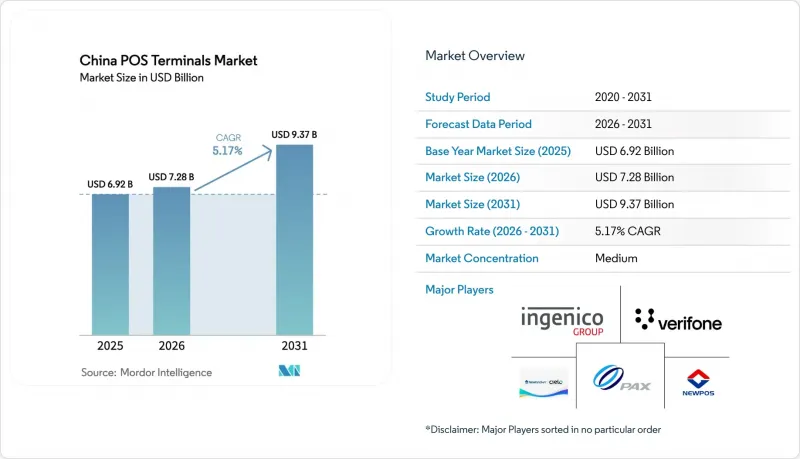
본 보고서는 결제 방식(접촉식 및 비접촉식), POS 유형(고정형 POS 시스템 및 모바일/휴대용 POS 시스템), 최종사용자 산업(소매, 호스피탈리티, 의료, 운송·물류, 기타 최종사용자 산업)별로 분류되어 있습니다. 시장 예측은 금액(달러) 기준으로 제시되어 있습니다.
중국 POS 단말기 시장의 동향 및 인사이트
디지털 위안화 시범 운영을 통한 정부의 무현금 경제 추진
디지털화폐의 시범 운영이 확대됨에 따라, 외국인 관광객은 1회 거래 한도 5,000달러, 연간 상한액 5만 달러 범위 내에서 지갑에 충전할 수 있게 되었으며, 디지털 위안화와 국제 카드 스킴을 모두 처리할 수 있는 듀얼 지원 단말기에 대한 수요가 촉진되고 있습니다. 관광객을 대상으로 하는 시설에서는 다중 결제 시스템 지원 하드웨어의 도입이 필수적인 반면, 암호화 관련 규제로 인해 단말기 내 암호화 모듈의 탑재가 의무화되어 있습니다. 규제에 대한 깊은 전문 지식을 갖춘 유서 깊은 벤더들은 이러한 인증 프로세스의 복잡화로 인해 혜택을 보고 있습니다.
모바일 지갑 지원 NFC POS의 급속한 확대
알리페이의 ‘탭 투 페이(Tap to Pay)’ 캠페인과 80만 곳의 의료 시설에 11억 2,000만 장의 의료 보험 QR코드가 도입됨에 따라 NFC 단말기 수주가 가속화되고 있습니다. 패스트푸드 체인에서는 생체 인증 지원 NFC 단말기를 활용하고 있으며, 베이징 지하철이 외국 은행 카드 사용을 허용한 것은 여러 지갑을 지원하는 탭 결제 솔루션으로의 전환을 뒷받침하고 있습니다. 단말기 사양에는 현재 사회보험 시스템과의 연동 및 생체 인증을 통한 본인 확인 기능이 포함되어 있습니다.
POS 네트워크를 표적으로 한 사이버 공격 증가
고도화된 공격은 현재 펌웨어와 클라우드 게이트웨이를 표적으로 삼고 있으며, 개인정보보호법에 따른 규정 준수 예산의 증가를 초래하고 있습니다. 소규모 인수업체들은 연중무휴 24시간 감시에 어려움을 겪고 있으며, 라이선스 취소 위험이 높아지면 시장에서 철수할 가능성이 있습니다.
부문 분석
비접촉식 시스템은 2025년 중국 POS 단말기 시장 점유율의 58.12%를 차지했으며, 탭 앤 고(Tap & Go)의 편의성이 위생적 고려 사항과 부합함에 따라 2031년까지 연평균 성장률(CAGR) 6.71%로 성장할 것으로 예상됩니다. 이 부문은 외국인 관광객에 대한 1회당 거래 한도를 철폐하는 정부의 규제에 힘입어 성장하고 있으며, 가맹점들이 듀얼 스킴을 지원하는 NFC 단말기로 교체하도록 촉진하고 있습니다.
얼굴 인식에서 지문 센서에 이르는 생체 인증 기능이 현재 비접촉 결제 흐름에 통합되어 있어 솔루션의 복잡성을 높이고 있습니다. 고액 거래나 국경 간 거래에서는 여전히 ‘칩 앤 PIN’ 방식이 채택되고 있어 틈새 시장에서 그 중요성을 유지하고 있습니다. 베이징 지하철에서 여러 전자지갑을 지원하는 사례는 비접촉식 단말기가 교통, 소매, 국제적 사용 사례를 하나의 단말기에 통합할 수 있음을 입증하고 있습니다.
기타 혜택:
- 엑셀 형식의 시장 예측(ME) 시트
- 3개월간의 애널리스트 지원
자주 묻는 질문
목차
제1장 소개
제2장 조사 방법
제3장 주요 요약
제4장 시장 구도
제5장 시장 규모와 성장 예측
제6장 경쟁 구도
제7장 시장 기회와 향후 전망
KSM 26.08.26According to Mordor Intelligence, the China POS terminals market size was valued at USD 6.92 billion in 2025 and estimated to grow from USD 7.28 billion in 2026 to reach USD 9.37 billion by 2031, at a CAGR of 5.17% during the forecast period (2026-2031).
This report is Segmented by Mode of Payment Acceptance (Contact-Based, and Contactless), POS Type (Fixed Point-Of-Sale Systems, and Mobile/Portable POS Systems), End-User Industry (Retail, Hospitality, Healthcare, Transportation and Logistics, and Other End-User Industries). The Market Forecasts are Provided in Terms of Value (USD).
China POS Terminals Market Trends and Insights
Government Push for Cashless Economy via Digital-Yuan Pilots
Expanded digital-currency pilots now allow foreign visitors to top up wallets with single-transaction limits of USD 5,000 and annual caps of USD 50,000, stimulating demand for dual-acceptance terminals capable of processing Digital Yuan and international card schemes. Tourist-facing venues must deploy multi-scheme hardware, while cryptography regulations enforce on-device encryption modules. Established vendors with deep regulatory expertise benefit from the resulting certification complexity.
Rapid Expansion of Mobile-Wallet-Ready NFC POS
Alipay's "Tap-to-Pay" campaign and the rollout of 1.12 billion medical-insurance QR codes across 800,000 healthcare sites accelerate NFC terminal orders. QSR chains leverage biometric NFC devices, and Beijing Metro's acceptance of foreign bank cards underscores the shift toward multi-wallet tap solutions. Terminal specifications now encompass social-insurance system links and biometric ID checks.
Rising Cyber-attacks Targeting POS Networks
Sophisticated breaches now target firmware and cloud gateways, inflating compliance budgets under the Personal Information Protection Law. Smaller acquirers struggle with 24/7 monitoring and may exit the market if license revocation risks escalate.
Other drivers and restraints analyzed in the detailed report include:
- Increasing Adoption by SMEs and QSRs
- Integration of AI-Powered Fraud-Detection Chips
- Price Pressure from SoftPOS Smartphone Apps
For complete list of drivers and restraints, kindly check the Table Of Contents.
Segment Analysis
Contactless systems captured 58.12% of the China POS terminals market share in 2025 and will grow at a 6.71% CAGR through 2031 as tap-and-go convenience aligns with hygiene preferences. The segment enjoys support from government rules lifting single-transaction caps for foreign visitors, spurring merchant upgrades to dual-scheme NFC terminals.
Biometric authentication layers, from facial recognition to fingerprint sensors, now accompany contactless flows, deepening solution complexity. Chip-and-PIN remains for high-value and cross-border transactions, preserving niche relevance. Beijing Metro's multi-wallet acceptance proves that contactless devices can merge transport, retail, and international use cases under one chassis.
Complete Report Scope:
- By Mode of Payment Acceptance
- Contact-based
- Contactless
- By POS Type
- Fixed Point-of-Sale Systems
- Mobile / Portable Point-of-Sale Systems
- By End-User Industry
- Retail
- Hospitality
- Healthcare
- Transportation and Logistics
- Other End-User Industries
List of Companies Covered in this Report:
- Ingenico Group SA
- Verifone Systems LLC
- PAX Global Technology Limited
- Fujian Newland Payment Technology Co., Ltd.
- New POS Technology Limited
- Shenzhen Xinguodu Technology Co., Ltd.
- Bitel Co., Ltd.
- Centerm Information Co., Ltd.
- Sunmi Technology Co., Ltd.
- Urovo Technology Co., Ltd.
- Justtide Technology Co., Ltd.
- Castles Technology Co., Ltd.
- Hisense Intelligent Commercial Equipment Co., Ltd.
- Guangzhou Zonerich Business Machine Co., Ltd.
- BBPOS Limited
- Sunyard Technology Co., Ltd.
- Wintec POS Co., Ltd.
- Equinox Payments LLC
- NEC Corporation
Additional Benefits:
- The market estimate (ME) sheet in Excel format
- 3 months of analyst support
TABLE OF CONTENTS
1 INTRODUCTION
- 1.1 Study Assumptions and Market Definition
- 1.2 Scope of the Study
2 RESEARCH METHODOLOGY
3 EXECUTIVE SUMMARY
4 MARKET LANDSCAPE
- 4.1 Market Overview
- 4.2 Market Drivers
- 4.2.1 Government Push for Cashless Economy via Digital-Yuan Pilots
- 4.2.2 Rapid Expansion of Mobile-Wallet-Ready NFC POS
- 4.2.3 Increasing Adoption by SMEs and QSRs
- 4.2.4 Integration of AI-Powered Fraud-Detection Chips
- 4.2.5 Rise of Unattended Smart POS in Tier-3 Cities
- 4.2.6 Mandated EMV-L3 Certification for Transit POS
- 4.3 Market Restraints
- 4.3.1 Rising Cyber-attacks Targeting POS Networks
- 4.3.2 Price Pressure from SoftPOS Smartphone Apps
- 4.3.3 Semiconductor Supply-Chain Volatility
- 4.3.4 Data-Localization Compliance Cost Spike
- 4.4 Industry Value Chain Analysis
- 4.5 Regulatory Landscape
- 4.5.1 Key Regulations and Compliance Standards
- 4.6 Impact of Macroeconomic Factors
- 4.7 Technological Outlook
- 4.8 Porter's Five Forces Analysis
- 4.8.1 Bargaining Power of Suppliers
- 4.8.2 Bargaining Power of Buyers
- 4.8.3 Threat of New Entrants
- 4.8.4 Intensity of Competitive Rivalry
- 4.8.5 Threat of Substitutes
- 4.9 Analysis of Major Case Studies
5 MARKET SIZE AND GROWTH FORECASTS (VALUE)
- 5.1 By Mode of Payment Acceptance
- 5.1.1 Contact-based
- 5.1.2 Contactless
- 5.2 By POS Type
- 5.2.1 Fixed Point-of-Sale Systems
- 5.2.2 Mobile / Portable Point-of-Sale Systems
- 5.3 By End-User Industry
- 5.3.1 Retail
- 5.3.2 Hospitality
- 5.3.3 Healthcare
- 5.3.4 Transportation and Logistics
- 5.3.5 Other End-User Industries
6 COMPETITIVE LANDSCAPE
- 6.1 Market Concentration
- 6.2 Strategic Moves
- 6.3 Market Share Analysis
- 6.4 Company Profiles (includes Global level Overview, Market level overview, Core Segments, Financials as available, Strategic Information, Market Rank/Share for key companies, Products and Services, and Recent Developments)
- 6.4.1 Ingenico Group SA
- 6.4.2 Verifone Systems LLC
- 6.4.3 PAX Global Technology Limited
- 6.4.4 Fujian Newland Payment Technology Co., Ltd.
- 6.4.5 New POS Technology Limited
- 6.4.6 Shenzhen Xinguodu Technology Co., Ltd.
- 6.4.7 Bitel Co., Ltd.
- 6.4.8 Centerm Information Co., Ltd.
- 6.4.9 Sunmi Technology Co., Ltd.
- 6.4.10 Urovo Technology Co., Ltd.
- 6.4.11 Justtide Technology Co., Ltd.
- 6.4.12 Castles Technology Co., Ltd.
- 6.4.13 Hisense Intelligent Commercial Equipment Co., Ltd.
- 6.4.14 Guangzhou Zonerich Business Machine Co., Ltd.
- 6.4.15 BBPOS Limited
- 6.4.16 Sunyard Technology Co., Ltd.
- 6.4.17 Wintec POS Co., Ltd.
- 6.4.18 Equinox Payments LLC
- 6.4.19 NEC Corporation
7 MARKET OPPORTUNITIES AND FUTURE OUTLOOK
- 7.1 White-space and Unmet-need Assessment


