|
시장보고서
상품코드
2116091
유럽의 카펫 타일 : 시장 점유율 분석, 업계 동향과 통계, 성장 예측(2026-2031년)Europe Carpet Tile - Market Share Analysis, Industry Trends & Statistics, Growth Forecasts (2026 - 2031) |
||||||
 Mordor Intelligence
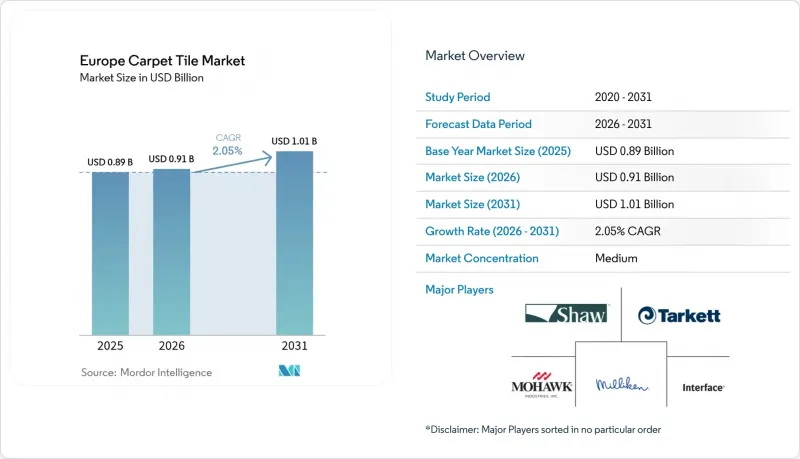
Mordor Intelligence에 따르면 유럽의 카펫 타일 시장 규모는 2025년에 8억 9,000만 달러로 평가되며, 2026년 9억 1,000만 달러에서 2031년까지 10억 1,000만 달러에 달할 것으로 예측되며, 예측 기간(2026-2031년) 동안 CAGR은 2.05%가 될 전망입니다.
본 보고서는 섬유 종류(나일론, 폴리에스터(PET), 폴리프로필렌, 울, 바이오 기반 섬유, 기타 섬유), 최종사용자(주거용, 상업용), 건설 형태(신축, 개보수·리모델링), 유통 채널(B2C/소매 소비자, B2B/시공업체·건설업체), 및 지역(영국, 기타)별로 분류되어 있습니다. 시장 전망은 금액(달러) 기준으로 제시되어 있습니다.
유럽 카펫 타일 시장의 동향 및 인사이트
상업 시설 리노베이션에서 모듈식이며 유지보수 부담이 적은 바닥재에 대한 선호도 증가
현재 상업용 부동산 소유주들은 임차인에게 미치는 영향을 최소화하고 유지 관리 예산을 절감하기 위해 카펫 타일을 지정하고 있습니다. 타일을 개별적으로 교체할 수 있는 인터페이스 덕분에 유동 인구가 많은 구역을 하룻밤 사이에 새롭게 단장할 수 있어, 가동 중단 시간을 단축하고 임차인의 만족도를 높일 수 있습니다. Tarkett사에 따르면, 2025년에는 자사의 상업용 카펫 매출의 62% 이상을 카펫 타일이 차지했으며, EcoBase를 채택한 모듈은 소각 처분에 비해 최대 84%의 CO2 감축을 실현하고 있다고 합니다. 이러한 운영상의 유연성은 특히 인테리어 비용을 임대인이 부담하는 관할 구역에서 임대 계약 협상 시 핵심적인 가치 요소로 작용하고 있습니다. 따라서 부동산 소유주가 바닥재 선정을 포트폴리오 수익률 관리와 연계함에 따라, 유럽의 카펫 타일 시장은 모듈화로의 구조적 전환으로 인한 혜택을 누리고 있습니다. 또한, 미리 절단된 타일은 시공 시 발생하는 폐기물을 줄여주므로, 엄격해지는 EU 공시 규정에 따라 ESG 목표 달성을 더욱 뒷받침하고 있습니다.
팬데믹 이후 사무실 인테리어 공사 및 하이브리드 업무 공간 재설계의 급증
하이브리드 근무 방식의 도입으로 기업들은 사무실을 협업 클러스터, 조용한 포드, 터치다운 포인트와 같은 구역으로 재구성할 수밖에 없었습니다. 카펫 타일은 흡음 효과가 있어 이용 패턴이 변화했을 때도 신속한 재구성이 가능합니다. 프라하에서는 2024년 인테리어 예산이 평균 1,235유로/m²(1,350달러/m²)이며, 개발업체들은 시공 일정을 단축하고 인건비를 절감하기 위해 점점 더 타일을 선택하고 있습니다. 호스피탈리티 업계에서도 유사한 전략이 채택되어, 모듈식 바닥재를 활용함으로써 회의실을 몇 시간 이내에 연회장으로 전환할 수 있게 되었습니다. 이러한 ‘유연성’이라는 주제는 현재 기업의 부동산 부서 및 시설 관리 팀의 사양 가이드에 확고히 자리 잡았으며, 향후 2년 동안 유럽 카펫 타일 시장의 제품 수요 하한선을 견고하게 뒷받침하고 있습니다.
브로드룸 카펫에 비해 높은 초기 비용
카펫 타일은 일반적으로 동등한 브로드룸 카펫 시공에 비해 15-25%의 가격 프리미엄이 붙어, 비용에 민감한 상업 부문이나 주거용도로의 채택을 제한하고 있습니다. 이러한 가격 차이는 부분적인 교체가 가능하고 시공 시 폐기물이 감소함으로써 발생하는 수명주기 비용상의 이점에도 불구하고 여전히 존재합니다. 이 가격 차이는 제조 공정의 복잡성, 특수한 배면 시스템, 그리고 정밀한 절단 요건에 기인하며, 이로 인해 제곱미터당 생산 비용이 증가하고 있습니다. 중·동유럽 시장에서는 가격에 민감한 사양 결정자들이 카펫 타일의 운영상 이점이 있음에도 불구하고, 특히 초기 예산 제약이 장기적인 유지보수 고려 사항보다 더 큰 대규모 시공의 경우, 광폭 카펫(브로드룸) 솔루션을 선택하는 경향이 있습니다. 그러나 제조사들은 가격에 대한 우려를 해소하면서도 모듈식만이 가진 핵심적인 이점을 유지하기 위해 밑면 시스템을 간소화한 보급형 타일 제품 라인을 점점 더 많이 제공하고 있습니다.
부문 분석
나일론은 내구성과 오염 저항성 덕분에 2025년 유럽 카펫 타일 시장에서 54.10%라는 압도적인 점유율을 차지했습니다. 한편, 바이오 기반 섬유는 모든 섬유 카테고리 중 가장 높은 연평균 성장률(CAGR)인 10.38%로 성장할 것으로 예측됩니다. 이러한 성장세는 기업의 탄소 감축 목표와 순환 경제를 향한 규제 추진에 기인합니다. 어망이나 폐카펫으로 제조되는 아쿠아필(AquaFil)사의 ‘ECONYL’이 해당 기업의 섬유 생산량의 절반 이상을 차지하게 됨에 따라, 재생 나일론의 유럽 카펫 타일 시장 규모도 마찬가지로 확대되고 있습니다.
또한 각 제조사들은 재활용 PET 병에서 추출한 PET와 부티크용 울 소재도 적극 추진하고 있습니다. 이러한 대체 소재는 스코프 3 배출량을 감축하고, 친환경 라벨을 통해 차별화를 꾀하는 호텔 브랜드에게 매력적입니다. 현재 진행 중인 소재 전환에는 공급망 재편이 필요하지만, 프리미엄이자 지속가능한 SKU의 가격 책정 여지를 넓혀, 저성장 거시경제 환경 하에서도 매출 회복력을 강화하게 될 것입니다.
2025년 유럽 카펫 타일 시장의 수요 중 63.05%를 상업 시설이 차지했습니다. 사무실, 의료 시설, 교육 시설은 내구성과 음향 성능을 중시하는 사양 덕분에 전반적으로 시장을 주도하고 있습니다. 호스피탈리티 및 레저 분야는 최종사용자 그룹 중 가장 높은 9.05%의 연평균 성장률(CAGR)을 기록할 것으로 예측됩니다. 봉쇄 기간 동안 연기되었던 호텔 리모델링 공사가 현재 진행 중이며, 운영사들은 시공 속도와 디자인의 유연성을 이유로 카펫 타일을 선호하고 있습니다.
기업 사무실 설계 요건에서는 협업, 사생활 보호, 사회적 교류를 위한 구역 설정이 점점 더 요구되고 있으며, 바닥재를 전면적으로 철거하지 않고도 재배치할 수 있는 모듈식 바닥재의 도입이 촉진되고 있습니다. 교육 시설 프로젝트에서는 교실의 잔향을 줄이기 위해 쿠션 안감이 있는 타일이 채택되고 있는 반면, 병원에서는 감염 방지 프로그램을 지원하기 위해 저 VOC(휘발성 유기 화합물) 제품군이 사용되고 있습니다. 이러한 다양한 사용 사례 덕분에 유럽 카펫 타일 시장은 특정 수직 시장의 경기 변동 영향을 덜 받게 되었습니다.
기타 혜택:
- 엑셀 형식의 시장 예측(ME) 시트
- 3개월간의 애널리스트 지원
자주 묻는 질문
목차
제1장 소개
제2장 조사 방법
제3장 주요 요약
제4장 시장 구도
제5장 시장 규모와 성장 예측
제6장 경쟁 구도
제7장 시장 기회와 향후 전망
KSM 26.08.26According to Mordor Intelligence, the Europe carpet tile market size was valued at USD 0.89 billion in 2025 and estimated to grow from USD 0.91 billion in 2026 to reach USD 1.01 billion by 2031, at a CAGR of 2.05% during the forecast period (2026-2031).
This report is Segmented by Fiber Type (Nylon, Polyester (PET), Polypropylene, Wool, Bio-Based Fibres, Other Fiber Types), End User (Residential, Commercial), Construction Type (New Construction, Remodeling/Retrofit), Distribution Channel (B2C/Retail Consumers, B2B/Contractors/Builders), and Geography (United Kingdom, and Other). The Market Forecasts are Provided in Terms of Value (USD).
Europe Carpet Tile Market Trends and Insights
Growing Preference for Modular, Low-Maintenance Flooring in Commercial Refurbishments
Commercial landlords now specify carpet tiles to limit tenant disruption and keep maintenance budgets low. Interfaces that allow selective tile exchange mean high-traffic zones can be refreshed overnight, reducing downtime and improving tenant satisfaction. Tarkett indicated that carpet tiles represented more than 62% of its commercial carpet sales in 2025, with EcoBase-backed modules enabling up to 84% CO2 savings compared with incineration. This operational flexibility has become a core value driver in lease negotiations, especially in jurisdictions where fit-out costs are borne by landlords. The Europe carpet tile market therefore benefits from a structural shift toward modularity as property owners align flooring decisions with portfolio yield management. Pre-cut tiles also generate less installation waste, further supporting ESG objectives under tightening EU disclosure rules .
Surge in Post-Pandemic Office Fit-Outs & Hybrid-Workspace Redesigns
Hybrid-work adoption pushed firms to re-zone offices into collaboration clusters, quiet pods, and touchdown points. Carpet tiles offer acoustic attenuation and permit fast reconfiguration when occupancy patterns change. In Prague, 2024 fit-out budgets averaged EUR 1,235/m2 (USD 1,350/m2), and developers increasingly chose tiles to compress installation schedules and limit labor costs . Hospitality venues mirrored this strategy by using modular flooring to flip meeting rooms into banquet spaces within hours. The flexibility theme has now entrenched itself in specification guides across corporate real-estate and facility-management teams, cementing a demand floor for Europe carpet tile market products over the next two years.
Higher Upfront Cost Versus Broadloom Carpet
Carpet tiles typically command 15-25% price premiums over equivalent broadloom installations, constraining adoption in cost-sensitive commercial segments and residential applications. This pricing gap persists despite lifecycle cost advantages from selective replacement capabilities and reduced installation waste. The premium reflects higher manufacturing complexity, specialized backing systems, and precision cutting requirements that increase production costs per square meter. Price-conscious specifiers in Central and Eastern European markets often default to broadloom solutions despite carpet tiles' operational benefits, particularly in large-scale installations where upfront budget constraints outweigh long-term maintenance considerations. However, manufacturers increasingly offer entry-level tile ranges with simplified backing systems to address price sensitivity while maintaining core modular benefits.
Other drivers and restraints analyzed in the detailed report include:
- EU-Wide Carbon Footprint Disclosure Boosting Demand for Recyclable Tile Backings
- Digital Dye-Injection Enabling Low-MOQ Bespoke Patterns for Designers
- Volatility in Crude-Derived Nylon & Bitumen Raw-Material Prices
For complete list of drivers and restraints, kindly check the Table Of Contents.
Segment Analysis
Nylon held a dominant 54.10% Europe carpet tile market share in 2025 owing to its durability and stain resistance. Bio-based fibers, however, are forecast to expand at a 10.38% CAGR, the highest among all fiber categories. This momentum stems from corporate carbon targets and regulatory pushes toward circularity. The Europe carpet tile market size for regenerated nylon is rising in parallel as Aquafil's ECONYL, made from fishing nets and post-consumer carpet, now supplies more than half of the company's fiber output.
Manufacturers also promote PET derived from recycled bottles and wool for boutique applications. These substitutions lower Scope 3 emissions and appeal to hotel brands pursuing eco-label differentiation. The ongoing materials shift requires supply-chain realignment but unlocks pricing headroom for premium sustainable SKUs, reinforcing top-line resilience even in low-growth macro environments.
Commercial premises commanded 63.05% of 2025 demand in the Europe carpet tile market. Offices, healthcare campuses, and education facilities collectively dominate through specifications that reward durability and acoustic performance. Hospitality and leisure are projected to log a 9.05% CAGR, the quickest among end-user groups. Hotel refurbishments postponed during lockdowns are now underway, and operators prefer carpet tiles for their speed of installation and design flexibility.
Corporate office briefs increasingly require zoning for collaboration, privacy, and social interaction, encouraging modular flooring that can be rearranged without full rip-outs. Education projects adopt cushion-backed tiles to tame reverberation in classrooms, while hospitals use low-VOC collections to support infection-control programs. The diversity of use cases cushions the Europe carpet tile market against cyclical shocks in any single vertical.
Complete Report Scope:
- By Fiber Type
- Nylon
- Polyester (PET)
- Polypropylene
- Wool
- Bio-based Fibres
- Other Fiber Types
- By End User
- Residential
- Commercial
- Hospitality & Leisure
- Retail & Shopping Centers
- Healthcare Facilities
- Education
- Corporate Offices
- Public & Government Buildings
- Other Commercial Users
- By Construction Type
- New Construction
- Remodeling / Retrofit
- By Distribution Channel
- B2C / Retail Consumers
- Home Centers
- Specialty Flooring Stores
- Online
- Other Distribution Channels
- B2B / Contractors / Builders
- B2C / Retail Consumers
- By Country
- United Kingdom
- Germany
- France
- Spain
- Italy
- BENELUX (Belgium, Netherlands, Luxembourg)
- NORDICS (Denmark, Finland, Iceland, Norway, Sweden)
- Rest of Europe
List of Companies Covered in this Report:
- Interface, Inc.
- Tarkett S.A.
- Shaw Industries Group, Inc. (Patcraft)
- Mohawk Industries, Inc. (Karastan & IVC)
- Milliken & Company
- Forbo Holding AG
- Gerflor SAS
- Beaulieu International Group (modulyss)
- Ege Carpets A/S
- Bolon AB
- Paragon Carpet Tiles
- Burmatex Ltd.
- Fletco Carpets A/S
- Quadrant Carpet
- Object Carpet GmbH
- Amtico International
- Mannington Mills, Inc.
- Tai Ping Carpets
- Oriental Weavers
- Balta Group
Additional Benefits:
- The market estimate (ME) sheet in Excel format
- 3 months of analyst support
TABLE OF CONTENTS
1 Introduction
- 1.1 Study Assumptions & Market Definition
- 1.2 Scope of the Study
2 Research Methodology
3 Executive Summary
4 Market Landscape
- 4.1 Market Overview
- 4.2 Market Drivers
- 4.2.1 Growing preference for modular, low-maintenance flooring in commercial refurbishments
- 4.2.2 Surge in post-pandemic office fit-outs & hybrid-workspace redesigns
- 4.2.3 EU-wide carbon-foot-print disclosure boosting demand for recyclable tile backings
- 4.2.4 Digital dye-injection enabling low-MOQ bespoke patterns for designers
- 4.2.5 Accelerated shift toward healthy-building certifications (BREEAM, WELL) requiring low-VOC materials
- 4.2.6 Expansion of flexible co-working chains across tier-2 European cities
- 4.3 Market Restraints
- 4.3.1 Higher upfront cost versus broadloom carpet
- 4.3.2 Volatility in crude-derived nylon & bitumen raw-material prices
- 4.3.3 Take-back obligations raising reverse-logistics expenses
- 4.3.4 Limited installer skill pool in Central & Eastern Europe
- 4.4 Value / Supply-Chain Analysis
- 4.5 Regulatory Landscape
- 4.6 Technological Outlook
- 4.7 Porter's Five Forces
- 4.7.1 Threat of New Entrants
- 4.7.2 Bargaining Power of Suppliers
- 4.7.3 Bargaining Power of Buyers
- 4.7.4 Threat of Substitutes
- 4.7.5 Competitive Rivalry
5 Market Size & Growth Forecasts
- 5.1 By Fiber Type
- 5.1.1 Nylon
- 5.1.2 Polyester (PET)
- 5.1.3 Polypropylene
- 5.1.4 Wool
- 5.1.5 Bio-based Fibres
- 5.1.6 Other Fiber Types
- 5.2 By End User
- 5.2.1 Residential
- 5.2.2 Commercial
- 5.2.2.1 Hospitality & Leisure
- 5.2.2.2 Retail & Shopping Centers
- 5.2.2.3 Healthcare Facilities
- 5.2.2.4 Education
- 5.2.2.5 Corporate Offices
- 5.2.2.6 Public & Government Buildings
- 5.2.2.7 Other Commercial Users
- 5.3 By Construction Type
- 5.3.1 New Construction
- 5.3.2 Remodeling / Retrofit
- 5.4 By Distribution Channel
- 5.4.1 B2C / Retail Consumers
- 5.4.1.1 Home Centers
- 5.4.1.2 Specialty Flooring Stores
- 5.4.1.3 Online
- 5.4.1.4 Other Distribution Channels
- 5.4.2 B2B / Contractors / Builders
- 5.4.1 B2C / Retail Consumers
- 5.5 By Country
- 5.5.1 United Kingdom
- 5.5.2 Germany
- 5.5.3 France
- 5.5.4 Spain
- 5.5.5 Italy
- 5.5.6 BENELUX (Belgium, Netherlands, Luxembourg)
- 5.5.7 NORDICS (Denmark, Finland, Iceland, Norway, Sweden)
- 5.5.8 Rest of Europe
6 Competitive Landscape
- 6.1 Market Concentration
- 6.2 Strategic Moves
- 6.3 Market Share Analysis
- 6.4 Company Profiles (includes Global level Overview, Market level overview, Core Segments, Financials as available, Strategic Information, Market Rank/Share for key companies, Products & Services, and Recent Developments)
- 6.4.1 Interface, Inc.
- 6.4.2 Tarkett S.A.
- 6.4.3 Shaw Industries Group, Inc. (Patcraft)
- 6.4.4 Mohawk Industries, Inc. (Karastan & IVC)
- 6.4.5 Milliken & Company
- 6.4.6 Forbo Holding AG
- 6.4.7 Gerflor SAS
- 6.4.8 Beaulieu International Group (modulyss)
- 6.4.9 Ege Carpets A/S
- 6.4.10 Bolon AB
- 6.4.11 Paragon Carpet Tiles
- 6.4.12 Burmatex Ltd.
- 6.4.13 Fletco Carpets A/S
- 6.4.14 Quadrant Carpet
- 6.4.15 Object Carpet GmbH
- 6.4.16 Amtico International
- 6.4.17 Mannington Mills, Inc.
- 6.4.18 Tai Ping Carpets
- 6.4.19 Oriental Weavers
- 6.4.20 Balta Group
7 Market Opportunities & Future Outlook
- 7.1 Up-cycling-ready tile backings compatible with emerging EU Extended Producer Responsibility schemes
- 7.2 AI-driven design platforms offering virtual-to-physical "mass customisation" tiles for boutique hospitality chains