|
시장보고서
상품코드
2116092
카펫 타일 : 시장 점유율 분석, 업계 동향과 통계, 성장 예측(2026-2031년)Carpet Tile - Market Share Analysis, Industry Trends & Statistics, Growth Forecasts (2026 - 2031) |
||||||
 Mordor Intelligence
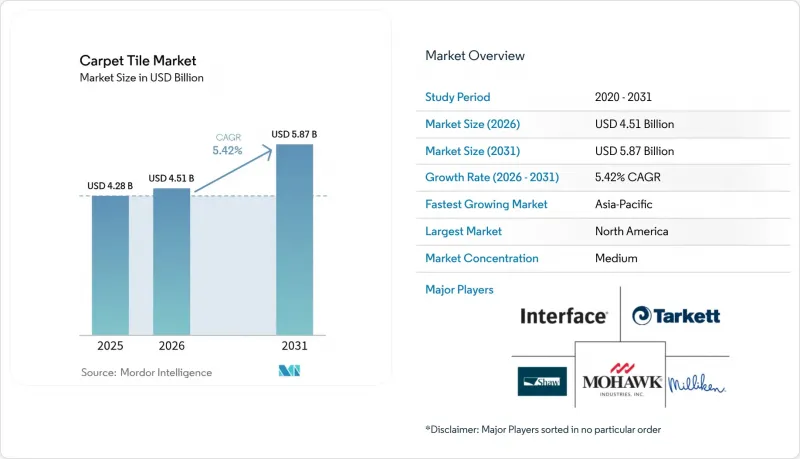
Mordor Intelligence에 따르면 카펫 타일 시장 규모는 2025년 42억 8,000만 달러에서 2026년에는 45억 1,000만 달러로 확대되고, 2026년부터 2031년까지 CAGR 5.42%를 기록하며 2031년까지 58억 7,000만 달러에 달할 것으로 예측됩니다.
본 보고서는 섬유 종류(나일론, 폴리에스터, 폴리프로필렌, 울, 바이오 유래 섬유, 기타 섬유), 최종사용자(주택, 상업 시설), 건설 유형(신축, 개보수·리노베이션), 유통 채널(B2C/소매, B2B/시공업체), 및 지역(아메리카, 유럽, 아시아태평양, 중동 및 아프리카)별로 분류되어 있습니다. 시장 예측은 금액(달러) 기준으로 제시되어 있습니다.
세계 카펫 타일 시장의 동향 및 인사이트
지속가능성을 중시한 사양 선정의 붐
기업의 ESG 목표에 따라 환경 지표는 ‘있으면 좋은’ 요소에서 ‘필수 구매 기준’으로 변화했습니다. 인터페이스(Interface)가 제시한 2040년까지의 ‘카본 네거티브’ 목표나, 쇼(Shaw)가 2018년에 달성한 상업 생산 분야의 탄소 중립은 기후 변화에 대한 노력이 제품 포트폴리오를 어떻게 재구성하고 있는지를 보여줍니다. 또한, 균사체를 이용하여 건설 폐기물을 무해화하는 ‘타르켓 마이코사이클(Tarquet MycoCycle)’과 같은 파트너십은 재생 가능한 순환 체계로의 추진력을 보여주고 있습니다. 아쿠아필(Aquafil)사가 폐기된 카펫을 원료로 하는 재생 나일론 ‘에코닐(ECONYL)’의 생산을 확대하고 있는 것은 폐쇄형 생산 사이클을 촉진하고, 버진 석유화학제품에 대한 의존도를 낮추고 있습니다. 건축가의 사양서에서는 ‘크래들 투 크래들(C2C)’이나 ‘인보디드 카본(내재된 탄소)’ 지표가 점점 더 많이 참조되고 있으며, 재활용 소재나 바이오 기반 소재의 함유 여부가 조달의 필수 조건이 되고 있습니다. 필 앤 스틱(Peel & Stick) 방식의 시스템은 습식 접착제를 배제하고, 사용 후 회수를 간소화함으로써 폐기물 최소화에 기여하고 있습니다.
상업 시설 리노베이션 주기의 회복
팬데믹의 영향으로 연기되었던 프로젝트들이, 이용자들이 하이브리드형 모델을 지향하는 업무 공간 재구상을 추진함에 따라 다시 수면 위로 떠오르고 있습니다. 맥킨지는 사무실이 기술을 활용한 협업 허브로 변모하고 있으며, 유연한 레이아웃에 대응하기 위한 바닥재 업그레이드가 촉진되고 있다고 지적합니다. CBRE의 2025년 1분기 매출이 12% 증가한 것은 특히 의료 및 기술 분야의 인테리어 공사 수요 증가와 일치합니다. 인터페이스(Interface)는 아메리카에서 수주가 17% 증가했고, 교육 분야의 매출이 18% 증가했다고 보고했으며, 이는 리모델링 비용이 카펫 타일 수주로 직접 이어지고 있음을 뒷받침합니다. JLL의 디자인 보고서에 따르면, 적응형 재사용이 주목받고 있는 반면, 교육 시설에서는 경제 부양책 자금을 활용하여 바닥재 교체가 진행되고 있습니다. 이러한 동향은 카펫 타일 시장을 지탱하는 꾸준한 교체 주기를 뒷받침하고 있습니다.
하드 서피스(LVT)에 의한 시장 잠식
럭셔리 비닐 타일(LVT)의 수입이 급증하며 시장 침투율이 81%에 달했습니다. 이는 미국의 다른 모든 바닥재 카테고리를 웃도는 수치로, 카펫 타일로부터 시장 점유율을 빼앗고 있습니다. 팬데믹으로 인해 위생에 대한 중요성이 높아지면서 세척이 가능한 바닥재가 선호되고 있습니다. 또한, LVT의 경질 코어 SPC 타입은 기존 문제였던 찌그러짐 현상을 해소하면서도 경쟁력 있는 가격을 유지하고 있습니다. 소매업 및 호텔·레스토랑 업계의 디자이너들은 디자인의 범용성과 청소 용이성이 선택의 중요한 요인이라고 지적하고 있습니다. 한편, 카펫 타일은 뛰어난 흡음성을 강조하고 있으며, 카펫·러그 협회(Carpet and Rug Institute)의 데이터도 경질 바닥재에 비해 우수한 흡음 계수를 보여주고 있습니다. 이러한 장점에도 불구하고, 카펫 타일은 가격 경쟁과 LVT 공급망의 현지화라는 과제에 직면해 있습니다. 이러한 요인들이 카펫 타일의 이익률 유지를 압박하고 있으며, 바닥재 시장 내 경쟁을 더욱 격화시키고 있습니다.
부문 분석
2025년에는 나일론이 55.58%의 시장 점유율을 유지했으며, 바이오 기반 섬유는 2031년까지 연평균 성장률(CAGR) 6.78%를 기록하며 가장 빠르게 성장하는 부문으로 부상하고 있습니다. 이러한 성장 가속화는 재생 가능 소재의 함유율을 우선시하는 기업의 지속가능성 정책과 친환경 건축물 인증 요건을 반영한 결과입니다. 폴리에스터(PET) 부문은 재활용 인프라 구축의 혜택을 받고 있으며, 모호크(Mohawk)사의 ‘EcoFlex ONE’은 76%의 재활용 소재를 배합하여 기존 제품에 비해 탄소 함량을 64% 감소시켰습니다. 폴리프로필렌의 용도는 습기에 민감한 환경에서 확대되고 있는 반면, 울 부문은 비용이 높음에도 불구하고 호스피탈리티 분야에서 프리미엄 위치를 유지하고 있습니다.
울/PA56 혼방사에 대한 조사에서는 흡습성과 생분해성이 향상된 것으로 입증되었으며, 바이오 기반 대체 소재가 환경에 미치는 영향을 줄이면서도 기존 섬유와 동등한 성능을 발휘할 수 있음을 시사하고 있습니다. 나일론의 시장 주도적 지위는 석유계 원자재 가격 변동과 지속가능성 요건에 따른 압박에 직면해 있지만, 뛰어난 내구성과 오염 저항성 덕분에 유동 인구가 많은 상업용 분야에서는 여전히 사양상 우선 선택지로 자리 잡고 있습니다. 섬유 종류의 세분화는 순수한 성능 측면의 고려보다는 최종사용자의 지속가능성에 대한 우선순위를 반영하는 경향이 강해지고 있으며, 가격이 비싸음에도 불구하고 바이오 기반 대안이 지지를 얻고 있습니다.
2025년에는 상업용이 시장 점유율의 71.62%를 차지했으며, 주거 부문은 2031년까지 연평균 성장률(CAGR) 6.52%로 성장의 원동력이 되고 있어, 부드러운 표면의 바닥재 전반의 감소 추세와는 대조적입니다. 이러한 주거 부문의 성장 가속화는 공동 주택 개발에서의 채택과, 기존의 브로드룸 제품과는 차별화된 카펫 타일의 DIY 시공 용이성에 기인합니다. 의료 시설은 상업 분야의 주요 촉진요인으로, 수명주기 비용 분석에 따르면 모듈식 카펫 타일은 50년 사용 기간 동안 경질 바닥재 대체품에 비해 뛰어난 경제적 가치를 제공하는 것으로 나타났습니다. 교육 분야도 특히 견조한 성장세를 보이고 있으며, 인터페이스(Interface)사는 연기되었던 리모델링 프로젝트가 구체화됨에 따라 2024년 전 세계 매출이 13% 증가했다고 보고했습니다.
호스피탈리티 분야에서는 밀리켄(Miliken)사의 ‘Modular Landscapes’ 시스템이 활용되고 있으며, 시공의 간소화와 부분 교체 기능 덕분에 브로드룸에 비해 25%의 비용 절감을 실현하고 있습니다. 기업 사무실에서는 음향 성능과 직원의 웰빙을 고려하여 카펫 타일 채택이 증가하고 있으며, 탈켓(Tarkett)사의 ‘DESSO SoundMaster’는 충격음 차음 성능을 8dB 향상시켰습니다.
지역별 분석
북미는 상업 시설 리노베이션의 회복과 지속가능성에 관한 사양 요건의 뒷받침으로 2025년에도 압도적인 점유율로 시장을 계속 주도하겠지만, 시장의 성숙화로 인해 성장이 제약받을 것으로 예상되어 2031년까지의 연평균 성장률(CAGR)은 4.82%로 둔화될 전망입니다. 이 지역은 관세의 영향을 받는 수입품에 비해 경쟁 우위를 제공하는 국내 생산능력의 혜택을 누리고 있으며, 쇼 인더스트리즈(Shaw Industries) 등의 기업은 수요 확대에 대응하기 위해 조지아주에서 생산능력을 확대하고 있습니다. 미국 연방정부 조달청(GSA)의 P100 기준은 연방 정부 건물에 대해 성능 기반 요건을 의무화하고 있어, 정부 부문에 제품을 공급하는 카펫 타일 제조업체에게 사양 면에서의 안정성을 제공하고 있습니다. 캐나다와 멕시코는 건설 활동의 회복을 통해 지역 성장에 기여하고 있지만, 주택 시장의 침체로 인해 주거용 시장으로의 진출은 제약을 받고 있습니다.
아시아태평양은 인도의 상업 건축 확대와 중국의 도시화 추세에 힘입어 2031년까지 가장 빠르게 성장하는 지역으로 부상하고 있습니다. 인도는 이 지역의 사무실 공간 수요의 절반 이상을 차지하고 있으며, 방갈로르와 하이데라바드와 같은 기술 허브가 사양 결정 활동을 주도하고 있습니다. 중국의 시장 발전은 국내 제조 능력과 기업의 지속가능성에 대한 인식 제고에 힘입고 있지만, 규제의 복잡성은 국제 제조업체들에게 사양 수립상의 과제가 되고 있습니다. 베트남과 태국을 포함한 동남아시아 시장은 외국인 직접 투자와 제조 시설 확장을 통해 지역 성장에 기여하고 있습니다. 일본과 호주는 안정적인 수요 패턴을 유지하고 있으며, 상업용 분야에서는 음향 성능과 디자인의 유연성이 중시되고 있습니다.
유럽에서는 경제적 불확실성과 규제 준수 요건에 제약을 받아 완만한 성장 추세를 보이고 있습니다. EU의 ‘지속가능한 제품을 위한 에코디자인 규정’은 카펫 타일 제조업체에게 기회와 과제를 동시에 안겨주고 있습니다. 탈켓(Tarkett)은 EcoVadis의 플래티넘 등급을 획득하여 평가 대상 기업 중 상위 1%에 이름을 올렸습니다. 이는 지속가능성 분야의 리더십이 유럽 시장에서 얼마나 큰 경쟁 우위를 가져다주는지를 보여줍니다. 이 지역에서 순환 경제 원칙에 대한 집중이 재활용 가능한 카펫 타일 시스템에 대한 수요를 견인하고 있으며, DESSO의 ‘SoundMaster’ 제품은 80%의 재활용 소재를 사용하여 ‘Cradle to Cradle’ 인증을 획득했습니다. 남미 및 중동 및 아프리카는 완만한 성장세를 보이고 있으며, 브라질과 아랍에미리트(UAE)가 상업 개발 프로젝트 및 호스피탈리티 부문의 확장을 주도하고 있습니다.
기타 혜택:
- 엑셀 형식의 시장 예측(ME) 시트
- 3개월간의 애널리스트 지원
자주 묻는 질문
목차
제1장 소개
제2장 조사 방법
제3장 주요 요약
제4장 시장 구도
제5장 시장 규모와 성장 예측
제6장 경쟁 구도
제7장 시장 기회와 향후 전망
KSM 26.08.26According to Mordor Intelligence, the carpet tile market size is expected to grow from USD 4.28 billion in 2025 to USD 4.51 billion in 2026 and is forecast to reach USD 5.87 billion by 2031 at 5.42% CAGR over 2026-2031.
This report is Segmented by Fiber Type (Nylon, Polyester, Polypropylene, Wool, Bio-Based Fibres, Other Fiber Types), End User (Residential, Commercial), Construction Type (New Construction, Remodeling/Retrofit), Distribution Channel (B2C/Retail, B2B/Contractors), and Geography (North America, South America, Europe, Asia-Pacific, Middle East and Africa). The Market Forecasts are Provided in Terms of Value (USD).
Global Carpet Tile Market Trends and Insights
Sustainability-driven Specification Boom
Corporate ESG targets have moved environmental metrics from nice-to-have to mandatory purchase criteria. Interface's goal of carbon negativity by 2040 and Shaw's carbon-neutral commercial production achieved in 2018 illustrate how climate commitments reposition product portfolios. Partnerships such as Tarkett-Mycocycle, which uses mycelia to detoxify construction waste, showcase the push toward regenerative cycles. Aquafil's expansion of ECONYL recycled nylon derived from discarded carpet feeds closed-loop manufacturing and reduces dependency on virgin petrochemicals. Architect specifications increasingly reference cradle-to-cradle and embodied-carbon metrics, making recycled or bio-based content a procurement prerequisite. Peel-and-stick systems support waste minimization by eliminating wet adhesives and simplifying end-of-life reclamation.
Commercial Renovation Cycle Rebound
Deferred pandemic projects are resurfacing as occupiers reimagine workplaces for hybrid models. McKinsey notes offices are morphing into tech-enabled collaboration hubs, triggering flooring upgrades to support flexible layouts. CBRE's 12% revenue increase in Q1-2025 aligns with rising fit-out demand, particularly in healthcare and technology verticals. Interface booked 17% order growth in the Americas and 18% education billings, confirming that renovation dollars translate directly into carpet tile orders. JLL design reports spotlight adaptive reuse, while education facilities deploy stimulus funds to refresh floor coverings. These dynamics reinforce a steady replacement cadence that underpins the carpet tile market.
Hard-surface (LVT) Cannibalisation
Luxury vinyl tile (LVT) imports surged to an 81% penetration rate, outpacing all other flooring categories in the U.S. and drawing market share away from carpet tiles. In the wake of the pandemic, there's been a heightened emphasis on hygiene, leading to a preference for washable surfaces. Additionally, the rigid-core SPC formats of LVT have addressed previous denting concerns while remaining competitively priced. Designers in retail and hospitality highlight design versatility and a perceived ease of cleaning as key factors in their choices. Carpet tiles, however, emphasize their superior sound absorption, supported by data from the Carpet and Rug Institute, which demonstrates better sound coefficients compared to hard surfaces. Despite this advantage, carpet tiles face increasing challenges from price wars and the localization of LVT supply chains. These factors are putting pressure on the margin resilience of carpet tiles, further intensifying competition in the flooring market.
Other drivers and restraints analyzed in the detailed report include:
- Rapid-install Peel-&-stick Systems
- Cost Advantage Over Broadloom in Life-cycle Terms
- Volatile Nylon & Bitumen Prices
For complete list of drivers and restraints, kindly check the Table Of Contents.
Segment Analysis
Bio-based fibers emerge as the fastest-growing segment at 6.78% CAGR through 2031, despite nylon maintaining 55.58% market share in 2025. This growth acceleration reflects corporate sustainability mandates and green building certification requirements that prioritize renewable material content. Polyester (PET) segments benefit from recycling infrastructure development, with Mohawk's EcoFlex ONE incorporating 76% recycled content and achieving 64% embodied carbon reduction compared to traditional options. Polypropylene applications expand in moisture-sensitive environments, while wool segments maintain premium positioning in hospitality applications despite higher costs.
Research into wool/PA56 blended yarns demonstrates enhanced moisture absorption and biodegradability characteristics, suggesting bio-based alternatives can match traditional fiber performance while reducing environmental impact. Nylon's market leadership faces pressure from volatile petroleum-based raw material costs and sustainability requirements, though superior durability and stain resistance maintain specification preference in high-traffic commercial applications. The fiber type segmentation increasingly reflects end-user sustainability priorities rather than pure performance considerations, with bio-based options gaining traction despite premium pricing.
Commercial applications command 71.62% market share in 2025, yet residential segments drive growth momentum at 6.52% CAGR through 2031, contradicting broader soft surface flooring decline patterns. This residential acceleration stems from multifamily development adoption and DIY installation capabilities that differentiate carpet tiles from traditional broadloom products. Healthcare facilities represent a key commercial growth driver, with lifecycle cost analysis demonstrating modular carpet tiles provide superior financial value over 50-year service periods compared to hard surface alternatives. Education segments show particular strength, with Interface reporting 13% global billing growth in 2024 as deferred renovation projects materialize.
Hospitality applications benefit from Milliken's Modular Landscapes system, which delivers 25% cost savings compared to broadloom through simplified installation and selective replacement capabilities. Corporate offices increasingly specify carpet tiles for acoustic performance and employee wellness considerations, with Tarkett's DESSO SoundMaster achieving +8 dB impact sound insulation improvement.
Complete Report Scope:
- By Fiber Type
- Nylon
- Polyester (PET)
- Polypropylene
- Wool
- Bio-based Fibres
- Other Fiber Types
- By End User
- Residential
- Commercial
- Hospitality & Leisure
- Retail & Shopping Centers
- Healthcare Facilities
- Education
- Corporate Offices
- Public & Government Buildings
- Other Commercial Users
- By Construction Type
- New Construction
- Remodeling / Retrofit
- By Distribution Channel
- B2C/Retail Consumers
- Home Centers
- Specialty Flooring Stores
- Online
- Other Distribution Channels
- B2B/Contractors/Builders
- B2C/Retail Consumers
- By Geography
- North America
- United States
- Canada
- Mexico
- South America
- Brazil
- Peru
- Chile
- Argentina
- Rest of South America
- Europe
- United Kingdom
- Germany
- France
- Spain
- Italy
- BENELUX
- NORDICS
- Rest of Europe
- Asia-Pacific
- India
- China
- Japan
- Australia
- South Korea
- South-East Asia
- Rest of Asia-Pacific
- Middle East and Africa
- United Arab Emirates
- Saudi Arabia
- South Africa
- Nigeria
- Rest of Middle East and Africa
- North America
Geography Analysis
North America maintains leads the market with dominating share in 2025, driven by commercial renovation recovery and sustainability specification requirements, though growth moderates to 4.82% CAGR through 2031 as market maturity constrains expansion. The region benefits from domestic manufacturing capabilities that provide competitive advantages against tariff-affected imports, with companies like Shaw Industries expanding production capacity in Georgia to serve growing demand. U.S. General Services Administration P100 standards mandate performance-based requirements for federal buildings, creating specification stability for carpet tile manufacturers serving government segments. Canada and Mexico contribute to regional growth through construction activity recovery, though housing market softness constrains residential applications.
Asia-Pacific emerges as the fastest-growing region through 2031, led by commercial construction expansion in India and China's urbanization trends. India accounts for over half of regional office space demand, with technology hubs like Bengaluru and Hyderabad driving specification activity. China's market development benefits from domestic manufacturing capabilities and growing corporate sustainability awareness, though regulatory complexity creates specification challenges for international manufacturers. Southeast Asian markets including Vietnam and Thailand contribute to regional growth through foreign direct investment and manufacturing facility expansion. Japan and Australia maintain steady demand patterns, with emphasis on acoustic performance and design flexibility in commercial applications.
Europe demonstrates moderate growth patterns constrained by economic uncertainty and regulatory compliance requirements, with the EU's Ecodesign for Sustainable Products Regulation creating both opportunities and challenges for carpet tile manufacturers. Tarkett achieved EcoVadis Platinum rating, ranking in the top 1% of assessed companies, demonstrating how sustainability leadership creates competitive advantages in European markets. The region's focus on circular economy principles drives demand for recyclable carpet tile systems, with DESSO SoundMaster products featuring 80% recycled content and Cradle to Cradle certification. South America and Middle East/Africa regions contribute modest growth, with Brazil and UAE leading through commercial development projects and hospitality sector expansion.
- Balsan
- Balta Group
- Beaulieu International Group
- Bentley Mills Inc.
- Brintons Carpets
- Dixie Group Inc.
- Engineered Floors LLC
- Ege Carpets
- Forbo Flooring Systems
- Gerflor Group
- Godfrey Hirst
- Huiton Carpet (China)
- Interface Inc.
- J+J Flooring Group
- Mannington Mills Inc.
- Milliken & Company
- Mohawk Industries Inc.
- Oriental Weavers
- Paragon Carpet Tiles
- Shaw Industries Group Inc.
- Tai Ping Carpets International
- Tarkett S.A.
- Victoria PLC
Additional Benefits:
- The market estimate (ME) sheet in Excel format
- 3 months of analyst support
TABLE OF CONTENTS
1 Introduction
- 1.1 Study Assumptions & Market Definition
- 1.2 Scope of the Study
2 Research Methodology
3 Executive Summary
4 Market Landscape
- 4.1 Market Overview
- 4.2 Market Drivers
- 4.2.1 Sustainability-Driven Specification Boom
- 4.2.2 Commercial Renovation Cycle Rebound
- 4.2.3 Rapid-Install Peel-&-Stick Systems
- 4.2.4 Cost Advantage Over Broadloom In Life-Cycle Terms
- 4.2.5 Modular Office Re-Configuration Demand
- 4.2.6 Static-Control Adoption In Data-Centres
- 4.3 Market Restraints
- 4.3.1 Hard-Surface (Lvt) Cannibalisation
- 4.3.2 Volatile Nylon & Bitumen Prices
- 4.3.3 Recycling of Mixed-Fibre Backings
- 4.3.4 Acoustic Performance Limitations in Open Offices
- 4.4 Industry Value Chain Analysis
- 4.5 Porter's Five Forces Analysis
- 4.5.1 Threat of New Entrants
- 4.5.2 Bargaining Power of Suppliers
- 4.5.3 Bargaining Power of Buyers
- 4.5.4 Threat of Substitutes
- 4.5.5 Competitive Rivalry
- 4.6 Insights into the Latest Trends and Innovations in the Market
- 4.7 Insights on Recent Developments (New Product Launches, Strategic Initiatives, Investments, Partnerships, JVs, Expansion, M&As, etc.) in the Market
5 Market Size & Growth Forecasts (Value in USD)
- 5.1 By Fiber Type
- 5.1.1 Nylon
- 5.1.2 Polyester (PET)
- 5.1.3 Polypropylene
- 5.1.4 Wool
- 5.1.5 Bio-based Fibres
- 5.1.6 Other Fiber Types
- 5.2 By End User
- 5.2.1 Residential
- 5.2.2 Commercial
- 5.2.2.1 Hospitality & Leisure
- 5.2.2.2 Retail & Shopping Centers
- 5.2.2.3 Healthcare Facilities
- 5.2.2.4 Education
- 5.2.2.5 Corporate Offices
- 5.2.2.6 Public & Government Buildings
- 5.2.2.7 Other Commercial Users
- 5.3 By Construction Type
- 5.3.1 New Construction
- 5.3.2 Remodeling / Retrofit
- 5.4 By Distribution Channel
- 5.4.1 B2C/Retail Consumers
- 5.4.1.1 Home Centers
- 5.4.1.2 Specialty Flooring Stores
- 5.4.1.3 Online
- 5.4.1.4 Other Distribution Channels
- 5.4.2 B2B/Contractors/Builders
- 5.4.1 B2C/Retail Consumers
- 5.5 By Geography
- 5.5.1 North America
- 5.5.1.1 United States
- 5.5.1.2 Canada
- 5.5.1.3 Mexico
- 5.5.2 South America
- 5.5.2.1 Brazil
- 5.5.2.2 Peru
- 5.5.2.3 Chile
- 5.5.2.4 Argentina
- 5.5.2.5 Rest of South America
- 5.5.3 Europe
- 5.5.3.1 United Kingdom
- 5.5.3.2 Germany
- 5.5.3.3 France
- 5.5.3.4 Spain
- 5.5.3.5 Italy
- 5.5.3.6 BENELUX
- 5.5.3.7 NORDICS
- 5.5.3.8 Rest of Europe
- 5.5.4 Asia-Pacific
- 5.5.4.1 India
- 5.5.4.2 China
- 5.5.4.3 Japan
- 5.5.4.4 Australia
- 5.5.4.5 South Korea
- 5.5.4.6 South-East Asia
- 5.5.4.7 Rest of Asia-Pacific
- 5.5.5 Middle East and Africa
- 5.5.5.1 United Arab Emirates
- 5.5.5.2 Saudi Arabia
- 5.5.5.3 South Africa
- 5.5.5.4 Nigeria
- 5.5.5.5 Rest of Middle East and Africa
- 5.5.1 North America
6 Competitive Landscape
- 6.1 Market Concentration
- 6.2 Strategic Moves
- 6.3 Market Share Analysis
- 6.4 Company Profiles {(includes Global level Overview, Market level overview, Core Segments, Financials as available, Strategic Information, Market Rank/Share for key companies, Products & Services, and Recent Developments)}
- 6.4.1 Balsan
- 6.4.2 Balta Group
- 6.4.3 Beaulieu International Group
- 6.4.4 Bentley Mills Inc.
- 6.4.5 Brintons Carpets
- 6.4.6 Dixie Group Inc.
- 6.4.7 Engineered Floors LLC
- 6.4.8 Ege Carpets
- 6.4.9 Forbo Flooring Systems
- 6.4.10 Gerflor Group
- 6.4.11 Godfrey Hirst
- 6.4.12 Huiton Carpet (China)
- 6.4.13 Interface Inc.
- 6.4.14 J+J Flooring Group
- 6.4.15 Mannington Mills Inc.
- 6.4.16 Milliken & Company
- 6.4.17 Mohawk Industries Inc.
- 6.4.18 Oriental Weavers
- 6.4.19 Paragon Carpet Tiles
- 6.4.20 Shaw Industries Group Inc.
- 6.4.21 Tai Ping Carpets International
- 6.4.22 Tarkett S.A.
- 6.4.23 Victoria PLC
7 Market Opportunities & Future Outlook
- 7.1 Rising Demand For Modular Flooring Solutions
- 7.2 Shift Toward Sustainable And Recycled Carpet Materials