

|
시장보고서
상품코드
2116387
말레이시아의 자동차 윤활유 시장 : 점유율 분석, 업계 동향과 통계, 성장 예측(2026-2031년)Malaysia Automotive Lubricants - Market Share Analysis, Industry Trends & Statistics, Growth Forecasts (2026 - 2031) |
||||||
 Mordor Intelligence
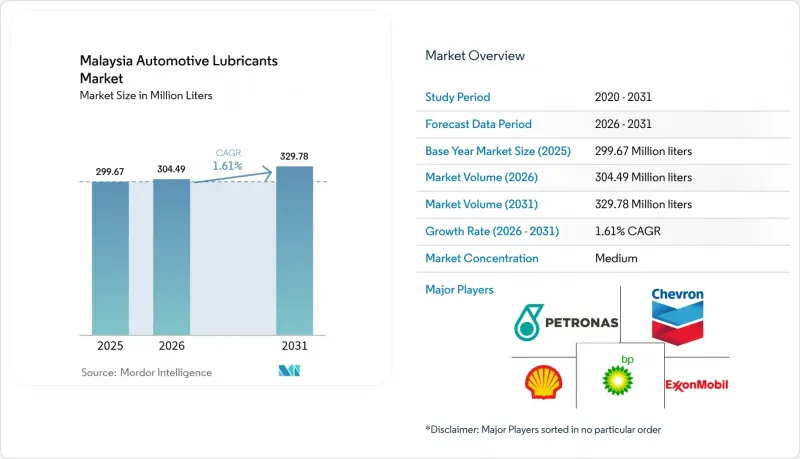
Mordor Intelligence에 의하면, 말레이시아 자동차 윤활유 시장 규모는 2025년 2억 9,967만 리터에서 2026년에는 3억 449만 리터로 확대되어 2026년부터 2031년까지 CAGR 1.61%로 성장을 지속하여, 2031년까지 3억 2,978만 리터에 이를 것으로 예측됩니다.
본 보고서는 제품 유형(자동차 엔진오일, 수동 변속기 오일, 자동 변속기 오일, 브레이크 오일, 자동차 그리스 및 기타 제품 유형)과 차량 유형(승용차, 상용차, 이륜차)별로 분류되어 있습니다. 시장 전망은 수량(리터) 기준으로 제시되어 있습니다.
말레이시아 자동차 윤활유 시장 동향 및 인사이트
차량 보유 대수 증가와 높은 자동차 보급률
2024년 1월부터 3월까지의 자동차 등록 대수는 20만 2,245대에 달하고, 전년 동기 대비 5% 증가했습니다. 이는 보유 대수와 윤활유 소비량 사이에 강력한 상관관계가 있음을 뒷받침합니다. 신차가 출시되어 프리미엄 합성유를 필요로 하는 정비 주기에 접어드는 한편, 노후화된 차량의 교체 수요도 증가하고 있습니다. 조호르바루나 페낭과 같은 지방 도시에서는 인구 밀도가 높아지고 있어, 인증 제품을 추진하는 체계적인 서비스 형태에 새로운 시장 기회가 창출되고 있습니다. 동 기간의 국내 조립 대수(21만 431대)는 OEM을 통한 공장 충전 및 애프터마켓 판매를 더욱 뒷받침하고 있습니다. 차량의 평균 사용 연수가 증가함에 따라 정기 정비 준수가 더욱 중요해지며, 이는 윤활유의 지속적인 소비를 촉진하고 있습니다.
퀵루브 체인 및 OEM 서비스 센터의 확장
PETRONAS AutoExpert는 윤활유 품질을 보장하고 브랜드 충성도를 강화하기 위해 표준화된 정비 서비스를 제공하는 전국 100개 지점 확장을 발표했습니다. 디지털 소매업체와의 제휴를 통해 신속한 시장 진출과 기존 고객 기반에 대한 접근이 가능해졌습니다. Sime Darby Motors의 ‘Drivecare’와 같은 OEM 주도의 노력은 자동차 제조업체들이 정비의 전 과정을 자체적으로 관리하고, 높은 수익률을 내는 윤활유 판매를 확보하려는 의도를 여실히 보여주고 있습니다. 체인형 매장은 일원화된 조달과 정비사 교육을 활용하여 가격 대비 서비스 가치 측면에서 독립 정비소를 능가하는 성과를 거두고 있습니다. 이러한 추세는 프리미엄화를 촉진하고 있습니다. 보증 요건 준수로 인해 범용 광물유 등급보다 정확한 사양의 윤활유가 우선시되기 때문입니다.
HEV/BEV 보급률 상승이 엔진오일 판매량을 압박
2024년 판매 대수에서 전기차(EV) 및 하이브리드차(HEV)가 차지하는 비율은 약 2-3%였으나, 2030년까지 15%로 늘리겠다는 정책 목표에 따라 내연기관용 윤활유 수요는 감소할 전망입니다. 연방 정부는 충전 인프라 구축 및 국내 조립 장려책에 총 24억 말레이시아 링깃을 배정하고 있습니다. 이에 대응하여 각 공급업체들은 전기차용 열관리액 도입으로 대처하고 있으며, 2024년 7월 UMW Grantt사가 발표한 브레이크액 및 냉각수 제품군이 그 예입니다. 이러한 신제품들은 단가가 높은 제품들이지만, 대량으로 소비되는 엔진오일 수요 감소를 완전히 상쇄할 수는 없습니다. 특히 라스트 마일 물류 분야의 차량 전기화는 주행 거리가 길수록 수요 감소 폭이 커지기 때문에 수요 감소에 대한 압박을 더욱 가중시키고 있습니다.
부문 분석
2025년, 말레이시아 자동차 윤활유 시장에서 엔진오일은 55.26%의 점유율을 유지했습니다. 이는 국내 차량 보유 대수에서 내연기관이 여전히 주류를 이루고 있기 때문입니다. 2025년에 시행된 인증 규정은 병행 수입의 장벽을 높여 기존 공급업체가 판매량을 유지하는 데 도움이 되고 있습니다. 그러나 카테고리가 성숙해짐에 따라 성장은 둔화되고 있으며, 제조업체들은 부가가치가 높은 합성유로 전환을 추진하고 있습니다. 대조적으로, 자동변속기 오일(ATF)은 승용 세단과 픽업 트럭 모두에서 다단 변속기가 보급됨에 따라 연평균 성장률(CAGR) 1.82%로 확대될 것으로 예측됩니다. 펜타스 플로라(Penta Flora)사의 현지 그룹 II 정제 공정을 통해 원가 절감과 원료 순환이 가능해져, 경쟁력 있는 가격의 프리미엄 ATF 생산이 가능해졌습니다.
국내 블렌딩 제조업체들은 F1 기술 이전을 활용하여, 잦은 정차와 재출발이 반복되는 도심 주행 주기에 적합한, 전단 안정성이 뛰어난 합성 오일을 제조하고 있습니다. 수동 변속기용 및 브레이크 오일의 경우, 교체 수요는 견조한 추세를 보이고 있지만, 수동 변속기 자체가 장기적인 감소 추세를 보이고 있어 판매량 증가는 기대하기 어렵습니다. 특수 분야(파워 스티어링 오일, 그리스, 작동유)는 전용 냉각수나 유전체가 필요한 차량의 전동화에 힘입어 소규모 기반에서 성장하고 있습니다. 예측 기간 동안 프리미엄화로 인해 평균 판매 가격이 판매량 증가율을 상회하는 속도로 상승할 것으로 예상되므로, 제품 구성의 고도화가 수익의 주요 원동력이 될 것입니다.
기타 혜택:
- 엑셀 형식 시장 예측(ME) 시트
- 3개월간의 애널리스트 지원
자주 묻는 질문
목차
제1장 서론
제2장 조사 방법
제3장 주요 요약
제4장 시장 구도
제5장 시장 규모와 성장 예측
제6장 경쟁 구도
제7장 시장 기회와 향후 전망
제8장 CEO가 직면하는 중요 전략적 과제
JHS 26.08.28According to Mordor Intelligence, the Malaysia automotive lubricants market size is expected to grow from 299.67 million liters in 2025 to 304.49 million liters in 2026 and is forecast to reach 329.78 million liters by 2031 at 1.61% CAGR over 2026-2031.
This report is Segmented by Product Type (Automotive Engine Oil, Manual Transmission Fluids, Automatic Transmission Fluids, Brake Fluids, Automotive Greases, and Other Product Types) and Vehicle Type (Passenger Vehicles, Commercial Vehicles, and Two-Wheelers). The Market Forecasts are Provided in Terms of Volume (liters).
Malaysia Automotive Lubricants Market Trends and Insights
Rising vehicle-parc growth and high motorization
Vehicle registrations reached 202,245 units between January and March 2024, up 5% year-over-year, reinforcing a robust link between parc size and lubricant consumption. Newer cars enter the maintenance cycle requiring premium synthetic oils, while aging vehicles increase replacement demand. Secondary urban centers, such as Johor Bahru and Penang, witness an increasing density, opening up white space for organized service formats that push certified products. Domestic assembly volumes-210,431 units in the same period-further support OEM factory-fill as well as aftermarket sales. As average vehicle age rises, adherence to scheduled maintenance becomes more critical, driving sustained lubricant turnover.
Acceleration of quick-lube chains and OEM service centers
PETRONAS AutoExpert has announced 100 outlets nationwide, using standardized servicing to assure lubricant quality and strengthen brand loyalty. Partnerships with digital retailers enable rapid market roll-out and access to established customer pools. OEM initiatives such as Sime Darby Motors' Drivecare highlight automakers' intent to own the maintenance journey and capture high-margin fluid sales. Chain formats utilize centralized procurement and technician training to outperform independent workshops in terms of price-to-service value. The trend supports premiumization because warranty compliance favors exact-spec lubricants over generic mineral grades.
Rising HEV/BEV penetration compressing engine-oil volumes
Electric and hybrid vehicles accounted for roughly 2-3% of 2024 sales, but policy targets of 15% by 2030 will reduce internal-combustion lubricant demand. Federal allocations totaling MYR 2.4 billion back charging corridors and local assembly incentives. Suppliers respond by introducing EV thermal-management fluids, as seen in UMW Grantt's brake fluid and coolant line released in July 2024. Although these new products carry a higher unit value, they cannot fully offset the displacement of high-volume engine oil. Fleet electrification, especially in last-mile logistics, adds downward pressure because high mileage amplifies the lost demand.
Other drivers and restraints analyzed in the detailed report include:
- Shift to low-viscosity synthetics after diesel subsidy reform
- Mandatory engine-oil certification order curbing counterfeits
- Cost-driven drain-interval stretching after fuel-subsidy cuts
For complete list of drivers and restraints, kindly check the Table Of Contents.
Segment Analysis
Engine oil retained a 55.26% share of the Malaysian automotive lubricants market in 2025, as internal-combustion engines still dominate the national vehicle parc. Certification rules effective in 2025 raise barriers for parallel imports, helping established suppliers defend volumes. Nevertheless, growth tapers as the category matures, prompting producers to shift toward value-added synthetics. Automatic-transmission fluids, in contrast, are expected to expand at a 1.82% CAGR as multi-speed gearboxes become more prevalent across both passenger sedans and pickups. Local Group II refines from Pentas Flora, trimming costs and closing the feedstock loop, enabling competitively priced premium ATF formulations.
Domestic blenders utilize Formula 1 transfer technology to produce shear-stable synthetics, suitable for stop-and-go urban duty cycles. Manual-transmission and brake fluids hold steady replacement demand but lack volume lift because manual transmissions are in secular decline. Specialty segments-power steering fluids, greases, and hydraulic oils-grow from a smaller base, driven by vehicle electrification that requires dedicated coolant and dielectric fluids. Over the forecast period, premiumization lifts average selling price faster than liters, so product-mix upgrades become the principal driver of revenue.
Complete Report Scope:
- By Product Type
- Automotive Engine Oil
- 0W-XX
- 5W-XX
- 10W-XX
- 15W-XX
- Monogrades
- Other Grades
- Manual Transmission Fluids (MTF)
- Automatic Transmission Fluids (ATF)
- Brake Fluids
- Automotive Greases
- Other Product Types (Power Steering Fluid etc.)
- Automotive Engine Oil
- By Vehicle Type
- Passenger Vehicles
- Commercial Vehicles
- Two-Wheelers
List of Companies Covered in this Report:
- Add Oil. (M) SDN BHD
- Advance Lube Enterprise Sdn Bhd
- AMSOIL INC.
- BP p.l.c.
- Chevron Corporation
- ENEOS Corporation
- ENOC Company
- Exxon Mobil Corporation
- Feoso Oil (Malaysia) Sdn.Bhd.
- FUCHS
- Idemitsu Kosan Co Ltd
- LIQUI MOLY
- Motul
- PENTAS FLORA
- Petromin Corporation
- Petron
- PETRONAS Lubricants International
- PTT LUBRICANTS
- Saudi Arabian Oil Co.
- Shell plc
- TotalEnergies
Additional Benefits:
- The market estimate (ME) sheet in Excel format
- 3 months of analyst support
TABLE OF CONTENTS
1 Introduction
- 1.1 Study Assumptions and Market Definition
- 1.2 Scope of the Study
2 Research Methodology
3 Executive Summary
4 Market Landscape
- 4.1 Market Overview
- 4.2 Market Drivers
- 4.2.1 Rising vehicle-parc growth and high motorisation
- 4.2.2 Acceleration of quick-lube chains and OEM service centres
- 4.2.3 Shift to low-viscosity synthetics post-diesel subsidy reform
- 4.2.4 Mandatory Engine-Oil Certification Order curbing counterfeits
- 4.2.5 Palm-oil bio-lubricant R&D bolstering domestic feedstock
- 4.3 Market Restraints
- 4.3.1 Rising HEV/BEV penetration compressing engine-oil volumes
- 4.3.2 Cost-driven drain-interval stretching after fuel-subsidy cuts
- 4.3.3 Grey-/illicit oils undercutting branded players
- 4.4 Value Chain and Distribution Channel Analysis
- 4.5 Porter's Five Forces
- 4.5.1 Threat of New Entrants
- 4.5.2 Bargaining Power of Suppliers
- 4.5.3 Bargaining Power of Buyers
- 4.5.4 Threat of Substitutes
- 4.5.5 Industry Rivalry
- 4.6 Regulatory Framework
- 4.7 Automotive Industry Trends
5 Market Size and Growth Forecasts (Volume)
- 5.1 By Product Type
- 5.1.1 Automotive Engine Oil
- 5.1.1.1 0W-XX
- 5.1.1.2 5W-XX
- 5.1.1.3 10W-XX
- 5.1.1.4 15W-XX
- 5.1.1.5 Monogrades
- 5.1.1.6 Other Grades
- 5.1.2 Manual Transmission Fluids (MTF)
- 5.1.3 Automatic Transmission Fluids (ATF)
- 5.1.4 Brake Fluids
- 5.1.5 Automotive Greases
- 5.1.6 Other Product Types (Power Steering Fluid etc.)
- 5.1.1 Automotive Engine Oil
- 5.2 By Vehicle Type
- 5.2.1 Passenger Vehicles
- 5.2.2 Commercial Vehicles
- 5.2.3 Two-Wheelers
6 Competitive Landscape
- 6.1 Market Concentration
- 6.2 Strategic Moves
- 6.3 Market Share (%)**/Ranking Analysis
- 6.4 Company Profiles (includes Global level Overview, Market level overview, Core Segments, Financials as available, Production Capacity, Strategic Information, Market Rank/Share for key companies, Products and Services, and Recent Developments)
- 6.4.1 Add Oil. (M) SDN BHD
- 6.4.2 Advance Lube Enterprise Sdn Bhd
- 6.4.3 AMSOIL INC.
- 6.4.4 BP p.l.c.
- 6.4.5 Chevron Corporation
- 6.4.6 ENEOS Corporation
- 6.4.7 ENOC Company
- 6.4.8 Exxon Mobil Corporation
- 6.4.9 Feoso Oil (Malaysia) Sdn.Bhd.
- 6.4.10 FUCHS
- 6.4.11 Idemitsu Kosan Co Ltd
- 6.4.12 LIQUI MOLY
- 6.4.13 Motul
- 6.4.14 PENTAS FLORA
- 6.4.15 Petromin Corporation
- 6.4.16 Petron
- 6.4.17 PETRONAS Lubricants International
- 6.4.18 PTT LUBRICANTS
- 6.4.19 Saudi Arabian Oil Co.
- 6.4.20 Shell plc
- 6.4.21 TotalEnergies
7 Market Opportunities and Future Outlook
- 7.1 White-space and Unmet-need Assessment


