

|
시장보고서
상품코드
2124759
베트남의 자동차 윤활유 시장 : 시장 점유율 분석, 업계 동향 및 통계, 성장 예측(2026-2031년)Vietnam Automotive Lubricants - Market Share Analysis, Industry Trends & Statistics, Growth Forecasts (2026 - 2031) |
||||||
 Mordor Intelligence
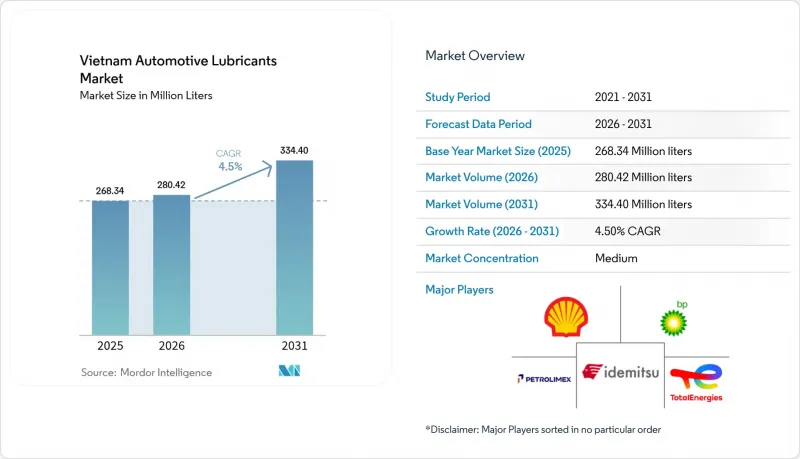
Mordor Intelligence에 의하면, 베트남의 자동차 윤활유 시장 규모는 2025년 2억 6,834만 리터로 평가되었고, 2026년에는 2억 8,042만 리터로 확대되어 2031년까지 3억 3,440만 리터에 이를 것으로 예측됩니다.
2026-2031년 연평균 성장률(CAGR) 4.5%로 성장할 것으로 전망됩니다.
본 보고서는 제품 유형별(자동차 엔진 오일 (0W-XX, 5W-XX, 10W-XX, 15W-XX, 모노그레이드, 기타), 수동 변속기 오일, 자동 변속기 오일, 브레이크 오일 등), 차량 유형별(승용차, 상용차, 이륜차)로 분류되어 있습니다. 시장 예측은 판매량(리터) 기준으로 제시되어 있습니다.
베트남의 자동차 윤활유 시장 동향 및 인사이트
도시 지역 이동 수단으로서 이륜차의 우위
베트남의 등록된 오토바이 대수는 2025년에 7,000만 대를 돌파했습니다. 신차 판매 대수는 소폭 감소했으나, 각 오토바이는 여전히 연간 3-4회 오일 교환이 이루어지고 있어, 이는 견실한 수요 기반을 형성하고 있으며, 베트남 자동차 윤활유 시장을 승용차 판매 변동으로부터 보호하고 있습니다. 2026년에 시행될 유로 5 배기가스 규제로 인해 라이더들은 저SAPS의 API SN Plus 및 JASO MA2 규격 오일로 전환하고 있으며, 이로 인해 프리미엄 합성유가 일반 소매 시장에 더욱 침투하고 있습니다. 전동 스쿠터의 보급률은 3자리 수의 성장률을 기록하며 확대되고 있지만, 베어링, 브레이크 유압 시스템, 구동계에는 양은 적더라도 여전히 그리스나 작동유가 필요하기 때문에 윤활유 판매량에는 실질적인 영향이 나타나지 않고 있습니다.
전자상거래 물류 차량의 급증
베트남의 총 상품 가치는 2023년 220억 달러에서 2025년에는 약 520억 달러로 증가했습니다. 이에 대응하여 각 택배 네트워크 업체들은 차량 대수를 40-50% 확대했으나, 그 결과 엔진은 스톱 앤 고(stop-and-go) 주행 주기에 노출되어 기존 오일 교환 주기가 절반으로 단축되었습니다. 현재 사업자들은 하루 14시간 가동 조건에서도 열 안정성을 발휘하는 반합성 오일(10W-40 및 5W-30)을 선호하여 사용하고 있습니다. 2024년에 발령된, 플랫폼 사업자에게 차량 정비 기록 공개를 의무화하는 정령에 따라 OEM 규격 윤활유의 채택이 촉진되고, 시장의 정규화가 가속화되고 있습니다.
가격에 민감한 소비자는 광물유를 선호한다.
차량 소유자의 약 70%가 구매 시 가격을 최우선으로 고려하기 때문에 합성유보다 소매 가격이 30-40% 저렴한 단일 점도 20W-50 및 15W-40 광유에 대한 수요가 여전히 뿌리 깊게 이어지고 있습니다. 이러한 오일은 매출 총이익률을 떨어뜨리고, 베트남 자동차 윤활유 시장에서 프리미엄 브랜드의 입지를 약화시키고 있습니다. 중국이나 인도의 2차 정제 업체에서 수입되는 자체 브랜드 제품은 API 라이선싱을 회피하는 경우가 많아, 이러한 상황을 더욱 악화시키고 있습니다.
부문 분석
2025년, 내연 기관이 승용차, 상용차, 이륜차 각 부문에서 여전히 표준 파워트레인으로 자리 잡고 있었기 때문에 자동차 엔진 오일은 베트남 자동차 윤활유 시장 점유율의 53.42%를 차지했습니다. 시장에서 자동변속기 오일 시장 규모는 Honda City나 Toyota Vios 등의 모델에 CVT가 보급되면서 2031년까지 연평균 성장률(CAGR) 4.71%로 확대될 것으로 예측됩니다. 반합성 10W-40 등급은 비용 한도를 초과하지 않으면서 오일 교환 주기를 연장할 수 있어, 차량 대여 업체 수요의 기반이 되고 있습니다. 브레이크 오일과 그리스는 여전히 틈새 시장이지만, 전자상거래 차량 대여 업체들 사이에서 일반화되고 있는 안전 기준 적합성 감사에서 필수적인 요소입니다.
OEM 제조업체의 출고 시 주입 과정에서 연비 효율 규제 대응이 진행됨에 따라, 저점도인 5W-30 및 0W-20 등급으로의 전환 경향이 나타나고 있습니다. 반면, 애프터마켓 사용자들은 여전히 10W-40이나 15W-40의 광유 제품을 선호하고 있어, 이로 인해 판매업체 입장에서는 두 가지 채널에 대응하는 재고 관리라는 과제가 더욱 심각해지고 있습니다. 2024년에 추가된 교통부 지침에 따라 정비 공장은 API SN Plus 이상의 오일을 재고로 보유해야 할 의무가 부과되었으며, 예산을 중시하는 고객조차도 더 고성능의 합성유로 전환하도록 유도되고 있습니다.
기타 혜택 :
- 엑셀 형식 시장 예측(ME) 시트
- 3개월간의 애널리스트 지원
자주 묻는 질문
목차
제1장 서론
제2장 조사 방법
제3장 주요 요약
제4장 시장 구도
제5장 시장 규모 및 성장 예측
제6장 경쟁 구도
제7장 시장 기회 및 향후 전망
AJY 26.09.15According to Mordor Intelligence, the Vietnam automotive lubricants market size is expected to increase from 268.34 million liters in 2025 to 280.42 million liters in 2026 and reach 334.40 million liters by 2031, growing at a CAGR of 4.5% over 2026-2031.

This report is Segmented by Product Type (Automotive Engine Oil [0W-XX, 5W-XX, 10W-XX, 15W-XX, Monogrades, and Other Grades], Manual Transmission Fluids, Automatic Transmission Fluids, Brake Fluids, and More), Vehicle Type (Passenger Vehicles, Commercial Vehicles, and Two-Wheelers). The Market Forecasts are Provided in Terms of Volume (Liters).
Vietnam Automotive Lubricants Market Trends and Insights
Two-Wheeler Dominance in Urban Mobility
Vietnam's registered motorbike parc surpassed 70 million units in 2025. Despite a slight contraction in new sales, each motorbike still undergoes three to four oil changes a year, forming a dependable demand base that insulates the Vietnam automotive lubricants market from swings in car sales. Euro 5 emission rules, effective 2026, are steering riders toward low-SAPS API SN Plus and JASO MA2 oils, pushing premium synthetics deeper into mass retail. Electric scooter uptake, while expanding at triple-digit rates, has yet to materially dent lubricant volumes because bearings, brake hydraulics, and drivetrains continue to need greases and fluids, albeit in smaller quantities.
Surge in E-Commerce Logistics Fleets
Vietnam's gross merchandise value rose from USD 22 billion in 2023 to an estimated USD 52 billion in 2025. Parcel networks responded by enlarging fleets 40-50%, subjecting engines to stop-start duty cycles that halve traditional drain intervals. Operators now favor semi-synthetic 10W-40 and 5W-30 oils that deliver thermal stability under 14-hour workdays. A 2024 decree requiring platforms to publish vehicle maintenance records is enforcing OEM-grade lubricant adoption and accelerating market formalization.
Price-Sensitive Consumers Favoring Mineral Oils
Approximately 70% of vehicle owners prioritize upfront price, driving persistent demand for monograde 20W-50 and 15W-40 mineral oils that retail at 30-40% below synthetics. These oils deliver thinner gross margins and dilute premium-brand positioning in the Vietnam automotive lubricants market. Private-label brands imported from secondary refiners in China and India compound the erosion, often bypassing API licensing.
Other drivers and restraints analyzed in the detailed report include:
- OEM Extended-Drain Interval Specifications
- Rapid Growth of Ride-Hailing Motorbike Fleets
- Growing Counterfeit Lubricant Trade
For complete list of drivers and restraints, kindly check the Table Of Contents.
Segment Analysis
Automotive Engine Oil captured 53.42% of the Vietnam automotive lubricants market share in 2025 as internal-combustion engines remained the default powertrain across passenger, commercial, and two-wheeler segments. The Vietnam automotive lubricants market size for automatic transmission fluids is projected to climb at a 4.71% CAGR through 2031, propelled by the spread of CVTs in models such as the Honda City and Toyota Vios. Semi-synthetic 10W-40 grades anchor fleet demand by extending drains without breaching cost ceilings. Brake Fluids and Greases remain niche but critical for safety-compliance audits now common among e-commerce fleets.
A convergence toward lower-viscosity 5W-30 and 0W-20 grades is emerging as OEM factory fills embrace fuel-efficiency mandates. Aftermarket riders, however, retain a preference for 10W-40 or 15W-40 mineral oils, reinforcing a dual-channel inventory challenge for distributors. Ministry of Transport guidelines added in 2024 now oblige workshops to stock API SN Plus or higher, nudging even budget clients toward better-performing synthetics.
Complete Report Scope:
- By Product Type
- Automotive Engine Oil
- 0W-XX
- 5W-XX
- 10W-XX
- 15W-XX
- Monogrades
- Other Grades
- Manual Transmission Fluids (MTF)
- Automatic Transmission Fluids (ATF)
- Brake Fluids
- Automotive Greases
- Other Product Types (Power Steering Fluid, etc.)
- Automotive Engine Oil
- By Vehicle Type
- Passenger Vehicles
- Commercial Vehicles
- Two-Wheelers
List of Companies Covered in this Report:
- AP SAIGON PETRO
- BP p.l.c.
- Chevron Corporation
- Exxon Mobil Corporation
- Fuchs Petrolub SE
- GS Caltex Corporation
- Idemitsu Kosan Co. Ltd
- Mekong Petrochemical Jsc
- Motul
- Petrolimex (PLX)
- PETRONAS Lubricants International
- PVOIL
- Repsol Vietnam
- Shell Plc
- TotalEnergies
- Wolf Oil Corporation
Additional Benefits:
- The market estimate (ME) sheet in Excel format
- 3 months of analyst support
TABLE OF CONTENTS
1 Introduction
- 1.1 Study Assumptions and Market Definition
- 1.2 Scope of the Study
2 Research Methodology
3 Executive Summary
4 Market Landscape
- 4.1 Market Overview
- 4.2 Market Drivers
- 4.2.1 Two-wheeler dominance in urban mobility
- 4.2.2 Surge in e-commerce logistics fleets
- 4.2.3 OEM extended-drain interval specifications
- 4.2.4 Rapid growth of ride-hailing motorbike rentals
- 4.2.5 Government incentives for domestic blending capacity
- 4.3 Market Restraints
- 4.3.1 Price-sensitive consumers favouring low-grade mineral oils
- 4.3.2 Growing counterfeit lubricant trade
- 4.3.3 Stricter environmental levy on used-oil disposal
- 4.4 Value Chain and Distribution Channel Analysis
- 4.5 Porter's Five Forces
- 4.5.1 Threat of New Entrants
- 4.5.2 Bargaining Power of Suppliers
- 4.5.3 Bargaining Power of Buyers
- 4.5.4 Threat of Substitutes
- 4.5.5 Industry Rivalry
- 4.6 Regulatory Framework
- 4.7 Automotive Industry Trends
5 Market Size and Growth Forecasts (Volume)
- 5.1 By Product Type
- 5.1.1 Automotive Engine Oil
- 5.1.1.1 0W-XX
- 5.1.1.2 5W-XX
- 5.1.1.3 10W-XX
- 5.1.1.4 15W-XX
- 5.1.1.5 Monogrades
- 5.1.1.6 Other Grades
- 5.1.2 Manual Transmission Fluids (MTF)
- 5.1.3 Automatic Transmission Fluids (ATF)
- 5.1.4 Brake Fluids
- 5.1.5 Automotive Greases
- 5.1.6 Other Product Types (Power Steering Fluid, etc.)
- 5.1.1 Automotive Engine Oil
- 5.2 By Vehicle Type
- 5.2.1 Passenger Vehicles
- 5.2.2 Commercial Vehicles
- 5.2.3 Two-Wheelers
6 Competitive Landscape
- 6.1 Market Concentration
- 6.2 Strategic Moves
- 6.3 Market Share (%)**/Ranking Analysis
- 6.4 Company Profiles (includes Global level Overview, Market level overview, Core Segments, Financials as available, Production Capacity, Strategic Information, Products and Services, and Recent Developments)
- 6.4.1 AP SAIGON PETRO
- 6.4.2 BP p.l.c.
- 6.4.3 Chevron Corporation
- 6.4.4 Exxon Mobil Corporation
- 6.4.5 Fuchs Petrolub SE
- 6.4.6 GS Caltex Corporation
- 6.4.7 Idemitsu Kosan Co. Ltd
- 6.4.8 Mekong Petrochemical Jsc
- 6.4.9 Motul
- 6.4.10 Petrolimex (PLX)
- 6.4.11 PETRONAS Lubricants International
- 6.4.12 PVOIL
- 6.4.13 Repsol Vietnam
- 6.4.14 Shell Plc
- 6.4.15 TotalEnergies
- 6.4.16 Wolf Oil Corporation
7 Market Opportunities and Future Outlook
- 7.1 White-space and Unmet-need Assessment


