|
시장보고서
상품코드
2116415
북미의 윤활유 : 시장 점유율 분석, 업계 동향 및 통계, 성장 예측(2026-2031년)North America Lubricants - Market Share Analysis, Industry Trends & Statistics, Growth Forecasts (2026 - 2031) |
||||||
 Mordor Intelligence
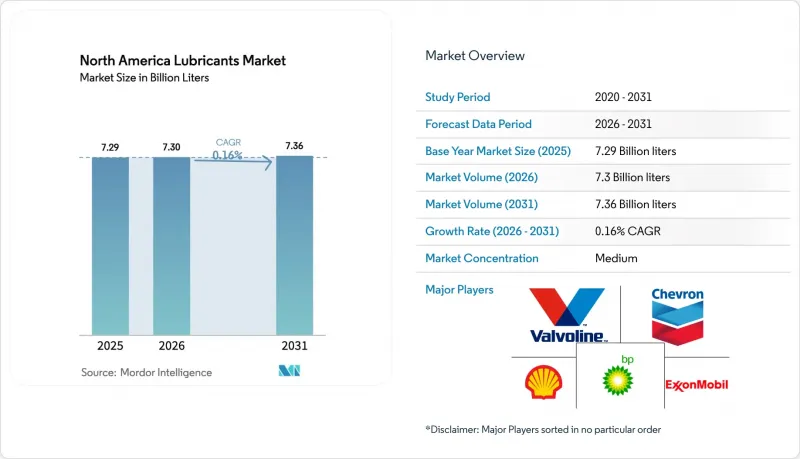
Mordor Intelligence에 의하면, 북미의 윤활유 시장 규모는 2025년에 72억 9,000만 리터로 평가되었습니다. 2026년 73억 리터에서 2031년까지 73억 6,000만 리터에 이를 것으로 예상되며, 예측 기간(2026-2031년) CAGR은 0.16%를 나타낼 전망입니다.
본 보고서는 제품 유형(자동차용 엔진 오일, 산업용 엔진 오일, 변속기 오일, 기어 오일, 브레이크 오일, 작동유 등), 최종 사용자 산업(자동차, 항공우주, 중장비 등),기유 유형(광물유계, 합성계 등), 지역(미국, 멕시코, 캐나다)별로 분류되어 있습니다. 시장 예측은 판매량(리터) 기준으로 제시되어 있습니다.
북미의 윤활유 시장 동향 및 인사이트
합성 윤활유 수요 급증
합성 윤활유는 가동 중단 시간을 줄이고 오일 교환 주기를 연장함으로써 자산 활용도를 높이고 수명 주기 비용을 절감하기 때문에 자동차 및 산업 장비 부문에서 점유율을 확대되고 있습니다. 쉘(Shell)에 따르면, 하이퍼스케일 데이터센터 운영 사업자들은 칩 수준의 열 부하 증가에 대응하기 위해 쉘의 액침 냉각 유체으로의 전환을 추진하고 있다고 합니다. 2024년에 도입된 미국석유협회(API)의 SQ 가솔린 엔진 오일 카테고리에서는 열적으로 안정된 합성 기유가 요구되고 있으며, 2025년에 예정된 ILSAC GF-7 규격도 이러한 전환을 뒷받침하고 있습니다. OEM의 보증 조건에서 합성 등급이 지정되는 사례가 증가하고 있으며, 이에 따라 북미의 윤활유 시장의 견인 수요가 강화되고 있습니다. 그룹 III 및 PAO의 자체 생산 능력을 보유한 제조업체들은 프리미엄 광물유와의 가격 차이가 축소되고 있는 점을 활용하고 있습니다. 열효율 향상은 운송용 및 고정식 엔진의 탈탄소화 목표 달성을 뒷받침하고 있습니다.
산업 생산의 회복
2023년 최저점에서 회복된 건설, 광업 및 일반 제조업은 유압 시스템, 기어박스, 금속 가공 공정에서의 윤활유 소비를 끌어올리고 있습니다. 공공 부문의 인프라 지출은 최신 배기가스 규제를 준수하는 저회분 작동유가 필요한 비도로용 기계에 대한 수요를 자극하고 있습니다. 광업 기업들은 마모가 심한 환경에서 재윤활 간격을 연장할 수 있는 합성 그리스를 선호하고 있습니다. 자동차 제조업체들이 배터리 하우징 및 전동 모터 생산 라인으로 전환함에 따라 공구 업그레이드가 진행되고 있으며, 이에 따라 금속 가공용 유체에 대한 수요가 증가하고 있습니다. 멕시코로의 니어쇼어링을 통한 생산 이전이 공장의 윤활유 수요를 확대시켜 북미의 윤활유 시장의 중기 전망을 밝게 하고 있습니다.
원유 및 기유 가격 변동
미국 멕시코만 연안의 그룹 I 및 그룹 II 정제 시설 폐쇄는 공급 유연성을 저하시키고, 정유시설의 정기 수리가 공시 가격에 미치는 영향을 확대시키고 있습니다. 계절적인 휘발유 수요 급증으로 정유사들은 연료 생산을 극대화하려 하기 때문에 기유공급이逼迫되어, 독립계 기업들은 현물 프리미엄을 지불할 수밖에 없습니다. 대형 통합 기업들은 원자재 가격 변동을 흡수하지만, 브렌트 원유 스프레드가 지속될 경우 그 비용을 하류로 전가합니다. 바이오 기유의 경제성은 동물성 지방이나 사용 후 식용유 가격 변동에 좌우되기 때문에 조달 계획이 복잡해지고 있습니다. 유통업체들은 재고를 헤지하고 있지만, 선물 가격이 약세를 보일 경우 고가의 재고를 떠안게 될 위험이 있어 북미의 윤활유 시장 전체의 단기 이익률을 압박하고 있습니다.
부문별 분석
2025년, 북미의 윤활유 시장 규모의 39.25%를 자동차용 엔진 오일이 차지했습니다. 이는 경차 및 대형차가 계속해서 차량 보유 대수의 대부분을 차지하고 있기 때문입니다. 이 하위 부문의 매출 구성은 가격 프리미엄을 얻을 수 있는 합성유에 치우쳐 있어, 판매량의 점진적인 감소가 수익에 미치는 영향을 완화하고 있습니다. 산업용 엔진 오일은 절대량(리터)으로는 적지만, 절삭 가공, 발전, 농업용 차량의 기계 현대화에 힘입어 0.64%라는 가장 높은 연평균 성장률(CAGR)을 기록하고 있습니다. 변속기 오일 수요는 양극화되어 있습니다. 기존의 자동변속기용은 감소하는 반면, 단가가 높은 전용 설계된 e-드라이브용 윤활유가 등장하고 있습니다. 기어 오일은 극압 성능이 필수적인 광업용 및 풍력 터빈의 기어박스로부터 혜택을 받고 있으며, 작동유는 저독성 및 난연성 등급이 지정되는 인프라 확충으로 인해 수요가 증가하고 있습니다.
견조한 틈새 분야가 북미의 윤활유 시장에 균형을 가져오고 있습니다. 그리스는 전기 구동 시스템의 베어링, 풍력 터빈의 피치 시스템, 그리고 NSF H1 인증이 필요한 식품 가공 장비 분야에서 기회를 포착하고 있습니다. 금속 가공유는 자동차 제조업체들이 알루미늄 화이트 바디 및 배터리 케이스 가공을 위한 설비 투자를 확대함에 따라 회복세를 보이고 있습니다. 데이터센터의 침지 냉각용 특수 절연액은 현재 총 판매량의 1% 미만에 그치고 있지만, 두 자릿수 성장률을 기록하며 고수익률 배합 제품의 전략적 가치를 높이고 있습니다. OEM의 서비스 충전 계약은 고객 확보 메커니즘으로 기능하고 있으며, 초기 충전 승인은 공급업체에게 있어 매우 중요한 경쟁의 장이 되고 있습니다.
기타 혜택 :
- 엑셀 형식 시장 예측(ME) 시트
- 3개월간의 애널리스트 지원
자주 묻는 질문
목차
제1장 서론
제2장 조사 방법
제3장 개요
제4장 시장 구도
제5장 시장 규모 및 성장 예측
제6장 경쟁 구도
제7장 시장 기회 및 향후 전망
제8장 CEO가 직면하는 중요한 전략적 과제
KTH 26.08.31According to Mordor Intelligence, the North America lubricants market size was valued at 7.29 billion liters in 2025 and estimated to grow from 7.3 billion liters in 2026 to reach 7.36 billion liters by 2031, at a CAGR of 0.16% during the forecast period (2026-2031).
This report is Segmented by Product Type (Automotive Engine Oil, Industrial Engine Oil, Transmission Fluids, Gear Oil, Brake Fluids, Hydraulic Fluids, and More), End-User Industry (Automotive, Aerospace, Heavy Equipment, and More), Base Stock Type (Mineral Oil-Based, Synthetic, and More), and Geography (United States, Mexico, Canada). The Market Forecasts are Provided in Terms of Volume (Liters).
North America Lubricants Market Trends and Insights
Synthetic-Lubricant Demand Surge
Synthetic products earn a share across the automotive and industrial equipment sectors because they reduce downtime and extend oil-change intervals, which increases asset utilization and lowers lifecycle costs. Shell reports that hyperscale data-center operators are switching to its immersion-cooling fluids to handle rising chip-level heat loads. The American Petroleum Institute's SQ gasoline-engine oil category, introduced in 2024, requires thermally stable synthetic base stocks, and the ILSAC GF-7 standard slated for 2025 reinforces this shift. OEM warranty terms are increasingly specifying synthetic grades, thereby strengthening pull-through demand in the North American lubricants market. Producers with captive Group III and PAO capacity capitalize on narrowing price gaps versus premium mineral stocks. Greater thermal efficiency also supports decarbonization targets in transport and stationary engines.
Industrial Output Rebound
Construction, mining, and general manufacturing, which rebounded from the 2023 trough, bolsters lubricant consumption in hydraulic systems, gearboxes, and metalworking operations. Public-sector infrastructure outlays stimulate demand for off-highway machinery that relies on low-ash fluids, which are compatible with modern emission controls. Mining companies favor synthetic greases that lengthen relubrication intervals in abrasive environments. Metalworking-fluid uptake follows tooling upgrades as vehicle makers convert lines for battery housing and e-motor production. Mexico's nearshoring inflows magnify factory lubricant demand, lifting the medium-term outlook for the North American lubricants market.
Crude- and Base-Oil Price Volatility
Closures of Group I and Group II units on the U.S. Gulf Coast reduce supply flexibility and magnify the impact of refinery turnarounds on posted prices. Seasonal gasoline demand spikes incentivize refiners to maximize fuel output, tightening base-stock availability and forcing independents to pay spot premiums. Integrated majors absorb feedstock swings but pass costs downstream when Brent widths persist. Bio-based base-oil economics fluctuate with tallow and used-cooking-oil pricing, complicating procurement planning. Distributors hedge inventories yet risk carrying high-priced stocks when futures soften, weighing on near-term margins across the North American lubricants market.
Other drivers and restraints analyzed in the detailed report include:
- Tightening CAFE and EPA Rules
- Expansion of E-Commerce DIY Channels
- Electric-Vehicle Fleet Expansion
For complete list of drivers and restraints, kindly check the Table Of Contents.
Segment Analysis
Automotive engine oils accounted for 39.25% of the North American lubricants market size in 2025, as light-duty and heavy-duty vehicles continue to dominate the rolling stock. The subsegment's value mix tilts toward synthetics that command price premiums, softening the revenue impact of gradual volume decline. Industrial engine oils, although smaller in absolute liters, post the quickest 0.64% CAGR thanks to machinery modernization across metal-cutting, power generation, and agricultural fleets. Transmission-fluid demand shows a bifurcated path: conventional automatics decline, yet purpose-designed e-drive lubricants emerge, carrying a higher unit value. Gear oils benefit from mining and wind-turbine gearboxes that mandate extreme-pressure performance, and hydraulic fluids gain from infrastructure build-outs that specify low-toxicity, fire-resistant grades.
Resilient niche classes add balance to the North American lubricants market. Greases capture opportunities in electric drivetrain bearings, wind turbine pitch systems, and food-processing equipment requiring NSF H1 certification. Metalworking fluids rebound in step with automakers' tooling up for aluminum body-in-white and battery-case machining. Specialty dielectric fluids for data-center immersion cooling, although currently less than 1 % of total liters, grow at a double-digit pace and reinforce the strategic value of high-margin formulations. OEM service-fill contracts act as a lock-in mechanism, making first-fill approvals a critical battleground for suppliers.
Complete Report Scope:
- By Product Type
- Automotive Engine Oil
- Industrial Engine Oil
- Transmission Fluids
- Gear Oil
- Brake Fluids
- Hydraulic Fluids
- Greases
- Process Oil (Including Rubber Process Oil and White Oil)
- Metalworking Fluids
- Turbine Oil
- Transformer Oil
- Other Product Types
- By End-user Industry
- Automotive
- Passenger Vehicles
- Commercial Vehicles
- Two-Wheelers
- Marine
- Aerospace
- Heavy Equipment
- Construction
- Mining
- Agriculture
- Industrial
- Power Generation
- Metallurgy and Metalworking
- Textiles
- Oil and Gas
- Other End-Use Industries
- Automotive
- By Base Stock Type
- Mineral Oil-Based Lubricants
- Synthetic Lubricants
- Semi-Synthetic Lubricants
- Bio-Based Lubricants
List of Companies Covered in this Report:
- AMSOIL Inc.
- Bardahl
- BP p.l.c
- Chevron Corporation
- CITGO Petroleum Lubricants
- Exxon Mobil Corporation
- FUCHS
- Idemitsu Lubricants America
- Kluber Lubrication
- Lucas Oil Products, Inc.
- Motul
- Petro-Canada Lubricants
- Phillips 66 Company
- Quaker Houghton
- Saudi Arabian Oil Co.
- Shell plc
- TotalEnergies
Additional Benefits:
- The market estimate (ME) sheet in Excel format
- 3 months of analyst support
TABLE OF CONTENTS
1 Introduction
- 1.1 Study Assumptions & Market Definition
- 1.2 Scope of the Study
2 Research Methodology
3 Executive Summary
4 Market Landscape
- 4.1 Market Overview
- 4.2 Market Drivers
- 4.2.1 Rising demand for high-performance synthetic lubricants
- 4.2.2 Industrial output rebound across construction, mining and manufacturing
- 4.2.3 Stricter CAFE / EPA fuel-economy rules driving low-viscosity oils
- 4.2.4 Rapid growth of e-commerce DIY aftermarket channels
- 4.2.5 Surging adoption of dielectric immersion-cooling fluids in data centres
- 4.3 Market Restraints
- 4.3.1 Crude- and base-oil price volatility
- 4.3.2 Accelerating electric-vehicle parc lowers ICE-oil volumes
- 4.3.3 Tight PFAS and micro-plastics rules threatening some additive chemistries
- 4.4 Value Chain Analysis
- 4.5 Regulatory Framework
- 4.6 End-User Trends
- 4.6.1 Automotive Industry
- 4.6.2 Manufacturing Industry
- 4.6.3 Power Generation Industry
- 4.7 Porter's Five Forces
- 4.7.1 Bargaining Power of Suppliers
- 4.7.2 Bargaining Power of Buyers
- 4.7.3 Threat of New Entrants
- 4.7.4 Threat of Substitutes
- 4.7.5 Degree of Competition
5 Market Size and Growth Forecasts (Volume)
- 5.1 By Product Type
- 5.1.1 Automotive Engine Oil
- 5.1.2 Industrial Engine Oil
- 5.1.3 Transmission Fluids
- 5.1.4 Gear Oil
- 5.1.5 Brake Fluids
- 5.1.6 Hydraulic Fluids
- 5.1.7 Greases
- 5.1.8 Process Oil (Including Rubber Process Oil and White Oil)
- 5.1.9 Metalworking Fluids
- 5.1.10 Turbine Oil
- 5.1.11 Transformer Oil
- 5.1.12 Other Product Types
- 5.2 By End-user Industry
- 5.2.1 Automotive
- 5.2.1.1 Passenger Vehicles
- 5.2.1.2 Commercial Vehicles
- 5.2.1.3 Two-Wheelers
- 5.2.2 Marine
- 5.2.3 Aerospace
- 5.2.4 Heavy Equipment
- 5.2.4.1 Construction
- 5.2.4.2 Mining
- 5.2.4.3 Agriculture
- 5.2.5 Industrial
- 5.2.5.1 Power Generation
- 5.2.5.2 Metallurgy and Metalworking
- 5.2.5.3 Textiles
- 5.2.5.4 Oil and Gas
- 5.2.5.5 Other End-Use Industries
- 5.2.1 Automotive
- 5.3 By Base Stock Type
- 5.3.1 Mineral Oil-Based Lubricants
- 5.3.2 Synthetic Lubricants
- 5.3.3 Semi-Synthetic Lubricants
- 5.3.4 Bio-Based Lubricants
6 Competitive Landscape
- 6.1 Market Concentration
- 6.2 Strategic Moves
- 6.3 Market Share**(%)/Ranking Analysis
- 6.4 Company Profiles (includes Global level Overview, Market level overview, Core Segments, Financials as available, Strategic Information, Market Rank/Share, Products & Services, Recent Developments)
- 6.4.1 AMSOIL Inc.
- 6.4.2 Bardahl
- 6.4.3 BP p.l.c
- 6.4.4 Chevron Corporation
- 6.4.5 CITGO Petroleum Lubricants
- 6.4.6 Exxon Mobil Corporation
- 6.4.7 FUCHS
- 6.4.8 Idemitsu Lubricants America
- 6.4.9 Kluber Lubrication
- 6.4.10 Lucas Oil Products, Inc.
- 6.4.11 Motul
- 6.4.12 Petro-Canada Lubricants
- 6.4.13 Phillips 66 Company
- 6.4.14 Quaker Houghton
- 6.4.15 Saudi Arabian Oil Co.
- 6.4.16 Shell plc
- 6.4.17 TotalEnergies
7 Market Opportunities & Future Outlook
- 7.1 White-space and Unmet-Need Assessment