|
시장보고서
상품코드
2073626
인도의 전기 버스 시장 : 점유율 분석, 업계 동향과 통계, 성장 예측(2026-2031년)India Electric Bus - Market Share Analysis, Industry Trends & Statistics, Growth Forecasts (2026 - 2031) |
||||||
 Mordor Intelligence
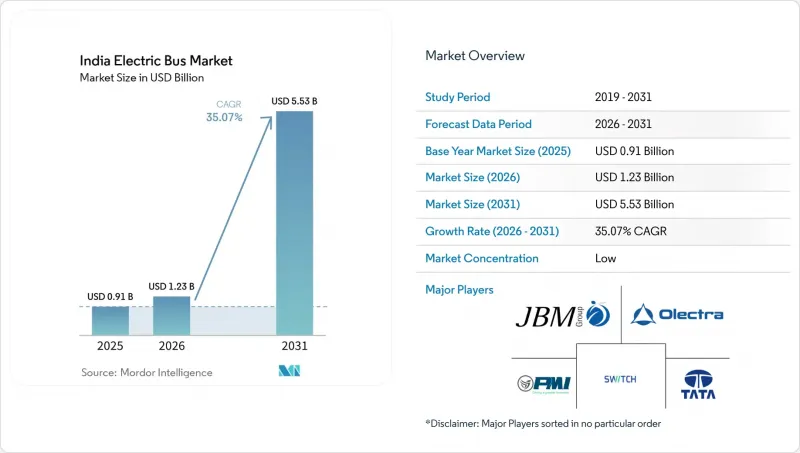
Mordor Intelligence에 의하면, 인도 전기 버스 시장 규모는 2025년에 9억 1,000만 달러로 평가되고 있어 2026년 12억 3,000만 달러에서 성장하여 2031년까지 55억 3,000만 달러에 이를 것으로 예측됩니다.
예측 기간(2026-2031년) 동안 연평균 성장률(CAGR)은 4.17%가 될 것으로 전망됩니다.
본 보고서는 추진 방식(배터리식 전기 버스 등), 용도(도시·대중교통 등), 배터리 화학 조성(LFP 등), 전장(9미터 미만 등), 모터 아키텍처(PMSM 등), 모터 출력(100kW 미만, 100-150kW 등), 주행 거리(100km 미만 등), 최종 용도 및 지역별로 분류되어 있습니다. 시장 전망은 금액(달러) 및 수량(대)으로 제시되어 있습니다.
인도 전기 버스 시장 동향과 인사이트
LFP 배터리 가격이 100달러/kWh라는 기준선을 밑돌았습니다.
아시아 주요 시장공급 과잉과 환율 호조가 맞물리면서, 국내 배터리 팩 가격은 하락하고 있습니다. 이러한 추세로 인해, 특히 이용률이 높은 노선에서 전기버스와 디젤 버스의 수명 주기 비용 차이가 점차 좁혀지고 있습니다. 새로운 현지 생산 능력의 등장과 정부의 인센티브 프로그램에 힘입어 가격은 더욱 하락할 전망입니다. 이러한 변화로 인해 인도의 여러 주에서 차량 전기화를 위한 결정이 가속화되고 있으며, 이는 인도 전기 버스 시장의 성장을 뒷받침하고 있습니다. 그동안 전기 버스 전환을 위한 비용 기준을 설정해 온 각사의 차량 관리위원회는 이러한 가격 동향을 반영하여 차량 교체 일정을 앞당기고 있습니다. 그러나 최근 원자재 가격 변동은 공급망에 여전히 위험이 존재함을 여실히 보여주고 있으며, 장기 조달 계약의 필요성을 강조하고 있습니다.
FAME II 및 PM-eBus 계획에 대한 자금 지원 신속화
에스크로에 기반한 지급 보증 메커니즘 덕분에 제조업체들은 자신감을 되찾고 있습니다. 이 시스템은 적시 지급을 보장할 뿐만 아니라, 수년에 걸친 미지급금을 청산하고, 이전에 정체되었던 조달 주기를 사실상 재개하고 있습니다. PM-eBus Sewa와 같은 국가 프로그램을 통해 여러 도시에서 대규모 도입이 승인되었으나, 당초 공약에 비해 자금 지급이 지연되고 있어 실행 속도가 매우 중요합니다. 인센티브 구조는 보조금과 비용의 균형을 맞추면서 중형 버스 모델을 우대하도록 설계되어 있습니다. 또한, 프로그램이 연장됨에 따라 OEM(원청 브랜드 제조업체)은 보다 명확한 계획 기간을 전망할 수 있게 되었습니다. 그러나 현재의 일정을 넘어선 명확한 로드맵이 부재하다는 점은 우려스러운 요소이며, 향후 수주 감소 가능성을 시사하고 있습니다. 요약하자면, 안정적인 보조금 지원이 조달에 대한 신뢰를 높여주고 있으며, 인도에서 급성장하고 있는 전기 버스 시장에 견고한 기반을 마련하고 있습니다.
1급 도시 이외 지역에서의 차고 전기화 지연
라지코트와 같은 도시나 이와 유사한 도시 지역에서는 많은 2급 차량 기지에서 급속 충전 인프라가 부족하여, 특히 주요 대도시권과 비교했을 때 차량 가동률이 저하되고 있습니다. 일부 주에서는 디지털 인프라가 더 잘 갖춰진 지역에 비해 계통 연계 승인을 받는 데 현저히 오랜 시간이 걸리기 때문에 프로젝트 일정이 지연되고 운영상의 불확실성이 커지고 있습니다. 각 충전기의 자본 비용은 일반적인 프로젝트 예산에서 상당한 비중을 차지하고 있어, 소규모 프로젝트에 재정적 부담을 주고 단계적 확장을 저해하고 있습니다. 또한, 다른 측면에서 볼 때, 국가에너지서비스청이 발표한 “서비스로서의 저장소(DaaS)” 이니셔티브는 진전을 보이고 있지만, 도시 차원에서의 도입은 복잡한 수익 분배 협상으로 인해 가로막혀 있으며, 그 결과 확산은 제한적인 수준에 그치고 있습니다.
부문별 분석
2025년, 인도의 전기 버스 시장에서 대도시권의 잘 갖춰진 차고지 충전 네트워크와 ‘FAME II” 정책에 따른 높은 경제성 덕분에 배터리식 전기 버스가 89.87%의 점유율을 차지했습니다. 한편, 연료전지 전기 버스는 한 번 충전으로 450km의 주행 거리를 실현하고 있어, 델리-찬디가르 및 뭄바이-푸네 구간 노선에 최적입니다. 수소 비용의 하락에 따라 연평균 성장률(CAGR) 36.58%를 나타낼 것으로 전망됩니다. 플러그인 하이브리드 차량은 보조금 지원이 부족한 데다, 제로 배출을 중시하는 공공기관에서 브랜드 가치 하락을 초래하기 때문에 여전히 극히 적은 시장 점유율에 그치고 있습니다.
높은 에너지 밀도와 급속 충전은 연료전지 기술의 큰 장점이지만, 높은 초기 투자 비용과 제한된 충전 인프라가 그 보급을 저해하고 있습니다. 현재, 충전 인프라가 충분히 갖춰진 도시 지역의 버스 차량에서는 배터리식 전기 버스가 주류를 이루고 있습니다. 그렇긴 하지만, 장거리 도시 간 노선에서의 주행 거리 제한은 수소를 동력원으로 하는 솔루션에 있어 기회로 작용하고 있습니다. 장기적으로는 추진 방식에 따른 전략이 서로 다른 방향으로 나아갈 것으로 예상되며, 도시 지역 운행에는 배터리식 전기 버스가, 장거리 이동에는 연료전지차가 선호될 것입니다. 두 기술 모두 인프라 관련 과제에 직면해 있으며, 이러한 과제는 향후 몇 년 동안 인도 전기 버스 시장의 발전을 좌우하는 데 중요한 역할을 할 것입니다.
2025년에는 도시 지역 및 대중교통 분야가 65.32%의 점유율을 차지하며 가장 큰 비중을 차지했습니다. 이는 델리, 벵갈루루, 뭄바이의 대기질 개선이라는 시급한 과제와 야간 충전 인프라 구축 현황을 반영한 것입니다. 도시 간 및 지역 간 서비스는 현재 규모가 작은 편이지만, 사업자들이 14-18m 길이의 연결 버스를 도입하여 프리미엄 특급 서비스를 시범적으로 운영하고 있는 만큼, 연평균 37.31%의 성장이 예상됩니다. 공항 셔틀이나 스쿨버스는 틈새 시장이지만, 고정 노선과 높은 자산 가동률 덕분에 사업 타당성이 명확히 입증되고 있습니다.
인도의 전기 버스 시장은 다양한 운행 주기에 대응하고 있습니다. 도시 버스는 하루에 180-220km를 주행하며 차고로 돌아오는 경로를 예측할 수 있는 반면, 시외 버스는 350-450km의 거리를 주행하므로 150-350kW급 고속도로용 충전기가 필요합니다. 사업자들의 관심이 높은데, 특히 ‘골든 쿼드릴래터럴”연선에서는 인프라 부족이 여전히 가장 큰 걸림돌로 남아 있습니다. 초고속 충전기가 보급되기 전까지는 차량 소유주들이 더 대용량의 배터리 팩을 추가하거나 장거리 노선의 전기화를 미루게 될 것입니다.
LFP는 2025년에도 68.37%의 점유율을 유지했습니다. 이는 주로 화재 안전성, 긴 수명, 그리고 2025년 초에 kWh당 100달러 미만으로 떨어지는 이정표를 달성한 데 기인합니다. NMC는 36.42%의 연평균 성장률(CAGR)을 기록하고 있는데, 이는 장거리 버스가 중량 제한을 초과하지 않으면서 450km의 주행 거리를 달성하기 위해 노력하고 있기 때문입니다.
리튬 티타네이트 배터리는 공항 셔틀 등 수송량이 많은 분야에서 활용되고 있는 반면, 나트륨 이온 배터리는 특히 국내 생산 라인이 가동을 시작한 것을 계기로 도시 네트워크를 위한 비용 대비 효과가 높은 솔루션으로 주목받고 있습니다. 전지 화학 종의 선정은 특정 운전 주기에 맞추어 점점 더 최적화되고 있습니다. 도시 내 노선에는 LFP가, 장거리 도시 간 이동에는 NMC가, 한랭지에는 나트륨 이온 배터리가, 급속 충전 루프에는 티타네이트 리튬이 각각 선호되고 있습니다. 이러한 다양한 접근 방식은 원자재 가격 변동에 대응하고 변화하는 보조금 제도에 적응하는 데 도움이 되며, 인도 전기 버스 시장에서 배터리 화학 유형 간의 역동적인 경쟁을 유지하고 있습니다.
기타 혜택:
- 엑셀 형식 시장 예측(ME) 시트
- 3개월간의 애널리스트 지원
자주 묻는 질문
목차
제1장 서론
제2장 조사 방법
제3장 주요 요약
제4장 시장 구도
제5장 시장 규모와 성장 예측
제6장 경쟁 구도
제7장 시장 기회와 향후 전망
제8장 CEO가 생각해야 할 중요 전략적 과제
JHS 26.07.09According to Mordor Intelligence, the indian electric bus market size is valued at USD 0.91 billion in 2025 and estimated to grow from USD 1.23 billion in 2026 to reach USD 5.53 billion by 2031, at a CAGR of 4.17% during the forecast period (2026-2031).
This report is Segmented by Propulsion (Battery Electric Bus, and More), Application (City/Transit, and More), Battery Chemistry (LFP, and More), Length (Below 9 M, and More), Motor Architecture (PMSM, and More), Motor Power (Below 100kW, 100-150 KW, and More), Range (Below 100 Km, and More), End Use, and Region. The Market Forecasts are Provided in Terms of Value (USD) and Volume (Units).
India Electric Bus Market Trends and Insights
Falling LFP Battery Prices below USD 100/kWh Threshold
Oversupply in major Asian markets, coupled with favorable currency movements, has driven down domestic battery pack prices. This trend is closing the lifetime cost gap between electric and diesel vehicles, especially on high-utilization routes. With new local manufacturing capacities emerging and bolstered by government incentive programs, prices are poised to drop further. This shift is accelerating fleet conversion decisions across several Indian states, supporting India electric bus market growth. Internal fleet committees, which had previously established cost thresholds for transitioning to electric, are now responding to these price trends with quicker replacement timelines. Yet, the recent volatility in raw material prices highlights persistent supply-chain risks, emphasizing the need for long-term procurement agreements.
Faster FAME II and PM-eBus Scheme Disbursements
Manufacturers have regained confidence, thanks to an escrow-based payment security mechanism. This system not only ensures timely payments but also clears long-standing dues, effectively restarting previously stalled procurement cycles . While national programs, such as PM-eBus Sewa, have greenlit extensive deployments in various cities, the pace of execution is crucial, mainly as disbursal rates trail behind initial commitments . The incentive structures are designed to favor mid-sized bus models, striking a balance between subsidies and costs. Moreover, the program's extension offers Original Equipment Manufacturers (OEMs) a more apparent planning horizon. Yet, the lack of a definitive roadmap beyond the current timeline raises eyebrows, suggesting a possible decline in future orders. In summary, steady subsidy flows are bolstering procurement confidence, laying a solid foundation for the burgeoning electric bus market in India.
Slow Depot Electrification Outside Tier-1 Cities
In cities like Rajkot and other similar urban areas, fleet utilization is hampered by a lack of fast-charging infrastructure at many tier-2 depots, especially when compared to major metropolitan hubs. In several states, project timelines are delayed and operational uncertainty is heightened due to grid connection approvals taking significantly longer than in regions with more advanced digital infrastructure. Capital costs for each charger consume a substantial portion of typical project budgets, putting financial pressure on smaller projects and deterring them from making incremental expansions. On another front, while the national energy services agency's depot-as-a-service initiative is making progress, its city-level adoption is hindered by complex revenue-sharing negotiations, resulting in a limited rollout.
Other drivers and restraints analyzed in the detailed report include:
- State-level Gross-Cost Contracts Gaining Traction
- Green-Hydrogen Blending Pilots for Long-Haul Routes
- Inter-state Toll-/Tax-waiver Asymmetry
For complete list of drivers and restraints, kindly check the Table Of Contents.
Segment Analysis
Battery electric buses owned 89.87% of the Indian electric bus market in 2025 due to mature depot charging networks in metros and strong FAME II economics. Fuel cell electric buses, however, promise a single-tank range of 450 km, ideal for Delhi-Chandigarh or Mumbai-Pune services, and are forecast to register a 36.58% CAGR as hydrogen costs decline. Plug-in hybrids remain negligible, lacking subsidy support and carrying brand-equity penalties among zero-emission-focused public agencies.
Energy density and fast refueling are significant advantages of fuel-cell technology; however, high capital costs and a limited refueling network hinder its widespread adoption. Battery-electric buses currently dominate city fleets where charging infrastructure is well-developed. Nonetheless, range limitations on long intercity routes present an opportunity for hydrogen-based solutions. In the long term, propulsion strategies are expected to diverge, with battery-electric vehicles being preferred for urban operations and fuel cells for longer-distance travel. Both technologies face infrastructure-related challenges, which will play a critical role in shaping the evolution of the Indian electric bus market in the coming years.
City and transit uses dominated with a 65.32% share in 2025, reflecting the urgent air-quality goals and the availability of overnight-charging infrastructure in Delhi, Bangalore, and Mumbai. Intercity and regional services, although smaller today, are expected to grow at a 37.31% annual rate as operators pilot articulated buses measuring 14-18m, offering premium express amenities. Airport shuttles and school buses form niche segments that nonetheless demonstrate business-case clarity due to fixed routes and high asset utilization.
The Indian electric bus market responds to differing duty cycles: city buses run 180-220 km daily with predictable depot returns, while intercity coaches cover ranges of 350-450 km and require 150-350 kW highway chargers. Operator interest is high, yet infrastructure scarcity remains the gating element, particularly along the Golden Quadrilateral. Until ultra-fast chargers proliferate, fleet owners will either add larger battery packs or defer electrification of long-haul routes.
LFP maintained a 68.37% share in 2025, primarily due to its fire safety, long cycle life, and the achievement of a sub-USD 100 per kWh milestone in early 2025. NMC underpins 36.42% CAGR as intercity coaches chase 450 km ranges without overshooting weight ratings.
Lithium titanate is being utilized in high-throughput applications such as airport shuttles, while sodium-ion batteries are gaining traction as a cost-effective solution for city networks, particularly as domestic production lines become operational. Battery chemistry selection is increasingly tailored to specific duty cycles: LFP is preferred for urban routes, NMC for longer intercity travel, sodium-ion for colder climates, and lithium titanate for rapid-charge loops. This diversified approach helps address raw material volatility and adapts to changing subsidy structures, maintaining dynamic competition among battery chemistries in the Indian electric bus market.
Complete Report Scope:
- By Propulsion
- Battery Electric Bus (BEB)
- Plug-in Hybrid Electric Bus (PHEB)
- Fuel Cell Electric Bus (FCEB)
- By Application
- City / Transit
- Intercity / Regional
- Coach / Tourist
- School Bus
- Airport
- Others
- By Battery Chemistry
- Lithium Iron Phosphate (LFP)
- Nickel Manganese Cobalt (NMC) / Nickel Cobalt Aluminum (NCA)
- Lithium Titanate (LTO)
- Others (Sodium-ion, emerging/pilots)
- By Length
- Below 9 m
- 9-14 m
- 14-18 m
- Above 18 m
- By Motor Architecture
- Permanent Magnet Synchronous Motor (PMSM)
- Induction Motor / Asynchronous AC
- Switched Reluctance Motor (SRM)
- Others
- By Motor Power
- Below 100 kW
- 100-150 kW
- 151-200 kW
- 201-250 kW
- 251-320 kW
- Above 320 kW
- By Range
- Below 100 km
- 101-200 km
- 201-300 km
- 301-450 km
- Above 450 km
- By End Use
- Public
- Private
- By Region / State
- North India
- New Delhi
- Uttar Pradesh
- Rest of North India
- West India
- Maharashtra
- Gujarat
- Rest of West India
- South India
- Karnataka
- Tamil Nadu
- Telangana
- Rest of South India
- East and North-East
- West Bengal
- Assam
- Rest of East and North-East
- North India
List of Companies Covered in this Report:
- Tata Motors Limited
- Switch Mobility (Ashok Leyland Limited)
- Olectra Greentech Ltd.
- JBM Auto Limited
- PMI Electro Mobility
- Volvo AB
- Eicher Motors Limited
- BYD India Pvt. Ltd.
- EKA Mobility
- KPIT Technologies (e-Powertrain)
- Erisha Mobility
Additional Benefits:
- The market estimate (ME) sheet in Excel format
- 3 months of analyst support
TABLE OF CONTENTS
1 Introduction
- 1.1 Study Assumptions and Market Definition
- 1.2 Scope of the Study
2 Research Methodology
3 Executive Summary
4 Market Landscape
- 4.1 Urbanization, Population and Transit Demand
- 4.2 Public-Transport Share and Mode Shift
- 4.3 Diesel-vs-Electricity/H2 Price Spread
- 4.4 Vehicle and Infrastructure CAPEX / OPEX
- 4.5 Financing Models
- 4.6 Bus Specifications and Vehicle Standards
- 4.7 Charging Stations and Topology
- 4.8 Hydrogen Stations Serving Buses
- 4.9 Subsidy / Incentive Value
- 4.10 OEM Line-up and Model Pipeline
- 4.11 Regulatory Framework
- 4.12 Vehicle Homologation and Safety
- 4.13 Procurement and Contracting Rules
- 4.14 Fiscal and Industrial Policy (Incentives, Duties, Localisation, EPR)
- 4.15 Market Drivers
- 4.15.1 Faster FAME II and PM-eBus Scheme Disbursements
- 4.15.2 State-level Gross-Cost Contracts Gaining Traction
- 4.15.3 Falling LFP Battery Prices below USD 100 /kWh Threshold
- 4.15.4 Mandates for 25 % Zero-Emission City Bus Fleets by 2027
- 4.15.5 Green-Hydrogen Blending Pilots for Long-Haul Routes
- 4.15.6 Make-in-India Packs with Sodium-ion Cells from 2026
- 4.16 Market Restraints
- 4.16.1 Inter-state Toll-/Tax-waiver Asymmetry
- 4.16.2 Slow Depot Electrification outside Tier-1 Cities
- 4.16.3 Scarcity of 150-350 kW Public Chargers on Highways
- 4.16.4 Limited Local Tier-2 Supply-Chain for SiC Inverters
- 4.17 Value / Supply-Chain Analysis
- 4.18 Porter's Five Forces
- 4.18.1 Threat of New Entrants
- 4.18.2 Bargaining Power of Suppliers
- 4.18.3 Bargaining Power of Buyers
- 4.18.4 Threat of Substitutes
- 4.18.5 Competitive Rivalry
5 Market Size and Growth Forecasts (Value (USD), Volume (Units))
- 5.1 By Propulsion
- 5.1.1 Battery Electric Bus (BEB)
- 5.1.2 Plug-in Hybrid Electric Bus (PHEB)
- 5.1.3 Fuel Cell Electric Bus (FCEB)
- 5.2 By Application
- 5.2.1 City / Transit
- 5.2.2 Intercity / Regional
- 5.2.3 Coach / Tourist
- 5.2.4 School Bus
- 5.2.5 Airport
- 5.2.6 Others
- 5.3 By Battery Chemistry
- 5.3.1 Lithium Iron Phosphate (LFP)
- 5.3.2 Nickel Manganese Cobalt (NMC) / Nickel Cobalt Aluminum (NCA)
- 5.3.3 Lithium Titanate (LTO)
- 5.3.4 Others (Sodium-ion, emerging/pilots)
- 5.4 By Length
- 5.4.1 Below 9 m
- 5.4.2 9-14 m
- 5.4.3 14-18 m
- 5.4.4 Above 18 m
- 5.5 By Motor Architecture
- 5.5.1 Permanent Magnet Synchronous Motor (PMSM)
- 5.5.2 Induction Motor / Asynchronous AC
- 5.5.3 Switched Reluctance Motor (SRM)
- 5.5.4 Others
- 5.6 By Motor Power
- 5.6.1 Below 100 kW
- 5.6.2 100-150 kW
- 5.6.3 151-200 kW
- 5.6.4 201-250 kW
- 5.6.5 251-320 kW
- 5.6.6 Above 320 kW
- 5.7 By Range
- 5.7.1 Below 100 km
- 5.7.2 101-200 km
- 5.7.3 201-300 km
- 5.7.4 301-450 km
- 5.7.5 Above 450 km
- 5.8 By End Use
- 5.8.1 Public
- 5.8.2 Private
- 5.9 By Region / State
- 5.9.1 North India
- 5.9.1.1 New Delhi
- 5.9.1.2 Uttar Pradesh
- 5.9.1.3 Rest of North India
- 5.9.2 West India
- 5.9.2.1 Maharashtra
- 5.9.2.2 Gujarat
- 5.9.2.3 Rest of West India
- 5.9.3 South India
- 5.9.3.1 Karnataka
- 5.9.3.2 Tamil Nadu
- 5.9.3.3 Telangana
- 5.9.3.4 Rest of South India
- 5.9.4 East and North-East
- 5.9.4.1 West Bengal
- 5.9.4.2 Assam
- 5.9.4.3 Rest of East and North-East
- 5.9.1 North India
6 Competitive Landscape
- 6.1 Market Concentration
- 6.2 Strategic Moves
- 6.3 Market Share Analysis
- 6.4 Company Profiles (Includes Global level Overview, Market level overview, Core Segments, Financials as available, Strategic Information, Market Rank/Share, Products and Services, Recent Developments)
- 6.4.1 Tata Motors Limited
- 6.4.2 Switch Mobility (Ashok Leyland Limited)
- 6.4.3 Olectra Greentech Ltd.
- 6.4.4 JBM Auto Limited
- 6.4.5 PMI Electro Mobility
- 6.4.6 Volvo AB
- 6.4.7 Eicher Motors Limited
- 6.4.8 BYD India Pvt. Ltd.
- 6.4.9 EKA Mobility
- 6.4.10 KPIT Technologies (e-Powertrain)
- 6.4.11 Erisha Mobility
7 Market Opportunities and Future Outlook
- 7.1 White-space and Unmet-need Assessment