

|
시장보고서
상품코드
2100741
전기 버스 시장 : 점유율 분석, 업계 동향 및 통계, 성장 예측(2026-2031년)Electric Bus - Market Share Analysis, Industry Trends & Statistics, Growth Forecasts (2026 - 2031) |
||||||
 Mordor Intelligence
Mordor Intelligence에 의하면, 전기 버스 시장 규모는 2025년 242억 2,000만 달러에서 2026년에는 287억 7,000만 달러로 확대되어 2026년부터 2031년까지 CAGR 18.81%로 성장을 지속하여, 2031년에는 681억 1,000만 달러에 이를 것으로 예측됩니다.
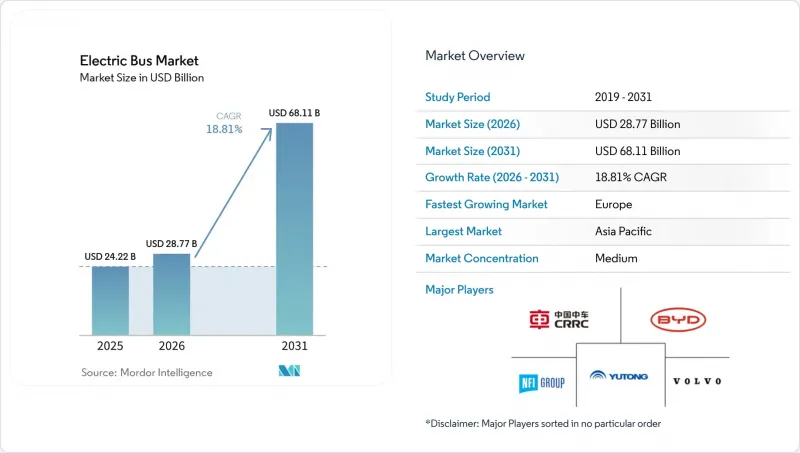
본 보고서는 추진 방식(배터리식 전기 버스 등), 용도(도시·대중교통 등), 배터리 화학 조성(LFP 등), 전장(9m 미만 등), 모터 구조(PMSM 등), 모터 출력(100kW 미만, 100-150kW, 기타), 주행 거리(100km 미만, 기타), 최종 용도(공공·민간), 지역별로 분류되어 있습니다. 시장 전망은 금액(달러) 및 수량(대수)으로 제시되어 있습니다.
세계 전기 버스 시장 동향과 인사이트
배터리 가격이 85달러/kWh 아래로 하락
아시아의 주요 생산 거점에서는 규모의 경제가 실현되어 배터리 비용의 지속적인 하락으로 이어지고 있습니다. 분석가들은 가까운 미래에 이러한 비용이 더욱 낮아지고, 차량 수명 및 연료 가격에 관한 일정한 조건이 충족된다면 보조금 없이도 전기차가 내연기관 차량과 가격 면에서 경쟁할 수 있게 될 가능성이 있다고 예측했습니다. 한편, 나트륨 이온 배터리와 같은 신기술은 기존의 리튬 이온 배터리에 비해 에너지 밀도 측면에서 다소 타협이 필요하긴 하지만, 비용 면에서 이점을 가져다줄 가능성이 있습니다. 배터리 가격 하락에 따라, 세컨드 라이프 배터리 시장에서는 눈에 띄는 활황이 나타나고 있습니다. 아직 상당한 사용 가능 용량을 남기고 있는 사용 후 배터리 팩이 고정형 에너지 저장 시스템으로 재활용되고 있습니다. 이러한 추세는 해당 배터리의 잔존 가치를 높일 뿐만 아니라, 전기차 리스 조건을 더욱 매력적으로 만드는 길도 열어주고 있습니다.
대도시에서의 전기차 도입 주류화
주요 도시의 제로 배출 규제는 사실상 디젤차 금지 조치로 기능하고 있으며, 차량 교체 주기를 최단 5년까지 단축시켜 지역 생산 능력을 초과하는 대규모 조달을 유발하고 있습니다. 각 기관은 차고 재설계 및 운전자 재교육에 드는 추가 비용을 부담하게 되어 프로젝트 예산이 15-20% 증가했습니다. 소규모 사업자는 저비용 자금 조달 수단이 없어 사업에서 철수하거나 합병하는 경우가 많으며, 그 결과 대규모 공공 차량 함대 간의 집중화가 진행되고 있습니다. 홍콩이나 호치민시 등 아시아의 도시들은 2030년까지 완전한 전기화를 실현하겠다고 공약하고 있으며, 이로 인해 수요의 정점이 동시에 발생하여 전 세계 공급망에 부담을 주고 있습니다. 규제 준수 비용은 차량에만 그치지 않고 송전망 업그레이드 및 직원 재교육까지 미치며, 도입 일정을 복잡하게 만들고 있습니다.
차고 내 전력망 업그레이드에 따른 병목 현상
전기 버스 차량군의 차고 수용 능력을 확대하려면 변압기 용량 증설이나 전력 회사와의 치밀한 조정 등 전력 인프라의 대폭적인 업그레이드가 필요한 경우가 많습니다. 이러한 프로젝트는 계통 연계 대기나 기존 부지의 토지 제약으로 인해 지연될 가능성이 있어, 전기 버스 시장의 부동산 계획에 복잡성과 비용을 가중시킵니다. 또한, 첨단 에너지 관리 시스템과 전력망 현대화가 필요해짐에 따라 추가적인 과제가 발생합니다. 원활한 통합과 확장성을 확보하기 위해서는 차량 운영 사업자, 전력 회사, 정책 입안자 간의 협력이 필수적입니다.
부문 분석
2025년 시점에서 배터리식 전기 버스는 전기 버스 시장 점유율의 83.92%를 차지했으나, 도시 간 운행 사업자들이 400-500km의 주행 거리와 15분 미만의 충전 시간을 중시함에 따라, 연료전지 버스는 2031년까지 연평균 성장률(CAGR) 20.82%를 나타낼 것으로 예측됩니다. 배터리 주행 거리가 300km를 초과함에 따라 플러그인 하이브리드 차량의 점유율은 축소되고 있습니다. BEB(배터리식 전기 버스)의 성장은 리튬 이온 배터리 가격 하락, 차고 내 충전 지원, 야간 충전 우대 요금과 직접적으로 연관되어 있습니다. FCEB(연료전지 버스)의 성장은 중량 감축이 매우 중요하며, 기존 수소 인프라를 통해 설비 투자가 절감되는 항만 지역이나 산간 지역을 중심으로 집중되고 있습니다.
도시 지역 차량의 경우 2028년까지 BEB가 표준화될 전망인 반면, 장거리 노선에서는 비용이 1kg당 3-4달러에 근접함에 따라 수소가 채택될 것으로 예측됩니다. 캘리포니아주의 ‘첨단 청정 차량 규정(Advanced Clean Fleets rule)’은 두 기술 모두를 규제 준수 대상으로 인정하고 있어, 규제상의 인센티브가 일관성을 갖추고 있습니다. 급속 충전과 가벼운 축 하중 덕분에, 그린 수소가 보급되면 FCEB는 시간 엄수가 요구되는 노선에서 경쟁력을 발휘할 것입니다.
2025년 도입 대수 중 도시 버스가 62.37%를 차지했으나, 300-450km의 주행 거리를 갖춘 배터리 팩의 보급이 확대됨에 따라 도시 간 버스 서비스는 연평균 성장률(CAGR) 19.18%를 나타낼 것으로 예측됩니다. 연방 정부의 막대한 보조금이 이러한 노력을 뒷받침하고 있으며, 스쿨버스의 전기화도 탄력을 받고 있습니다. 한편, 공항 셔틀 사업자들은 제한된 운행 환경에서 소음 및 배기가스 감축을 목표로 전기차로의 전환을 추진하고 있습니다.
도시 내 노선은 정지 및 재출발이 잦은 교통 상황에서 회생 제동의 이점을 최대한 활용할 수 있어 전기화의 선두를 달리고 있습니다. 도시 간 노선에서의 도입도 증가 추세에 있습니다. 이는 배터리의 에너지 밀도 향상과 비용의 급격한 하락으로 인해 고가의 노선상 충전소에 대한 의존도가 낮아졌기 때문입니다. 또한, 관광용 및 기업용 셔틀 차량 모두 지속가능성 목표에 부합하고, 유지보수 수요를 대폭 줄일 수 있는 이점을 누리기 위해 전기차 모델로의 전환을 추진하고 있습니다.
LFP 배터리 팩은 비용과 열적 안정성 덕분에 2025년 도입 대수의 59.63%를 차지했습니다. 또한, NMC/NCA 계열 배터리는 에너지 밀도가 250 Wh/kg을 초과함에 따라 연평균 성장률(CAGR) 20.28%를 나타낼 것으로 예측됩니다. 리튬 티타네이트 배터리는 급속 충전이 요구되는 도시 지역의 순환 노선에 적합하며, 나트륨 이온 배터리는 비용 효율성을 중시하는 단거리 용도를 대상으로 합니다.
LFP의 코발트 프리 설계는 공급망 리스크를 완화하고, 성능 저하를 가속화하지 않으면서 완전 방전 사이클을 가능하게 합니다. NMC 및 NCA 아키텍처는 450km 이상의 주행 거리가 필요한 노선에 대응하지만, 보다 견고한 열 관리가 필요하기 때문에 팩 비용이 높아집니다. 나트륨 이온 배터리는 리튬 가격 변동의 영향을 덜 받는 반면, 주행 거리 성능이 저하되기 때문에 밀집된 도시 지역에서의 운행으로 제한됩니다.
지역별 분석
2025년에는 아시아태평양이 시장을 주도하며 총 출하량의 64.82%를 차지했습니다. 중국의 대규모 전기 버스 도입과 인도의 국가적 보조금 정책이 맞물려 아시아 전역에서 버스 차량의 전동화가 가속화되고 있습니다. 이러한 정책으로 인해 전기 버스와 디젤버스의 비용 격차가 줄어들고 있어, 사업자들의 전환이 용이해지고 있습니다. 한편, 일본과 한국은 수소 모빌리티의 최전선에 위치하며, 수소 인프라 구축과 더욱 친환경적인 교통수단 추진을 위해 연료전지버스를 국가 전략에 포함시키고 있습니다.
유럽에서는 EU의 ‘청정 차량 지침’에 따른 제로 배출 도시 버스 추진을 뒷받침으로, 연평균 성장률(CAGR) 19.88%라는 견실한 성장이 예상됩니다. 독일과 프랑스 등 여러 국가들은 전기 버스에 대한 막대한 재정적 인센티브를 통해 이러한 전환을 지원하고 있습니다. 또한 런던, 파리, 밀라노 등의 도시에서는 저배출 구역 설정을 배경으로 디젤 차량의 단계적 폐지를 위한 노력을 강화하고 있습니다. 국내 배터리 셀 생산을 촉진하기 위해 현지 조달 의무화 움직임이 탄력을 받고 있으며, 노스볼트(Northvolt)나 LG 에너지솔루션과 같은 업계 대기업들이 기가팩토리의 생산 능력을 확대되고 있습니다.
북미에서는 연방 정부의 보조금 및 인프라 구축 노력이, 특히 스쿨버스 도입 측면에서 이러한 전환을 뒷받침하고 있습니다. 그러나 전력 회사와의 계통 연계가 지연되면서 진전이 저해되고 있습니다. 한편, 라틴아메리카에서는 각 도시가 재정적 과제를 극복하기 위해 ‘Route-as-a-Service’와 같은 혁신적인 계약 모델을 시범적으로 도입하고 있습니다. 중동에서는 각 도시가 보다 광범위한 지속가능성 목표에 부합하도록 주요 셔틀 노선에 전기 버스를 도입하고 있습니다.
기타 혜택:
- 엑셀 형식 시장 예측(ME) 시트
- 3개월간의 애널리스트 지원
자주 묻는 질문
목차
제1장 서론
제2장 조사 방법
제3장 주요 요약
제4장 시장 구도
제5장 시장 규모와 성장 예측
제6장 경쟁 구도
제7장 시장 기회와 향후 전망
제8장 CEO가 직면하는 중요 전략적 과제
JHS 26.08.07According to Mordor Intelligence, the electric bus market size is expected to grow from USD 24.22 billion in 2025 to USD 28.77 billion in 2026 and is forecast to reach USD 68.11 billion by 2031 at an 18.81% CAGR over 2026-2031.
This report is Segmented by Propulsion (Battery Electric Bus, and More), Application (City/Transit, and More), Battery Chemistry (LFP, and More), Length (Below 9m, and More), Motor Architecture (PMSM, and More), Motor Power (Below 100kW, 100-150kW, and More), Range (Below 100km, and More), End Use (Public and Private), and Geography. The Market Forecasts are Provided in Terms of Value (USD) and Volume (Units).
Global Electric Bus Market Trends and Insights
Battery-Price Decline Below USD 85/kWh
Major Asian production hubs have achieved economies of scale, leading to a continued decline in battery costs. Analysts predict that these costs will decrease further in the near future, potentially allowing electric vehicles to compete with internal combustion engines on price, even without subsidies, provided certain conditions regarding vehicle lifespan and fuel prices are met. Meanwhile, emerging technologies like sodium-ion batteries offer potential cost benefits, albeit with some trade-offs in energy density when compared to traditional lithium-ion batteries. As battery prices fall, there's a noticeable uptick in second-life battery markets. End-of-life battery packs, still boasting considerable usable capacity, are being repurposed for stationary energy storage. This trend not only bolsters the residual values of these batteries but also paves the way for more attractive leasing terms for electric vehicles.
Mainstream EV Mandates in Megacities
Zero-emission rules in major cities act as de facto diesel bans, compressing fleet-renewal timelines to as little as five years and triggering large-scale procurements that outpace local manufacturing capacity. Agencies shoulder added expenses for depot redesigns and driver retraining, inflating project budgets by 15-20%. Smaller operators often exit or merge because they lack access to low-cost capital, increasing concentration among large public fleets. Asian cities such as Hong Kong and Ho Chi Minh City pledge full electrification by 2030, creating synchronized demand peaks that strain global supply chains. Compliance costs extend beyond vehicles, encompassing grid upgrades and workforce reskilling, which complicate rollout schedules.
Grid-Upgrade Bottlenecks at Depots
Expanding depot capacity for electric fleets often requires significant upgrades to power infrastructure, including additional transformer capacity and extended coordination with utilities. These projects can be delayed by interconnection queues and land constraints at older sites, which add complexity and cost to real-estate planning in the electric bus market. Furthermore, the need for advanced energy management systems and grid modernization adds another layer of challenges, requiring collaboration between fleet operators, utilities, and policymakers to ensure seamless integration and scalability.
Other drivers and restraints analyzed in the detailed report include:
- Global OEM Platform Modularization
- Hydrogen FCEB Pilots in Port Corridors
- Scarcity of TCO-Viable Fuel-Cell Grade H2
For complete list of drivers and restraints, kindly check the Table Of Contents.
Segment Analysis
Battery-electric buses held an 83.92% Electric Bus Market share in 2025, while fuel-cell models are forecasted to have a 20.82% CAGR through 2031, as intercity operators value a 400-500 km range and sub-15-minute refueling. Plug-in hybrids shrink as battery ranges exceed 300 km. BEB growth ties directly to lithium-ion price drops, depot-charging compatibility, and favorable overnight charging tariffs. FCEB growth clusters around ports and mountainous regions, where weight savings are crucial and existing hydrogen infrastructure reduces capital expenditures.
City fleets will standardize on BEBs by 2028, whereas long-haul corridors adopt hydrogen as costs approach USD 3-4 per kg. California's Advanced Clean Fleets rule recognizes both technologies for compliance, aligning regulatory incentives. Fast refueling and lighter axle loads make FCEBs competitive on time-sensitive routes, provided green hydrogen scales.
City buses accounted for 62.37% of 2025 deployments; however, intercity services are projected to grow at a 19.18% CAGR due to the widening availability of 300-450 km battery packs. With substantial federal grants backing the initiative, school-bus electrification is gaining momentum. Meanwhile, airport shuttle operators are turning to electric vehicles, aiming to reduce noise and emissions in their confined operating environments.
Urban routes lead the charge in electrification, as their stop-and-go traffic optimally harnesses the benefits of regenerative braking. Intercity adoption is on the rise, thanks to advancements in battery energy density and plummeting costs, which lessen the dependence on costly en-route charging stations. Additionally, both tourism and corporate shuttle fleets are transitioning to electric models, aligning with sustainability goals and reaping the benefits of significantly reduced maintenance needs.
LFP packs captured 59.63% of 2025 installations on cost and thermal stability, and NMC/NCA chemistries are expected to see a 20.28% CAGR as density surpasses 250 Wh/kg. Lithium-titanate caters to fast-charge urban loops, while sodium-ion targets cost-sensitive, short-range applications.
LFP's cobalt-free design mitigates supply-chain risk and enables full-depth-of-discharge cycles without accelerated degradation. NMC and NCA architectures serve routes requiring a range of over 450 km but require more robust thermal management, which raises pack expense. Sodium-ion reduces exposure to lithium pricing but sacrifices range capability, constraining it to dense urban runs.
Complete Report Scope:
- By Propulsion
- Battery Electric Bus (BEB)
- Plug-in Hybrid Electric Bus (PHEB)
- Fuel Cell Electric Bus (FCEB)
- By Application
- City / Transit
- Intercity / Regional
- Coach / Tourist
- School Bus
- Airport
- Others
- By Battery Chemistry
- Lithium Iron Phosphate (LFP)
- Nickel Manganese Cobalt (NMC) / Nickel Cobalt Aluminum (NCA)
- Lithium Titanate (LTO)
- Others (Sodium-ion, emerging / pilots)
- By Length
- Below 9 m
- 9-14 m
- 14-18 m
- Above 18 m
- By Motor Architecture
- Permanent Magnet Synchronous Motor (PMSM)
- Induction Motor / Asynchronous AC
- Switched Reluctance Motor (SRM)
- Others
- By Motor Power
- Below 100 kW
- 100-150 kW
- 151-200 kW
- 201-250 kW
- 251-320 kW
- Above 320 kW
- By Range
- Below 100 km
- 100-200 km
- 201-300 km
- 300-450 km
- Above 450 km
- By End Use
- Public
- Private
- By Geography
- North America
- United States
- Canada
- Mexico
- Rest of North America
- South America
- Brazil
- Argentina
- Rest of South America
- Europe
- Germany
- France
- Italy
- Spain
- United Kingdom
- Rest of Europe
- Asia-Pacific
- China
- India
- Japan
- South Korea
- Asia-Pacific
- Middle East and Africa
- United Arab Emirates
- South Africa
- Rest of Middle East and Africa
- North America
Geography Analysis
In 2025, the Asia-Pacific region dominated the market, accounting for 64.82% of the total volume. China's extensive fleet of electric buses, coupled with India's national subsidy initiatives, is propelling the electrification of bus fleets across Asia. These initiatives are narrowing the cost disparity between electric and diesel buses, making it easier for operators to transition. At the same time, Japan and South Korea are positioning themselves at the forefront of hydrogen mobility, integrating fuel-cell buses into their national agendas to bolster hydrogen infrastructure and advocate for cleaner transportation.
Europe is on track to achieve a robust 19.88% CAGR, spurred by the EU Clean Vehicles Directive's push for zero-emission city buses. Countries such as Germany and France are backing this transition with substantial financial incentives for electric buses. Furthermore, cities like London, Paris, and Milan are intensifying their efforts to phase out diesel fleets, bolstered by the establishment of low-emission zones. In a bid to boost domestic battery-cell production, local-content mandates are gaining traction, with industry giants like Northvolt and LG Energy Solution ramping up their gigafactory capacities.
In North America, federal grants and infrastructure initiatives are championing the transition, especially within school bus fleets. Yet, progress is hampered by utility interconnection delays. Meanwhile, in Latin America, cities are experimenting with innovative contract models, such as "route-as-a-service," to navigate financial hurdles. In the Middle East, urban centers are integrating electric buses into their central shuttle routes, aligning with broader sustainability goals.
- BYD Company Ltd.
- Yutong Bus Co. Ltd.
- CRRC Electric Vehicle Co. Ltd.
- NFI Group
- Volvo Group AB
- Proterra Inc.
- Alexander Dennis Ltd.
- VDL Bus and Coach
- Ebusco Holding N.V.
- Solaris Bus and Coach
- Switch Mobility Ltd.
- Wrightbus
- Tata Motors Ltd.
- Ashok Leyland Ltd.
- Daimler Truck Holding AG
- King Long United Automotive
- Zhongtong Bus Co. Ltd.
- Anhui Ankai Automobile
- Chery Automobile Co. Ltd.
- Chongqing Changan Automobile
Additional Benefits:
- The market estimate (ME) sheet in Excel format
- 3 months of analyst support
TABLE OF CONTENTS
1 Introduction
- 1.1 Study Assumptions and Market Definition
- 1.2 Scope of the Study
2 Research Methodology
3 Executive Summary
4 Market Landscape
- 4.1 Urbanization, Population and Transit Demand
- 4.2 Public Transport Share and Mode Shift
- 4.3 Diesel vs Electricity/Hydrogen Price Spread
- 4.4 Vehicle and Infra CAPEX / OPEX
- 4.5 Financing Models
- 4.6 Bus Specs and Vehicle Standards
- 4.7 Charging Stations and Charging Topology
- 4.8 Hydrogen Stations Serving Buses
- 4.9 Subsidy / Incentive Value
- 4.10 OEM Line-up and Model Pipeline
- 4.11 Regulatory Framework
- 4.12 Vehicle Homologation and Safety
- 4.13 Procurement and Contracting Rules
- 4.14 Fiscal and Industrial Policy (Incentives, Duties, Localization, EPR)
- 4.15 Market Overview
- 4.16 Market Drivers
- 4.16.1 Mainstream EV Mandates in Megacities
- 4.16.2 Battery-Price Decline Below USD 85/kWh
- 4.16.3 Hydrogen FCEB Pilots in Port Corridors
- 4.16.4 Global OEM Platform Modularization
- 4.16.5 Route-as-a-Service Contracting
- 4.16.6 Second-Life Battery Monetization
- 4.17 Market Restraints
- 4.17.1 Grid-Upgrade Bottlenecks at Depots
- 4.17.2 Scarcity of TCO-Viable Fuel-Cell Grade H?
- 4.17.3 Residual-Value Uncertainty
- 4.17.4 Critical-Minerals Export Curbs
- 4.18 Value / Supply-Chain Analysis
- 4.19 Porter's Five Forces
- 4.19.1 Threat of New Entrants
- 4.19.2 Bargaining Power - Suppliers
- 4.19.3 Bargaining Power - Buyers
- 4.19.4 Threat of Substitutes
- 4.19.5 Competitive Rivalry
5 Market Size and Growth Forecasts (Value and Volume)
- 5.1 By Propulsion
- 5.1.1 Battery Electric Bus (BEB)
- 5.1.2 Plug-in Hybrid Electric Bus (PHEB)
- 5.1.3 Fuel Cell Electric Bus (FCEB)
- 5.2 By Application
- 5.2.1 City / Transit
- 5.2.2 Intercity / Regional
- 5.2.3 Coach / Tourist
- 5.2.4 School Bus
- 5.2.5 Airport
- 5.2.6 Others
- 5.3 By Battery Chemistry
- 5.3.1 Lithium Iron Phosphate (LFP)
- 5.3.2 Nickel Manganese Cobalt (NMC) / Nickel Cobalt Aluminum (NCA)
- 5.3.3 Lithium Titanate (LTO)
- 5.3.4 Others (Sodium-ion, emerging / pilots)
- 5.4 By Length
- 5.4.1 Below 9 m
- 5.4.2 9-14 m
- 5.4.3 14-18 m
- 5.4.4 Above 18 m
- 5.5 By Motor Architecture
- 5.5.1 Permanent Magnet Synchronous Motor (PMSM)
- 5.5.2 Induction Motor / Asynchronous AC
- 5.5.3 Switched Reluctance Motor (SRM)
- 5.5.4 Others
- 5.6 By Motor Power
- 5.6.1 Below 100 kW
- 5.6.2 100-150 kW
- 5.6.3 151-200 kW
- 5.6.4 201-250 kW
- 5.6.5 251-320 kW
- 5.6.6 Above 320 kW
- 5.7 By Range
- 5.7.1 Below 100 km
- 5.7.2 100-200 km
- 5.7.3 201-300 km
- 5.7.4 300-450 km
- 5.7.5 Above 450 km
- 5.8 By End Use
- 5.8.1 Public
- 5.8.2 Private
- 5.9 By Geography
- 5.9.1 North America
- 5.9.1.1 United States
- 5.9.1.2 Canada
- 5.9.1.3 Mexico
- 5.9.1.4 Rest of North America
- 5.9.2 South America
- 5.9.2.1 Brazil
- 5.9.2.2 Argentina
- 5.9.2.3 Rest of South America
- 5.9.3 Europe
- 5.9.3.1 Germany
- 5.9.3.2 France
- 5.9.3.3 Italy
- 5.9.3.4 Spain
- 5.9.3.5 United Kingdom
- 5.9.3.6 Rest of Europe
- 5.9.4 Asia-Pacific
- 5.9.4.1 China
- 5.9.4.2 India
- 5.9.4.3 Japan
- 5.9.4.4 South Korea
- 5.9.4.5 Asia-Pacific
- 5.9.5 Middle East and Africa
- 5.9.5.1 United Arab Emirates
- 5.9.5.2 South Africa
- 5.9.5.3 Rest of Middle East and Africa
- 5.9.1 North America
6 Competitive Landscape
- 6.1 Market Concentration
- 6.2 Strategic Moves
- 6.3 Market Share Analysis
- 6.4 Company Profiles (Includes Global level Overview, Market level overview, Core Segments, Financials as available, Strategic Information, Market Rank/Share for key companies, Products and Services, and Recent Developments)
- 6.4.1 BYD Company Ltd.
- 6.4.2 Yutong Bus Co. Ltd.
- 6.4.3 CRRC Electric Vehicle Co. Ltd.
- 6.4.4 NFI Group
- 6.4.5 Volvo Group AB
- 6.4.6 Proterra Inc.
- 6.4.7 Alexander Dennis Ltd.
- 6.4.8 VDL Bus and Coach
- 6.4.9 Ebusco Holding N.V.
- 6.4.10 Solaris Bus and Coach
- 6.4.11 Switch Mobility Ltd.
- 6.4.12 Wrightbus
- 6.4.13 Tata Motors Ltd.
- 6.4.14 Ashok Leyland Ltd.
- 6.4.15 Daimler Truck Holding AG
- 6.4.16 King Long United Automotive
- 6.4.17 Zhongtong Bus Co. Ltd.
- 6.4.18 Anhui Ankai Automobile
- 6.4.19 Chery Automobile Co. Ltd.
- 6.4.20 Chongqing Changan Automobile
7 Market Opportunities and Future Outlook
- 7.1 White-space and Unmet-need Assessment


