

|
시장보고서
상품코드
2118076
OTT용 AI 현지화 시장 : 시장 점유율 분석, 업계 동향 및 통계, 성장 예측(2026-2031년)AI Localization For OTT - Market Share Analysis, Industry Trends & Statistics, Growth Forecasts (2026 - 2031) |
||||||
 Mordor Intelligence
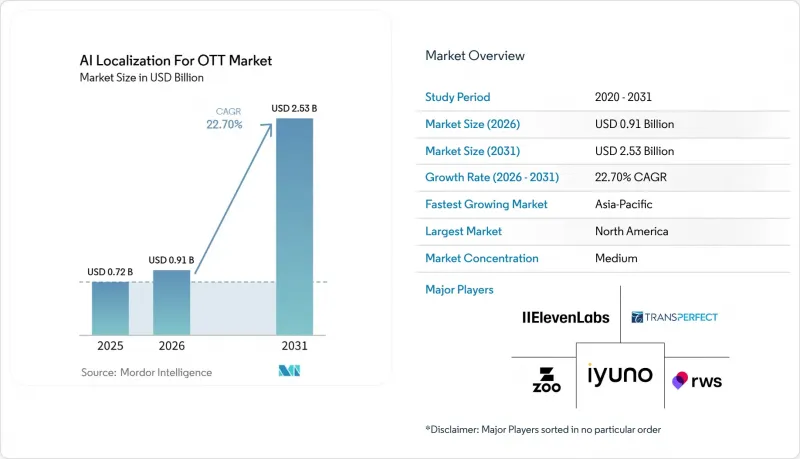
Mordor Intelligence에 의하면, OTT용 AI 현지화 시장 규모는 2025년 7억 2,000만 달러로 평가되었고, 2026년에는 9억 1,000만 달러로 추정되고, 2026-2031년 CAGR 22.70%로 성장을 지속할 전망이며, 2031년에는 25억 3,000만 달러에 이를 것으로 예측됩니다.
본 보고서는 현지화 기능별(자막·캡션, 더빙·보이스오버, 메타데이터·아트웍 현지화, 음성 해설), 배포 방식별(클라우드, 온프레미스, 하이브리드), 컨텐츠 유형별(영화·영상 작품, TV 프로그램, 다큐멘터리), 지역별(북미, 남미, 유럽, 아시아태평양, 기타)로 분류되어 있습니다. 시장 예측은 금액(달러) 기준으로 제시되어 있습니다.
OTT용 AI 현지화 시장 동향 및 인사이트
국경을 초월한 OTT 컨텐츠 배포의 확대
세계 스트리밍 플랫폼은 단일 공통 더빙 트랙이 아닌, 여러 가지 다른 언어 버전이 필요한 시장에 진출하고 있습니다. 플랫폼은 다양한 시청자층을 위해 동시에 컨텐츠를 준비해야 하므로, 이러한 배포 패턴은 자동화된 현지화의 유용성을 높이고 있습니다. Disney+는 2026년 7월, 음성 지원 언어를 58개 언어로 확대하여 17개 언어를 추가하는 한편, 아랍어 및 히브리어 사용자를 위해 오른쪽에서 왼쪽으로 읽는 인터페이스를 도입했습니다. 언어 지원 범위가 기존에는 주요 시장보다 컨텐츠 제공이 늦어졌던 시장까지 확대됨에 따라, OTT용 AI 현지화 시장도 성장하고 있습니다. 피어 리뷰를 거친 연구에 따르면, Netflix와 Amazon Prime Video는 Iyuno, VSI, Deluxe 등 소수의 주요 다국적 현지화 제공업체에 의존하여 방대한 양의 다국어 컨텐츠 제작을 조정하고 있는 것으로 밝혀졌습니다. 플랫폼이 다수의 언어로 동시 스트리밍을 목표로 할 때, 이러한 구조는 처리 능력의 한계를 초래할 가능성이 있습니다. 따라서 OTT용 AI 현지화 시장에서는 기존 벤더나 플랫폼과의 관계를 대체하기보다는 그들과 협력하여 업무를 수행하는 제공업체가 유리한 입지를 차지할 가능성이 있습니다.
모국어를 통한 스트리밍 경험에 대한 수요
신흥 대규모 시장에서 스트리밍이 확대됨에 따라, 지역 언어로 시청하는 것이 중심적인 역할을 하고 있습니다. 인도에서는 Prime Video 고객의 대다수가 여러 언어로 컨텐츠를 시청하고 있으며, 다국어 오리지널 작품 제공이 표준 출시 요건이 되었습니다. 이러한 추세는 인도 국내 및 국제 시장의 시청자에게 서비스를 제공할 수 있는 현지화에 대한 수요도 뒷받침하고 있습니다. 한국의 K-FAST 프로그램에서는 방대한 카탈로그에 수록된 컨텐츠를 영어, 스페인어, 포르투갈어로 현지화했습니다. 이 프로그램은 시작 후 짧은 기간 내에 많은 국가에서 상당한 수의 시청자를 확보했습니다. QVC 재팬은 비디오 온 디맨드(VOD) 카탈로그를 위해 다국어 AI 자막 기능을 도입할 예정이며, 사용자는 일본어, 영어, 중국어, 한국어 자막을 선택할 수 있게 될 것입니다. 이러한 동향은 OTT용 AI 현지화 시장이 국내 접근성 향상과 해외 컨텐츠 배포를 모두 뒷받침하고 있음을 보여줍니다.
문화적 적응과 감정 표현에서의 품질 편차
OTT용 AI 현지화 시장은 여전히 품질의 편차를 겪고 있습니다. 이는 AI 더빙이 관용구, 문화 특유의 감정 표현, 비언어적 연기 표현에서 신뢰성이 부족하기 때문입니다. 이러한 단점은 시청자가 현실감을 강하게 기대하는 프리미엄 오리지널 시리즈나 드라마에서 특히 큰 문제가 됩니다. Prime Video는 시청자들로부터 품질에 대한 우려가 제기되자, 한국 드라마의 AI 생성 스페인어 더빙 버전을 삭제했습니다. 이 결과는 사람이 참여하는 워크플로우라 하더라도 문화적으로 독특한 컨텐츠에 대한 시청자의 기대에 부응하지 못하는 경우가 있음을 보여줍니다. 동료 심사를 거친 분석에 따르면, 중앙 집중식 현지화 기법은 지역을 불문하고 워크플로우를 표준화할 수 있는 반면, 문화적 고유성을 훼손할 가능성이 있는 것으로 밝혀졌습니다. 모델은 지역별 연기 전통보다는 자원이 풍부한 언어 쌍이나 일반적인 표현 스타일을 기반으로 더 광범위하게 학습됩니다. OTT용 AI 현지화 시장에서는 브랜드나 문화적 중요도가 높은 작품의 경우, 앞으로도 인간에 의한 언어적·창의적 검토가 지속적으로 필요할 것으로 보입니다.
부문 분석
2025년에는 자막·캡션이 시장의 35.64%를 차지했으며, 현지화 기능 중 가장 큰 점유율을 기록했습니다. 이러한 주도적인 역할은 기술적 복잡성이 비교적 낮고, 광범위한 스트리밍 카탈로그에서 초기부터 채택되어 온 점을 반영합니다. 또한, 캡션은 미국에서 IP로 배포되는 관련 프로그램에 적용되는 접근성 요건의 혜택도 받고 있습니다. 더빙 및 보이스오버는 2026-2031년 연평균 성장률(CAGR) 22.86%를 나타낼 것으로 예측됩니다. 이러한 성장은 AI 음성 합성 비용의 감소와, 기존에는 비용 부담이 커서 대응할 수 없었던 카탈로그 작품의 더빙이 가능해지는 기회를 반영한 것입니다. 플랫폼 사업자는 자막을 언어 시장으로의 첫 번째 진입점으로 활용할 수 있습니다. 그 후, 시청자 수요가 증가하고 더 큰 투자가 가능해진 단계에서 더빙 버전을 추가할 수 있습니다. 이러한 단계적인 접근 방식을 통해 이러한 기능들은 직접적으로 경쟁하지 않고 상호 협력하여 작동하게 됩니다.
OTT용 AI 현지화 시장에는 각 언어판 출시 시 정기적이지만 눈에 잘 띄지 않는 워크플로우로 메타데이터 및 아트워크 현지화가 포함됩니다. 타이틀이 다른 언어로 출시될 때마다 현지화된 썸네일, 타이틀 카드, 개요, 검색용 메타데이터를 준비해야 합니다. AI 도구는 플랫폼 예산에서 주목도가 낮은 경우에도 이러한 반복적인 작업을 극히 낮은 한계 비용으로 처리할 수 있습니다. 음성 해설은 수익 측면에서 규모가 가장 작은 기능이지만, 접근성 관련 규정으로 인해 시각 장애가 있는 시청자에게 제공되는 것이 권장되고 있습니다. 미국의 접근성 프레임워크에 따라 관련 프로그램에 자막을 제공하는 것이 공식적인 요건이 되었으며, 이는 접근성 높은 미디어 서비스에 대한 폭넓은 관심을 촉진하고 있습니다. 음성 해설은 비용 제약으로 인해 제공 범위가 제한되는 경우에도 자동화된 제작 방식의 혜택을 누릴 수 있습니다. 다만, 해설의 타이밍을 신중하게 조정하여 원본 프로그램의 의미를 정확하게 전달해야 하는 상황에서는 여전히 사람의 확인이 필수적입니다. 따라서 OTT용 AI 현지화 시장은 광범위한 카탈로그의 워크플로우와 특정 접근성 요건 모두에 의해 뒷받침되고 있습니다.
지역별 분석
북미의 OTT용 AI 현지화 시장은 2025년에 전체 시장의 38.42%를 차지했습니다. 이는 미국의 주요 스트리밍 플랫폼, 스튜디오, 현지화 기술 공급업체가 집중되어 있는 점이 뒷받침하고 있습니다. 프라임 비디오(Prime Video)는 2025년 3월, 영어 및 라틴아메리카 스페인어로 라이선스가 확보된 영화와 시리즈 12편을 대상으로 AI를 활용한 더빙 시범 프로젝트를 시작했습니다. ElevenLabs는 2026년 2월, 기업 가치 110억 달러로 5억 달러 규모의 시리즈 D 자금 조달을 완료했습니다. 캐나다 역시 북미 스튜디오 사업과의 협력을 통해 현지화 수요를 뒷받침하고 있습니다. 멕시코에서는 2026년 법 개정에 따라 합성 음성 사용에 관한 동의 및 보상 체계가 의무화되었습니다. 이러한 요건들은 지역 및 국제 시청자를 대상으로 하는 스페인어 더빙 사업에 영향을 미치고 있습니다.
유럽에서는 2026년 8월 2일부터 EU AI법에 따라 AI를 활용한 더빙 컨텐츠에 공개 의무가 적용됨에 따라, 독자적인 규정 준수 환경 하에서 운영되고 있습니다. 이 지역에는 스페인, 독일, 프랑스, 이탈리아와 같은 주요 더빙 시장이 있습니다. 이러한 시장에는 확립된 견고한 더빙 관행이 존재하여, 출연자의 참여를 줄이는 자동화 모델에 대한 거부감이 발생할 가능성이 있습니다. 동시에, 서비스 제공업체는 합성 음성에 대해 감사 가능한 기술적 통제 수단을 개발해야 할 이유가 있습니다. 따라서 유럽의 OTT용 AI 현지화 시장 규모는 현지화된 컨텐츠에 대한 수요와 규제 및 품질에 대한 기대치를 충족하기 위한 비용 모두에 의해 형성되고 있습니다. 이 지역에서는 자동화와 인간의 감독을 결합한 하이브리드 시스템이 선호될 가능성이 있습니다.
아시아태평양은 2026-2031년 연평균 성장률(CAGR) 23.24%를 나타낼 것으로 예측되며, 이는 지역별로는 가장 높은 성장률입니다. 인도의 경우, Prime Video 이용자의 60% 이상이 4개 이상의 언어로 컨텐츠를 스트리밍 시청하고 있어 다국어 시청에 대한 수요가 매우 높습니다. JioHotstar는 2026년, 제작 자동화, 다국어 AI 기능, 엔지니어링 각 분야에서 75명 이상의 AI 관련 인재를 채용했습니다. 한국 정부가 지원하는 프로그램은 현지화된 K-컨텐츠가 여러 해외 시장에 어떻게 배포될 수 있는지를 보여주었습니다. 일본에서는 2026년 7월 QVC Japan이 서비스를 개시함에 따라 플랫폼 차원의 다국어 자막 기능이 추가되었습니다. 남미와 아프리카는 여전히 초기 단계 시장이지만, 스와힐리어, 하우사어, 줄루어, 아랍어 방언에 관한 데이터가 제한적이어서 아프리카 일부 지역에서는 단기적인 출력 품질에 제약이 발생하고 있습니다. 중동에서는 사우디아라비아와 아랍에미리트가 플랫폼 및 컨텐츠에 대한 투자를 확대함에 따라 아랍어 현지화에 대한 수요가 증가하고 있습니다.
기타 혜택
- 엑셀 형식 시장 예측(ME) 시트
- 3개월간의 애널리스트 지원
자주 묻는 질문
목차
제1장 서론
제2장 조사 방법
제3장 주요 요약
제4장 시장 구도
제5장 시장 규모 및 성장 예측
제6장 경쟁 구도
제7장 시장 기회 및 향후 전망
AJY 26.09.03According to Mordor Intelligence, the AI localization for OTT market size is expected to grow from USD 0.72 billion in 2025 to USD 0.91 billion in 2026 and is forecast to reach USD 2.53 billion by 2031 at 22.70% CAGR over 2026-2031.
This report is Segmented by Localization Function (Subtitling and Captioning, Dubbing and Voice-Over, Metadata and Artwork Localization, and Audio Description), Deployment (Cloud, On-Premises, and Hybrid), Content Type (Movies and Films, TV Shows, and Documentaries), and Geography (North America, South America, Europe, Asia-Pacific, and More). The Market Forecasts are Provided in Terms of Value (USD).
Global AI Localization For OTT Market Trends and Insights
Expansion of Cross-Border OTT Content Distribution
Global streaming platforms are entering markets that need several distinct language versions rather than a single shared dub track. This release pattern makes automated localization more useful because platforms need to prepare content for several audiences at the same time. Disney+ expanded audio support to 58 languages in July 2026, adding 17 languages and a right-to-left interface for Arabic and Hebrew users. The AI localization for OTT market is expanding as language coverage reaches markets that previously received content later than core markets. A peer-reviewed study found that Netflix and Amazon Prime Video depend on a limited set of large transnational localization providers, including Iyuno, VSI, and Deluxe, to coordinate high-volume multilingual output. The same structure can create capacity pressure when platforms seek simultaneous releases across many languages. The AI localization for OTT market can therefore favor providers that work with existing vendor and platform relationships rather than attempting to replace them.
Demand for Native-Language Streaming Experiences
Regional language viewing is becoming central to streaming expansion in large emerging markets. In India, a majority of Prime Video customers streamed content in multiple languages, making multilingual originals a standard release requirement. This preference also supports demand for localization that can serve audiences within India and in international markets. South Korea's K-FAST program localized extensive content across a large catalog into English, Spanish, and Portuguese. The program reached substantial viewership across many countries within a short period of its launch. QVC Japan is expected to introduce multilingual AI subtitle functionality for its video-on-demand catalog, allowing users to choose subtitles in Japanese, English, Chinese, and Korean. These developments indicate that the AI localization for OTT market supports both domestic accessibility and overseas content distribution.
Quality Variability in Cultural Adaptation and Emotional Performance
The AI localization for OTT market still faces quality variation because AI dubbing is less reliable for idioms, culturally specific emotions, and nonverbal performance. These shortcomings matter most for premium original series and dramas, where viewers have high expectations for authenticity. Prime Video removed AI-generated Spanish dubs of South Korean dramas after viewers raised quality concerns. The outcome showed that even a workflow with human involvement can fail to meet audience expectations for culturally distinctive content. A peer-reviewed analysis found that centralized localization practices can standardize workflows across geographies while reducing cultural specificity. Models are trained more extensively on high-resource language pairs and common delivery styles than on regional performance traditions. The AI localization for OTT industry will continue to need human linguistic and creative review for titles with greater brand and cultural stakes.
Other drivers and restraints analyzed in the detailed report include:
- Requirement for Faster and Lower-Cost Dubbing and Subtitling
- Accessibility and Multilingual Content Compliance Requirements
- Voice-Likeness, Consent, Copyright, and Performer-Rights Exposure
For complete list of drivers and restraints, kindly check the Table Of Contents.
Segment Analysis
Subtitling and captioning accounted for 35.64% of the market in 2025, making it the largest localization function. Its leading role reflects lower technical complexity and earlier use across broad streaming catalogs. Captioning also benefits from accessibility requirements that apply to relevant IP-delivered programming in the United States. Dubbing and voice-over is projected to grow at a 22.86% CAGR from 2026 to 2031. The growth reflects the lower cost of AI voice synthesis and the opportunity to dub catalog titles that previously could not support the expense. Platforms can use subtitles as an initial entry point for a language market. They can then add dubbed versions when audience demand supports a larger investment. This sequencing means the functions can work together rather than compete directly.
The AI localization for OTT market includes metadata and artwork localization as a recurring but less visible workflow within each language release. Localized thumbnails, title cards, summaries, and search metadata need to be prepared whenever a title is released in another language. AI tools can process these repeat tasks at very low marginal cost, even though they may receive less attention in platform budgets. Audio description is the smallest function by revenue, but accessibility rules support its use for viewers with visual impairments. The U.S. accessibility framework has made captioning a formal requirement for relevant programming and supports broader attention to accessible media services. Audio description can benefit from automated production methods where cost has limited coverage. Human review remains necessary where descriptions must be timed carefully and preserve the meaning of the original program. The AI localization for OTT market is therefore supported by both broad catalog workflows and specific accessibility needs.
Complete Report Scope:
- By Localization Function
- Subtitling and Captioning
- Dubbing and Voice-Over
- Metadata and Artwork Localization
- Audio Description
- By Deployment
- Cloud
- On-Premises
- Hybrid
- By Content Type
- Movies and Films
- TV Shows and Episodic Content
- Documentaries
- Other Content Type
- By Geography
- North America
- United States
- Canada
- Mexico
- South America
- Brazil
- Argentina
- Rest of South America
- Europe
- United Kingdom
- Germany
- France
- Spain
- Italy
- Russia
- Rest of Europe
- Asia-Pacific
- China
- Japan
- India
- South Korea
- Rest of Asia-Pacific
- Middle East
- Turkiye
- Saudi Arabia
- United Arab Emirates
- Rest of Middle East
- Africa
- South Africa
- Nigeria
- Egypt
- Rest of Africa
- North America
Geography Analysis
The AI localization for OTT market in North America accounted for 38.42% of the market in 2025, supported by the concentration of major streaming platforms, studios, and localization technology vendors in the United States. Prime Video began an AI-aided dubbing pilot in March 2025 for 12 licensed movies and series in English and Latin American Spanish. ElevenLabs closed a USD 500 million Series D at an USD 11 billion valuation in February 2026. Canada also supports localization demand through its links to North American studio operations. Mexico's 2026 legal changes require consent and remuneration frameworks for synthetic voice use. These requirements affect Spanish-language dubbing operations that serve regional and international audiences.
Europe operates under a distinct compliance environment because the EU AI Act applies disclosure obligations to AI-dubbed content from August 2, 2026. The region has major dubbing markets in Spain, Germany, France, and Italy. These markets have strong, established dubbing practices, which can create resistance to automated models that reduce performer involvement. At the same time, providers have a reason to develop auditable technical controls for synthetic audio. The AI localization for OTT market size in Europe is therefore shaped by both demand for localized content and the cost of meeting regulatory and quality expectations. The region can favor hybrid systems that pair automation with human oversight.
Asia-Pacific is projected to grow at a 23.24% CAGR from 2026 to 2031, the highest regional rate. India has extensive demand for multilingual viewing because more than 60% of Prime Video customers in the country streamed content in 4 or more languages. JioHotstar recruited more than 75 AI roles in 2026 across production automation, multilingual AI capabilities, and engineering. South Korea's government-supported program showed how localized K-content can be distributed across several overseas markets. Japan added platform-level multilingual subtitle functionality through QVC Japan's July 2026 launch. South America and Africa remain earlier-stage opportunities, while limited data for Swahili, Hausa, Zulu, and Arabic dialects constrains near-term output quality in parts of Africa. The Middle East is seeing more demand for Arabic-language localization as Saudi Arabia and the UAE increase platform and content investment.
- RWS Holdings plc
- TransPerfect Global, Inc.
- ZOO Digital Group plc
- Keywords Studios plc
- Iyuno, Inc.
- Deluxe Entertainment Services Group Inc.
- VSI Group
- AppTek, Inc.
- ElevenLabs, Inc.
- Deepdub Ltd.
- Respeecher, Inc.
- Veritone, Inc.
- Camb.ai, Inc.
- Dubverse.ai Pvt. Ltd.
- Happy Scribe, S.L.
- Speechify, Inc.
- 3Play Media, Inc.
- CaptionHub Limited
- Phrase, Inc.
- HeyGen Technology Inc.
Additional Benefits:
- The market estimate (ME) sheet in Excel format
- 3 months of analyst support
TABLE OF CONTENTS
1 INTRODUCTION
- 1.1 Study Assumptions and Market Definition
- 1.2 Scope of the Study
2 RESEARCH METHODOLOGY
3 EXECUTIVE SUMMARY
4 MARKET LANDSCAPE
- 4.1 Market Overview
- 4.2 Market Drivers
- 4.2.1 Expansion of Cross-Border OTT Content Distribution
- 4.2.2 Demand for Native-Language Streaming Experiences
- 4.2.3 Requirement for Faster and Lower-Cost Dubbing and Subtitling
- 4.2.4 Accessibility and Multilingual Content Compliance Requirements
- 4.2.5 Localization of Long-Tail Content Libraries Through AI Cost Curves
- 4.2.6 Increasing Use of AI Localization for Regional and Secondary Releases
- 4.3 Market Restraints
- 4.3.1 Quality Variability in Cultural Adaptation and Emotional Performance
- 4.3.2 Voice-Likeness, Consent, Copyright, and Performer-Rights Exposure
- 4.3.3 Limited Training Data for Dialects, Minority Languages, and Regional Accents
- 4.3.4 Integration Complexity Across OTT Media Supply Chains
- 4.4 Industry Value-Chain Analysis
- 4.5 Impact of Macroeconomic Factors on the Market
- 4.6 Regulatory Landscape
- 4.7 Technological Outlook
- 4.8 Porter's Five Forces Analysis
- 4.8.1 Bargaining Power of Suppliers
- 4.8.2 Bargaining Power of Buyers
- 4.8.3 Threat of New Entrants
- 4.8.4 Threat of Substitutes
- 4.8.5 Competitive Rivalry
5 MARKET SIZE AND GROWTH FORECASTS (VALUE)
- 5.1 By Localization Function
- 5.1.1 Subtitling and Captioning
- 5.1.2 Dubbing and Voice-Over
- 5.1.3 Metadata and Artwork Localization
- 5.1.4 Audio Description
- 5.2 By Deployment
- 5.2.1 Cloud
- 5.2.2 On-Premises
- 5.2.3 Hybrid
- 5.3 By Content Type
- 5.3.1 Movies and Films
- 5.3.2 TV Shows and Episodic Content
- 5.3.3 Documentaries
- 5.3.4 Other Content Type
- 5.4 By Geography
- 5.4.1 North America
- 5.4.1.1 United States
- 5.4.1.2 Canada
- 5.4.1.3 Mexico
- 5.4.2 South America
- 5.4.2.1 Brazil
- 5.4.2.2 Argentina
- 5.4.2.3 Rest of South America
- 5.4.3 Europe
- 5.4.3.1 United Kingdom
- 5.4.3.2 Germany
- 5.4.3.3 France
- 5.4.3.4 Spain
- 5.4.3.5 Italy
- 5.4.3.6 Russia
- 5.4.3.7 Rest of Europe
- 5.4.4 Asia-Pacific
- 5.4.4.1 China
- 5.4.4.2 Japan
- 5.4.4.3 India
- 5.4.4.4 South Korea
- 5.4.4.5 Rest of Asia-Pacific
- 5.4.5 Middle East
- 5.4.5.1 Turkiye
- 5.4.5.2 Saudi Arabia
- 5.4.5.3 United Arab Emirates
- 5.4.5.4 Rest of Middle East
- 5.4.6 Africa
- 5.4.6.1 South Africa
- 5.4.6.2 Nigeria
- 5.4.6.3 Egypt
- 5.4.6.4 Rest of Africa
- 5.4.1 North America
6 COMPETITIVE LANDSCAPE
- 6.1 Market Concentration
- 6.2 Strategic Moves
- 6.3 Market Share Analysis
- 6.4 Company Profiles (includes Global Level Overview, Market Level Overview, Core Segments, Financials as available, Strategic Information, Market Rank/Share, Products and Services, Recent Developments)
- 6.4.1 RWS Holdings plc
- 6.4.2 TransPerfect Global, Inc.
- 6.4.3 ZOO Digital Group plc
- 6.4.4 Keywords Studios plc
- 6.4.5 Iyuno, Inc.
- 6.4.6 Deluxe Entertainment Services Group Inc.
- 6.4.7 VSI Group
- 6.4.8 AppTek, Inc.
- 6.4.9 ElevenLabs, Inc.
- 6.4.10 Deepdub Ltd.
- 6.4.11 Respeecher, Inc.
- 6.4.12 Veritone, Inc.
- 6.4.13 Camb.ai, Inc.
- 6.4.14 Dubverse.ai Pvt. Ltd.
- 6.4.15 Happy Scribe, S.L.
- 6.4.16 Speechify, Inc.
- 6.4.17 3Play Media, Inc.
- 6.4.18 CaptionHub Limited
- 6.4.19 Phrase, Inc.
- 6.4.20 HeyGen Technology Inc.
7 MARKET OPPORTUNITIES AND FUTURE OUTLOOK
- 7.1 White-Space and Unmet-Need Assessment


