
|
시장보고서
상품코드
2118121
미국의 의료 관련 소포 라스트 마일 배송 시장 : 시장 점유율 분석, 업계 동향 및 통계, 성장 예측(2026-2031년)United States Healthcare Parcel Last-mile Delivery - Market Share Analysis, Industry Trends & Statistics, Growth Forecasts (2026 - 2031) |
||||||
 Mordor Intelligence
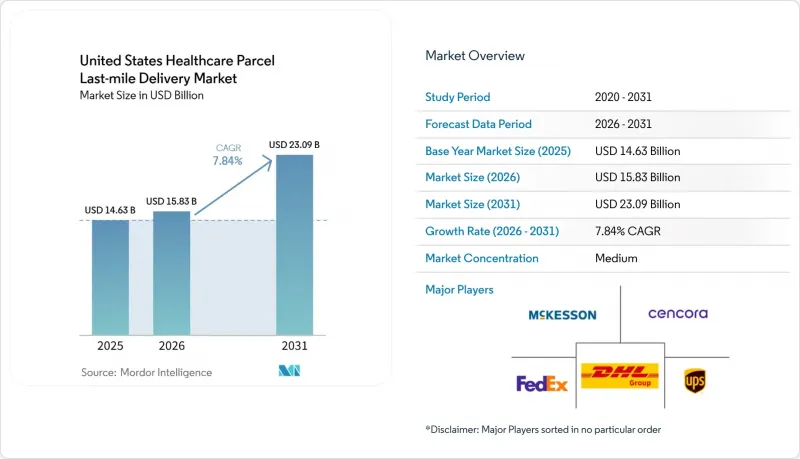
Mordor Intelligence에 의하면, 미국의 의료 관련 소포 라스트 마일 배송 시장 규모는 2025년에 146억 3,000만 달러로 평가되었고, 2026년 158억 3,000만 달러에서 2031년까지 230억 9,000만 달러로 추정되고, 2026-2031년 예측 기간 CAGR 7.84%로 성장할 것으로 추정되고 있습니다.
미국의 의료 관련 소포 라스트 마일 배송 시장의 성장은 전문 의약품으로의 꾸준한 전환, 재택 간호 서비스의 확대, 더 신속하고 신뢰할 수 있는 처방전 조제에 대한 환자 수요 증가에 힘입어 이루어지고 있습니다. 본 보고서는 배송 유형별(표준 배송, 당일 배송, 익일 배송), 온도 유형별(온도 제어형, 온도 관리 없음), 제품 유형별(의약품, 백신, 기타), 제공 모델별(B2C, B2B), 최종 사용자별(온라인 약국 및 오프라인 약국, 진단 실험실, 기타), 지역별(북동부, 남동부, 서부, 기타)로 분류되어 있습니다. 시장 전망은 금액(달러) 기준으로 제시되어 있습니다.
미국의 의료 관련 소포 라스트 마일 배송 시장 동향 및 인사이트
환자에게 직접 배송하는 전문 약국 풀필먼트의 확대
환자에게 직접 배송하는 방식은 미국의 의료 관련 소포 라스트 마일 배송 시장의 배송 방식을 변화시키고 있습니다. 이는 처방전 의약품이 기존 유통 채널을 거치지 않고 환자의 자택으로 직접 배송되는 사례가 증가하고 있기 때문입니다. 이러한 변화에 따라, 보호 대상인 의료 정보의 취급, 배송 확인, 의료 제공업체 및 약국 시스템과의 보다 원활한 연동을 지원할 수 있는 소포 배송 경로에 대한 수요가 높아지고 있습니다. 또한, 서비스 중단을 최소화하면서 환자의 일정 관리 및 배송 실패 시 대응을 관리할 수 있는 네트워크에 대한 수요도 증가하고 있습니다. 이에 따라 의료 시스템 및 약국의 업무 흐름과 강력한 연계를 갖춘 사업자는 전문 의약품 배송에서 발생하는 중요한 인계 과정의 마찰을 줄임으로써 경쟁 우위를 확보하고 있습니다.
처방전 재조제 시 ‘당일·익일’ 배송에 대한 기대감 고조
미국 의료 관련 소포 라스트 마일 배송 시장에서 환자들의 기대는 특히 처방전 재발급이나 긴급 치료 수요와 관련하여, 보다 광범위한 전자상거래 서비스 기준에 가까워지고 있습니다. 치료 지연이 치료에 지장을 주는 분야, 예를 들어 암 치료 지원, 주사제, 기타 환자에게 신속하게 전달해야 하는 치료법 등에서는 당일·익일 배송에 대한 수요가 가장 높게 나타나고 있습니다. 또한, 일부 의약품은 며칠에 걸친 배송 기간을 허용할 수 없기 때문에 지역별 배송 체계의 밀도를 높일 필요성도 커지고 있습니다. 방사성 의약품이나 특정 환자 전용 의약품 등 시간적 제약이 엄격한 제품의 경우, 몇 시간 내에 임상적 가치가 저하될 가능성이 있으므로 서비스 과제는 더욱 커집니다.
HIPAA, 보관 이력(Chain-of-Custody), 규제 의약품에 관한 엄격한 규정 준수 부담
미국 의료 관련 소포 라스트 마일 배송 시장에서는 규정 준수가 여전히 큰 제약 요인으로 작용하고 있습니다. 이는 사업자가 환자 데이터, 보관 기록, 규제 의약품을 일반 소포 배송 업체보다 더 엄격한 규칙에 따라 취급해야 하기 때문입니다. 이러한 요건으로 인해 계약, 위변조 방지 대책, 추적 로그, 보관 절차, 배송 확인을 통해 운영 비용이 증가합니다. 또한, 규제 의약품의 배송 요건은 주마다 다르기 때문에 네트워크 전체에 걸쳐 운영 조건에 편차가 발생하여 전국적인 관리가 더욱 어려워지고 있습니다. 단 한 번의 부실한 프로세스만으로도 사업자는 심각한 법적·재정적 위험에 노출될 가능성이 있으며, 이는 소규모 운송업체 시장 진입 장벽을 높이고 있습니다.
부문 분석
2025년, 미국 의료 관련 소포 라스트 마일 배송 시장에서 익일 배송은 41.44%의 점유율을 차지했으며, 금액 기준으로 가장 큰 배송 형태가 되었습니다. 이러한 주도적 지위는 소매 약국, 전문 약국, 병원 외래 조제 약국에 서비스를 제공하는 기존 처방전 조제 기반을 반영한 것입니다. 이 부문은 서비스의 신뢰성이 중요하지만, 반드시 긴급한 임상 대응이 요구되는 것은 아닌 정기적인 처방전 재조제 프로그램에 적합합니다. 또한, 확립된 배송 경로의 밀도나 시간적 제약이 엄격한 다른 의료 관련 배송에 비해 운영 부담이 적다는 점에서도 장점이 있습니다.
당일 배송은 2031년까지 연평균 성장률(CAGR) 11.92%로 확대될 것으로 예측되며, 미국 의료 관련 소포 라스트 마일 배송 시장에서 가장 빠르게 성장하는 부문이 될 전망입니다. 방사성 의약품은 시기가 치료의 연속성에 영향을 미칠 수 있는 긴급한 종양학 보조 요법 및 재택치료용 비품 보충에 대한 수요를 견인하고 있습니다. 재택치료용 소모품, 일반의약품, 진단 키트 보충 등 긴급성이 요구되지 않는 제품에 대해서는 여전히 표준 배송이 그 역할을 수행하고 있습니다. 또한, 이 부문은 규제 준수 상황에도 좌우되며, 지정 의약품이나 취급에 주의가 필요한 제품이 존재하기 때문에 법적 및 업무적 관점에서 당일 배송 수요에 대응할 수 있는 배송 업체의 수가 제한되어 있습니다. 시간이 지남에 따라 이로 인해 양극화된 구조가 형성되어, 익일 배송이 배송량의 주축으로 남아 있는 반면, 당일 배송은 서비스 차별화와 가격 결정력이 집중되는 프리미엄 부문으로 자리매김하게 됩니다.
2025년, 미국의 의료 관련 소포 라스트마일 배송 시장 규모 중 온도 관리가 필요 없는 화물이 52.86%를 차지했으며, 온도 관리 유형 중에서 가장 큰 점유율을 기록했습니다. 상온 배송이 현재 취급량의 대부분을 차지하는 이유는 많은 표준 의약품, 진단 키트,재택치료 용품, 일상적인 의료기기가 포함되어 있기 때문입니다. 이 때문에 이 부문은 규모 확대나 네트워크 활용이라는 관점에서 운영상 중요한 위치를 차지하고 있습니다. 또한, 이는 최종 인도 시 특별한 온도 관리가 필요 없는 의료 제품의 도입 기반이 광범위하게 존재하고 있음을 반영합니다.
온도 관리가 필요한 화물의 출하량은 2031년까지 연평균 성장률(CAGR) 8.70%로 확대될 것으로 예측되며, 미국의 의료 관련 소포 라스트마일 배송 시장에서 이 점유율 격차는 축소될 가능성이 높습니다. Cencora의 분석에 따르면, 2027년까지 전 세계적으로 출시되는 의약품의 절반은 콜드체인 보관이 필요할 것으로 예상되며, 이는 2013-2017년 기간의 37%에 비해 증가한 수치입니다. 또한, 세포 치료나 유전자 치료의 경우 기존의 2℃-8℃ 범위를 초과하는 극저온 조건이 필요할 가능성이 있어, 온도 관리에 대한 요구도 점점 더 엄격해지고 있습니다. 이러한 변화로 인해 인증 및 검증된 프로세스는 단순한 선택적 이점이 아닌 필수 요건이 되었습니다. 또한, 미국의 의료 관련 소포 라스트 마일 배송 시장에서 더 큰 역할을 수행하고자 하는 운송 사업자에게 있어 온도 관리는 전략적 요건이 되고 있습니다.
기타 혜택
- 엑셀 형식 시장 예측(ME) 시트
- 3개월간의 애널리스트 지원
자주 묻는 질문
목차
제1장 서론
제2장 조사 방법
제3장 주요 요약
제4장 시장 구도
제5장 시장 규모 및 성장 예측(금액, 2026-2031년)
제6장 경쟁 구도
제7장 시장 기회 및 향후 전망
AJY 26.09.03According to Mordor Intelligence, the United States healthcare parcel last-mile delivery market size was valued at USD 14.63 billion in 2025 and is estimated to grow from USD 15.83 billion in 2026 to USD 23.09 billion by 2031, at a CAGR of 7.84% during the forecast period 2026-2031.
Growth in the United States healthcare parcel last-mile delivery market is being supported by a steady shift toward specialty pharmaceuticals, more care delivered at home, and stronger patient demand for faster, more reliable prescription fulfillment. This report is Segmented by Delivery Type (Standard, Same-Day, Next-Day), by Temperature Type (Temperature Type, Non-Temperature), by Product Type (Pharmaceuticals, Vaccines, and More), by Delivery Model (B2C, B2B), by End User (E-Pharmacies, Diagnostic Labs, and More), and by Geography (Northeast, Southeast, West, and More). The Market Forecasts are Provided in Terms of Value (USD).
United States Healthcare Parcel Last-mile Delivery Market Trends and Insights
Expansion of Direct-to-Patient Specialty Pharmacy Fulfillment
Direct-to-patient fulfillment is changing the shipment profile of the United States healthcare parcel last-mile delivery market, as more prescriptions now move directly to patients' homes rather than through older channel steps. That shift raises demand for parcel routing that can support the handling of protected health information, delivery confirmation, and better integration with provider and pharmacy systems. It also creates a larger need for networks that can manage patient scheduling and failed delivery recovery with fewer service breaks. Operators with stronger links to health systems and pharmacy workflows are therefore gaining an advantage by reducing friction in handoffs that matter in specialty drug delivery.
Rising Same-Day and Next-Day Expectations for Prescription Refills
Patient expectations in the United States healthcare parcel last-mile delivery market are moving closer to broader e-commerce service standards, especially for refill and urgent therapy needs. Same-day and next-day demand is strongest where treatment delays can interrupt care, including oncology support, injectables, and other therapies that must reach the patient quickly. This also increases the need for denser local dispatch capacity, as some healthcare shipments cannot tolerate multi-day delivery windows. The service challenge is greater for time-sensitive products such as radiopharmaceuticals and certain patient-specific medications because their clinical value can decline within hours.
Tight HIPAA, Chain-of-Custody, and Controlled-Substance Compliance Burden
Compliance remains a major restraint in the United States healthcare parcel last-mile delivery market because operators must handle patient data, documented custody, and controlled substances under stricter rules than standard parcel providers. These requirements raise operating costs through agreements, tamper controls, tracking logs, retention practices, and delivery verification. The burden also becomes harder to manage at the national scale because controlled-substance courier requirements vary by state, creating uneven operating conditions across networks. A single weak process can expose an operator to severe legal and financial consequences, which increases the barrier to entry for smaller carriers.
Other drivers and restraints analyzed in the detailed report include:
- Growth in Home-Based Care and Hospital-at-Home Programs
- Temperature Integrity Requirements for Biologics and Vaccines
- High Cost of Qualified Cold-Chain Packaging and Re-Ice Management
For complete list of drivers and restraints, kindly check the Table Of Contents.
Segment Analysis
Next-day delivery accounted for 41.44% of the United States healthcare parcel last-mile delivery market share in 2025, making it the largest delivery type by value. Its leadership reflects the existing prescription fulfillment backbone that serves retail pharmacies, specialty pharmacies, and outpatient hospital dispensaries. This segment fits recurring refill programs where service reliability matters, but an urgent clinical response is not always required. It also benefits from established route density and a lower operating burden than most time-critical healthcare deliveries.
Same-day delivery is projected to expand at a 11.92% CAGR through 2031, making it the fastest-growing segment of the United States healthcare parcel last-mile delivery market. Radiopharmaceuticals are driving demand for urgent oncology support therapies and home health resupply, where timing can influence care continuity. Standard delivery still holds a role for non-urgent products such as home healthcare consumables, over-the-counter medications, and diagnostic kit replenishment. The segment is also shaped by compliance, as scheduled substances and sensitive products reduce the pool of couriers who can legally and operationally serve same-day demand. Over time, this creates a bifurcated structure where next-day remains the volume anchor, while same-day becomes the premium layer where service differentiation and pricing power concentrate.
Non-temperature-controlled shipments accounted for 52.86% of the United States healthcare parcel last-mile delivery market size in 2025, giving them the largest share among temperature types. Ambient deliveries account for the current volume because they include many standard pharmaceuticals, diagnostic kits, home healthcare supplies, and routine medical devices. This makes the segment operationally important for scale and network utilization. It also reflects the large installed base of healthcare products that do not require specialized thermal controls during the final handoff.
Temperature-controlled shipments are forecast to grow at a 8.70% CAGR through 2031, suggesting the share gap is likely to narrow in the United States healthcare parcel last-mile delivery market. Cencora indicated that half of all pharmaceutical products launched globally through 2027 will require cold-chain storage, compared with 37% for the 2013-2017 cohort. The need for temperature control is also becoming more demanding, as cell and gene therapies may require cryogenic conditions beyond the conventional 2 °C to 8 °C range. That shift turns certifications and validated processes into baseline requirements rather than optional advantages. It also makes temperature control a strategic requirement for carriers seeking a larger role in the United States healthcare parcel last-mile delivery market.
Complete Report Scope:
- By Delivery Type
- Standard Delivery
- Same-Day Delivery
- Next-Day Delivery
- By Temperature Type
- Temperature Controlled
- Non-Temperature Controlled
- By Product Type
- Pharmaceuticals
- Prescription and Specialty Drugs
- OTC Drugs
- Biopharmaceuticals (Biologics and Biosimilars)
- Vaccines
- Clinical Trial Materials
- Cell and Gene Therapies
- Medical Devices
- Veterinary Medicine
- Blood, Plasma and Blood Components
- Diagnostic and Laboratory Products
- Home Healthcare Supplies
- Others
- Pharmaceuticals
- By Delivery Model
- B2C
- B2B
- By End User
- Hospitals and Clinics
- E-Pharmacies and Pharmacies
- Diagnostic Laboratories
- Home Healthcare Providers
- Direct-to-Patient Deliveries
- Others
- By Region
- Northeast
- Southeast
- Midwest
- Southwest
- West
List of Companies Covered in this Report:
- FedEx
- UPS
- DHL Group
- Cencora, Inc.
- McKesson Corporation
- Cardinal Health
- MedSpeed
- USPack
- Medical Couriers Inc. (MCI)
- Dropoff
- Life Couriers
- Priority Dispatch, Inc.
- MedZoomer
- Stat Experts, Inc.
- Lab Logistics
- OnWay
- Airspace
- Kuehne+Nagel (Including QuickSTAT)
- LifeScience Logistics
- National Courier Express
- ScriptDrop
- Courier Express
Additional Benefits:
- The market estimate (ME) sheet in Excel format
- 3 months of analyst support
TABLE OF CONTENTS
1 Introduction
- 1.1 Study Assumptions and Market Definition
- 1.2 Scope of the Study
2 Research Methodology
3 Executive Summary
4 Market Landscape
- 4.1 Market Overview and Role of Parcel Last-Mile Delivery in Healthcare Logistics
- 4.2 Healthcare Spending Trends
- 4.3 Market Drivers
- 4.3.1 Expansion of Direct-to-Patient Specialty Pharmacy Fulfillment
- 4.3.2 Rising Same-Day and Next-Day Expectations for Prescription Refills
- 4.3.3 Growth in Home-Based Care and Hospital-at-Home Programs
- 4.3.4 Temperature Integrity Requirements for Biologics and Vaccines
- 4.3.5 Integration of Delivery Orchestration Software With Pharmacy and EMR Workflows
- 4.3.6 Expansion of Rural and Underserved Area Coverage Through Hybrid Carrier Networks
- 4.4 Market Restraints
- 4.4.1 Tight HIPAA, Chain-of-Custody, and Controlled-Substance Compliance Burden
- 4.4.2 High Cost of Qualified Cold-Chain Packaging and Re-Ice Management
- 4.4.3 Driver Shortages and Failed-Delivery Redelivery Costs
- 4.4.4 Fragmented State-Level Operating Requirements for Courier and Medical Transport Models
- 4.5 Regulatory Framework
- 4.6 Value Chain and Distribution Channel Architecture Analysis
- 4.7 Technology Innovations Outlook
- 4.8 Porter's Five Forces Analysis
- 4.8.1 Threat of New Entrants
- 4.8.2 Bargaining Power of Suppliers
- 4.8.3 Bargaining Power of Buyers
- 4.8.4 Threat of Substitutes
- 4.8.5 Rivalry Among Competitors
- 4.9 Evolution of Healthcare Parcel Last-Mile Delivery Requirements
- 4.10 Impact of Geo-Political Events on Supply Chain Shifts
5 Market Size and Growth Forecasts (Value, 2026-2031)
- 5.1 By Delivery Type
- 5.1.1 Standard Delivery
- 5.1.2 Same-Day Delivery
- 5.1.3 Next-Day Delivery
- 5.2 By Temperature Type
- 5.2.1 Temperature Controlled
- 5.2.2 Non-Temperature Controlled
- 5.3 By Product Type
- 5.3.1 Pharmaceuticals
- 5.3.1.1 Prescription and Specialty Drugs
- 5.3.1.2 OTC Drugs
- 5.3.2 Biopharmaceuticals (Biologics and Biosimilars)
- 5.3.3 Vaccines
- 5.3.4 Clinical Trial Materials
- 5.3.5 Cell and Gene Therapies
- 5.3.6 Medical Devices
- 5.3.7 Veterinary Medicine
- 5.3.8 Blood, Plasma and Blood Components
- 5.3.9 Diagnostic and Laboratory Products
- 5.3.10 Home Healthcare Supplies
- 5.3.11 Others
- 5.3.1 Pharmaceuticals
- 5.4 By Delivery Model
- 5.4.1 B2C
- 5.4.2 B2B
- 5.5 By End User
- 5.5.1 Hospitals and Clinics
- 5.5.2 E-Pharmacies and Pharmacies
- 5.5.3 Diagnostic Laboratories
- 5.5.4 Home Healthcare Providers
- 5.5.5 Direct-to-Patient Deliveries
- 5.5.6 Others
- 5.6 By Region
- 5.6.1 Northeast
- 5.6.2 Southeast
- 5.6.3 Midwest
- 5.6.4 Southwest
- 5.6.5 West
6 Competitive Landscape
- 6.1 Market Concentration
- 6.2 Key Strategic Moves
- 6.3 Market Share Analysis
- 6.4 Company Profiles (includes Global level Overview, Market level overview, Core Segments, Financials as available, Strategic Information, Market Rank/Share for key companies, Products & Services, and Recent Developments)
- 6.4.1 FedEx
- 6.4.2 UPS
- 6.4.3 DHL Group
- 6.4.4 Cencora, Inc.
- 6.4.5 McKesson Corporation
- 6.4.6 Cardinal Health
- 6.4.7 MedSpeed
- 6.4.8 USPack
- 6.4.9 Medical Couriers Inc. (MCI)
- 6.4.10 Dropoff
- 6.4.11 Life Couriers
- 6.4.12 Priority Dispatch, Inc.
- 6.4.13 MedZoomer
- 6.4.14 Stat Experts, Inc.
- 6.4.15 Lab Logistics
- 6.4.16 OnWay
- 6.4.17 Airspace
- 6.4.18 Kuehne+Nagel (Including QuickSTAT)
- 6.4.19 LifeScience Logistics
- 6.4.20 National Courier Express
- 6.4.21 ScriptDrop
- 6.4.22 Courier Express
7 Market Opportunities and Future Outlook
- 7.1 White-space and Unmet-Need Assessment