

|
시장보고서
상품코드
2119010
금속 가공 산업용 대체 연료 및 원료(AFR) 시장 : 시장 점유율 분석, 산업 동향 및 통계 데이터, 성장 예측(2026-2031년)Alternate Fuel and Raw Materials (AFR) For Metal Processing Industry - Market Share Analysis, Industry Trends & Statistics, Growth Forecasts (2026 - 2031) |
||||||
 Mordor Intelligence
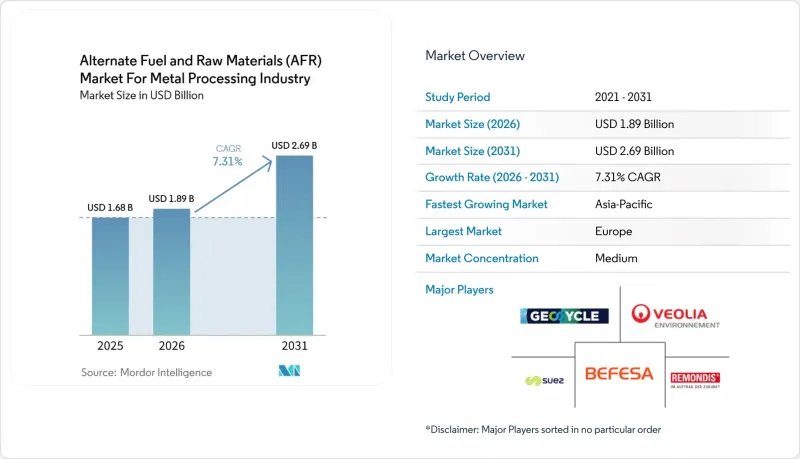
Mordor Intelligence에 의하면, 금속 가공 산업용 대체 연료 및 원료(AFR) 시장 규모는 2025년 16억 8,000만 달러로 평가되었고, 2026년에는 18억 9,000만 달러로 추정되고, 2031년까지 26억 9,000만 달러에 이를 것으로 예상되며, 2026-2031년 CAGR 7.31%로 성장할 전망입니다.
본 보고서는 연료 유형별(RDF, SRF, 기타), 원자재 유형별(비산재, 주물 모래, 기타), 용도별(제강, 제철·고로, 전기 아크로, 기타 용도), 지역별(북미, 유럽, 아시아태평양, 남미, 중동 및 아프리카)로 분류되어 있습니다. 시장 전망은 금액(달러) 기준으로 제시되어 있습니다.
금속 가공 산업용 대체 연료 및 원료(AFR) 시장 동향과 전망
산업의 탈탄소화 및 화석 연료 대체
대체 연료 및 원료(AFR) 시장은 철강 및 금속 가공 업체에 대한 화석 연료 사용 감축 압력으로부터 혜택을 받고 있습니다. 일부 지역에서는 스크랩을 원료로 하는 전기 아크로 제조 공정이 기존 제조 공정에 비해 저렴한 비용으로 배출 감축을 실현할 수 있습니다. 이로 인해 공정 전체를 대체하는 것이 현실적으로 어려운 경우에도 회수 연료나 2차 원료의 단기적 활용이 촉진되고 있습니다. 전기 아크로(EAF)의 생산 능력이 확대됨에 따라 구매자들은 더 많은 바이오카본 캐리어와 슬래그 조절재를 필요로 하고 있습니다. 보스트 알피네(Voest Alpine)는 2026년 6월, 도나비츠 그린테크 제철소 확장을 위한 1억 유로의 추가 투자를 승인했습니다. 이 투자는 인증된 저탄소 원료를 공급할 수 있는 공급업체들이 새로운 용광로의 생산 능력으로부터 혜택을 누릴 수 있음을 시사합니다.
제철 산업에서 저탄소 환원제 수요 증가
대체 연료 및 원료(AFR) 시장은 내재 탄소량이 적은 환원제에 대한 수요에 힘입어 성장하고 있습니다. 2026년 조사에 따르면, 바이오숯은 전기 아크로(EAF) 제강 과정에서 슬래그 발포제 및 보조 환원제 역할을 하는 것으로 밝혀졌습니다. 바이오숯과 코크스의 혼합은 전력 사용량을 줄이면서 슬래그 발포의 운전 조건을 확대할 수 있습니다. 미네소타 대학교 천연자원연구소는 2026년에 상업 규모의 전기 아크로용 바이오카본 실증 실험 준비를 진행하고 있습니다. 아르셀로미탈 에스파냐(ArcelorMittal Espana)는 제강 공정에서 합성가스로 활용하기 위한 SRF 가스화에 관한 파일럿 시험 및 기술경제성 평가를 완료했습니다. 이러한 프로젝트를 통해 바이오매스, SRF 및 관련 환원 원료는 제강 운영상의 의사결정에서 더욱 중요한 요소로 자리 잡고 있습니다.
AFR의 품질 및 불순물 함량 변동성
대체 연료 및 원료(AFR) 시장은 회수된 원료의 수분, 발열량, 염소 함량이 불규칙하여 재료 품질 문제에 직면해 있습니다. 이러한 변동은 용광로의 안정성에 영향을 미치며, 운영 담당자가 보수적인 대체율을 설정하는 요인이 됩니다. 또한, 금속 용도의 경우 납, 아연, 구리 및 기타 미량 금속의 엄격한 관리가 요구됩니다. 이는 화학 성분의 허용 범위가 좁은 판재 제품을 생산하는 전기 아크로에서 특히 중요합니다. 디지털 선별이나 배치 인증을 통해 가시성은 향상되지만, 물리적 분리가 불필요해지는 것은 아닙니다. 용광로 규격을 항상 충족하는 공급업체는 혼합 원료를 판매하는 가공업체보다 더 견고한 입지를 구축할 수 있습니다.
부문 분석
2025년, 표준화된 사양과 잘 구축된 선별 네트워크에 힘입어 고형 회수 연료(SRF)는 대체 연료 및 원료(AFR) 시장의 31.2%를 차지했습니다. CEN 및 ISO 규격은 가공업체가 고형 회수 연료의 관련 특성을 문서화하는 데 도움이 됩니다. SRF는 재료 전처리 기술이 성숙한 경우, 공동 처리에서 일관된 선택지가 됩니다. RDF는 여전히 저비용 선택지이지만, 그 성분이 광범위하기 때문에 용광로에서의 사용이 제한될 수 있습니다. 폐플라스틱은 특정 제철 및 전기 아크로 용도에서 2차 탄소원으로 활용될 수 있습니다. 연료 선택은 탄소 함량, 오염 위험, 지역 내 입수 가능성 및 수용 프로세스에 따라 달라집니다. 공급업체는 구매자의 배출 감축 목표와 안정적인 성능에 대한 요구 사항 간의 균형을 맞추어야 합니다. 따라서 대체 연료 및 원료(AFR) 업계에서는 모든 폐기물 유래 연료를 호환 가능한 것으로 취급하기보다는 연료 등급별로 분류하는 처리 시스템이 요구되고 있습니다. 성숙한 유럽 시장은 수거·선별 인프라가 이미 산업 사용자와 연계되어 있어 여전히 우위를 점하고 있습니다.
바이오매스는 2031년까지 연평균 성장률(CAGR) 9.2%를 나타낼 것으로 예측되며, 이는 모든 연료 유형 중 가장 높은 성장률입니다. 바이오숯은 전기 아크로 운영 시 슬래그의 발포 및 보조 환원을 촉진할 수 있습니다. 또한 구매자가 문서화된 생물 유래 탄소 함량을 요구할 경우에도 이 소재는 유용합니다. 천연자원연구소(Natural Resources Research Institute)가 2026년에 실시할 상업 규모 실증 실험에서는 북미 생산자와 관련된 운영 조건 하에서 이 기법이 검증될 예정입니다. 비산림 유래 원료 또한 이용 가능한 공급 기반을 확대할 가능성이 있습니다. 마쓰다는 2026년 4월, 큐폴라로 사용을 목적으로 한 대나무 부스러기 연탄에 대한 시험을 완료했습니다. 따라서 대체 연료 및 원료(AFR) 시장은 품질 및 추적성 요건을 충족하는 지역별 바이오매스 공급원에서 혜택을 받을 수 있습니다. 바이오매스 공급업체는 여전히 저장, 수분, 운송 밀도 및 계절별 수거 조건을 관리해야 합니다. 이러한 운영상의 제약이 강력한 성장이 광범위한 상업적 도입으로 이어질지 여부를 결정짓게 될 것입니다.
지역별 분석
2025년, 유럽은 대체 연료 및 원료(AFR) 시장 규모의 36.2%를 차지했습니다. 이러한 선도적 지위는 폐기물 규제, 수거 인프라, 산업 처리 능력, 그리고 탄소 비용 노출에 의해 뒷받침되고 있습니다. 유럽연합 집행위원회의 2025년판 ‘폐기물 기본 지침’ 개정을 통해 발생 억제, 분리 수거 및 재활용 의무가 강화되고 있습니다. 또한, 규정(EU) 2024/1252에 따라 채굴 폐기물 및 과거 폐기물로부터의 자재 회수에 대한 관심도 높아지고 있습니다. 독일, 네덜란드, 벨기에는 이 지역의 SRF 및 2차 원료 공급망에서 여전히 중심적인 역할을 수행하고 있습니다. 이들 국가에는 치밀한 폐기물 분리 수거 네트워크와 확립된 산업 사용자가 존재합니다. 따라서 유럽의 처리 업체들은 특정 품질 등급의 재료를 공급하는 데 유리한 입장에 있습니다. 유럽의 대체 연료 및 원료(AFR) 시장은 앞으로도 폐기물을 매립 처분에서 멀리하고 검증된 회수 경로로 유도하는 정책에 계속 의존할 것입니다.
아시아태평양은 2031년까지 연평균 성장률(CAGR) 9.6%를 나타낼 것으로 예측되며, 이는 지역별 가장 높은 성장률입니다. 이 지역에서는 철강 생산 능력 확대와 배출 강도를 줄이기 위한 각국의 노력이 맞물려 진행되고 있습니다. 이에 따라 전기 아크로 및 직접 환원철(DRI) 공정에서 저탄소 원료에 대한 수요가 증가하고 있습니다. 대체 연료 및 원료(AFR) 시장에서 아시아태평양은 성숙한 유럽의 시스템보다 더 큰 공급망 개발 기회를 지니고 있습니다. 이 지역의 구매자들에게는 신뢰할 수 있는 수거, 전처리 및 인증 시스템이 필요합니다. 농업 잔여물은 수거 체계가 갖춰지면 바이오매스 유래 환원재의 현지 조달원이 될 수 있습니다. 가장 큰 기회는 철강 생산 능력, 잔여물 확보 가능성, 그리고 산업 물류가 중첩되는 지역에 있습니다. 현지 처리 네트워크를 구축한 공급업체는 저밀도 자재로 인한 운송 비용 부담을 피할 수 있습니다.
북미, 남미, 중동 및 아프리카는 대체 연료 및 원료(AFR) 시장에서 아직 초기 단계에 있는 유망 지역입니다. 미국 에너지부는 저탄소 철강 생산을 위한 방안으로 메탄 열분해를 이용한 직접 환원철에 관한 2026년 기술 보고서를 발표했습니다. 이러한 프로젝트는 철강 설비의 업그레이드에 따라 적합한 재생 원료에 대한 수요를 확대시킬 가능성이 있습니다. 홀심(Holcim)의 보고서에 따르면, 지오사이클(Geocycle)은 2025년에 전 세계적으로 1,260만 톤의 폐기물을 처리했으며, 홀심사의 열에너지 수요의 40% 가까이를 순환형 폐기물 유래 에너지 원으로 충당했습니다. 이 수집·전처리 모델은 금속 부문 수요가 확대되는 지역에서 산업용 공동 처리에 대한 참고 사례가 될 것입니다. 남미 및 중동 및 아프리카에서는 폐기물 처리 체계가 더욱 세분화되어 있으며, 운송 경로도 길어지고 있습니다. 이러한 지역에서 안정적인 공급 규모를 실현하기 위해서는 분리 수거 및 현지 전처리에 대한 투자가 필요할 것입니다.
기타 혜택 :
- Excel 형식 시장 예측(ME) 시트
- 3개월간의 애널리스트 지원
자주 묻는 질문
목차
제1장 서론
제2장 분석 방법
제3장 주요 요약
제4장 시장 구도
제5장 시장 규모 및 성장률 예측
제6장 경쟁 구도
제7장 시장 기회 및 향후 전망
AJY 26.09.03According to Mordor Intelligence, the alternate fuel and Raw Materials Market For Metal Processing Industry size is expected to increase from USD 1.68 billion in 2025 to USD 1.89 billion in 2026 and reach USD 2.69 billion by 2031, growing at a CAGR of 7.31% over 2026-2031.
This report is Segmented by Fuel Types (RDF, SRF, and Others), Raw Material Types (Fly Ash, Foundry Sand, and Others), Application (Steelmaking, Ironmaking and Blast Furnaces, Electric Arc Furnaces and Other Applications), and Geography (North America, Europe, Asia-Pacific, South America, and the Middle East and Africa). The Market Forecasts are Provided in Terms of Value (USD).
Insights and Trends of Alternate Fuel and Raw Materials (AFR) Market For Metal Processing Industry
Industrial Decarbonization and Fossil-Fuel Substitution
The alternate fuel and raw materials market benefits from pressure on steel and metal processors to reduce fossil fuel use. Scrap electric arc furnace routes can offer lower-cost emissions reductions than conventional routes in some regions . This supports near-term use of recovered fuels and secondary materials where full process replacement is not practical. As electric arc furnace capacity grows, buyers need more bio-carbon carriers and slag-conditioning materials. Voestalpine approved EUR 100 million of additional investment for its Donawitz Greentec steel expansion in June 2026 . That investment indicates that suppliers with certified low-carbon inputs can benefit from new furnace capacity.
Rising Demand for Low-Carbon Reducing Agents in Steelmaking
The alternate fuel and raw materials market is supported by demand for reducing agents with lower embedded carbon. A 2026 review found that biochar can work as a foaming slag agent and auxiliary reducing agent in electric arc furnace steelmaking. Biochar and coke blends can widen operating conditions for slag foaming while lowering electricity use. The University of Minnesota Natural Resources Research Institute is preparing a commercial-scale electric arc furnace biocarbon demonstration in 2026. ArcelorMittal Espana completed a pilot and techno-economic evaluation of SRF gasification for synthesis gas applications in steelmaking . These projects make biomass, SRF, and related reducing inputs more relevant to operational steelmaking decisions.
Inconsistent AFR Quality and Contaminant Loads
The alternate fuel and raw materials market faces a material quality challenge because recovered streams vary in moisture, calorific value, and chlorine content. These changes can affect furnace stability and lead operators to set conservative substitution rates. Metal applications also require strict control of lead, zinc, copper, and other trace metals. This is especially important for electric arc furnaces producing flat products with narrow chemistry limits. Digital sorting and batch certification can improve visibility, but they do not remove the need for physical segregation. Suppliers that consistently meet furnace-grade specifications can command a more defensible position than processors selling mixed material.
Other drivers and restraints analyzed in the detailed report include:
- Tightening Landfill Diversion and Circular-Economy Requirements
- Integration of Waste-Derived Feedstocks into Existing Furnace Systems
- High Logistics Costs for Low-Density Waste Streams
For complete list of drivers and restraints, kindly check the Table Of Contents.
Segment Analysis
Solid Recovered Fuel held 31.2% of the alternate fuel and raw materials market size in 2025, supported by standardized specifications and developed sorting networks. CEN and ISO methods help processors document the relevant characteristics of solid recovered fuels. SRF provides a consistent option for co-processing where material preparation is mature. RDF remains a lower-cost option, although its broader composition can limit furnace use. Waste plastics can provide secondary carbon in selected ironmaking and electric arc furnace applications. The fuel choice depends on carbon content, contamination risk, local availability, and the receiving process. Suppliers must balance a buyer's emissions objectives with its requirements for consistent performance. The alternate fuel and raw materials industry, therefore, needs processing systems that separate fuel grades rather than treating all waste-derived fuels as interchangeable. Mature European markets retain an advantage because the collection and sorting infrastructure is already connected to industrial users.
Biomass is projected to record a 9.2% CAGR through 2031, the fastest rate among fuel types. Biochar can support slag foaming and auxiliary reduction within electric arc furnace operations. The same material can be valuable when buyers need documented biogenic carbon content. The Natural Resources Research Institute's 2026 commercial-scale demonstration will test this route under operating conditions relevant to North American producers. Non-forest feedstocks can also widen the available supply base. Mazda completed trials involving bamboo-waste briquettes for cupola furnace use in April 2026. The alternate fuel and raw materials market can therefore gain from regional biomass streams that meet quality and traceability requirements. Biomass suppliers still need to manage storage, moisture, transport density, and seasonal collection conditions. These operating constraints will determine whether strong growth translates into broad commercial adoption.
Complete Report Scope:
- By Fuel Type
- Refuse-Derived Fuel (RDF)
- Solid Recovered Fuel (SRF)
- Biomass
- Waste Plastics
- Other Fuel Types
- By Raw Material Type
- Fly Ash
- Blast Furnace Slag
- Foundry Sand
- Steel Slag
- Other Raw Material Types
- By Application
- Steelmaking
- Ironmaking and Blast Furnaces
- Electric Arc Furnaces
- Non-Ferrous Metal Smelting
- Ferroalloy Production
- Other Applications
- By Geography
- North America
- United States
- Canada
- Mexico
- Europe
- Germany
- France
- Italy
- Spain
- United Kingdom
- Poland
- Russia
- Rest of Europe
- Asia-Pacific
- China
- India
- Japan
- South Korea
- Australia
- Indonesia
- Vietnam
- Thailand
- Rest of Asia-Pacific
- South America
- Brazil
- Argentina
- Chile
- Rest of South America
- Middle East and Africa
- Saudi Arabia
- United Arab Emirates
- Egypt
- South Africa
- Morocco
- Rest of Middle East and Africa
- North America
Geography Analysis
Europe held 36.2% of the alternate fuel and raw materials market size in 2025. Its leading position rests on waste regulation, collection infrastructure, industrial processing capacity, and carbon-cost exposure. The European Commission's 2025 Waste Framework Directive update reinforces prevention, separate collection, and improved recycling obligations. Regulation (EU) 2024/1252 also strengthens interest in recovering materials from extractive and legacy waste. Germany, the Netherlands, and Belgium remain central to regional SRF and secondary-material supply chains. These countries have dense waste sorting networks and established industrial users. European processors are therefore better placed to offer specified material grades. The alternate fuel and raw materials market in Europe will continue to depend on policies that direct materials away from landfill and toward verified recovery routes.
Asia-Pacific is forecast to grow at a 9.6% CAGR through 2031, the highest regional rate. The region combines steel capacity expansion with national efforts to reduce emissions intensity. This increases demand for low-carbon inputs in electric arc furnace and direct reduced iron routes. The alternate fuel and raw materials market has a larger supply-chain development opportunity in Asia-Pacific than in mature European systems. Regional buyers need dependable collection, preprocessing, and certification systems. Agricultural residues may provide a local source of biomass-derived reducing material where collection can be organized. The strongest opportunity lies where steel capacity, residue availability, and industrial logistics overlap. Suppliers that establish local processing networks can avoid the transport penalty associated with low-density materials.
North America, South America, and the Middle East and Africa are earlier-stage opportunity areas for the alternate fuel and raw materials market. The US Department of Energy published a 2026 technical report on methane-pyrolysis-driven direct reduced iron as a route toward lower-carbon steel production. Such projects can widen the need for compatible recovered inputs as steel assets are upgraded. Holcim reported that Geocycle managed 12.6 million tonnes of waste globally in 2025 and supported nearly 40% of Holcim thermal energy needs with circular waste-derived sources. The same collection and preparation model can inform industrial co-processing where metal-sector demand develops. South America and the Middle East and Africa face more fragmented waste handling and longer transport routes. Investment in sorting and local preparation will be necessary before these regions can scale supply reliably.
- Airex Energy Inc.
- Averda International Limited
- Befesa S.A.
- Biffa Limited
- Blue Phoenix Group B.V.
- EEW Energy from Waste GmbH
- Enva Group Limited
- Fomento de Construcciones y Contratas, S.A.
- Geocycle SA
- Holcim AG
- Indaver NV
- N+P Group B.V.
- PreZero International GmbH
- Ragn-Sells AB
- REMONDIS SE & Co. KG
- Renewi plc
- SARIA SE & Co. KG
- Sembcorp Environment Pte. Ltd.
- SUEZ S.A.
- Veolia Environnement S.A.
- Viridor Limited
Additional Benefits:
- The market estimate (ME) sheet in Excel format
- 3 months of analyst support
TABLE OF CONTENTS
1 INTRODUCTION
- 1.1 Study Assumptions and Market Definition
- 1.2 Scope of the Study
2 RESEARCH METHODOLOGY
3 EXECUTIVE SUMMARY
4 MARKET LANDSCAPE
- 4.1 Market Overview
- 4.2 Market Drivers
- 4.2.1 Industrial Decarbonization and Fossil-Fuel Substitution
- 4.2.2 Tightening Landfill Diversion and Circular-Economy Requirements
- 4.2.3 Rising Demand for Low-Carbon Reducing Agents in Steelmaking
- 4.2.4 Integration of Waste-Derived Feedstocks into Existing Furnace Systems
- 4.2.5 Digital Quality Certification for Heterogeneous AFR Streams
- 4.2.6 Monetization of Embedded Mineral and Carbon Value in Industrial Residues
- 4.3 Market Restraints
- 4.3.1 Inconsistent AFR Quality and Contaminant Loads
- 4.3.2 High Logistics Costs for Low-Density Waste Streams
- 4.3.3 Furnace-Specific Feeding and Emissions Compatibility Constraints
- 4.3.4 Competition from Higher-Value Recycling and Secondary-Material Uses
- 4.4 Value Chain Analysis
- 4.5 Regulatory Landscape
- 4.6 Technological Outlook
- 4.7 Porter's Five Forces Analysis
- 4.7.1 Bargaining Power of Suppliers
- 4.7.2 Bargaining Power of Buyers
- 4.7.3 Threat of New Entrants
- 4.7.4 Threat of Substitutes
- 4.7.5 Competitive Rivalry
5 MARKET SIZE AND GROWTH FORECASTS
- 5.1 By Fuel Type
- 5.1.1 Refuse-Derived Fuel (RDF)
- 5.1.2 Solid Recovered Fuel (SRF)
- 5.1.3 Biomass
- 5.1.4 Waste Plastics
- 5.1.5 Other Fuel Types
- 5.2 By Raw Material Type
- 5.2.1 Fly Ash
- 5.2.2 Blast Furnace Slag
- 5.2.3 Foundry Sand
- 5.2.4 Steel Slag
- 5.2.5 Other Raw Material Types
- 5.3 By Application
- 5.3.1 Steelmaking
- 5.3.2 Ironmaking and Blast Furnaces
- 5.3.3 Electric Arc Furnaces
- 5.3.4 Non-Ferrous Metal Smelting
- 5.3.5 Ferroalloy Production
- 5.3.6 Other Applications
- 5.4 By Geography
- 5.4.1 North America
- 5.4.1.1 United States
- 5.4.1.2 Canada
- 5.4.1.3 Mexico
- 5.4.2 Europe
- 5.4.2.1 Germany
- 5.4.2.2 France
- 5.4.2.3 Italy
- 5.4.2.4 Spain
- 5.4.2.5 United Kingdom
- 5.4.2.6 Poland
- 5.4.2.7 Russia
- 5.4.2.8 Rest of Europe
- 5.4.3 Asia-Pacific
- 5.4.3.1 China
- 5.4.3.2 India
- 5.4.3.3 Japan
- 5.4.3.4 South Korea
- 5.4.3.5 Australia
- 5.4.3.6 Indonesia
- 5.4.3.7 Vietnam
- 5.4.3.8 Thailand
- 5.4.3.9 Rest of Asia-Pacific
- 5.4.4 South America
- 5.4.4.1 Brazil
- 5.4.4.2 Argentina
- 5.4.4.3 Chile
- 5.4.4.4 Rest of South America
- 5.4.5 Middle East and Africa
- 5.4.5.1 Saudi Arabia
- 5.4.5.2 United Arab Emirates
- 5.4.5.3 Egypt
- 5.4.5.4 South Africa
- 5.4.5.5 Morocco
- 5.4.5.6 Rest of Middle East and Africa
- 5.4.1 North America
6 COMPETITIVE LANDSCAPE
- 6.1 Market Concentration
- 6.2 Strategic Moves
- 6.3 Market Share Analysis
- 6.4 Company Profiles (includes Global Level Overview, Market Level Overview, Core Segments, Financials as available, Strategic Information, Market Rank/Share, Products and Services, Recent Developments)
- 6.4.1 Airex Energy Inc.
- 6.4.2 Averda International Limited
- 6.4.3 Befesa S.A.
- 6.4.4 Biffa Limited
- 6.4.5 Blue Phoenix Group B.V.
- 6.4.6 EEW Energy from Waste GmbH
- 6.4.7 Enva Group Limited
- 6.4.8 Fomento de Construcciones y Contratas, S.A.
- 6.4.9 Geocycle SA
- 6.4.10 Holcim AG
- 6.4.11 Indaver NV
- 6.4.12 N+P Group B.V.
- 6.4.13 PreZero International GmbH
- 6.4.14 Ragn-Sells AB
- 6.4.15 REMONDIS SE & Co. KG
- 6.4.16 Renewi plc
- 6.4.17 SARIA SE & Co. KG
- 6.4.18 Sembcorp Environment Pte. Ltd.
- 6.4.19 SUEZ S.A.
- 6.4.20 Veolia Environnement S.A.
- 6.4.21 Viridor Limited
7 MARKET OPPORTUNITIES AND FUTURE OUTLOOK
- 7.1 White-Space and Unmet-Need Assessment


