|
시장보고서
상품코드
2119022
독일의 와이어 및 케이블 : 시장 점유율 분석, 산업 동향 및 통계 데이터, 성장 예측(2026-2031년)Germany Wire and Cable - Market Share Analysis, Industry Trends & Statistics, Growth Forecasts (2026 - 2031) |
||||||
 Mordor Intelligence
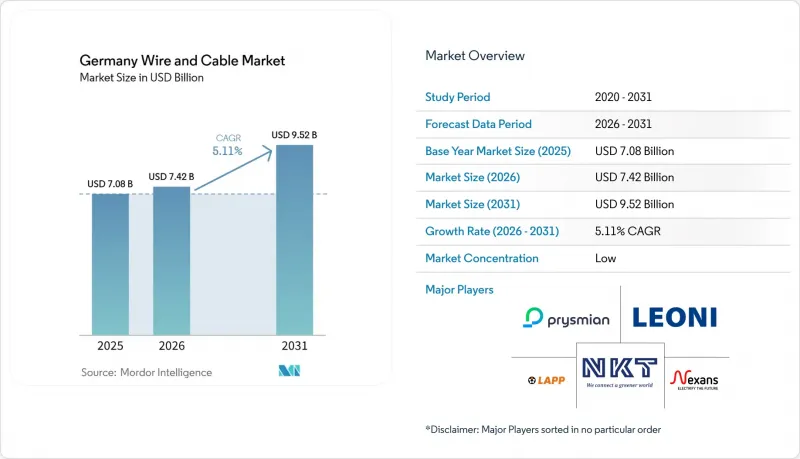
Mordor Intelligence에 의하면, 독일의 와이어 및 케이블 시장 규모는 2025년에 70억 8,000만 달러로 평가되었습니다. 2026년에 74억 2,000만 달러에 달하고, 2031년까지 95억 2,000만 달러에 이를 것으로 예측되며, 2026년부터 2031년에 걸쳐 CAGR 5.11%로 성장할 전망입니다.
본 보고서는 전압(초고전압·고전압(35kV 초과) 등), 케이블 유형(전력 케이블 등), 도체(구리, 알루미늄 등), 부설 방법(가공, 지하 등),최종 사용자 업종(건설(주택 및 상업) 등), 절연(절연재 포함, 절연재 없음)별로 분류되어 있습니다. 시장 예측은 금액(달러) 기준으로 제시되어 있습니다.
독일의 와이어 및 케이블 시장 동향 및 인사이트
재생에너지에 따른 송전망 확장이 케이블 수요를 대규모로 재편하고 있습니다.
독일은 2030년까지 30 GW, 2035년까지 50 GW의 해상 풍력 발전 설비 용량 도입을 목표로 하고 있으며, 이에 따라 고전압 및 초고전압 시스템에 대한 수요가 뒷받침되고 있습니다. ‘해상 네트워크 개발 계획 2025’에서는 2034년까지 해상 지역의 연결 요건이 규정되어 있습니다. 2025년 7월, 연방 네트워크청(Bundesnetzagentur)은 525 kV, 2 GW 규모의 ‘SuedOstLink’ 최종 구간을 승인했습니다. BDEW 및 ZVEI에 따르면, 노후화된 설비의 교체와 재생에너지 발전, 히트 펌프, 충전 인프라의 연결을 위해 2045년까지 50만 km 이상의 전력 케이블이 필요할 것으로 보입니다. 송전 프로젝트의 경우, 케이블 매설 수년 전에 적합한 생산 능력을 확보해야 하므로 이러한 규모 수요는 장기 공급 계약을 촉진합니다. 그 결과, 독일의 와이어 및 케이블 시장은 단기적인 건설 주기가 아닌 송전망 주도의 지속적인 조달 주기의 영향을 받게 될 것입니다.
산업 자동화 및 인더스트리 4.0에 대한 투자가 특수 케이블 수요를 뒷받침하고 있습니다.
산업 자동화는 독일 공장에서 유연성, 내유성, 전자기 차폐 기능을 갖춘 케이블에 대한 수요를 지속적으로 뒷받침하고 있습니다. 공장 업그레이드에는 기계, 로봇, 생산 설비를 위한 신뢰성 높은 신호, 제어 및 전원 연결이 필요합니다. 케이블 시스템은 정기적으로 갱신해야 하므로, 이러한 노력은 교체 수요와 신규 설치 수요 모두를 뒷받침하고 있습니다. 싱글 페어 이더넷 및 데이터 통신용 전원 케이블(PoD)의 설계는 설치 길이가 짧더라도 개별 기계에서 케이블의 부가가치를 높일 수 있습니다. 또한 제조업체가 더 높은 신뢰성과 이동성 요건을 충족하는 케이블 사양을 채택할 때에도 독일의 와이어 및 케이블 시장은 혜택을 보고 있습니다. 이러한 수요는 바이에른주, 바덴뷔르템베르크주, 노르트라인베스트팔렌주의 제조업 집적지에서 특히 두드러지게 나타납니다.
구리와 알루미늄의 가격 변동이 전체 밸류체인의 이익률을 압박
2026년 1월 29일, 런던 금속 거래소(LME)에서 구리 가격은 톤당 1만 4,527.50달러의 장중 최고치를 기록했습니다. 2026년 1월 구리 대 알루미늄 가격 비율은 4.3에 달하여, 재료 대체가 진행될 것으로 예상되는 3.5-4.0 범위를 상회했습니다. 이러한 상황으로 인해 프로젝트 사양이 허용하는 한, 주급전선 및 송전 용도에서 알루미늄 사용이 증가할 가능성이 있습니다. 고정 가격의 설계·조달·시공(EPC) 계약에서는 입찰 제출부터 납품까지의 기간 동안 금속 가격이 변동할 경우, 공급업체는 위험에 노출될 수 있습니다. 상품 벤치마크에 연동된 공식 가격 책정은 이러한 위험을 완화할 수 있지만, 프로젝트 소유자의 승인이 필요합니다. 독일의 와이어 및 케이블 시장은 공급업체가 원자재 구매를 헤지하고 계약을 통해 비용을 회수할 수 있는 능력에 여전히 민감한 상황입니다.
부문별 분석
2025년, 독일의 와이어 및 케이블 시장에서 저전압 케이블은 49.68%의 점유율을 차지했습니다. 이는 건축 배선, 충전 회로, 산업기계, 라스트 마일 배전 연결 등에 사용되며 광범위한 교체 수요를 창출하고 있습니다. 신축 주택 건설은 여전히 부진한 상태이며, 2025년 12월 주택 건설에 관한 ifo 비즈니스 기후 지수는 -20.6포인트를 기록했습니다. 이로 인해 해당 기간 동안 건축용 전선의 수주가 일부 감소했습니다. 한편, 산업 시설의 개보수 및 충전 설비 설치 프로그램이 기타 저전압 용도 분야 수요를 뒷받침했습니다.
중전압 케이블은 배전망 강화, 재생에너지 집전 네트워크, 산업용 변전소 연결, 그리고 노후화된 가공 설비를 지하 시스템으로 교체하는 작업을 뒷받침하고 있습니다. 이러한 공사는 도시, 농촌 및 산업 지역에서 지속적인 수요를 뒷받침하고 있습니다. 초고압 및 고압 케이블은 2031년까지 연평균 성장률(CAGR) 6.48%를 나타낼 것으로 예측됩니다. SuedLink, SuedOstLink, A-Nord, Ultranet, Korridor B와 같은 프로젝트에서는 대량의 지하 케이블이 필요합니다. 기술 시험 및 전력 사업자의 적격성 요건으로 인해, 이러한 프로젝트를 수행할 수 있는 공급업체의 범위는 제한되어 있습니다.
2025년, 독일의 와이어 및 케이블 시장에서 전력 케이블은 59.84%를 차지했습니다. 전력 케이블은 발전소에서 재생에너지를 송전하고, 구리나 알루미늄으로 제작된 시스템을 통해 산업용 및 도시 네트워크에 전력을 배전합니다. 신호 및 제어 케이블은 자동화 장비와 공정 산업의 계측 장비를 지원합니다. 동축 케이블과 데이터 케이블은 방송 시스템 및 기존 인프라에서 계속해서 중요한 역할을 수행하고 있습니다. 이러한 용도로 인해 전력 케이블은 독일의 와이어 및 케이블 시장에서 계속해서 중심적인 위치를 차지하고 있습니다.
광섬유 케이블은 2031년까지 연평균 성장률(CAGR) 5.89%로 확대될 것으로 예측됩니다. 이 부문은 FTTH(Fiber-to-the-Home)의 확산, 5G 백홀 요구 사항, 데이터센터 간 상호 연결의 혜택을 받고 있으며, VDE의 개정된 지침도 건물 내 연결을 뒷받침하고 있습니다. 데이터센터 캠퍼스에서는 향후 네트워크 업그레이드에 대응할 수 있는 고밀도 광섬유 라우팅이 요구되고 있습니다. 광섬유 수요에는 액세스 연결, 백본 회선 및 상업시설 내 연결도 포함됩니다. 이러한 광범위한 역할로 인해 광섬유 케이블은 중요한 성장 분야가 되었지만, 전력 케이블이 여전히 가장 큰 점유율을 차지하고 있습니다.
기타 혜택 :
- 엑셀 형식 시장 예측(ME) 시트
- 3개월간의 애널리스트 지원
자주 묻는 질문
목차
제1장 서론
제2장 분석 방법
제3장 주요 요약
제4장 시장 구도
제5장 시장 규모 및 성장률 예측
제6장 경쟁 구도
제7장 시장 기회 및 향후 전망
KTH 26.09.04According to Mordor Intelligence, the Germany wire and Cable Market size is projected to be USD 7.08 billion in 2025, USD 7.42 billion in 2026, and reach USD 9.52 billion by 2031, growing at a CAGR of 5.11% from 2026 to 2031.
This report is Segmented by Voltage (Extra- and High-Voltage (Greater Than 35 KV), and More), Cable Type (Power Cable, and More), Conductor (Copper, Aluminum, and More), Installation (Overhead, Underground, and More), End-User Vertical (Construction (Residential and Commercial), and More), and Insulation (Insulated, and Non-Insulated). The Market Forecasts are Provided in Terms of Value (USD).
Germany Wire and Cable Market Trends and Insights
Renewable-Power Grid Expansion Reshapes Cable Demand At Scale
Germany's target is 30 GW of installed offshore wind capacity by 2030 and 50 GW by 2035, supporting demand for high-voltage and extra-high-voltage systems. The Offshore Network Development Plan 2025 set out connection requirements for offshore areas through 2034. The Bundesnetzagentur approved the final section of the 543 km SuedOstLink at 525 kV and 2 GW in July 2025. BDEW and ZVEI said more than 500,000 km of power cables will be needed by 2045 to replace aging assets and connect renewable generation, heat pumps, and charging infrastructure. This volume encourages long-term supply arrangements, because transmission projects require qualified production capacity years before cable installation. The Germany wire and cable market is consequently exposed to a durable grid-led procurement cycle rather than a short construction cycle.
Industrial Automation and Industry 4.0 Investment Supports Specialty Cable Demand
Industrial automation continues to support demand for flexible, oil-resistant, and electromagnetically shielded cables in German factories. Factory upgrades require dependable signal, control, and power connections for machinery, robotics, and production equipment. This work supports both replacement demand and new installations, as moving cable systems require periodic renewal. Single-pair Ethernet and power-over-data cable designs can increase the value of cable content in individual machines, even when installed lengths are shorter. The Germany wire and cable market also benefits when manufacturers adopt cable specifications that meet higher reliability and motion requirements. These needs are most visible in manufacturing corridors in Bavaria, Baden-Wurttemberg, and North Rhine-Westphalia.
Copper and Aluminum Price Volatility Pressures Margins Across the Value Chain
Copper reached an intraday high of USD 14,527.50 per tonne on the London Metal Exchange on January 29, 2026. The copper-to-aluminum price ratio reached 4.3 in January 2026, above the 3.5-4.0 range cited for increased material substitution. This situation can increase aluminum use in main feeders and transmission applications where project specifications permit it. Fixed-price engineering, procurement, and construction contracts leave suppliers exposed when metal prices change between bid submission and delivery. Formula pricing tied to commodity benchmarks can reduce this risk, though it requires the project owners' acceptance. The Germany wire and cable market remains sensitive to suppliers' ability to hedge material purchases and recover costs through contracts.
Other drivers and restraints analyzed in the detailed report include:
- Fiber-Optic and Data-Center Infrastructure Expansion Creates a Parallel Demand Cycle
- Electric-Vehicle and Charging-Infrastructure Electrification Increases Cable Requirements
- High Installation Costs For Underground and Submarine Cables Strain Project Economics
For complete list of drivers and restraints, kindly check the Table Of Contents.
Segment Analysis
Low-voltage cable accounted for 49.68% of the German wire and cable market share in 2025. It is used in building wiring, charging circuits, industrial machinery, and last-mile distribution connections, creating a broad replacement base. New residential construction remained weak, with the ifo Business Climate Index for residential construction at -20.6 points in December 2025. This reduced some building-wire orders during the period. Industrial retrofits and charging installation programs provided demand in other low-voltage uses.
Medium-voltage cable supports distribution-grid reinforcement, renewable collector networks, industrial substation connections, and the replacement of aging overhead assets with underground systems. This work supports recurring demand across urban, rural, and industrial locations. Extra- and high-voltage cable is projected to record a 6.48% CAGR through 2031. SuedLink, SuedOstLink, A-Nord, Ultranet, and Korridor B require large volumes of land cable. Technical testing and utility qualification requirements limit the field of suppliers able to serve these projects.
Power cable accounted for 59.84% of the Germany wire and cable market in 2025. It transmits renewable electricity from generation sites and distributes power through industrial and urban networks using copper and aluminum systems. Signal and control cable supports automation equipment and process-industry instrumentation. Coaxial and data cables continue to play a role in broadcast systems and existing infrastructure. These applications keep the power cable at the center of the Germany wire and cable market.
Fiber-optic cable is expected to expand at a 5.89% CAGR through 2031. The category benefits from fiber-to-the-home deployment, 5G backhaul requirements, and data-center interconnection, while the VDE's updated guideline supports in-building connections. Data-center campuses require dense fiber routing that can accommodate later network upgrades. Fiber demand also includes access connections, backbone links, and connections inside commercial properties. This broad role makes fiber cable an important growth area, while power cable retains the largest share.
Complete Report Scope:
- By Voltage
- Extra- and High-Voltage (Greater Than 35 kV)
- Medium-Voltage (1-35 kV)
- Low-Voltage (Less Than 1 kV)
- By Cable Type
- Power Cable
- Fiber-Optic Cable
- Signal and Control Cable
- Coaxial and Data Cable
- By Conductor Material
- Copper
- Aluminum
- Optical Glass/Polymer
- By Installation
- Overhead
- Underground
- Submarine
- By End-User Vertical
- Construction
- Residential
- Commercial
- Power Infrastructure (Utilities and Renewables)
- Telecommunications and Data Centers
- Oil and Gas and Petrochemicals
- Automotive and Mobility
- Industrial Manufacturing
- Construction
- By Insulation
- Insulated
- Non-Insulated
List of Companies Covered in this Report:
- Prysmian S.p.A.
- Nexans S.A.
- NKT A/S
- LEONI AG
- LAPP GmbH
- HELUKABEL GmbH
- PHOENIX CONTACT GmbH and Co. KG
- igus GmbH
- Murrelektronik GmbH
- Weidmuller Interface GmbH and Co. KG
- Hans Turck GmbH and Co. KG
- TKD Kabel GmbH
- Kabelwerk Eupen AG
- SAB Brockskes GmbH and Co. KG
- Faber Kabel GmbH
- Sudkabel GmbH
- Waskonig + Walter Kabel-Werk GmbH and Co. KG
- Gebauer and Griller Kabelwerke GmbH
- METZ CONNECT GmbH
- Sumitomo Electric Industries, Ltd.
- TE Connectivity Ltd.
Additional Benefits:
- The market estimate (ME) sheet in Excel format
- 3 months of analyst support
TABLE OF CONTENTS
1 INTRODUCTION
- 1.1 Study Assumptions and Market Definition
- 1.2 Scope of the Study
2 RESEARCH METHODOLOGY
3 EXECUTIVE SUMMARY
4 MARKET LANDSCAPE
- 4.1 Market Overview
- 4.2 Market Drivers
- 4.2.1 Renewable-Power Grid Expansion
- 4.2.2 Industrial Automation and Industry 4.0 Investment
- 4.2.3 Fiber-Optic and Data-Center Infrastructure Expansion
- 4.2.4 Electric-Vehicle and Charging-Infrastructure Electrification
- 4.2.5 High-Voltage Cable Demand from North-South Transmission Corridors
- 4.2.6 Cable-Theft Prevention and Smart Cable Monitoring Adoption
- 4.3 Market Restraints
- 4.3.1 Copper and Aluminum Price Volatility
- 4.3.2 High Installation Costs for Underground and Submarine Cables
- 4.3.3 Skilled-Labor Shortages and Approval Delays
- 4.3.4 Cybersecurity and Physical-Security Requirements for Connected Cable Systems
- 4.4 Industry Supply Chain Analysis
- 4.5 Regulatory Landscape
- 4.6 Technological Outlook
- 4.7 Impact of Macroeconomic Factors on the Market
- 4.8 Investment Analysis
- 4.9 Porter's Five Forces Analysis
- 4.9.1 Bargaining Power of Suppliers
- 4.9.2 Bargaining Power of Buyers
- 4.9.3 Threat of New Entrants
- 4.9.4 Threat of Substitutes
- 4.9.5 Intensity of Competitive Rivalry
5 MARKET SIZE AND GROWTH FORECASTS (VALUE)
- 5.1 By Voltage
- 5.1.1 Extra- and High-Voltage (Greater Than 35 kV)
- 5.1.2 Medium-Voltage (1-35 kV)
- 5.1.3 Low-Voltage (Less Than 1 kV)
- 5.2 By Cable Type
- 5.2.1 Power Cable
- 5.2.2 Fiber-Optic Cable
- 5.2.3 Signal and Control Cable
- 5.2.4 Coaxial and Data Cable
- 5.3 By Conductor Material
- 5.3.1 Copper
- 5.3.2 Aluminum
- 5.3.3 Optical Glass/Polymer
- 5.4 By Installation
- 5.4.1 Overhead
- 5.4.2 Underground
- 5.4.3 Submarine
- 5.5 By End-User Vertical
- 5.5.1 Construction
- 5.5.1.1 Residential
- 5.5.1.2 Commercial
- 5.5.2 Power Infrastructure (Utilities and Renewables)
- 5.5.3 Telecommunications and Data Centers
- 5.5.4 Oil and Gas and Petrochemicals
- 5.5.5 Automotive and Mobility
- 5.5.6 Industrial Manufacturing
- 5.5.1 Construction
- 5.6 By Insulation
- 5.6.1 Insulated
- 5.6.2 Non-Insulated
6 COMPETITIVE LANDSCAPE
- 6.1 Market Concentration
- 6.2 Strategic Moves
- 6.3 Vendor Positioning Analysis
- 6.4 Company Profiles (includes Global Level Overview, Market Level Overview, Core Segments, Financials as available, Strategic Information, Market Rank/Share, Products and Services, Recent Developments)
- 6.4.1 Prysmian S.p.A.
- 6.4.2 Nexans S.A.
- 6.4.3 NKT A/S
- 6.4.4 LEONI AG
- 6.4.5 LAPP GmbH
- 6.4.6 HELUKABEL GmbH
- 6.4.7 PHOENIX CONTACT GmbH and Co. KG
- 6.4.8 igus GmbH
- 6.4.9 Murrelektronik GmbH
- 6.4.10 Weidmuller Interface GmbH and Co. KG
- 6.4.11 Hans Turck GmbH and Co. KG
- 6.4.12 TKD Kabel GmbH
- 6.4.13 Kabelwerk Eupen AG
- 6.4.14 SAB Brockskes GmbH and Co. KG
- 6.4.15 Faber Kabel GmbH
- 6.4.16 Sudkabel GmbH
- 6.4.17 Waskonig + Walter Kabel-Werk GmbH and Co. KG
- 6.4.18 Gebauer and Griller Kabelwerke GmbH
- 6.4.19 METZ CONNECT GmbH
- 6.4.20 Sumitomo Electric Industries, Ltd.
- 6.4.21 TE Connectivity Ltd.
7 MARKET OPPORTUNITIES AND FUTURE OUTLOOK
- 7.1 White-Space and Unmet-Need Assessment