

|
시장보고서
상품코드
2119656
독일의 데이터센터 건설 시장 : 점유율 분석, 업계 동향과 통계, 성장 예측(2026-2031년)Germany Data Center Construction - Market Share Analysis, Industry Trends & Statistics, Growth Forecasts (2026 - 2031) |
||||||
 Mordor Intelligence
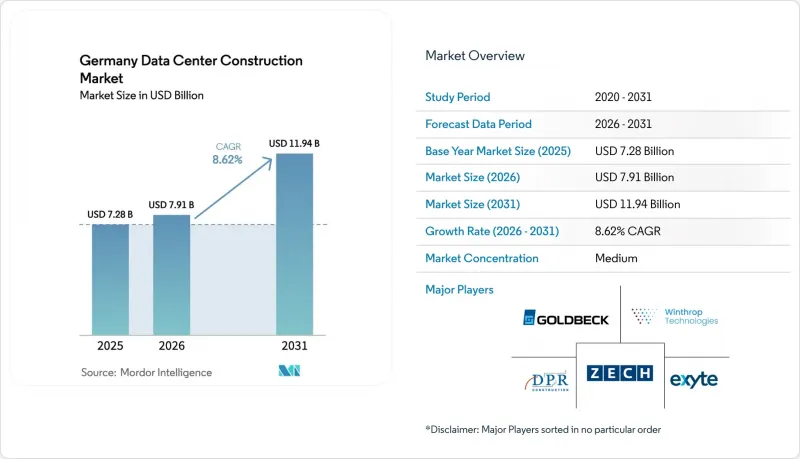
Mordor Intelligence에 의하면, 독일의 데이터센터 건설 시장 규모는 2025년에 72억 8,000만 달러로 평가되었고 2026년 79억 1,000만 달러에서 2031년까지 119억 4,000만 달러에 이를 것으로 예측되며, 예측 기간(2026-2031년)에서 CAGR은 8.62%를 나타낼 전망입니다.
본 보고서에서는 업계를 인프라(전기 인프라, 기계 인프라, 일반 건설), 티어 유형(Tier 1 및 2, Tier 3, Tier 4), 데이터센터 유형(코로케이션, 하이퍼스케일러(CSP)의 자체 건설 등)별로 세분화하고 있습니다. 시장 규모 및 전망은 상기 모든 부문에 대해 금액(백만 달러) 기준으로 제시되어 있습니다.
독일 데이터센터 건설 시장 동향 및 인사이트
하이퍼스케일 클라우드의 설비 투자 붐이 수 기가와트 규모의 확장을 주도
하이퍼스케일 사업자들은 사상 최대 규모의 자본 투자를 통해 독일 데이터센터 건설 시장을 재정의하고 있습니다. AWS는 기가와트 규모의 부하에 대응하고 18-24개월의 납기를 상정한 프랑크푸르트 근교의 여러 캠퍼스에 94억 4,000만 달러를 투자하여, 조립식 모듈 및 동시 인허가 절차에 대한 수요를 촉진하고 있습니다. 이에 이어 마이크로소프트는 32억 유로(36억 달러)를 투자하는 확장 계획을 발표했습니다. 이를 통해 국내 AI 처리 능력은 두 배로 증가하며, 40kW를 초과하는 랙이 도입될 예정입니다. 여러 건물을 동시에 건설하는 일정에서는 분산된 부지 간에 작업 팀과 물류를 병행하여 조정할 수 있는 기업이 유리한 반면, 소규모 지역 도급업체는 시장에서 배제될 위험에 직면해 있습니다. 공사 기간 단축으로 인해 숙련된 인력과 특수 개폐 장치를 둘러싼 경쟁이 심화되며, 세계 공급망에 대한 의존도가 높아지고 있습니다. 따라서 독일 데이터센터 건설 시장에서는 PUE 성능을 저해하지 않으면서 신속하게 규모를 확장할 수 있는 건설사가 우대받고 있습니다.
AI/ML 랙 밀도의 변화가 액체 냉각 프로젝트를 가속화하고 있습니다.
현재 AI 추론 및 훈련 클러스터는 랙당 80kW를 초과하고 있어 공랭식 냉각은 더 이상 현실적이지 않게 되었으며, 액체 냉각으로의 개조나 그린필드 도입이 잇따르고 있습니다. 구글이 공개한 1MW CDU 설계도는 하이퍼스케일러 각사가 채택하고 있는 표준화된 고전압·액체 냉각 대응 아키텍처를 보여줍니다. GlobalConnect와 같은 선구적인 기업들은 액체 냉각 도입 프로젝트 후 냉각 에너지를 90% 절감했다고 보고하며, 새로운 효율성 기준을 확립하고 있습니다. Supermicro는 2024년부터 2025년까지 2,000대 이상의 수냉식 랙을 출하하며 하드웨어의 급속한 보급을 뒷받침하는 동시에 새로운 건설 기준을 정착시켰습니다. 현재 건설사들은 슬래브 시공 단계에서 냉각액 분배 장치와 열 회수 루프를 통합하고 있으며, 이로 인해 후속 공정이 단축되면서 독일 데이터센터 건설 시장의 계약 범위에도 변화가 생기고 있습니다.
프랑크푸르트 주변의 110kV 송전망 연결 부족으로 인해 파이프라인 프로젝트가 지연되고 있습니다.
프랑크푸르트의 110 kV 간선 송전망은 최대 부하에 가까운 상태로 가동되고 있으며, 신규 계통 연계까지의 리드타임이 최대 8년에 달하고, 일반적인 하이퍼스케일 계획 주기를 훨씬 초과하고 있습니다. 디지털 리얼티가 운영하는 20곳 이상의 현지 시설군은 기존 수요의 높음과 그로 인한 포화 상태를 여실히 보여주고 있습니다. 이에 대응하기 위해 개발사들은 프로젝트를 100MW 미만으로 분할하거나, 브란덴부르크주, 베를린, 노르트라인-베스트팔렌주로 발판을 옮기고 있습니다. 건설 일정은 전력 회사의 증설 공사 승인 여부에 좌우되게 되어 EPC 계약을 복잡하게 만들고 있습니다. 그 결과, 독일 데이터센터 건설 시장에서는 송전망 접근성 부족이 토지 평가액과 PPA 프리미엄에 반영되고 있습니다.
부문 분석
2025년, Tier 3는 독일 데이터센터 건설 시장 점유율의 56.68%를 차지하며, 신뢰성과 비용 효율성의 균형이 뛰어나다는 것이 확인되었습니다. 한편, 티어 4는 연평균 성장률(CAGR) 10.74%로 확대되고 있으며, 2026년부터 2031년까지 독일 데이터센터 건설 시장에서 가장 빠른 성장 속도를 보이고 있습니다. 하이퍼스케일 및 금융 서비스 구매자들은 99.995%의 가동률을 달성하기 위해 고도의 중복성을 정당화하고 있습니다. 건설 요건에는 듀얼 액티브 전원 경로, 병렬 유지보수가 가능한 냉각 시스템, 그리고 내결함성 광섬유 경로가 포함됩니다. Tier 4 설계를 전문으로 하는 건설사는 더 높은 수익률을 확보할 수 있지만, 더 긴 테스트 주기와 규제 감사에 대응해야 합니다.
기업들이 클라우드로 전환하고 더 높은 가용성을 요구함에 따라, Tier 1 및 Tier 2 데이터센터 건설에 대한 수요는 현재 제한적입니다. Tier 3 및 Tier 4를 중심으로 한 통합이 진행됨에 따라, 엔터프라이즈 호스팅에서 AI 지원 하이퍼스케일 시설로의 전환이 가속화되고 있습니다. 마이크로소프트의 32억 유로 규모의 확장 계획에서는 지속적인 머신러닝 워크로드를 처리하도록 설계된 Tier 4 홀이 지정되어 있습니다. 병렬 유지보수 아키텍처에 풍부한 경험을 가진 기업은 안정적인 수주 파이프라인을 유지할 수 있는 반면, 저티어에 중점을 둔 계약업체는 기술 재교육이 필요할 수 있습니다. 따라서 독일 데이터센터 건설 업계는 최소한으로 요구되는 신뢰성이 높아짐에 따라 프리미엄 티어로 전환하고 있습니다.
2025년 매출에서 코로케이션이 차지하는 비중은 48.65%였으나, 자체 건설 하이퍼스케일 프로젝트는 연평균 11.87%의 성장률이 예상되어 독일 데이터센터 건설 시장 규모 확대에 더욱 박차를 가하고 있습니다. 소버린 클라우드 전략에 따라 각 하이퍼스케일러 기업들은 중립적인 호스트를 우회하여 시설을 완전히 자체 소유하고 있습니다. 이러한 소유 모델에서는 수 기가와트 규모의 캠퍼스를 확장해야 하며, 신속한 인허가 절차, 고전압 변전소, 그리고 캠퍼스 전체에 걸친 액체 냉각이 요구됩니다.
엣지 및 엔터프라이즈용 건설은 규모는 작지만 전략적으로 중요하며, 지연 시간에 민감한 워크로드와 규제상의 데이터 거주 요건을 충족시킵니다. 아마존이 브란덴부르크 주에서 추진 중인 78억 유로 규모의 소버린 클라우드 프로그램은 하이퍼스케일러 기업들이 각국의 규정 준수 요건과 자체 관리형 인프라를 어떻게 결합해 나갈지를 여실히 보여줍니다. 계약업체의 입장에서 볼 때, 하이퍼스케일러의 자체 건설 프로젝트는 엄격한 벤더 감사를 실시하는 소수의 대규모 고객에 업무 범위가 집중된다는 것을 의미합니다. 코로케이션 제공업체들은 독일 데이터센터 건설 시장에서 경쟁력을 유지하기 위해 지역 열 재활용 및 ‘에너지-어-서비스(EaaS)’ 모델을 제시하고 있습니다.
기타 혜택:
- 엑셀 형식 시장 예측(ME) 시트
- 3개월간의 애널리스트 지원
자주 묻는 질문
목차
제1장 서론
제2장 조사 방법
제3장 개요
제4장 시장 구도
제5장 데이터센터의 주요 통계
제6장 독일에서 데이터센터 건설에 인공지능(AI)의 도입
제7장 규제 및 컴플라이언스 프레임워크
제8장 시장 규모와 성장 예측
제9장 경쟁 구도
제10장 시장 기회와 향후 전망
JHS 26.09.03According to Mordor Intelligence, the Germany data center construction market size was valued at USD 7.28 billion in 2025 and estimated to grow from USD 7.91 billion in 2026 to reach USD 11.94 billion by 2031, at a CAGR of 8.62% during the forecast period (2026-2031).
This report Segments the Industry Into Infrastructure (By Electrical Infrastructure, by Mechanical Infrastructure, General Construction), by Tier Type (Tier 1 and 2, Tier 3, Tier 4), by Data Center Type (Colocation, Self-Built Hyperscalers (CSPs) and More). The Market Sizes and Forecasts are Provided in Terms of Value (USD Million) for all the Above Segments.
Germany Data Center Construction Market Trends and Insights
Hyperscale Cloud Capex Boom Fuels Multi-GW Build-outs
Hyperscale operators are redefining the Germany data center construction market through record capital deployment. AWS committed USD 9.44 billion to multiple Frankfurt-area campuses designed for gigawatt-scale loads and 18-24 month delivery timetables,catalyzing demand for prefabricated modules and concurrent permitting. Microsoft followed with a EUR 3.2 billion (USD 3.6 billion) expansion that doubles national AI capacity and specifies racks above 40 kW. Multi-building scheduling favors firms that can coordinate parallel crews and logistics across dispersed plots, while smaller regional contractors risk displacement. Accelerated timelines intensify competition for skilled labor and specialized switchgear, deepening reliance on global supply chains. The Germany data center construction market therefore rewards builders that scale quickly without compromising PUE performance.
AI/ML Rack-Density Shift Accelerates Liquid-Cooling Projects
AI inference and training clusters now exceed 80 kW per rack, making air cooling impractical and triggering a wave of liquid-cooling retrofits and green-field deployments. Google's open 1 MW CDU blueprint illustrates a standardized high-voltage, liquid-ready architecture adopted by hyperscalers. Early movers such as GlobalConnect report 90% cuts in cooling energy after submersion projects, setting new efficiency baselines. Supermicro shipped more than 2,000 liquid-cooled racks between 2024 and 2025, proving fast hardware uptake and locking in new construction norms. Construction firms now integrate coolant distribution units and heat-recovery loops at slab stage, compressing later trades and altering contractual scopes within the Germany data center construction market.
Scarce 110 kV Grid Connections Around Frankfurt Delay Pipeline Projects
Frankfurt's 110 kV backbone operates near maximum load, extending new interconnection lead times to as long as eight years, well beyond typical hyperscale planning cycles. Digital Realty's cluster of more than 20 local facilities underlines the demand legacy and the resulting saturation. In response, developers fragment projects below 100 MW or pivot to Brandenburg, Berlin, and North Rhine-Westphalia. Construction scheduling becomes contingent on utility-approved reinforcement works, complicating EPC contracts. The Germany data center construction market therefore prices grid-access scarcity into land valuations and PPA premiums.
Other drivers and restraints analyzed in the detailed report include:
- Mandatory 50% Renewable-Power Requirement Under EnEfG Drives Retrofit Spending
- Grid-Capacity Re-allocation Scheme Opens Secondary Metros
- Cap-ex Inflation on Switchgear and Generators Raises Construction Costs
For complete list of drivers and restraints, kindly check the Table Of Contents.
Segment Analysis
Tier 3 captured 56.68% of the Germany data center construction market share in 2025, confirming its balance of reliability and cost efficiency. Tier 4, however, is expanding at 10.74% CAGR, the swiftest pace within the Germany data center construction market size during 2026-2031. Hyperscale and financial-services buyers justify premium redundancy to achieve 99.995% uptime. Construction mandates include dual active power paths, concurrently maintainable cooling, and fault-tolerant fiber routes. Builders specializing in Tier 4 designs can command higher margins but must manage longer testing cycles and regulatory audits.
Tier 1 and Tier 2 builds now attract limited demand as enterprises shift to cloud and require higher availability. Consolidation around Tier 3 and Tier 4 accelerates a move from enterprise hosting to AI-ready hyperscale estates. Microsoft's EUR 3.2 billion expansion specifies Tier 4 halls designed for continuous machine-learning workloads. Firms with deep experience in concurrent-maintenance architectures will see sustained pipelines, while contractors focused on lower tiers may need to reskill. The Germany data center construction industry therefore rotates toward premium tiers as table-stake reliability rises.
Colocation accounted for 48.65% of 2025 revenue, yet self-build hyperscale projects are forecast to rise 11.87% annually, adding momentum to the Germany data center construction market size trajectory. Sovereign-cloud strategies drive hyperscalers to own facilities outright, bypassing neutral hosts. This ownership model scales multi-gigawatt campuses and demands fast-track permitting, high-voltage substations, and campus-wide liquid cooling.
Edge and enterprise builds remain smaller but strategic, supporting latency-sensitive workloads and regulatory data residency. Amazon's EUR 7.8 billion Brandenburg sovereign-cloud program underscores how hyperscalers combine national compliance with self-managed infrastructure. For contractors, hyperscale self-builds concentrate scope into fewer, larger clients with stringent vendor audits. Colocation providers counter with district-heat reuse and energy-as-a-service models to stay competitive inside the Germany data center construction market.
Complete Report Scope:
- By Tier Type
- Tier 1 and 2
- Tier 3
- Tier 4
- By Data Center Type
- Colocation
- Self-build Hyperscalers (CSPs)
- Enterprise and Edge
- By Infrastructure
- By Electrical Infrastructure
- Power Distribution Solution
- Power Backup Solutions
- By Mechanical Infrastructure
- Cooling Systems
- Racks and Cabinets
- Servers and Storage
- Other Mechanical Infrastructure
- General Construction
- Service - Design and Consulting, Integration, Support and Maintenance
- By Electrical Infrastructure
List of Companies Covered in this Report:
- Michel Bau GmbH and Co KG
- Mercury Engineering
- Collen Construction Ltd
- DPR Construction
- Royal HaskoningDHV
- Soben
- Winthrop Technologies Ltd
- Zech Group SE
- Exyte GmbH
- Noris Network AG
- CBRE Group Inc.
- STRABAG SE
- NTT Global Data Centers EMEA GmbH
- GOLDBECK GmbH
- Arup Group Ltd
- Turner and Townsend Ltd
- Munters AB
- Siemens AG (Infrastructure)
- Schneider Electric SE
- Vertiv Holdings Co
Additional Benefits:
- The market estimate (ME) sheet in Excel format
- 3 months of analyst support
TABLE OF CONTENTS
1 INTRODUCTION
- 1.1 Study Assumptions and Market Definition
- 1.2 Scope of the Study
2 RESEARCH METHODOLOGY
3 EXECUTIVE SUMMARY
4 MARKET LANDSCAPE
- 4.1 Market Overview
- 4.2 Market Drivers
- 4.2.1 Hyperscale cloud capex boom fuels multi-GW build-outs
- 4.2.2 AI/ML rack-density shift (>80 kW/rack) accelerates liquid-cooling projects
- 4.2.3 Mandatory 50 % renewable-power requirement under EnEfG (2024) drives retrofit spending
- 4.2.4 Grid-capacity re-allocation scheme (Repartition-verfahren) opens secondary metros
- 4.2.5 Waste-heat purchase incentives (up to EUR 180/MWh) spur heat-re-use infrastructure
- 4.2.6 On-site H? fuel-cell pilots cut diesel-backup OPEX in Tier 3/4 builds
- 4.3 Market Restraints
- 4.3.1 Scarce 110 kV grid connections around Frankfurt delays >200 MW pipeline
- 4.3.2 Cap-ex inflation on switchgear and generators (+32 % since 2022)
- 4.3.3 Tightened PUE ?1.2 (new DCs) under EnEfG raises design costs
- 4.3.4 Berlin land-use moratorium near TXL airport restricts hyperscale plots
- 4.4 Value / Supply-Chain Analysis
- 4.5 Regulatory Landscape
- 4.6 Technological Outlook
- 4.7 Porter's Five Forces
- 4.7.1 Bargaining Power of Suppliers
- 4.7.2 Bargaining Power of Consumers
- 4.7.3 Threat of New Entrants
- 4.7.4 Threat of Substitutes
- 4.7.5 Intensity of Competitive Rivalry
5 KEY DATA CENTER STATISTICS
- 5.1 Exhaustive Data Center Operators in Germany (in MW)
- 5.2 List of Major Upcoming Data Center Projects in Germany (2025-2030)
- 5.3 CAPEX and OPEX For Germany Data Center Construction
- 5.4 Data Center Power Capacity Absorption In MW, Selected Cities, Germany, 2023 and 2024
6 ARTIFICIAL INTELLIGENCE (AI) INCLUSION IN DATA CENTER CONSTRUCTION IN Germany
7 REGULATORY and COMPLIANCE FRAMEWORK
8 MARKET SIZE and GROWTH FORECASTS (VALUE)
- 8.1 By Tier Type
- 8.1.1 Tier 1 and 2
- 8.1.2 Tier 3
- 8.1.3 Tier 4
- 8.2 By Data Center Type
- 8.2.1 Colocation
- 8.2.2 Self-build Hyperscalers (CSPs)
- 8.2.3 Enterprise and Edge
- 8.3 By Infrastructure
- 8.3.1 By Electrical Infrastructure
- 8.3.1.1 Power Distribution Solution
- 8.3.1.2 Power Backup Solutions
- 8.3.2 By Mechanical Infrastructure
- 8.3.2.1 Cooling Systems
- 8.3.2.2 Racks and Cabinets
- 8.3.2.3 Servers and Storage
- 8.3.2.4 Other Mechanical Infrastructure
- 8.3.3 General Construction
- 8.3.4 Service - Design and Consulting, Integration, Support and Maintenance
- 8.3.1 By Electrical Infrastructure
9 COMPETITIVE LANDSCAPE
- 9.1 Market Concentration
- 9.2 Strategic Moves
- 9.3 Market Share Analysis
- 9.4 Data Center Infrastructure Investment Based on Megawatt (MW) Capacity, 2024 vs 2030
- 9.5 Data Center Construction Landscape (Key Vendors Listings)
- 9.6 Company Profiles (includes Global level Overview, Market level overview, Core Segments, Financials as available, Strategic Information, Market Rank/Share for key companies, Products and Services, Recent Developments)
- 9.6.1 Michel Bau GmbH and Co KG
- 9.6.2 Mercury Engineering
- 9.6.3 Collen Construction Ltd
- 9.6.4 DPR Construction
- 9.6.5 Royal HaskoningDHV
- 9.6.6 Soben
- 9.6.7 Winthrop Technologies Ltd
- 9.6.8 Zech Group SE
- 9.6.9 Exyte GmbH
- 9.6.10 Noris Network AG
- 9.6.11 CBRE Group Inc.
- 9.6.12 STRABAG SE
- 9.6.13 NTT Global Data Centers EMEA GmbH
- 9.6.14 GOLDBECK GmbH
- 9.6.15 Arup Group Ltd
- 9.6.16 Turner and Townsend Ltd
- 9.6.17 Munters AB
- 9.6.18 Siemens AG (Infrastructure)
- 9.6.19 Schneider Electric SE
- 9.6.20 Vertiv Holdings Co
10 MARKET OPPORTUNITIES and FUTURE OUTLOOK
- 10.1 White-Space and Unmet-Need Assessment


