

|
시장보고서
상품코드
2119663
베트남의 데이터센터 건설 : 시장 점유율 분석, 업계 동향과 통계, 성장 예측(2026-2031년)Vietnam Data Center Construction - Market Share Analysis, Industry Trends & Statistics, Growth Forecasts (2026 - 2031) |
||||||
 Mordor Intelligence
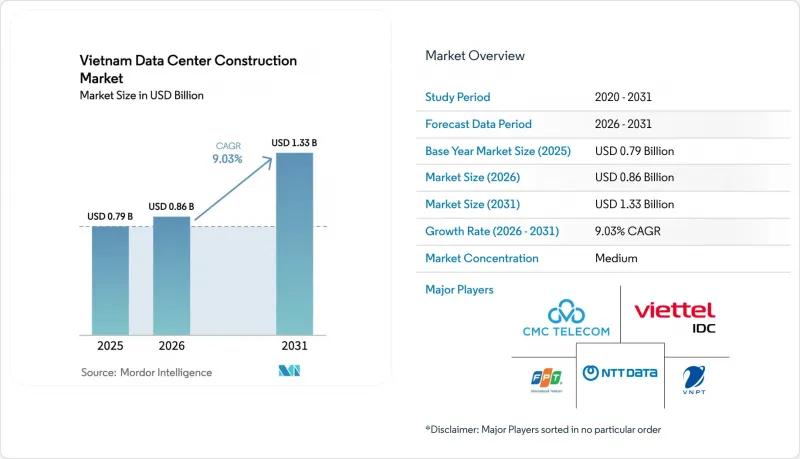
Mordor Intelligence에 따르면 베트남의 데이터센터 건설 시장 규모는 2025년에 7억 9,000만 달러로 평가되며, 2026년 8억 6,000만 달러에서 2031년까지 13억 3,000만 달러에 달할 것으로 예측되며, 예측 기간(2026-2031년) 동안 CAGR은 9.03%가 될 전망입니다.
본 보고서에서는 시장을 인프라(전기 인프라, 기계 인프라, 일반 건설, 서비스), 티어 유형(Tier 1·2, Tier 3, Tier 4), 데이터센터 유형(코로케이션, 자체 구축형 하이퍼스케일러(CSP) 등)별로 분류하고 있습니다. 시장 규모 및 전망은 상기 모든 부문에 대해 금액(달러) 단위로 제시되어 있습니다.
베트남 데이터센터 건설 시장의 동향 및 인사이트
데이터 현지화 의무가 수요를 견인
베트남의 제53호 정령 및 2025년 7월에 시행될 종합적인 데이터법에 따라, 세계 플랫폼은 지정된 중요 및 핵심 데이터를 국내에 저장해야 할 의무가 있습니다. 규정 준수 기한이 다가옴에 따라 시설 조달이 진행되고 있으며, 알리바바가 국가로부터 임대하던 랙에서 전용 시설로 전환하기로 결정한 것이 그 증거입니다. 2025년 말 완공 예정인 정부 출자 국립 데이터센터는 공통된 보안 및 중복성 기준을 설정하고 있어, 이에 따라 기업들의 기대가 높아지고 있습니다. 구글이 국내 최초의 하이퍼스케일 시설을 계획하고 있다는 사실은 주권에 관한 법규제가 현재 사업 전개 전략을 좌우하고 있음을 여실히 보여줍니다. 이러한 정책들이 맞물리면서 현지 건설업체들에게는 예측 가능하고 안정적인 수주 파이프라인이 형성되고 있습니다.
클라우드 및 OTT 트래픽의 급증으로 인프라 수요 확대
상용 5G는 2024년 10월 전국에서 서비스를 시작했으며, 2025년 3월 기준 평균 다운로드 속도는 247.78 Mbps에 달했습니다. 이에 따라 UHD 스트리밍 및 클라우드 게이밍이 가능해지면서 백엔드 컴퓨팅 수요가 급증하고 있습니다. 정부는 2025년까지 전체 가구의 90%에 200 Mbps의 유선 통신 속도를 보장하겠다는 목표를 세웠으며, 기업용으로는 대칭형 1 Gbps 회선이 제공되고 있습니다. 60kW 랙을 갖춘 현재 건설 중인 Viettel의 140MW 캠퍼스는 서비스 제공업체의 트래픽 예측이 고밀도 설계에 얼마나 직접적인 영향을 미치는지를 여실히 보여줍니다. 라스트 마일의 용량이 조금씩 증가할 때마다 로컬 처리 워크로드가 증가하며, 이용률은 지역 평균을 크게 상회하는 수준을 유지하고 있습니다.
수입에 대한 높은 의존도가 비용을 끌어올리고 있습니다
베트남의 반도체 산업 기반은 여전히 설계에 중점을 두고 있어 정밀 개폐장치, 칠러, GPU를 수입할 수밖에 없으며, 건설사는 운임 인상 및 환율 변동 위험에 노출되어 있습니다. 결정 제409/QD-BXD호에 근거하여 책정된 건설 비용 벤치마크는 전 세계적인 공급 부족 시 발생하는 설비 가격 급등을 상쇄할 수 없습니다. 슈나이더 일렉트릭(Schneider Electric)이 미국 내 생산 확대에 중점을 두게 된 것은 공급업체들이 지역화를 추진하고 있음을 여실히 보여주며, 동남아시아의 구매자들은 리드타임 부족이라는 위험에 노출되어 있습니다.
부문 분석
2025년에도 Tier 3 사이트는 시장 점유율 60.75%를 유지했습니다. 이는 많은 기업들이 여전히 중복성과 설비 투자에 대한 신중함 사이의 균형을 맞추고 있기 때문입니다. 따라서 베트남 데이터센터 건설 시장 규모에서는 Tier 3가 여전히 가장 큰 비중을 차지하고 있지만, Tier 4 사업은 2031년까지 연평균 성장률(CAGR) 11.7%라는 가장 빠른 성장 궤도를 타고 있습니다. 투자자들은 빈번하게 발생하는 전력 품질 문제를, 자본 비용이 상승하더라도 워크로드를 완전 병렬 시스템으로 전환할 정당한 이유로 해석하고 있습니다. Viettel의 140MW 규모 Tan Phu Trung 캠퍼스는 Tier 3 인증을 목표로 하고 있지만, AI 클러스터용으로 Tier 4 대응 모듈을 예비로 마련해 두어 설계 철학이 과도기에 있음을 시사하고 있습니다.
높은 티어로의 전환은 하이퍼스케일러의 허용 임계값도 반영하고 있습니다. GPU 훈련 클러스터는 며칠에 걸친 작업 실행을 위험에 빠뜨리지 않으면서 다운타임의 위험을 감수할 수 없습니다. NVIDIA가 베트남 정부와 체결한 AI 연구개발 센터 개설에 관한 양해각서에서는 공급망 파트너에게 Tier 4 기준이 부과되고 있습니다. 베트남의 데이터센터 건설 시장이 확대되는 가운데, Tier 4 빌트-투-수트(BTS) 계약이 프리미엄 서비스의 수익을 견인하는 반면, Tier 1/2 시설은 개발·테스트 및 로컬 엣지 사용 사례를 위해 축소되는 추세입니다.
2025년에도 코로케이션은 56.70%의 점유율을 유지하며 베트남 데이터센터 건설 시장의 기반을 이루고 있습니다. 그럼에도 불구하고 Google, Alibaba 및 지역 OTT 사업자들이 풀스택 제어를 우선시하는 가운데, 자체 건설을 통한 하이퍼스케일 프로그램은 연평균 성장률(CAGR) 12.9%를 기록하고 있습니다. 2024년 규제 완화로 100% 외국인 소유가 허용되면서, 과거 진입 기업들을 코로케이션 임대로 이끌었던 출자 제한이 해소되었습니다.
합작 투자 모델은 여전히 유효합니다. STT GDC와 VNG의 제휴는 현지 인허가 및 토지 보유와 국제적인 모범 사례를 기반으로 한 건설 기술을 결합한 것입니다. 그러나 대부분의 하이퍼스케일러는 독자적인 네트워크 패브릭, 전문적인 보안, 맞춤형 AI 칩 클러스터를 통합하기 위해 완전한 그린필드 건설을 선호합니다. 이러한 추세로 인해 콜로케이션 기존 사업자들은 엣지 사이트의 밀도, 소버린 클라우드 계층화, 또는 산업별 규정 준수 대응 등을 통해 차별화를 꾀할 수밖에 없게 되었습니다.
기타 혜택:
- 엑셀 형식의 시장 예측(ME) 시트
- 3개월간의 애널리스트 지원
자주 묻는 질문
목차
제1장 소개
제2장 조사 방법
제3장 주요 요약
제4장 시장 구도
제5장 데이터센터의 주요 통계
제6장 베트남의 데이터센터 건설에의 인공지능(AI)의 도입
제7장 규제 및 컴플라이언스 프레임워크
제8장 시장 규모와 성장 예측
제9장 경쟁 구도
제10장 시장 기회와 향후 전망
KSM 26.09.03According to Mordor Intelligence, the Vietnam data center construction market size was valued at USD 0.79 billion in 2025 and estimated to grow from USD 0.86 billion in 2026 to reach USD 1.33 billion by 2031, at a CAGR of 9.03% during the forecast period (2026-2031).
This report Segments the Industry Into Infrastructure (By Electrical Infrastructure, by Mechanical Infrastructure, General Construction), by Tier Type (Tier 1 and 2, Tier 3, Tier 4), by Data Center Type (Colocation, Self-Built Hyperscalers (CSPs) and More). The Market Sizes and Forecasts are Provided in Terms of Value (USD Million) for all the Above Segments.
Vietnam Data Center Construction Market Trends and Insights
Data-Localization Mandate Drives Demand
Vietnam's Decree 53 and the comprehensive Data Law effective July 2025 oblige global platforms to store designated "important" and "core" data onshore. Compliance timelines accelerate facility sourcing, evidenced by Alibaba shifting from state-rented racks to dedicated builds. The government-funded National Data Center, due late-2025, sets common security and redundancy baselines that raise enterprise expectations. Google's plan for its first domestic hyperscale site underlines how sovereignty statutes now dictate footprint strategies. Together these policies create a predictable, captive pipeline for local construction contractors.
Cloud and OTT Traffic Surge Amplifies Infrastructure Needs
Commercial 5G went live nationwide in October 2024 and averaged 247.78 Mbps download by March 2025, enabling UHD streaming and cloud gaming that swell back-end compute demand. Government targets guarantee 200 Mbps fixed speeds for 90% of households by 2025, while enterprises gain symmetric 1 Gbps pipes. Viettel's ongoing 140 MW campus with 60 kW racks epitomizes how service-provider traffic forecasts translate directly into high-density design. Each incremental rise in last-mile capacity multiplies local processing workloads, sustaining utilization rates well above regional averages.
High Import Dependency Raises Costs
Vietnam's semiconductor base still emphasizes design, forcing imports of precision switchgear, chillers, and GPUs, exposing builders to freight surcharges and currency swings. Construction-cost benchmarks issued under Decision 409/QD-BXD cannot offset equipment price escalation when global supply tightens. Schneider Electric's pivot to expand manufacturing in the United States underscores how suppliers are regionalizing, leaving Southeast Asian buyers vulnerable to lead-time gaps
Other drivers and restraints analyzed in the detailed report include:
- Renewable-Energy Access Transforms Economics
- Nationwide 5G Rollout Creates Edge-Compute Demand
- MEP-Skills Shortage Delays Projects
For complete list of drivers and restraints, kindly check the Table Of Contents.
Segment Analysis
Tier 3 sites retained 60.75% market share in 2025 as most enterprises still balance redundancy and capex prudence. The Vietnam data center construction market size for Tier 3 therefore remained largest, while Tier 4 operations set the fastest 11.7% CAGR trajectory into 2031. Investors interpret frequent power-quality incidents as justification for moving workloads to fully concurrent systems, even when capital costs rise. Viettel's 140 MW Tan Phu Trung campus targets Tier III certification yet benches Tier IV-ready modules for AI clusters, signalling a transitional design mindset.
Higher-tier momentum also mirrors hyperscaler tolerance thresholds; GPU training clusters cannot risk downtime without jeopardizing multi-day job runs. NVIDIA's memorandum with the Vietnamese government to open an AI R&D center imposes Tier 4 baselines on supply-chain partners. As the Vietnam data center construction market broadens, Tier 4 build-to-suit contracts drive premium service revenues, while Tier 1/2 footprints contract toward dev-test and local-edge use cases.
Colocation retained 56.70% share in 2025, anchoring the Vietnam data center construction market. Nonetheless, self-build hyperscale programs clock a 12.9% CAGR as Google, Alibaba, and regional OTT players prioritize full-stack control. Deregulation in 2024 allowing 100% foreign ownership eliminates equity constraints that once steered entrants toward colocation leases.
Joint-venture blueprints remain relevant; STT GDC's alliance with VNG combines local permits and land banks with international best-practice construction. Yet most hyperscalers favor outright greenfield builds to integrate proprietary network fabrics, specialized security, and custom-AI chip clusters. The trend forces colocation incumbents to chase differentiation via edge-site density, sovereign-cloud tiers, or sector-specific compliance wrappers.
Complete Report Scope:
- By Tier Type
- Tier 1 and 2
- Tier 3
- Tier 4
- By Data Center Type
- Colocation
- Self-build Hyperscalers (CSPs)
- Enterprise and Edge
- By Infrastructure
- By Electrical Infrastructure
- Power Distribution Solution
- Power Backup Solutions
- By Mechanical Infrastructure
- Cooling Systems
- Racks and Cabinets
- Servers and Storage
- Other Mechanical Infrastructure
- General Construction
- Service - Design and Consulting, Integration, Support and Maintenance
- By Electrical Infrastructure
List of Companies Covered in this Report:
- Viettel IDC
- VNPT
- FPT Telecom
- CMC Telecom
- NTT GDC Vietnam
- ST Telemedia GDC Vietnam
- Keppel DC Vietnam
- GDS Holdings
- Digital Realty-Mapletree JV
- KDDI Telehouse Vietnam
- Gaw NP Industrial
- CotekCNS
- AECOM
- Obayashi Corp
- Turner Construction
- Rider Levett Bucknall
- Artelia Group
- Firstgreen Engineering
- Arup Vietnam
- Schneider Electric Vietnam
Additional Benefits:
- The market estimate (ME) sheet in Excel format
- 3 months of analyst support
TABLE OF CONTENTS
1 INTRODUCTION
- 1.1 Study Assumptions and Market Definition
- 1.2 Scope of the Study
2 RESEARCH METHODOLOGY
3 EXECUTIVE SUMMARY
4 MARKET LANDSCAPE
- 4.1 Market Overview
- 4.2 Market Drivers
- 4.2.1 Data-localization mandate (Decree 53)
- 4.2.2 Cloud and OTT traffic boom
- 4.2.3 Low power tariffs and renewable PPAs
- 4.2.4 Nationwide 5G + fibre backhaul rollout
- 4.2.5 Sub-sea cable expansion (ADC2, SJC2)
- 4.2.6 Green-finance access for "net-zero" DCs
- 4.3 Market Restraints
- 4.3.1 High imported CAPEX / OPEX
- 4.3.2 Skilled MEP commissioning talent gap
- 4.3.3 Grid-instability in hydropower-lean seasons
- 4.3.4 Speculative AI-DC overbuild bubble risk
- 4.4 Value / Supply-Chain Analysis
- 4.5 Regulatory Landscape
- 4.6 Technological Outlook
- 4.7 Porter's Five Forces
- 4.7.1 Bargaining Power of Suppliers
- 4.7.2 Bargaining Power of Consumers
- 4.7.3 Threat of New Entrants
- 4.7.4 Threat of Substitutes
- 4.7.5 Intensity of Competitive Rivalry
5 KEY DATA CENTER STATISTICS
- 5.1 Exhaustive Data Center Operators in Vietnam (in MW)
- 5.2 List of Major Upcoming Data Center Projects in Vietnam (2025-2030)
- 5.3 CAPEX and OPEX For Vietnam Data Center Construction
- 5.4 Data Center Power Capacity Absorption In MW, Selected Cities, Vietnam, 2023 and 2024
6 ARTIFICIAL INTELLIGENCE (AI) INCLUSION IN DATA CENTER CONSTRUCTION IN Vietnam
7 REGULATORY and COMPLIANCE FRAMEWORK
8 MARKET SIZE and GROWTH FORECASTS (VALUE)
- 8.1 By Tier Type
- 8.1.1 Tier 1 and 2
- 8.1.2 Tier 3
- 8.1.3 Tier 4
- 8.2 By Data Center Type
- 8.2.1 Colocation
- 8.2.2 Self-build Hyperscalers (CSPs)
- 8.2.3 Enterprise and Edge
- 8.3 By Infrastructure
- 8.3.1 By Electrical Infrastructure
- 8.3.1.1 Power Distribution Solution
- 8.3.1.2 Power Backup Solutions
- 8.3.2 By Mechanical Infrastructure
- 8.3.2.1 Cooling Systems
- 8.3.2.2 Racks and Cabinets
- 8.3.2.3 Servers and Storage
- 8.3.2.4 Other Mechanical Infrastructure
- 8.3.3 General Construction
- 8.3.4 Service - Design and Consulting, Integration, Support and Maintenance
- 8.3.1 By Electrical Infrastructure
9 COMPETITIVE LANDSCAPE
- 9.1 Market Concentration
- 9.2 Strategic Moves
- 9.3 Market Share Analysis
- 9.4 Data Center Infrastructure Investment Based on Megawatt (MW) Capacity, 2024 vs 2030
- 9.5 Data Center Construction Landscape (Key Vendors Listings)
- 9.6 Company Profiles (includes Global level Overview, Market level overview, Core Segments, Financials as available, Strategic Information, Market Rank/Share for key companies, Products and Services, Recent Developments)
- 9.6.1 Viettel IDC
- 9.6.2 VNPT
- 9.6.3 FPT Telecom
- 9.6.4 CMC Telecom
- 9.6.5 NTT GDC Vietnam
- 9.6.6 ST Telemedia GDC Vietnam
- 9.6.7 Keppel DC Vietnam
- 9.6.8 GDS Holdings
- 9.6.9 Digital Realty-Mapletree JV
- 9.6.10 KDDI Telehouse Vietnam
- 9.6.11 Gaw NP Industrial
- 9.6.12 CotekCNS
- 9.6.13 AECOM
- 9.6.14 Obayashi Corp
- 9.6.15 Turner Construction
- 9.6.16 Rider Levett Bucknall
- 9.6.17 Artelia Group
- 9.6.18 Firstgreen Engineering
- 9.6.19 Arup Vietnam
- 9.6.20 Schneider Electric Vietnam
10 MARKET OPPORTUNITIES and FUTURE OUTLOOK
- 10.1 White-space and Unmet-Need Assessment


