|
시장보고서
상품코드
2119808
인도의 데이터센터 스토리지 : 시장 점유율 분석, 업계 동향 및 통계, 성장 예측(2026-2032년)India Data Center Storage - Market Share Analysis, Industry Trends & Statistics, Growth Forecasts (2026 - 2032) |
||||||
 Mordor Intelligence
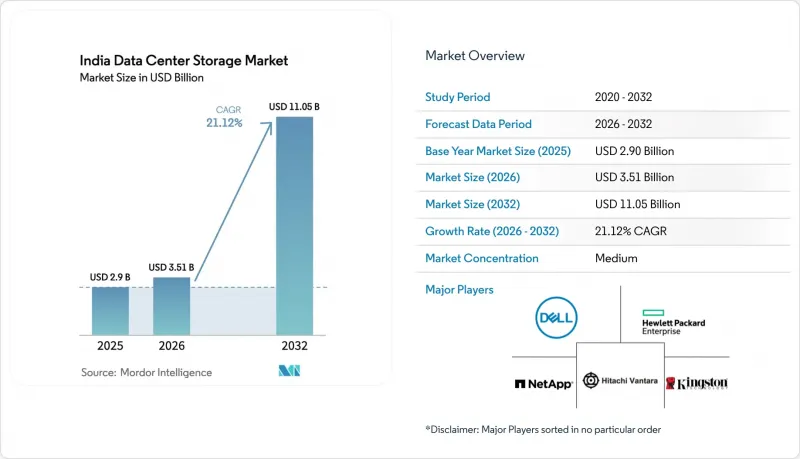
Mordor Intelligence에 의하면, 2026년 인도의 데이터센터 스토리지 시장 규모는 35억 1,000만 달러로 추정되고 2025년 29억 달러에서 확대해, 2032년에는 110억 5,000만 달러에 이를 것으로 예측됩니다.
2026-2032년 동안의 연평균 성장률(CAGR)은 21.12%가 될 것으로 전망됩니다.
본 보고서는 스토리지 기술(네트워크 연결형 스토리지, 스토리지 영역 네트워크, 기타),스토리지 유형(기존 스토리지, 올플래시 스토리지, 하이브리드 스토리지), 데이터센터 유형(코로케이션, 하이퍼스케일·자체 구축형, 기타), 최종 사용자 산업(IT 및 통신, 기타)별로 분류되어 있습니다. 시장 예측은 금액(달러) 기준으로 제시되어 있습니다.
인도의 데이터센터 스토리지 시장 동향 및 인사이트
IT 인프라의 확대
기업의 현대화에 따라 국내 설비 용량은 계속 두 배로 증가하고 있으며, 1,255MW에서 2025년 말까지 2,070MW에 달했습니다. ‘디지털 인디아(Digital India)’ 이니셔티브와 연계된 데이터센터 설비 투자 프로그램을 통해 2027년까지 1,000억 달러 이상이 투입되어, 하이브리드 클라우드 확장을 뒷받침할 차세대 어레이에 대한 수요가 앞당겨지고 있습니다. 국립정보학센터(NIC)가 추진하는 6억 달러 규모의 구와하티 건설 프로젝트 등 연방 정부 프로젝트는 북동부 주에 서비스를 제공하는 벤더 생태계를 활성화할 지역 노드를 추가하고 있습니다. 스토리지 아키텍트는 직접 어태치형 구성을 폐지하고 퍼블릭 클라우드, 프라이빗 클라우드, 엣지 클라우드 간 상호 운용이 가능한 소프트웨어 정의형 스택을 채택하고 있으며, 이를 통해 인도의 데이터센터용 스토리지 시장 수익 전망이 더욱 명확해지고 있습니다. 나그푸르나 라이푸르와 같은 2차 허브 도시는 토지 및 전력 가격이 포화 상태에 이른 대도시권에 비해 TCO(총 소유 비용) 측면에서 우위가 높아지고 있어 중요성이 커지고 있으며, 비즈니스 기회의 분산이 더욱 진행되고 있습니다.
하이퍼스케일 데이터센터에 대한 투자 확대
획기적인 설비 투자가 인도의 데이터센터용 스토리지 시장을 재편하고 있습니다. Reliance Industries가 계획 중인 300억 달러 규모의 잠나가르 캠퍼스는 사상 최대인 3GW의 IT 부하를 목표로 하고 있으며, 대규모 병렬 플래시 어레이가 필요한 AI 훈련 클러스터에 최적화되어 있습니다. 이와 동시에, 마이크로소프트, 블랙록, 테마섹이 주도하는 300억 달러 규모의 ‘프로젝트 MGX’ 컨소시엄이 아시아 내 14개 후보지 중 뭄바이를 선정함으로써, 하이퍼스케일 부문의 지속적인 성장세를 강조하고 있습니다.
구글의 60억 달러 규모 비사카파트남 시설은 ‘소버린 클라우드’라는 개념을 확고히 하며, 지역에 뿌리내린 스토리지 수요를 더욱 공고히 하고 있습니다. 이러한 메가 프로젝트로 인해 조달 동향은 NVMe-oF, 이레이저 코딩, 고급 티어링으로 이동하고 있으며, 이는 하이퍼스케일러가 지연 시간과 전력 소비를 억제하는 데 도움이 됩니다. 이러한 파급 효과로 인해, 인도 데이터센터 스토리지 시장의 기존 벤더들은 오픈 API 및 종량제 계약으로 전환할 수밖에 없게 되었습니다.
높은 초기 투자 비용
평균 건설 비용은 1MW당 540만 달러 전후로 유지되고 있으며, 스토리지가 예산의 15-20%를 차지하기 때문에 자금 조달에 제약이 있는 도입 기업들에게는 걸림돌이 되고 있습니다. 올플래시 어레이는 성능 면에서 뛰어나지만, 하이브리드형 제품보다 평균 판매 가격(ASP)이 높기 때문에 중소기업의 리프레시 주기 지연을 초래하고 있습니다. 뭄바이와 벵갈루루의 높은 코로케이션 임대료는 TCO(총 소유 비용)에 대한 우려를 더욱 심화시키고 있으며, 운영 비용(OPEX) 기반의 ‘STaaS(Storage-as-a-Service)’ 모델의 매력을 높이고 있습니다. 히타치 반타라(Hitachi Vantara)나 델(Dell) 등의 벤더는 용량과 성능을 유연하게 조정할 수 있는 종량제 서비스 제공을 확대하고 있어, 인도의 데이터센터 스토리지 시장에서 이러한 제약을 부분적으로 완화하고 있습니다.
부문 분석
2025년, 스토리지 영역 네트워크(SAN)는 미션 크리티컬 데이터베이스에 블록 수준 처리량이 필수적인 BFSI(은행 및 금융 및 보험) 및 통신 플랫폼에 힘입어 45.40%의 점유율로 인도의 데이터센터 스토리지 시장을 계속해서 주도했습니다. 자본 집약적이긴 하지만, SAN 패브릭은 높은 트랜잭션 워크로드에 필요한 일관된 지연 시간과 견고한 조닝을 실현합니다. 인도 국립은행(State Bank of India)의 ‘YONO’ 서비스 확장은 6,400만 명의 모바일 사용자를 저지연 Oracle RAC 클러스터에 연결함으로써 SAN의 중요성을 부각시키고 있습니다. Tier 1 은행들의 데이터베이스 통합이 진행됨에 따라, SAN 기반 도입을 중심으로 한 인도의 데이터센터용 스토리지 시장 규모는 꾸준히 확대될 것으로 전망됩니다. 한편, 네트워크 연결 스토리지(NAS)는 뭄바이와 하이데라바드 주변 미디어 제작사의 스트리밍, 디자인 협업, 분석 워크로드에 힘입어 2032년까지 연평균 성장률(CAGR) 18.97%를 나타낼 것으로 전망됩니다.
다루기 까다로운 파일 서버에서 클러스터형 NAS로의 전환은 데이터 민주화를 촉진하고, 스케일아웃을 통한 확장을 간소화합니다. QNAP이나 NetApp과 같은 벤더들은 현재 멀티 프로토콜 액세스를 통합하고 있어, 고객은 통합 어레이 내에서 SAN과 NAS 모드를 전환할 수 있게 되었습니다. 직접 어태치드(Direct Attached) 구성은 확장성보다 단순성이 우선시되는 엣지 노드에서 틈새 역할을 유지하고 있는 반면, 소프트웨어 정의 스토리지는 범용 하드웨어의 경제성에 매력을 느낀 기술 스타트업들 사이에서 초기 기반을 다져가고 있습니다. 전반적으로, 규정 준수 규제가 감사 추적 및 불변 스냅샷을 제공하는 아키텍처를 권장하고 있기 때문에 프로토콜 혼합 전략이 인도의 데이터센터 스토리지 시장 전체의 유연성을 높일 것으로 기대됩니다.
올플래시 어레이는 2025년에 이미 인도의 데이터센터 스토리지 시장 점유율의 38.10%를 차지했으며, 가격 대비 성능의 성숙도를 반영하여 연평균 17.05%의 복합 성장률로 확대될 것으로 예측됩니다. 대규모 AI 훈련 클러스터에서는 GPU의 유휴 시간을 최소화하기 위해 페타바이트 규모의 플래시 풀이 필요하지만, 이는 기존 HDD 계층으로는 충족할 수 없는 요구 사항입니다. 조직이 지연 시간에 민감한 핀테크 및 OTT 워크로드를 실행함에 따라, 인도의 데이터센터용 스토리지 시장에서 플래시 시스템의 규모는 확대될 전망입니다.
기존의 회전식 미디어는 TB당 비용이 여전히 결정적인 요소인 아카이브 계층에서 그 입지를 유지하고 있습니다. 하이브리드 어레이는 프런트엔드에 SSD를, 백엔드에 HDD를 조합함으로써 신중한 CIO들에게 과도기적인 비용 효율성을 제공합니다. 삼성(Samsung)과 Acro와 같은 산업 제휴는 SSD에 대한 접근성을 확대하고 공급을 현지화함으로써 NAND 가격 변동을 완화하는 것을 목표로 하고 있습니다. PCIe 5.0 및 존 네임스페이스 지원 SSD가 주류가 됨에 따라 I/O당 단위 에너지 소비량은 감소할 전망이며, 이는 인도 데이터센터 스토리지 시장에서 플래시 스토리지의 성장세를 더욱 강화할 것으로 보입니다.
기타 혜택
- 엑셀 형식 시장 예측(ME) 시트
- 3개월간 애널리스트 지원
자주 묻는 질문
목차
제1장 서론
제2장 조사 방법
제3장 주요 요약
제4장 시장 구도
제5장 시장 규모 및 성장 예측
제6장 경쟁 구도
제7장 시장 기회 및 향후 전망
KTHAccording to Mordor Intelligence, India data center storage market size in 2026 is estimated at USD 3.51 billion, growing from 2025 value of USD 2.90 billion with 2032 projections showing USD 11.05 billion, growing at 21.12% CAGR over 2026-2032.
This report is Segmented by Storage Technology (Network Attached Storage, Storage Area Network, and More), Storage Type (Traditional Storage, All-Flash Storage, Hybrid Storage), Data Center Type (Colocation, Hyperscale/Self-built, and More), End-User Industry (IT and Telecommunication, and More). The Market Forecasts are Provided in Terms of Value (USD).
India Data Center Storage Market Trends and Insights
Expansion of IT Infrastructure
Enterprise modernization continues to double national capacity, rising from 1,255 MW to an expected 2,070 MW by end-2025. Data center capex programs tied to the Digital India initiative inject over USD 100 billion through 2027, pulling forward demand for next-generation arrays that underpin hybrid-cloud rollouts. Federal projects such as the National Informatics Centre's USD 600 million Guwahati build add regional nodes that stimulate vendor ecosystems serving northeastern states. Storage architects are retiring direct-attached deployments in favor of software-defined stacks that interoperate across public, private, and edge clouds, reinforcing revenue visibility for the India data center storage market. Secondary hubs such as Nagpur and Raipur gain relevance because land and power pricing widen TCO advantages over saturated metros, further decentralizing opportunities.
Increased Investments in Hyperscale Data Centers
Landmark capital outlays are reshaping the India data center storage market. Reliance Industries' planned USD 30 billion Jamnagar campus targets a record 3 GW IT load and is optimized for AI training clusters that need massively parallel flash arrays. In parallel, the USD 30 billion Project MGX consortium-anchored by Microsoft, BlackRock, and Temasek-selects Mumbai among fourteen Asia sites, underscoring sustained hyperscale momentum.
Google's USD 6 billion Visakhapatnam facility cements the sovereign-cloud narrative, further locking in localized storage demand. Such megaprojects tilt procurement toward NVMe-oF, erasure coding, and advanced tiering that help hyperscalers curb latency and power draw. The ripple effect compels incumbent vendors in the India data center storage market to pivot toward open APIs and consumption-based contracting.
High Initial Investment Cost
Average build costs hover at USD 5.4 million per MW, with storage absorbing 15-20% of budgets, impeding cash-constrained adopters . All-flash arrays, while performance-superior, command higher ASPs than hybrid peers, delaying refresh cycles within small enterprises. Premium colocation rents in Mumbai and Bengaluru compound TCO concerns, making opex-based storage-as-a-service models more enticing. Vendors such as Hitachi Vantara and Dell are scaling pay-per-use offerings that flex in capacity and performance, partially offsetting this restraint within the India data center storage market.
Other drivers and restraints analyzed in the detailed report include:
- Government Data-Localization Mandates
- AI/ML Workload Proliferation Driving High-Performance Arrays
- Import-Dependent Component Price Volatility
For complete list of drivers and restraints, kindly check the Table Of Contents.
Segment Analysis
Storage Area Networks continued to dominate the India data center storage market in 2025 with a 45.40% share, driven by BFSI and telecom platforms that mandate block-level throughput for mission-critical databases. Although capital intensive, SAN fabrics deliver consistent latency and robust zoning required for high-transaction workloads. State Bank of India's YONO expansion underscores SAN relevance by anchoring 64 million mobile users on low-latency Oracle RAC clusters. The India data center storage market size for SAN-based deployments is projected to rise steadily as tier-1 banks consolidate databases. At the same time, Network Attached Storage posts a 18.97% CAGR through 2032, fueled by streaming, design collaboration, and analytics workloads in media production houses around Mumbai and Hyderabad.
Migration from cumbersome file servers to clustered NAS advances data democratization and simplifies scale-out growth. Vendors such as QNAP and NetApp now bundle multiprotocol access, enabling customers to toggle between SAN and NAS modalities within unified arrays. Direct-attached configurations retain niche roles at edge nodes where simplicity trumps scalability, while software-defined storage is carving early footholds among tech startups attracted to commodity hardware economics. Overall, blended protocol strategies are expected to elevate flexibility across the India data center storage market as compliance rules favor architectures providing audit trails and immutable snapshots.
All-flash arrays already captured 38.10% of the India data center storage market share in 2025 and are projected to compound at 17.05% annually, reflecting maturing price-performance economics. Large AI training clusters require petabyte-scale flash pools to minimize GPU idle time, an imperative that conventional HDD tiers cannot satisfy. The India data center storage market size for flash systems is poised to grow as organizations execute latency-critical fintech and OTT workloads.
Traditional spinning media endures within archival tiers, where cost per TB remains decisive. Hybrid arrays marry SSD front-ends with HDD back-ends, offering transitional economics for cautious CIOs. Industry alliances such as Samsung-Acro aim to widen SSD accessibility and localize supply to cushion NAND price swings. As PCIe 5.0 and zoned-namespace SSDs mainstream, unit energy per I/O is set to decline, reinforcing flash momentum within the India data center storage market.
Complete Report Scope:
- By Storage Technology
- Network Attached Storage (NAS)
- Storage Area Network (SAN)
- Direct Attached Storage (DAS)
- Other Technologies
- By Storage Type
- Traditional Storage
- All-Flash Storage
- Hybrid Storage
- By Data Center Type
- Colocation
- Hyperscale / Self-built
- Enterprise / Edge / Modular
- By End-User Industry
- IT and Telecommunication
- BFSI
- Government
- Media and Entertainment
- Other End Users
List of Companies Covered in this Report:
- Dell Inc.
- Hewlett Packard Enterprise
- NetApp Inc.
- Hitachi Vantara LLC
- Kingston Technology Company Inc.
- Pure Storage Inc.
- Lenovo Group Limited
- Fujitsu Limited
- Oracle Corporation
- Seagate Technology LLC
- Cisco Systems Inc.
- IBM Corporation
- Huawei Technologies Co. Ltd.
- Western Digital Corporation
- Micron Technology Inc.
- Super Micro Computer Inc.
- Inspur Group
- Synology Inc.
- QNAP Systems Inc.
- Nimbus Data Inc.
- Zadara Storage Inc.
Additional Benefits:
- The market estimate (ME) sheet in Excel format
- 3 months of analyst support
TABLE OF CONTENTS
1 INTRODUCTION
- 1.1 Study Assumptions and Market Definition
- 1.2 Scope of the Study
2 RESEARCH METHODOLOGY
3 EXECUTIVE SUMMARY
4 MARKET LANDSCAPE
- 4.1 Market Overview
- 4.2 Market Drivers
- 4.2.1 Expansion of IT infrastructure
- 4.2.2 Increased investments in hyperscale data centers
- 4.2.3 Government data-localisation mandates
- 4.2.4 AI/ML workload proliferation driving high-performance arrays
- 4.2.5 Rise of edge data centers in tier-2/3 cities
- 4.2.6 Growth of fintech and digital payments ecosystem
- 4.3 Market Restraints
- 4.3.1 High initial investment cost
- 4.3.2 Unreliable power supply in secondary cities
- 4.3.3 Import-dependent component price volatility
- 4.3.4 Shortage of skilled storage professionals
- 4.4 Value / Supply-Chain Analysis
- 4.5 Regulatory Landscape
- 4.6 Technological Outlook
5 MARKET SIZE and GROWTH FORECASTS
- 5.1 By Storage Technology
- 5.1.1 Network Attached Storage (NAS)
- 5.1.2 Storage Area Network (SAN)
- 5.1.3 Direct Attached Storage (DAS)
- 5.1.4 Other Technologies
- 5.2 By Storage Type
- 5.2.1 Traditional Storage
- 5.2.2 All-Flash Storage
- 5.2.3 Hybrid Storage
- 5.3 By Data Center Type
- 5.3.1 Colocation
- 5.3.2 Hyperscale / Self-built
- 5.3.3 Enterprise / Edge / Modular
- 5.4 By End-User Industry
- 5.4.1 IT and Telecommunication
- 5.4.2 BFSI
- 5.4.3 Government
- 5.4.4 Media and Entertainment
- 5.4.5 Other End Users
6 COMPETITIVE LANDSCAPE
- 6.1 Market Share Analysis
- 6.2 Company Profiles (includes Global level Overview, Market level overview, Core Segments, Financials as available, Strategic Information, Market Rank/Share for key companies, Products and Services, and Recent Developments)
- 6.2.1 Dell Inc.
- 6.2.2 Hewlett Packard Enterprise
- 6.2.3 NetApp Inc.
- 6.2.4 Hitachi Vantara LLC
- 6.2.5 Kingston Technology Company Inc.
- 6.2.6 Pure Storage Inc.
- 6.2.7 Lenovo Group Limited
- 6.2.8 Fujitsu Limited
- 6.2.9 Oracle Corporation
- 6.2.10 Seagate Technology LLC
- 6.2.11 Cisco Systems Inc.
- 6.2.12 IBM Corporation
- 6.2.13 Huawei Technologies Co. Ltd.
- 6.2.14 Western Digital Corporation
- 6.2.15 Micron Technology Inc.
- 6.2.16 Super Micro Computer Inc.
- 6.2.17 Inspur Group
- 6.2.18 Synology Inc.
- 6.2.19 QNAP Systems Inc.
- 6.2.20 Nimbus Data Inc.
- 6.2.21 Zadara Storage Inc.
7 MARKET OPPORTUNITIES and FUTURE OUTLOOK
- 7.1 White-space and Unmet-Need Assessment