|
시장보고서
상품코드
2119813
중국의 데이터센터 스토리지 : 시장 점유율 분석, 업계 동향 및 통계, 성장 예측(2026-2031년)China Data Center Storage - Market Share Analysis, Industry Trends & Statistics, Growth Forecasts (2026 - 2031) |
||||||
 Mordor Intelligence
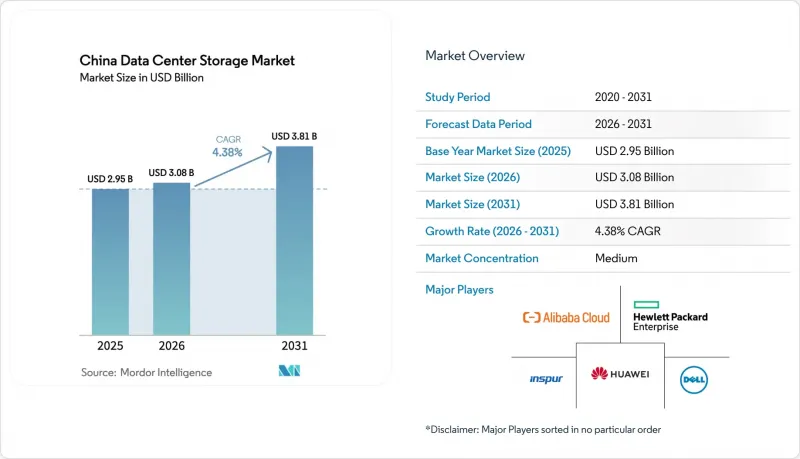
Mordor Intelligence에 의하면, 중국의 데이터센터 스토리지 시장 규모는 2025년 29억 5,000만 달러로 평가되었습니다. 2026년에는 30억 8,000만 달러로 확대되어 2026-2031년에 걸쳐 CAGR 4.38%로 성장을 지속하여, 2031년에는 38억 1,000만 달러에 이를 것으로 예측됩니다.
본 보고서에서는 산업을 스토리지 기술(네트워크 연결형 스토리지, 스토리지 영역 네트워크, 기타), 스토리지 유형(기존 HDD 어레이, 기타),데이터센터 유형(코로케이션 시설, 기타), 폼 팩터(랙 마운트형, 기타), 인터페이스(SAS/SATA, NVMe, 기타), 최종 사용자(IT 및 통신, 기타)의 범주로 분류하고 있습니다. 시장 예측은 금액(미화) 기준으로 제시되어 있습니다.
중국의 데이터센터 스토리지 시장 동향 및 인사이트
국영 기업과 주요 인터넷 기업의 ‘클라우드 퍼스트’ 전략
국영 기업과 알리바바(Alibaba) 등의 주요 플랫폼은 디지털 전환 요건을 충족하기 위해 설비 투자 상한선을 높이고 있습니다. 알리바바만 해도 AI 및 클라우드 하드웨어에 3년간 530억 달러를 투자하겠다고 약속했으며, 단일 스택에서 분석, 훈련, 백업을 지원하는 멀티티어 스토리지에 대한 단기적인 수요를 높이고 있습니다. 차이나 텔레콤의 의료 자회사는 영상 및 유전체 분석 워크로드를 처리하기 위해 확장 가능한 블록 및 오브젝트 스토리지 용량이 필요한 성(省) 수준의 데이터 풀을 구축하고 있습니다. 관민 협력 전략을 통해 NVMe 성능과 페타바이트 규모의 오브젝트 리포지토리를 결합한 시스템에 대한 수주가 증가하고 있습니다. 이는 지연 시간과 비용의 균형을 적절히 맞출 수 있는 벤더에게 중국의 데이터센터 스토리지 시장이 보상을 제공하는 ‘최적의 지점’입니다. 또한 국영 기업의 조달 지침에서는 국산 컨트롤러가 우선적으로 고려되고 있어, 이를 통해 현지 기업들은 부품 구성 비율(BOM)을 높일 수 있는 길이 열렸습니다.
‘동부 데이터·서부 컴퓨팅’ 허브 구축
‘동부 데이터·서부 컴퓨팅’ 프로그램에서는 8개의 국가 허브 노드와 10개의 클러스터 구역을 구축하기 위해 약 330억 달러가 투입되고 있으며, 전력망에 부하가 걸리는 연안 지역에서 재생에너지가 풍부한 내륙 지역으로 컴퓨팅 트래픽을 우회시키고 있습니다. 사업자들은 서부 클러스터를 배치 처리 및 아카이브 워크로드용으로 설계하고 있으며, 고밀도 HDD 케이지와 대용량 오브젝트 시스템의 구매를 촉진하고 있습니다. 그리드 자산의 디지털 트윈이 이러한 허브에 실시간 텔레메트리 데이터를 전송하고 있으며, 콜드 데이터를 에너지 효율이 높은 풀로 이전하는 지능형 계층화 엔진의 필요성이 부각되고 있습니다. 하드웨어 선정에 있어서는 현재 해발 고도, 냉각 요구 사항, 원격 관리 자동화가 고려되고 있으며, 그 결과 중국의 데이터센터 스토리지 시장에서 AI 지원 오케스트레이션 소프트웨어에 대한 수요가 증가하고 있습니다.
Tier 1 대도시권의 전력 사용 효율(PUE) 상한선
베이징, 상하이, 광저우에서는 신규 홀에 대해 PUE 1.3 이하를 의무화하고, 기존 시설에는 개조 기한을 부과하며, 랙 수준의 전력 소비 예산 및 냉각 밀도에 제한을 두고 있습니다. 각 사업자들은 HDD JBOD를 플래시 쉘프로 교체하여 전력 소비를 80% 절감하고 있지만, 초기 설비 투자(Capex)는 여전히 중소기업에게 장벽으로 작용하고 있습니다. 하이난도 해안에 설치된 액체 침지형 포드 및 수중 모듈은 도시 계획 기준을 충족하면서 랙당 최대 100kW를 흡수합니다. 이러한 제약으로 인해 단기적인 출하량은 억제되겠지만, 중국의 데이터센터용 스토리지 시장은 세밀한 전력 제한 기능을 갖춘 펌웨어를 탑재한 에너지 효율이 높은 아키텍처로 전환되고 있습니다.
부문 분석
SAN 도입은 2025년 중국 데이터센터 스토리지 시장 매출의 45.83%를 차지하며, 국영 은행, 통신 코어 네트워크, ERP 워크로드에서 중앙 집중식 블록 스토리지에 대한 꾸준한 수요를 반영했습니다. 확립된 파이버 채널 패브릭, 고가용성, 인증된 상호 운용성 덕분에 소프트웨어 정의형 대안이 성숙해 가고 있음에도 불구하고, 조달 주기는 여전히 SAN 교체를 중심으로 이루어지고 있습니다. 예측 기간 동안, SAN 갱신의 대부분은 NVMe-FC로의 업그레이드 및 오브젝트 리포지토리에 대한 지능형 계층화를 포함하며, 이는 CIO가 기존 워크플로우를 포기하지 않고도 급증하는 AI 훈련 데이터 세트를 관리할 수 있도록 지원합니다.
동시에, 오브젝트 및 테이프 솔루션은 연평균 성장률(CAGR) 6.05%를 기록하며 모든 기술 중 가장 높은 성장률을 보이고 있습니다. AI 모델 훈련에는 페타바이트 규모의 이미지와 텍스트 코퍼스가 소모되는데, 이는 비용 최적화된 HDD 또는 플래터당 1.6Pb의 용량을 가진 차세대 광학 미디어를 기반으로 하는 S3 호환 플랫폼에 가장 적합합니다. 또한, 중요 데이터의 경우 콜드 아카이브 규정에 따라 오프라인 사본 보관이 의무화되어 있어 테이프 라이브러리의 중요성이 다시 높아지고 있습니다. SAN과 오브젝트 클러스터 간의 원활한 네임스페이스 공유를 제공하는 벤더는 중국의 데이터센터 스토리지 시장에서 각 기업이 자체적인 속도로 현대화를 추진하는 가운데 우위를 점하고 있습니다.
중국의 데이터센터 스토리지 시장 규모에서 2025년 매출의 47.10%는 여전히 HDD 어레이가 차지했지만, 전년 대비 추세로는 SSD(SSD)가 우세합니다. AI 추론, 실시간 분석, 고빈도 거래에서 기계적 지연 시간이 제거됨에 따라 올플래시 어레이는 2031년까지 연평균 성장률(CAGR) 7.55%로 성장할 전망입니다. YMTC의 QLC 수명 연장으로 가격 차이가 좁혀짐에 따라, 은행 및 클라우드 제공업체들은 리프레시 주기에서 관계형 데이터베이스를 플래시 계층으로 이전하도록 장려받고 있습니다. 전력 효율에 관한 규제로 인해, 15K RPM SAS 드라이브에 비해 테라바이트당 전력 소비량이 5분의 1에 불과한 SSD로의 조달 경향이 더욱 강화되고 있습니다.
플래시 캐시를 프런트엔드에 갖춘 비용 효율적인 대용량 스토리지가 필요한 미드티어 워크로드의 경우, 하이브리드 시스템이 여전히 필수적입니다. 각 벤더는 QLC SSD, PMR HDD, 압축 ASIC을 단일 섀시에 결합하여 고객이 단계적으로 전환할 수 있는 경로를 제공합니다. 그 결과, 순수 HDD 인클로저의 출하 대수는 감소하고 있지만, 콜드 아카이브용 보관 시설에서는 일회성 기록 스토리지로서 여전히 수 TB급 헬륨 드라이브가 구매되고 있습니다. 따라서 중국의 데이터센터용 스토리지 시장은 활성 데이터 세트에는 플래시, 장기 아카이브에는 고밀도 HDD 또는 테이프를 사용하는 2계층 모델로 진화하고 있습니다.
기타 혜택
- 엑셀 형식 시장 예측(ME) 시트
- 3개월간의 애널리스트 지원
자주 묻는 질문
목차
제1장 서론
제2장 조사 방법
제3장 주요 요약
제4장 시장 구도
제5장 시장 규모 및 성장 예측
제6장 경쟁 구도
제7장 시장 기회 및 향후 전망
KTHAccording to Mordor Intelligence, the China data center storage market size is expected to grow from USD 2.95 billion in 2025 to USD 3.08 billion in 2026 and is forecast to reach USD 3.81 billion by 2031 at 4.38% CAGR over 2026-2031.
This report Segments the Industry Into Storage Technology (Network Attached Storage, Storage Area Network, and More), Storage Type (Traditional Storage, and More), Data Center Type (Colocation Facilities and More), , Form Factor(Rack-Mounted and More), Interface(sas / SATA, Nvme and More), and End User (IT and Telecommunication, and More). The Market Forecasts are Provided in Terms of Value (USD).
China Data Center Storage Market Trends and Insights
Cloud-First Strategies of SOEs and Internet Giants
State-owned enterprises and leading platforms such as Alibaba are raising capital-expenditure ceilings to meet digital-transformation mandates. Alibaba alone pledged USD 53 billion over three years for AI and cloud hardware, lifting near-term demand for multi-tier storage that supports analytics, training, and backup in a single stack. China Telecom's healthcare subsidiary is rolling out provincial data pools that require scalable block and object capacity for imaging and genomic workloads. Unified public-and-private strategies increase orders for systems that combine NVMe performance with petabyte-scale object repositories, a sweet spot where the China data center storage market rewards vendors able to balance latency and cost. Procurement guidelines from SOEs also give preference to domestic controllers, offering local firms a route to higher bill-of-materials share.
National East-Data-West-Compute Hub Rollout
The East-Data-West-Compute program has committed almost USD 33 billion to build eight national hub nodes and 10 cluster zones, routing compute traffic away from grid-strained coastlines to renewable-rich inland sites. Operators design western clusters for batch processing and archival workloads, spurring purchases of dense HDD cages and high-capacity object systems. Digital twins of grid assets feed real-time telemetry into these hubs, underscoring the need for intelligent tiering engines that migrate cold data to energy-efficient pools. Hardware selection now factors altitude, cooling requirements, and remote-management automation, which in turn elevates the China data center storage market's appetite for AI-enabled orchestration software.
Power-Use-Efficiency Caps in Tier-1 Metros
Beijing, Shanghai, and Guangzhou mandate PUE below 1.3 for new halls and impose retrofit timelines on legacy sites, restricting rack-level watt budgets and cooling density. Operators replace HDD JBODs with flash shelves, drawing 80% less power, yet initial capex remains a hurdle for smaller enterprises. Liquid-immersion pods and underwater modules off Hainan absorb up to 100 kW per rack while meeting urban planning codes. These constraints moderate near-term shipment volumes but shift the China data center storage market toward energy-efficient architectures with granular power-capping firmware.
Other drivers and restraints analyzed in the detailed report include:
- AI/LLM Workload Surge Demanding High-IOPS Flash Arrays
- Semiconductor Self-Reliance Push Boosting Domestic NAND Supply
- Import Restrictions on Advanced Controllers > Supply Risk
For complete list of drivers and restraints, kindly check the Table Of Contents.
Segment Analysis
SAN deployments accounted for 45.83% of 2025 revenue within the China data center storage market, reflecting entrenched demand for centralized block storage from state banks, telecom core networks, and ERP workloads. Established Fibre-Channel fabrics, high availability, and certified interoperability keep procurement cycles locked into SAN replacements even as software-defined options mature. Over the forecast window, most SAN refreshes include NVMe-FC upgrades and intelligent tiering to object repositories, helping CIOs manage surging AI training datasets without abandoning existing workflows.
At the same time, object and tape solutions post a 6.05% CAGR, the fastest among all technologies. AI model training consumes petabyte-scale image and text corpora, well suited to S3-compatible platforms backed by cost-optimized HDDs or next-generation optical media capable of 1.6 Pb per platter. Tape libraries also regain relevance because cold-archive regulations require offline copies for critical data. Vendors that offer seamless namespace sharing between SAN and object clusters gain an advantage as enterprises modernize at their own pace across the China data center storage market.
HDD arrays still delivered 47.10% of 2025 revenue in the China data center storage market size, yet year-on-year trendlines favor solid-state drives. All-flash arrays expand at 7.55% CAGR to 2031 as AI inference, realtime analytics, and high-frequency trading reject mechanical latency. YMTC's QLC endurance improvements narrow the price gap, encouraging banks and cloud providers to migrate relational databases to flash tiers during refresh cycles. Power-efficiency mandates further tilt procurement toward SSDs that draw one-fifth the watts per terabyte compared to 15 K RPM SAS drives.
Hybrid systems remain essential for mid-tier workloads needing cost-effective bulk capacity with a flash cache front end. Vendors mix QLC SSDs, PMR HDDs, and compression ASICs in a single chassis, providing a glide path for customers to transition gradually. As a result, shipments of pure HDD enclosures decline, yet cold-archive vaults continue purchasing multi-TB helium drives for write-once storage. The China data center storage market therefore evolves into a two-tier model-flash for active datasets and high-density HDD or tape for deep archives.
Complete Report Scope:
- By Storage Technology
- Network Attached Storage (NAS)
- Storage Area Network (SAN)
- Direct Attached Storage (DAS)
- Object and Tape Storage
- By Storage Type
- Traditional HDD Arrays
- All-Flash Arrays (AFA)
- Hybrid Storage
- By Data Center Type
- Colocation Facilities
- Hyperscalers/Cloud Service Providers
- Enterprise and Edge
- By End User
- IT and Telecommunication
- BFSI
- Government and Public Sector
- Media and Entertainment
- Healthcare and Life Sciences
- Manufacturing
- By Form Factor
- Rack-mounted
- Blade and Modular
- Disaggregated / Composable
- By Interface
- SAS / SATA
- NVMe
- Fibre Channel and iSCSI
List of Companies Covered in this Report:
- Alibaba Cloud Computing Co., Ltd.
- Baidu AI Cloud Computing Ltd.
- China Telecom Corporation Limited
- China Unicom Ltd.
- Dell Technologies Inc.
- Fujitsu Limited
- Hewlett Packard Enterprise Company
- Hitachi Vantara LLC
- H3C Technologies Co., Limited
- Huawei Technologies Co., Ltd.
- Inspur Electronic Information Industry Co., Ltd.
- Kingston Technology Company, Inc.
- Lenovo Group Limited
- NetApp Inc.
- Oracle Corporation
- Pure Storage, Inc.
- Seagate Technology LLC
- Tencent Cloud Computing (Beijing) Co., Ltd.
- Western Digital Corporation
- Yangtze Memory Technologies Co., Ltd.
Additional Benefits:
- The market estimate (ME) sheet in Excel format
- 3 months of analyst support
TABLE OF CONTENTS
1 INTRODUCTION
- 1.1 Study Assumptions and Market Definition
- 1.2 Scope of the Study
2 RESEARCH METHODOLOGY
3 EXECUTIVE SUMMARY
4 MARKET LANDSCAPE
- 4.1 Market Overview
- 4.2 Market Drivers
- 4.2.1 Cloud-first strategies of SOEs and internet giants
- 4.2.2 National East-Data-West-Compute hub rollout
- 4.2.3 AI/LLM workload surge demanding high-IOPS flash arrays
- 4.2.4 Growing adoption of SDS & HCI in Tier-2 city colos
- 4.2.5 5 G edge-cloud integration for low-latency services
- 4.2.6 Semiconductor self-reliance push boosting domestic NAND supply
- 4.3 Market Restraints
- 4.3.1 Power-use efficiency caps in Tier-1 metros
- 4.3.2 Import restrictions on advanced controllers greater than supply risk
- 4.3.3 Under-utilization of newly built AI data centers
- 4.3.4 Shortage of skilled data-storage architects outside coastal regions
- 4.4 Value / Supply-Chain Analysis
- 4.5 Regulatory Landscape
- 4.6 Technological Outlook
- 4.7 Porter's Five Forces Analysis
- 4.7.1 Threat of New Entrants
- 4.7.2 Bargaining Power of Buyers
- 4.7.3 Bargaining Power of Suppliers
- 4.7.4 Threat of Substitutes
- 4.7.5 Competitive Rivalry
- 4.8 Assessment of the impact of Macro Economic Trends on the Market
5 MARKET SIZE AND GROWTH FORECASTS (VALUE)
- 5.1 By Storage Technology
- 5.1.1 Network Attached Storage (NAS)
- 5.1.2 Storage Area Network (SAN)
- 5.1.3 Direct Attached Storage (DAS)
- 5.1.4 Object and Tape Storage
- 5.2 By Storage Type
- 5.2.1 Traditional HDD Arrays
- 5.2.2 All-Flash Arrays (AFA)
- 5.2.3 Hybrid Storage
- 5.3 By Data Center Type
- 5.3.1 Colocation Facilities
- 5.3.2 Hyperscalers/Cloud Service Providers
- 5.3.3 Enterprise and Edge
- 5.4 By End User
- 5.4.1 IT and Telecommunication
- 5.4.2 BFSI
- 5.4.3 Government and Public Sector
- 5.4.4 Media and Entertainment
- 5.4.5 Healthcare and Life Sciences
- 5.4.6 Manufacturing
- 5.5 By Form Factor
- 5.5.1 Rack-mounted
- 5.5.2 Blade and Modular
- 5.5.3 Disaggregated / Composable
- 5.6 By Interface
- 5.6.1 SAS / SATA
- 5.6.2 NVMe
- 5.6.3 Fibre Channel and iSCSI
6 COMPETITIVE LANDSCAPE
- 6.1 Market Concentration
- 6.2 Strategic Moves
- 6.3 Market Share Analysis
- 6.4 Company Profiles (includes Global-level Overview, Market-level Overview, Core Segments, Financials, Strategic Information, Market Rank/Share, Products & Services, Recent Developments)
- 6.4.1 Alibaba Cloud Computing Co., Ltd.
- 6.4.2 Baidu AI Cloud Computing Ltd.
- 6.4.3 China Telecom Corporation Limited
- 6.4.4 China Unicom Ltd.
- 6.4.5 Dell Technologies Inc.
- 6.4.6 Fujitsu Limited
- 6.4.7 Hewlett Packard Enterprise Company
- 6.4.8 Hitachi Vantara LLC
- 6.4.9 H3C Technologies Co., Limited
- 6.4.10 Huawei Technologies Co., Ltd.
- 6.4.11 Inspur Electronic Information Industry Co., Ltd.
- 6.4.12 Kingston Technology Company, Inc.
- 6.4.13 Lenovo Group Limited
- 6.4.14 NetApp Inc.
- 6.4.15 Oracle Corporation
- 6.4.16 Pure Storage, Inc.
- 6.4.17 Seagate Technology LLC
- 6.4.18 Tencent Cloud Computing (Beijing) Co., Ltd.
- 6.4.19 Western Digital Corporation
- 6.4.20 Yangtze Memory Technologies Co., Ltd.
7 MARKET OPPORTUNITIES & FUTURE OUTLOOK
- 7.1 White-space and Unmet-need Assessment