|
시장보고서
상품코드
2119809
필리핀의 데이터센터 스토리지 : 시장 점유율 분석, 업계 동향 및 통계, 성장 예측(2026-2031년)Philippines Data Center Storage - Market Share Analysis, Industry Trends & Statistics, Growth Forecasts (2026 - 2031) |
||||||
 Mordor Intelligence
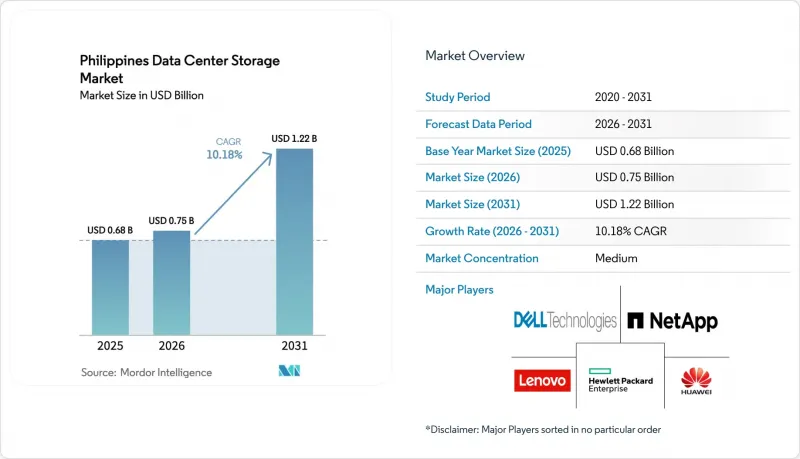
Mordor Intelligence에 의하면, 필리핀의 데이터센터 스토리지 시장 규모는 2025년에 6억 8,000만 달러로 평가되었습니다. 2026년 7억 5,000만 달러에서 2031년까지 12억 2,000만 달러에 이를 것으로 예상되며, 예측 기간(2026-2031년) CAGR은 10.18%를 나타낼 전망입니다.
본 보고서는 스토리지 기술(네트워크 연결형 스토리지(NAS), 스토리지 영역 네트워크(SAN), 기타), 스토리지 유형(기존 HDD 어레이, 기타),최종 사용자(IT 및 통신, 은행, 금융서비스 및 보험(BFSI), 정부 기관, 기타), 폼 팩터(랙 마운트형, 기타), 인터페이스(SAS/SATA, 기타)별로 분류되어 있습니다. 모든 부문에 대해 시장 규모와 전망은 금액(미 달러)으로 제시되어 있습니다.
필리핀의 데이터센터 스토리지 시장 동향 및 인사이트
IT 인프라 확대 및 디지털 전환
디지털 경제는 2024년에 450억 달러에 달하고, GDP의 8.5%에 해당했으며, 2030년까지 5조 필리핀 페소의 가치를 창출할 가능성이 있습니다. 이러한 국가적 전환에 따라 기업들이 사일로화된 어레이에서 탄력적으로 확장 가능한 클라우드 네이티브 플랫폼으로 전환함에 따라 스토리지 아키텍처에 대한 근본적인 재검토가 진행되고 있습니다. 마닐라 워터(Manila Water)의 클라우드 기반 물 관리 시스템 도입은 미션 크리티컬한 사례로, 2,700만 명 주민에 대한 서비스 연속성을 확보하는 동시에 데이터 유출 위험을 최소화하고 있습니다. ‘디지털 필리핀 캠페인’ 및 ‘국가 광대역 계획’과 같은 정부 프로그램에 힘입어, 기업의 85%가 2026년까지 워크로드를 클라우드로 이전할 의향을 밝혔으며, On-Premise, 엣지, 하이퍼스케일 시설에 걸친 하이브리드 스토리지 도입이 촉진되고 있습니다. 또한, 무역산업부가 400개 이상의 공장을 대상으로 실시한 ‘스마트 산업 준비도 지수’는 실시간 분석을 가능하게 하는 엣지 스토리지에 대한 수요를 더욱 부추기고 있습니다.
하이퍼스케일 및 코로케이션에 대한 투자 급증
AI 랙은 기존 전력 밀도의 2배 이상을 필요로 하기 때문에 하이퍼스케일 사업자들은 2024년 한 해 동안만 필리핀 내 시설 건설에 47억 달러를 투자했습니다. 에퀴닉스가 1억 달러를 투자해 마닐라의 3곳을 임베디드하고 1,000대의 캐리어 중립 캐비닛을 추가한 것은 해외로부터의 신뢰도가 높음을 보여줍니다. PLDT는 50MW 규모의 하이퍼스케일 시설을 개장하고 10억 달러 규모의 REIT 상장을 검토하고 있는 반면, 글로브 텔레콤은 124MW 규모의 캠퍼스 건설에 착수했습니다. 뉴 클라크 시티에 건설 중인 나라 테크놀로지 파크의 300MW 그린 데이터센터는 필리핀 최대 규모가 될 전망입니다. 이러한 프로젝트에서는 AI 추론 워크로드를 위해 저지연 처리량을 실현하는 NVMe 기반 올플래시 어레이가 요구되고 있습니다.
엔터프라이즈급 스토리지에 대한 고액의 설비 투자
플래시 미디어는 연간 15%의 가격 하락과 2022년부터 2025년에 걸쳐 QLC 가격이 60% 폭락했음에도 불구하고, HDD에 비해 여전히 5-7배의 가격 프리미엄을 유지했습니다. 중소기업들은 중복 어레이, 백업 어플라이언스, 데이터 개인정보 보호법에서 의무화한 규정 준수 관리에 필요한 자금 조달에 어려움을 겪고 있습니다. 리스나 신용 한도가 제한적인 메트로 마닐라 이외의 지역에서는 자금 조달 격차가 더욱 커지고 있습니다. 구독 모델이 탄력을 받고 있습니다. 퓨어스토리지의 ‘에버그린’ 포트폴리오는 2025 회계연도 3분기에 구독 매출을 22% 확대하며, 초기 현금 지출을 줄여주는 운영 비용(OPEX) 기반의 대안을 제공했습니다.
부문별 분석
2025년에는 스토리지 영역 네트워크(SAN)가 매출의 43.75%를 차지하며, 미션 크리티컬한 핵심 뱅킹 및 통신 사업자의 OSS/BSS 워크로드에서 신뢰성을 입증했습니다. 오브젝트 스토리지와 테이프 스토리지는 플랫 네임스페이스 아키텍처에서 뛰어난 확장성을 발휘하는 AI, 미디어 스트리밍, IoT 데이터에 힘입어 연평균 성장률(CAGR) 12.02%로 가장 빠르게 성장하고 있습니다. 네트워크 연결형 시스템은 파일 수준의 편의성을 중시하는 중소기업 사이에서 확고한 입지를 유지하고 있는 반면, 직접 어태치형 구성은 연구실의 HPC 클러스터를 지원하고 있습니다. 오브젝트 스토리지 분야의 필리핀의 데이터센터 스토리지 시장 규모는 구글과 같은 하이퍼스케일러가 260Tbps 용량의 TPU 케이블을 구축하여 비정형 컨텐츠를 로컬 노드로 대량으로 전송함에 따라 급속히 확대될 전망입니다. Dell과 같은 벤더들은 PowerStore에 S3 호환 서비스를 통합하여 단일 어플라이언스 내에서 블록, 파일, 오브젝트 프로토콜을 통합하고 있습니다.
사업자들은 AI를 활용한 계층화를 점점 더 많이 활용하여, 사용 빈도가 낮은 데이터 세트를 테이프 라이브러리나 클라우드 버킷으로 이전하는 동시에, 지연 시간에 민감한 분석 처리를 위해 SAN 플래시를 확보하고 있습니다. 이러한 최적화를 통해 자본을 절약하면서도 BSP의 데이터 보존 규정도 준수할 수 있습니다. 그 결과, 필리핀의 데이터센터 스토리지 시장은 성능을 희생하지 않으면서 GB당 비용 관리를 추구하는 BFSI(은행 및 금융 및 보험) 및 미디어 플레이어의 하이브리드 도입 확대로부터 혜택을 보고 있습니다.
2025년에도 HDD 어레이는 여전히 매출의 41.60%를 차지하며, 테라바이트당 비용을 중시하는 미디어 아카이브 및 백업 저장소에 서비스를 제공했습니다. 그러나 AI 추론 워크로드에는 마이크로초 단위의 응답 시간이 요구되기 때문에 올플래시 어레이는 2031년까지 연평균 성장률(CAGR) 12.85%를 기록할 전망입니다. 따라서 NVMe의 보급에 따라 필리핀의 데이터센터 스토리지 시장에서 올플래시의 점유율은 급증할 것으로 예측됩니다. 시게이트의 30TB 열 보조 자기 기록(HAMR) 드라이브는 HDD의 혁신성을 보여주고 있지만, 웨스턴 디지털의 기업 분할은 디스크와 플래시의 미래가 갈라지고 있음을 시사합니다. 플래시 가격 곡선이 연간 15% 하락하는 가운데, 하이브리드 어레이는 SSD 계층과 대용량 스핀들을 결합함으로써 통신 및 핀테크 부문의 테넌트에 있는 트랜잭션 데이터베이스에 대응할 수 있는 타협점을 제공합니다.
DICT의 ‘클라우드 퍼스트’ 정책 하에서 SaaS 및 PaaS 스택이 레거시 HDD SAN으로는 달성할 수 없는 IOPS 밀도를 요구함에 따라 플래시로의 전환이 가속화되고 있습니다. 또한, 데이터 현지화 규제로 인해 대규모 데이터 세트는 국내에 보관되어야 하므로, 메트로 마닐라의 제한된 바닥 면적을 효율적으로 활용하는 플래시 기반 중복 제거 기술에 대한 수요가 증가하고 있습니다. 그 결과, 예측 기간 동안 필리핀의 데이터센터 스토리지 시장은 NVMe 및 QLC SSD 도입으로 계속해서 편중될 것으로 보입니다.
기타 혜택
- 엑셀 형식 시장 예측(ME) 시트
- 3개월간의 애널리스트 지원
자주 묻는 질문
목차
제1장 서론
제2장 조사 방법
제3장 주요 요약
제4장 시장 구도
제5장 시장 규모 및 성장 예측
제6장 경쟁 구도
제7장 시장 기회 및 향후 전망
KTHAccording to Mordor Intelligence, the Philippines data center storage market size was valued at USD 0.68 billion in 2025 and estimated to grow from USD 0.75 billion in 2026 to reach USD 1.22 billion by 2031, at a CAGR of 10.18% during the forecast period (2026-2031).
This report is Segmented Into Storage Technology (Network Attached Storage (NAS), Storage Area Network (SAN) and More), Storage Type (Traditional Storage, and More), and End-User (IT & Telecommunication, BFSI, Government, and More). Form Factor (Rack-Mounted and More), Interface (SAS / SATA and More). The Market Sizes and Forecasts are Provided in Terms of Value (USD) for all the Segments.
Philippines Data Center Storage Market Trends and Insights
Expansion of IT infrastructure and digital transformation
The digital economy reached USD 45 billion in 2024, equating to 8.5% of GDP, and could unlock PHP 5 trillion in value by 2030. This national pivot is overhauling storage architectures as enterprises move from siloed arrays to cloud-native platforms that scale elastically. Manila Water's cloud-based water-management rollout illustrates mission-critical adoption, safeguarding service continuity for 27 million residents while minimizing data-loss risk. Government programs such as the Digital Philippines Campaign and the National Broadband Plan mean 85% of firms intend to migrate workloads to cloud by 2026, spurring uptake of hybrid storage that spans on-premises, edge, and hyperscale facilities. The Department of Trade and Industry's Smart Industry Readiness Index across 400+ factories is further prompting demand for edge storage that enables real-time analytics.
Surge in hyperscale and colocation investments
Hyperscalers are allocating USD 4.7 billion to Philippine builds in 2024 alone, as AI racks require more than double traditional power density. Equinix's USD 100 million purchase of three Manila sites adds 1,000 carrier-neutral cabinets, demonstrating foreign confidence. PLDT opened a 50 MW hyperscale facility and is weighing a USD 1 billion REIT listing, while Globe Telecom has broken ground on a 124 MW campus . Narra Technology Park's 300 MW green data-center build in New Clark City will be the country's largest. These projects demand NVMe-based all-flash arrays that deliver low-latency throughput for AI inference workloads.
High capex for enterprise-grade storage
Flash media retains a 5-7X price premium to HDD despite 15% annual declines and a projected 60% QLC price crash between 2022-2025. SMEs struggle to fund redundant arrays, backup appliances, and compliance controls mandated by the Data Privacy Act. Financing gaps are wider outside Metro Manila, where leasing and credit lines are limited. Subscription models are gaining ground-Pure Storage's Evergreen portfolio drove 22% subscription revenue expansion in Q3 FY 2025-offering opex options that soften initial cash outlays.
Other drivers and restraints analyzed in the detailed report include:
- Rapid cloud and hybrid-cloud adoption
- Government CREATE and DICT green-DC incentives
- Shortage of certified storage engineers
For complete list of drivers and restraints, kindly check the Table Of Contents.
Segment Analysis
Storage Area Networks led revenue with 43.75% share in 2025, underscoring their reliability for mission-critical core-banking and telco OSS/BSS workloads. Object and Tape Storage is the fastest riser at 12.02% CAGR, propelled by AI, media streaming, and IoT data that scale better on flat-namespace architectures. Network-attached systems retain footholds among SMEs that favor file-level simplicity, while direct-attached setups cater to HPC clusters in research labs. The Philippines data center storage market size for object storage will expand swiftly as hyperscalers like Google deploy TPU cables delivering 260 Tbps capacity and flooding local nodes with unstructured content Vendors such as Dell have embedded S3-compatible services in PowerStore, aligning block, file, and object protocols inside a single appliance.
Operators increasingly apply AI-infused tiering to shuttle cold datasets into tape libraries or cloud buckets while reserving SAN flash for latency-sensitive analytics. This optimization preserves capital and aligns with BSP retention rules. In turn, the Philippines data center storage market benefits from widening hybrid adoption across BFSI and media enterprises pursuing cost-per-GB discipline without sacrificing performance.
HDD arrays still captured 41.60% revenue in 2025, servicing media archives and backup vaults that value USD/terabyte. Yet all-flash arrays will post a 12.85% CAGR through 2031 as AI inference workloads require microsecond response times. The Philippines data center storage market share of all-flash will thus rise sharply alongside NVMe penetration. Seagate's 30 TB Heat-Assisted Magnetic Recording drives underscore HDD innovation, yet Western Digital's corporate split indicates divergent futures for disk and flash. As flash price curves drop 15% yearly, hybrid arrays offer a compromise, combining SSD tiers with high-capacity spindles to serve transactional databases across telecom and fintech tenants.
Migration to flash accelerates under DICT's cloud-first policy because SaaS and PaaS stacks expect IOPS densities unattainable on legacy HDD SANs. Data-localization rules also keep large datasets on-shore, lifting demand for efficient flash-based deduplication that stretches scarce floor space in Metro Manila. Consequently, the Philippines data center storage market continues to skew toward NVMe and QLC SSD deployments over the forecast horizon.
Complete Report Scope:
- By Storage Technology
- Network Attached Storage (NAS)
- Storage Area Network (SAN)
- Direct Attached Storage (DAS)
- Object and Tape Storage
- By Storage Type
- Traditional HDD Arrays
- All-Flash Arrays (AFA)
- Hybrid Storage
- By Data Center Type
- Colocation Facilities
- Hyperscalers/Cloud Service Providers
- Enterprise and Edge
- By End User
- IT and Telecommunication
- BFSI
- Government and Public Sector
- Media and Entertainment
- Healthcare and Life Sciences
- Manufacturing
- By Form Factor
- Rack-mounted
- Blade and Modular
- Disaggregated / Composable
- By Interface
- SAS / SATA
- NVMe
- Fibre Channel and iSCSI
List of Companies Covered in this Report:
- Dell Inc.
- Huawei Technologies Co., Ltd.
- Hewlett Packard Enterprise Company
- Lenovo Group Limited
- NetApp, Inc.
- Fujitsu Limited
- Oracle Corporation
- Seagate Technology Holdings PLC
- Western Digital Corporation
- Infortrend Technology, Inc.
- Pure Storage, Inc.
- Hitachi Vantara LLC
- IBM Corporation
- Synology Inc.
- Toshiba Electronic Devices and Storage Corp.
- Nutanix, Inc.
- NEC Corporation
- Netgear, Inc.
- Overland-Tandberg Holdings AB
- Kingston Technology Company, Inc.
Additional Benefits:
- The market estimate (ME) sheet in Excel format
- 3 months of analyst support
TABLE OF CONTENTS
1 INTRODUCTION
- 1.1 Study Assumptions and Market Definition
- 1.2 Scope of the Study
2 RESEARCH METHODOLOGY
3 EXECUTIVE SUMMARY
4 MARKET LANDSCAPE
- 4.1 Market Overview
- 4.2 Market Drivers
- 4.2.1 Expansion of IT infrastructure and digital transformation
- 4.2.2 Surge in hyperscale and colocation investments
- 4.2.3 Rapid cloud and hybrid-cloud adoption
- 4.2.4 Government CREATE and DICT green-DC incentives
- 4.2.5 BSP Circular 1122 data-localization mandate
- 4.2.6 AI-driven analytics workload boom (NVMe flash uptake)
- 4.3 Market Restraints
- 4.3.1 High capex for enterprise-grade storage
- 4.3.2 Shortage of certified storage engineers
- 4.3.3 Inter-island fibre and power reliability gaps
- 4.3.4 Peso depreciation inflating imported flash costs
- 4.4 Value / Supply-Chain Analysis
- 4.5 Regulatory Landscape (PH-specific)
- 4.6 Technological Outlook (AI/Edge/NVMe, SDS)
- 4.7 Porters Five Forces
- 4.7.1 Threat of New Entrants
- 4.7.2 Bargaining Power of Buyers
- 4.7.3 Bargaining Power of Suppliers
- 4.7.4 Threat of Substitutes
- 4.7.5 Intensity of Competitive Rivalry
- 4.8 Assessment of Macro Economic Trends on the Market
5 Market Size and Growth Forecasts (Value)
- 5.1 By Storage Technology
- 5.1.1 Network Attached Storage (NAS)
- 5.1.2 Storage Area Network (SAN)
- 5.1.3 Direct Attached Storage (DAS)
- 5.1.4 Object and Tape Storage
- 5.2 By Storage Type
- 5.2.1 Traditional HDD Arrays
- 5.2.2 All-Flash Arrays (AFA)
- 5.2.3 Hybrid Storage
- 5.3 By Data Center Type
- 5.3.1 Colocation Facilities
- 5.3.2 Hyperscalers/Cloud Service Providers
- 5.3.3 Enterprise and Edge
- 5.4 By End User
- 5.4.1 IT and Telecommunication
- 5.4.2 BFSI
- 5.4.3 Government and Public Sector
- 5.4.4 Media and Entertainment
- 5.4.5 Healthcare and Life Sciences
- 5.4.6 Manufacturing
- 5.5 By Form Factor
- 5.5.1 Rack-mounted
- 5.5.2 Blade and Modular
- 5.5.3 Disaggregated / Composable
- 5.6 By Interface
- 5.6.1 SAS / SATA
- 5.6.2 NVMe
- 5.6.3 Fibre Channel and iSCSI
6 COMPETITIVE LANDSCAPE
- 6.1 Market Concentration
- 6.2 Strategic Moves
- 6.3 Market Share Analysis
- 6.4 Company Profiles (includes Global level Overview, Market level overview, Core Segments, Financials as available, Strategic Information, Market Rank/Share for key companies, Products and Services, and Recent Developments)
- 6.4.1 Dell Inc.
- 6.4.2 Huawei Technologies Co., Ltd.
- 6.4.3 Hewlett Packard Enterprise Company
- 6.4.4 Lenovo Group Limited
- 6.4.5 NetApp, Inc.
- 6.4.6 Fujitsu Limited
- 6.4.7 Oracle Corporation
- 6.4.8 Seagate Technology Holdings PLC
- 6.4.9 Western Digital Corporation
- 6.4.10 Infortrend Technology, Inc.
- 6.4.11 Pure Storage, Inc.
- 6.4.12 Hitachi Vantara LLC
- 6.4.13 IBM Corporation
- 6.4.14 Synology Inc.
- 6.4.15 Toshiba Electronic Devices and Storage Corp.
- 6.4.16 Nutanix, Inc.
- 6.4.17 NEC Corporation
- 6.4.18 Netgear, Inc.
- 6.4.19 Overland-Tandberg Holdings AB
- 6.4.20 Kingston Technology Company, Inc.
7 MARKET OPPORTUNITIES and FUTURE OUTLOOK
- 7.1 White-space and Unmet-need Assessment