

|
시장보고서
상품코드
2120551
HVAC 장비 : 시장 점유율 분석, 업계 동향 및 통계, 성장 예측(2026-2031년)HVAC Equipment - Market Share Analysis, Industry Trends & Statistics, Growth Forecasts (2026 - 2031) |
||||||
 Mordor Intelligence
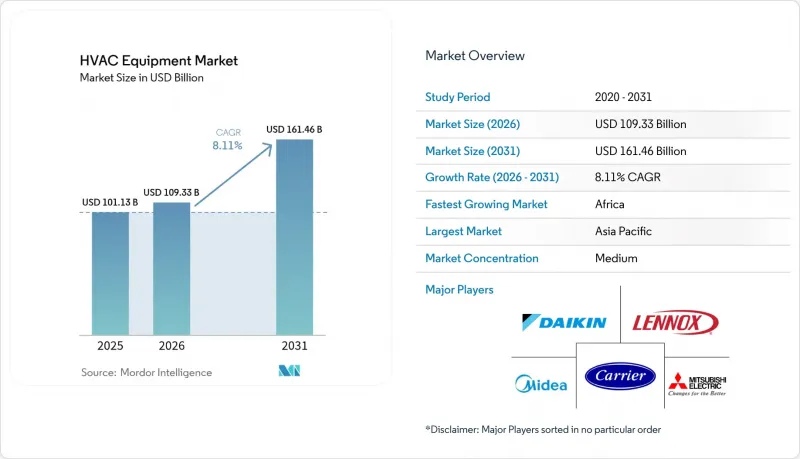
Mordor Intelligence에 의하면, HVAC 장비 시장 규모는 2025년 1,011억 3,000만 달러로 평가되었습니다. 2026년 1,093억 3,000만 달러에서 2031년까지 1,614억 6,000만 달러로 확대되어 2026-2031년에 걸쳐 CAGR 8.11%를 나타낼 것으로 예측됩니다.
본 보고서는 기기 유형별(난방 기기, 환기 기기, 공조 기기), 설치 유형별(신축, 개보수·교체), 최종 사용자별(주거, 상업, 산업), 상업용 건물 유형별(오피스 빌딩, 의료시설, 교육 기관, 데이터센터, 기타), 지역별로 분류되어 있습니다. 시장 전망은 금액(달러) 기준으로 제시되어 있습니다.
세계의 HVAC 장비 시장 동향 및 인사이트
유럽의 엄격한 건축물 에너지 기준에 따른 히트 펌프 보급 가속화
유럽의 2024년 지침에 따르면, 2025년 이후 신규 화석 연료 보일러 사용이 금지되며, 비주거용 건물 중 에너지 성능이 가장 낮은 상위 16%의 건물에 대해서는 2030년까지 최소 에너지 성능 기준을 충족해야 합니다. 이에 따라 소유주는 계절 성능 계수(SPF)가 3.5를 초과하는 공기원 또는 지열 히트펌프를 설치해야만 합니다. 각국의 법령도 이러한 움직임을 뒷받침하고 있습니다. 프랑스의 ‘RE2020’은 주택의 탄소 강도를 4kg CO2e/m²·로 제한하고 있으며, 독일의 개정 ‘Gebaudeenergiegesetz(건축물 에너지법)’은 재생에너지를 통한 열 공급 비율을 65%로 규정하고 있습니다. 탄소세 및 가스 구매량 감축으로 인해 투자 회수 기간이 10년 이하가 되므로, 두 제도 모두 경제적으로도 타당합니다. OEM 각사도 이에 대응하고 있습니다. 다이킨은 2027년까지 벨기에의 생산 능력을 3배인 연간 150만 대로 확대할 계획이며, 정책 주도형 수요가 지속될 것이라는 확신을 강조하고 있습니다. 따라서 히트펌프 도입은 HVAC 장비 시장의 성장 전망에 있어 단독으로 가장 큰 긍정적 요인으로 작용하고 있습니다.
북유럽·FLAP-D 지역 내 데이터센터 건설 급증에 따른 정밀 냉각 수요 증가
각 클라우드 하이퍼스케일러 기업들은 북유럽 국가들에 메가와트 규모의 시설을 계속해서 집중시키고 있습니다. 이 지역의 연평균 기온은 5℃-12℃이며, 에어사이드 이코노마이저를 통해 냉각 시간의 최대 70%를 충당할 수 있어 전력 사용 효율(PUE)을 1.2 이하로 억제할 수 있습니다. 오덴세에 위치한 Meta의 150MW 캠퍼스에서는 해수 냉각을 활용하여 겨울철 기계식 냉동을 불필요하게 하고, 연간 1,200만 달러의 에너지 비용을 절감하고 있습니다. Microsoft의 스톡홀름 확장 프로젝트에서는 주변 온도에서 2°C 이내의 범위에서 작동하는 단열 타워를 채택하고 있습니다. 현재, DTC(Direct-to-Chip) 방식의 액체 냉각 솔루션은 열이 데이터 홀로 유입되기 전에 그 80%를 배출하고 있으며, 이를 통해 랙당 30kW의 밀도를 실현하여 기존 공랭식 장치보다 높은 가격 프리미엄을 확보하고 있습니다. 따라서 정밀 냉각은 높은 수익률을 보이는 하위 부문으로 자리매김하며, HVAC 장비 시장 전체를 견인하고 있습니다.
OEM의 저 GWP 냉매 전환에 따른 높은 초기 비용
EU의 프레온 가스 할당량은 2030년까지 2015년 기준치의 2.4%로 낮아질 예정이며, R410A의 단계적 폐지가 임박해 있습니다. 이로 인해 저가연성 A2L 냉매로의 전환을 위한 설비 갱신으로, 생산 거점 1곳당 5,000만-1억 달러의 설비 투자가 필요합니다. 다이킨은 생산 라인 1개를 전환하는 데 1,800만 달러가 소요될 것으로 추산하고 있습니다. 존슨 컨트롤스는 2027년까지 그룹 전체적으로 2억 5,000만 달러의 비용이 소요될 것으로 예상하고 있으며, 전환 기간 동안 이익률이 120 베이시스 포인트 하락할 것으로 전망하고 있습니다. 열교환 코일의 대형화, 추가 누출 센서, 새로운 안전 인증으로 인해 1대당 300-500달러의 비용 증가가 발생하지만, 가격에 민감한 부문에서는 이 비용을 가격에 전가하기 어렵습니다. 설비 투자의 상각이 완료될 때까지는 수익성에 미치는 부정적인 영향이 HVAC 장비 시장의 확장에 다소 제동을 거는 요인이 될 것입니다.
부문별 분석
난방 기기 시장은 2031년까지 연평균 성장률(CAGR) 8.78%로 확대되어 신규 프로젝트와 개보수 공사 모두에서 히트 펌프가 화로와 보일러를 대체함에 따라 HVAC 장비 시장 전체를 상회하는 성장률을 보였습니다. 2025년까지 난방 부문 매출에서 히트 펌프가 58%를 차지한 반면, 보일러와 난로는 32%를 유지했습니다. 이는 동유럽의 지역 난방 개보수에서 대용량 상업용 보일러가 여전히 경제적이기 때문입니다. 이러한 변화는 EU 규제로 인해 독립형 화석 연료 보일러가 금지된 데 더해, 미국이 연방 정부와 전력 회사의 리베이트를 결합하여 투자 회수 기간을 10년에서 6년으로 단축함에 따라 더욱 확대되었습니다.
공조 기기는 2025년 매출에서 27.89%로 가장 큰 비중을 차지했지만, 북미와 서유럽 가정에서는 도입률이 거의 포화 상태에 이르렀고, 효율성을 중시한 교체에 중점을 두고 있어 성장 속도는 완만했습니다. 그럼에도 불구하고, 공조 부문 내에서는 복합 용도의 고층 빌딩 및 데이터센터의 랙 밀도 증가에 힘입어 VRF와 액체 냉각 솔루션이 두 자릿수 성장을 기록했습니다. 환기 제품은 ASHRAE 241에 따른 MERV 13 필터로의 업그레이드가 의료 및 교육 부문에서 진행됨에 따라 2025년 매출의 22%를 차지했습니다. 난방 부문의 견조한 성장과 냉방 부문의 꾸준한 교체가 맞물려, HVAC 장비 시장의 장기적인 확장을 뒷받침하는 균형 잡힌 수요 구성이 확인되었습니다.
2025년 매출액 중 개보수 및 교체가 62.33%를 차지했습니다. 이는 전 세계 건축물의 노후화와 고정 속도 장치를 인버터 구동 모델로 교체하는 것이 에너지 절약 측면에서 유리하다는 계산이 반영된 결과입니다. 20년 동안 사용한 SEER 값 10의 장치를 SEER 값 16의 2025년형 모델로 교체하면 상당한 에너지 절약 효과를 기대할 수 있습니다. 구형 유닛은 신형 모델에 비해 60% 더 많은 전력을 소비하므로, 상업시설 소유주에게는 연간 400-600달러의 절감 효과로 이어집니다. 이러한 절감 효과는 운영 비용 절감으로 이어질 뿐만 아니라, 구형 장비를 조기에 교체해야 할 타당한 이유가 되기도 합니다.
한편, 신축 시장은 북유럽 및 FLAP-D 회랑 지역의 데이터센터 캠퍼스, 초기 인테리어 공사 단계에서 VRF를 지정하는 인도·베트남·필리핀의 고층 주거용 빌딩, 정밀 냉각이 필요한 중동의 산업 플랜트 덕분에 연평균 성장률(CAGR) 8.58%로 확대되고 있습니다. 개발업자들은 고성능 빌딩의 기계 설비에 프로젝트 예산의 8%-12%를 배정하는 경우가 많아, 이것이 초기 단계에서 상당한 수요를 견인하고 있습니다. 리모델링 기술, 모듈식 AHU, 덕트리스형 미니 에어컨, 옥상 설치형 패키지 유닛의 융합으로 그 경계가 모호해지고 있지만, 당분간 리모델링은 HVAC 장비 시장 규모에서 가치의 기반이 될 것으로 보입니다.
지역별 분석
아시아태평양은 2025년 매출의 38.56%를 차지했으며, 그 원동력은 중국의 실내 에어컨 출하 대수 8,500만 대와 인도의 인버터식 에어컨 보급률이 2023년 30%에서 2025년 60%로 급증하고 있다는 점입니다. 동남아시아의 고층 빌딩에서는 VRF 시스템의 도입이 확대되고 있는 반면, 일본의 일반 가정에서는 노후화된 스플릿형 에어컨을 저GWP 모델로 교체하는 움직임이 진행되고 있습니다. 그 결과, 해당 지역은 세계 평균을 상회하는 성장이 예상되며, 연평균 성장률(CAGR)은 8.3%로 전망됩니다.
북미는 2025년 매출의 26%를 차지하며 연평균 성장률(CAGR) 7.9%를 기록했습니다. 이는 ‘인플레이션 억제법’에 따른 세액 공제와 버지니아주, 텍사스주, 오리건주에서의 데이터센터 건설이 요인으로 작용했습니다. 유럽은 매출의 22%를 차지하며, 연평균 성장률(CAGR)은 8.6%로 성장을 지속하고 있습니다. 이는 보일러 사용 금지 조치에 따라 히트펌프로의 전환이 진행되고 있는 점과, 계절 성능 계수(COP)가 4.5를 초과하는 지열 이용이 스칸디나비아 국가들에서 주도되고 있는 점이 배경에 있습니다. 중동은 사우디아라비아의 NEOM 도시나 아랍에미리트의 데이터 허브와 같은 메가 프로젝트를 배경으로 매출의 8%를 차지했으며, 연평균 성장률(CAGR)은 8.8%를 기록했습니다. 이 지역에서는 여름철 기온이 45℃에 달하기 때문에 시스템의 대형화와 이중화가 요구되고 있습니다.
남미는 브라질 주택 시장의 회복에 힘입어 2025년 판매량의 6%를 차지하고 연평균 성장률(CAGR) 7.5%를 기록했으나, 아르헨티나 시장의 변동으로 인해 성장세가 제한되었습니다. 한편, 아프리카는 2025년 시장 규모가 40억 달러에서 시작되며, 광산 캠프에서의 태양광 하이브리드형 패키지 유닛 도입과 도시 지역의 전기 요금 절감을 위한 인버터 개조가 진행됨에 따라, 업계를 선도하는 9.12%의 연평균 성장률(CAGR)로 확대될 것으로 예측됩니다. 이러한 동향이 맞물려 아시아태평양은 HVAC 장비 시장의 수익 주축이 될 것이며, 아프리카는 성장률 측면에서 선두를 달리는 시장이 될 전망입니다.
기타 혜택
- 엑셀 형식 시장 예측(ME) 시트
- 3개월간의 애널리스트 지원
자주 묻는 질문
목차
제1장 서론
제2장 조사 방법
제3장 주요 요약
제4장 시장 구도
제5장 시장 규모 및 성장 예측
제6장 경쟁 구도
제7장 시장 기회 및 향후 전망
KTH 26.09.04According to Mordor Intelligence, the HVAC equipment market size is projected to expand from USD 101.13 billion in 2025 and USD 109.33 billion in 2026 to USD 161.46 billion by 2031, registering an 8.11% CAGR between 2026 and 2031.
This report is Segmented by Equipment Type (Heating Equipment, Ventilation Equipment, Air-Conditioning Equipment), Installation Type (New Construction, and Retrofit/Replacement), End User (Residential, Commercial, Industrial), Commercial Building Type (Office Buildings, Healthcare Facilities, Educational Institutions, Data Centers, and More), and Geography. The Market Forecasts are Provided in Terms of Value (USD).
Global HVAC Equipment Market Trends and Insights
Stringent Building Energy Codes in Europe Accelerating Heat-Pump Adoption
Europe's 2024 directive outlawed new fossil-fuel boilers from 2025 and requires the worst 16% of non-residential buildings to meet minimum energy-performance thresholds by 2030, forcing owners to install air- or ground-source heat pumps that exceed seasonal performance factors of 3.5. National statutes amplify the push: France's RE2020 caps carbon intensity at 4 kg CO2 e /m2-year for homes, Germany's amended Gebaudeenergiegesetz demands 65% renewable heat, and both frameworks align economically when carbon taxes and avoided gas purchases reduce payback periods below a decade. OEMs have responded. Daikin tripled Belgian capacity to 1.5 million units per year by 2027, underscoring confidence that policy-led demand will persist. Heat-pump adoption, therefore, delivers the single-largest positive uplift to the HVAC equipment market growth outlook.
Surge in Data-Center Construction in Nordics and FLAP-D Region Elevating Precision Cooling Demand
Cloud hyperscalers continue clustering megawatt-scale facilities in the Nordics, where average annual temperatures of 5 °C-12 °C allow air-side economizers to serve up to 70% of cooling hours, cutting power-usage-effectiveness below 1.2. Meta's 150 MW campus in Odense leveraged seawater cooling to eliminate winter mechanical refrigeration and save USD 12 million per year in energy expense. Microsoft's Stockholm expansion relies on adiabatic towers operating within 2 °C of ambient. Direct-to-chip liquid solutions now pull 80% of heat before it enters data halls, permitting 30 kW-per-rack densities that command price premiums over legacy air units. Precision cooling, therefore, becomes a high-margin subsegment, pushing the overall HVAC equipment market upwards.
High Upfront Cost of Low-GWP Refrigerant Transition for OEMs
EU F-gas quotas fall to 2.4% of 2015 baselines by 2030, forcing R410A retirement and driving capital spending of USD 50 million-USD 100 million per manufacturing site to retool for mildly flammable A2L refrigerants. Daikin cites USD 18 million to convert a single line; Johnson Controls expects USD 250 million group-wide through 2027, compressing margins by 120 bp during the transition. Larger heat-exchanger coils, additional leak sensors, and new safety certifications add USD 300-USD 500 per unit, costs difficult to pass through in price-sensitive segments. Until tooling amortizes, the drag on profitability acts as a modest brake on HVAC equipment market expansion.
Other drivers and restraints analyzed in the detailed report include:
- Rapid Uptake of VRF Systems in High-Rise Asian Residential Complexes
- Inflation Reduction Act Tax Credits Catalyzing Early Furnace Replacement Cycles
- Talent Shortage of Certified HVAC Technicians in Mature Markets
For complete list of drivers and restraints, kindly check the Table Of Contents.
Segment Analysis
Heating equipment expanded at an 8.78% CAGR through 2031, outpacing the overall HVAC equipment market as heat pumps displaced furnaces and boilers in both new projects and retrofits. By 2025, heating revenue, heat pumps captured 58%, while boilers and furnaces retained 32%, because large-capacity commercial boilers remain economical for district-heating upgrades in Eastern Europe. The shift widened after EU rules banned standalone fossil-fuel boilers, and the United States, by combining federal and utility rebates, compressed payback periods from 10 to 6 years.
Air-conditioning equipment, although accounting for the largest 27.89% slice of 2025 revenue, grew more slowly because North American and Western European households operate at near-saturation and focus on efficiency-driven replacements. Nonetheless, VRF and liquid-cooling solutions posted double-digit gains inside the air-conditioning category, buoyed by mixed-use high-rises and data-center rack densities. Ventilation products accounted for 22% of 2025 sales, following upgrades in healthcare and education to MERV 13 filtration under ASHRAE 241. The blend of robust heating growth and steady cooling replacements confirms a balanced demand mix that supports the long-run expansion of the HVAC equipment market.
Retrofit and replacement accounted for 62.33% of 2025 revenue, reflecting the aging global building stock and energy-savings math that favor swapping fixed-speed units for inverter-driven models. Replacing a 20-year-old 10 SEER unit with a 2025 model featuring a 16 SEER rating can result in significant energy savings. The older unit consumes 60% more electricity compared to the newer model, leading to annual savings of USD 400 to USD 600 for commercial owners. These savings not only reduce operational costs but also justify the early replacement of outdated equipment.
New construction, however, is advancing at an 8.58% CAGR thanks to data-center campuses in the Nordics and FLAP-D corridor, residential towers in India, Vietnam, and the Philippines that specify VRF at first fit-out, and Middle-Eastern industrial plants requiring precision cooling. Developers frequently allocate 8%-12% of project budgets to mechanical systems in high-performance buildings, driving significant upfront demand. The convergence of retrofit techniques, modular AHUs, ductless minis, and rooftop packaged units blurs boundaries, yet retrofit remains the value anchor of the HVAC equipment market size in the near term.
Complete Report Scope:
- By Equipment Type
- Heating Equipment
- Boilers and Furnaces
- Heat Pumps
- Unitary Heaters
- Ventilation Equipment
- Air Handling Units
- Humidifiers and Dehumidifiers
- Air Filters
- Fan Coil Units
- Air-Conditioning Equipment
- Unitary Air Conditioners
- Ducted Splits
- Ductless Mini-Splits
- Packaged Rooftops
- Variable Refrigerant Flow (VRF) Systems
- Room Air Conditioners
- Packaged Terminal Air Conditioners
- Chillers
- Unitary Air Conditioners
- Heating Equipment
- By Installation Type
- New Construction
- Retrofit / Replacement
- By End User
- Residential
- Commercial
- Industrial
- By Commercial Building Type
- Office Buildings
- Healthcare Facilities
- Hospitality and Leisure
- Retail Stores and Malls
- Educational Institutions
- Data Centers
- By Geography
- North America
- United States
- Canada
- Mexico
- South America
- Brazil
- Argentina
- Rest of South America
- Europe
- United Kingdom
- Germany
- France
- Italy
- Rest of Europe
- Asia Pacific
- China
- Japan
- India
- South Korea
- Rest of Asia Pacific
- Middle East and Africa
- Middle East
- United Arab Emirates
- Saudi Arabia
- Rest of Middle East
- Africa
- South Africa
- Egypt
- Rest of Africa
- Middle East
- North America
Geography Analysis
Asia Pacific held 38.56% of 2025 revenue, anchored by China's 85 million room-air-conditioner shipments and India's surge in inverter-AC penetration from 30% in 2023 to 60% in 2025. Southeast Asian high-rises are increasingly adopting VRF systems, while Japanese households are swapping out their aging split systems for low-GWP models. As a result, the region is set to outpace the global average, with a projected growth rate of 8.3% CAGR.
North America delivered 26% of 2025 turnover and 7.9% CAGR, shaped by the Inflation Reduction Act's tax credits and data-center builds in Virginia, Texas, and Oregon. Europe contributed 22% of revenue, advancing at an 8.6% CAGR, as the boiler ban drives heat-pump retrofits and Scandinavia leads ground-source adoption, with seasonal performance factors above 4.5. The Middle East posted 8% share and an 8.8% CAGR on megaprojects such as Saudi Arabia's NEOM city and United Arab Emirates data hubs, where 45 °C summers require oversizing and redundancy.
South America added 6% of 2025 volume and 7.5% CAGR, buoyed by Brazil's residential rebound yet tempered by Argentine volatility, while Africa, starting from a USD 4 billion 2025 base, is forecast to expand at a leading 9.12% CAGR as mining camps adopt solar-hybrid packaged units and urban centers retrofit inverters to curb electricity costs. Together, these dynamics position Asia Pacific as the revenue anchor and Africa as the percentage-growth frontier of the HVAC equipment market.
- Daikin Industries Ltd.
- Carrier Global Corp.
- Trane Technologies PLC
- Johnson Controls International PLC
- Mitsubishi Electric Corp.
- Lennox International Inc.
- Rheem Manufacturing Co.
- Midea Group
- Gree Electric Appliances Inc.
- NIBE Group
- Panasonic Holdings Corporation
- Samsung Electronics Co., Ltd.
- LG Electronics Inc.
- Bosch Thermotechnology
- Vaillant Group
- Alfa Laval AB
- Stiebel Eltron GmbH and Co. KG
- Systemair AB
- Greenheck Fan Corporation
- FlaktGroup
- TROX GmbH
- Swegon Group AB
- Hitachi-Johnson Controls Air Conditioning
- Danfoss A/S
Additional Benefits:
- The market estimate (ME) sheet in Excel format
- 3 months of analyst support
TABLE OF CONTENTS
1 INTRODUCTION
- 1.1 Study Assumptions and Market Definition
- 1.2 Scope of the Study
2 RESEARCH METHODOLOGY
3 EXECUTIVE SUMMARY
4 MARKET LANDSCAPE
- 4.1 Market Overview
- 4.2 Market Drivers
- 4.2.1 Stringent Building Energy Codes in Europe Accelerating Heat-Pump Adoption
- 4.2.2 Surge in Data-Center Construction in Nordics and FLAP-D Region Elevating Precision Cooling Demand
- 4.2.3 Rapid Uptake of Variable-Refrigerant-Flow (VRF) Systems in High-Rise Asian Residential Complexes
- 4.2.4 Inflation Reduction Act Tax Credits Catalyzing Early Furnace Replacement Cycles
- 4.2.5 District-Heating Expansion in Eastern Europe Spurring Large-Capacity Boiler Retrofits
- 4.2.6 Solar-Hybrid HVAC Packages Gaining Traction in Off-Grid African Mining Camps
- 4.3 Market Restraints
- 4.3.1 High Up-Front Cost of Low-GWP Refrigerant Transition for OEMs
- 4.3.2 Talent Shortage of Certified HVAC Technicians in Mature Markets
- 4.3.3 Semiconductor Supply-Chain Volatility Constraining VRF Inverter Availability
- 4.3.4 Stringent F-Gas Quotas in EU Increasing Compliance Burden for Importers
- 4.4 Industry Value Chain Analysis
- 4.5 Regulatory Outlook
- 4.6 Technological Outlook
- 4.7 Impact of Macroeconomic Factors on the Market
- 4.8 Porter's Five Forces Analysis
- 4.8.1 Bargaining Power of Suppliers
- 4.8.2 Bargaining Power of Buyers
- 4.8.3 Threat of New Entrants
- 4.8.4 Threat of Substitutes
- 4.8.5 Intensity of Competitive Rivalry
- 4.9 Key Performance Indicators
5 MARKET SIZE AND GROWTH FORECASTS (VALUE)
- 5.1 By Equipment Type
- 5.1.1 Heating Equipment
- 5.1.1.1 Boilers and Furnaces
- 5.1.1.2 Heat Pumps
- 5.1.1.3 Unitary Heaters
- 5.1.2 Ventilation Equipment
- 5.1.2.1 Air Handling Units
- 5.1.2.2 Humidifiers and Dehumidifiers
- 5.1.2.3 Air Filters
- 5.1.2.4 Fan Coil Units
- 5.1.3 Air-Conditioning Equipment
- 5.1.3.1 Unitary Air Conditioners
- 5.1.3.1.1 Ducted Splits
- 5.1.3.1.2 Ductless Mini-Splits
- 5.1.3.1.3 Packaged Rooftops
- 5.1.3.1.4 Variable Refrigerant Flow (VRF) Systems
- 5.1.3.2 Room Air Conditioners
- 5.1.3.3 Packaged Terminal Air Conditioners
- 5.1.3.4 Chillers
- 5.1.3.1 Unitary Air Conditioners
- 5.1.1 Heating Equipment
- 5.2 By Installation Type
- 5.2.1 New Construction
- 5.2.2 Retrofit / Replacement
- 5.3 By End User
- 5.3.1 Residential
- 5.3.2 Commercial
- 5.3.3 Industrial
- 5.4 By Commercial Building Type
- 5.4.1 Office Buildings
- 5.4.2 Healthcare Facilities
- 5.4.3 Hospitality and Leisure
- 5.4.4 Retail Stores and Malls
- 5.4.5 Educational Institutions
- 5.4.6 Data Centers
- 5.5 By Geography
- 5.5.1 North America
- 5.5.1.1 United States
- 5.5.1.2 Canada
- 5.5.1.3 Mexico
- 5.5.2 South America
- 5.5.2.1 Brazil
- 5.5.2.2 Argentina
- 5.5.2.3 Rest of South America
- 5.5.3 Europe
- 5.5.3.1 United Kingdom
- 5.5.3.2 Germany
- 5.5.3.3 France
- 5.5.3.4 Italy
- 5.5.3.5 Rest of Europe
- 5.5.4 Asia Pacific
- 5.5.4.1 China
- 5.5.4.2 Japan
- 5.5.4.3 India
- 5.5.4.4 South Korea
- 5.5.4.5 Rest of Asia Pacific
- 5.5.5 Middle East and Africa
- 5.5.5.1 Middle East
- 5.5.5.1.1 United Arab Emirates
- 5.5.5.1.2 Saudi Arabia
- 5.5.5.1.3 Rest of Middle East
- 5.5.5.2 Africa
- 5.5.5.2.1 South Africa
- 5.5.5.2.2 Egypt
- 5.5.5.2.3 Rest of Africa
- 5.5.5.1 Middle East
- 5.5.1 North America
6 COMPETITIVE LANDSCAPE
- 6.1 Market Concentration
- 6.2 Strategic Moves
- 6.3 Market Share Analysis
- 6.4 Company Profiles (includes Global Level Overview, Market Level Overview, Core Segments, Financials as Available, Strategic Information, Market Rank/Share for Key Companies, Products and Services, Recent Developments)
- 6.4.1 Daikin Industries Ltd.
- 6.4.2 Carrier Global Corp.
- 6.4.3 Trane Technologies PLC
- 6.4.4 Johnson Controls International PLC
- 6.4.5 Mitsubishi Electric Corp.
- 6.4.6 Lennox International Inc.
- 6.4.7 Rheem Manufacturing Co.
- 6.4.8 Midea Group
- 6.4.9 Gree Electric Appliances Inc.
- 6.4.10 NIBE Group
- 6.4.11 Panasonic Holdings Corporation
- 6.4.12 Samsung Electronics Co., Ltd.
- 6.4.13 LG Electronics Inc.
- 6.4.14 Bosch Thermotechnology
- 6.4.15 Vaillant Group
- 6.4.16 Alfa Laval AB
- 6.4.17 Stiebel Eltron GmbH and Co. KG
- 6.4.18 Systemair AB
- 6.4.19 Greenheck Fan Corporation
- 6.4.20 FlaktGroup
- 6.4.21 TROX GmbH
- 6.4.22 Swegon Group AB
- 6.4.23 Hitachi-Johnson Controls Air Conditioning
- 6.4.24 Danfoss A/S
7 MARKET OPPORTUNITIES AND FUTURE OUTLOOK
- 7.1 White-Space and Unmet-Need Assessment


