

|
시장보고서
상품코드
2124399
유럽의 HVAC 장비 시장 : 시장 점유율 분석, 업계 동향 및 통계, 성장 예측(2026-2031년)Europe HVAC Equipment - Market Share Analysis, Industry Trends & Statistics, Growth Forecasts (2026 - 2031) |
||||||
 Mordor Intelligence
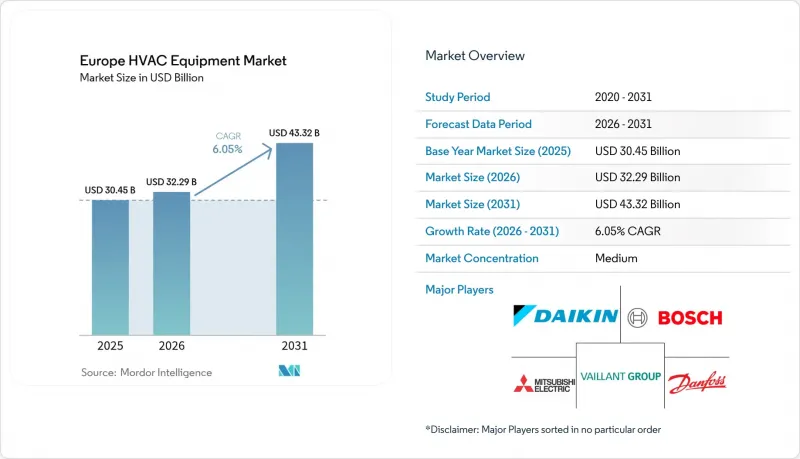
Mordor Intelligence에 의하면, 2026년 유럽의 HVAC 장비 시장 규모는 322억 9,000만 달러로 추정되며, 2025년 304억 5,000만 달러에서 2031년에는 433억 2,000만 달러에 달할 것으로 예측됩니다.
2026-2031년 연평균 성장률(CAGR)은 6.05%를 나타낼 전망입니다.
본 보고서는 기기별(공조·환기 설비, 난방 설비), 최종 사용자 산업별(주거, 상업, 산업 및 제조, 기타), 설치 형태별(신축, 개보수·교체), 유통 채널별(OEM-설치 업체 네트워크, 도매·유통업체, 기타), 국가별(독일, 영국, 프랑스, 이탈리아,스페인, 러시아, 기타)로 분류되어 있습니다.
유럽의 HVAC 장비 시장 동향 및 인사이트
EU 그린딜의 효율성 의무화가 시장 변혁을 주도
2024년 EU 전역에 도입된 최소 효율 기준 의무화와 560억 유로(655억 7,000만 달러)에 달하는 히트펌프 도입 장려 조치로 인해, 기기 수요 양상이 일변하여, 2025년 1분기 독일의 히트펌프 설치 대수는 전년 동기 대비 60% 증가한 4만 3,000대에 달했습니다. 보조금 제도 덕분에 공기-물형 모델의 판매 대수가 2만 2,000대에서 3만 8,000대 가까이 급증했으며, 정책 입안자들이 온수 순환 시스템과의 통합에 지나치게 중점을 두고 있음을 여실히 드러냈습니다. 네덜란드의 ISDE 환급금은 2025년에 삭감되었지만, 해당국은 여전히 2030년까지 주택의 20%에 히트펌프를 설치하는 것을 목표로 하고 있으며, 이에 따라 유럽의 HVAC 장비 시장은 연평균 성장률(CAGR) 9.7%를 유지하고 있습니다. 각 제조업체는 자연 냉매를 채택한 설계를 도입하거나, 구매자가 초기 비용을 부담하지 않아도 되는 자금 조달 방안을 마련함으로써 이에 대응하고 있습니다.
노후된 보일러 교체로 시장 확대 가속화
2024년 가스 가격 상승과 탄소 배출 제재 강화에 따라 유럽 전역에서 약 1억 3,000만 대의 구형 보일러가 교체 시기를 맞이했습니다. OEM 각사는 설치 업체 체제를 확보하기 위해 M&A를 가속화했으며, 그 대표적인 사례로 2024년 8월 다이킨이 스웨덴의 Kylslaget AB를 인수한 것을 들 수 있습니다. 기존의 물 순환 시스템과의 호환성을 고려하여 설계된 개보수용 히트펌프는 설치 시간을 단축하고 시공업체의 생산성을 향상시켜, 신축 건물 수가 비교적 적은 시장에서도 교체 수요를 끌어올렸습니다.
막대한 초기 투자 비용이 시장 침투를 저해
히트 펌프 시스템의 비용은 여전히 보일러 교체 비용의 3-5배에 달하며, 보조금이 있음에도 불구하고 동유럽 및 지방 가구에 있어서는 장벽이 되고 있습니다. OEM 각사가 도입한 복잡한 자금 조달 패키지는 행정적 장벽을 높이고 판매 주기를 늦추고 있습니다. 가처분 소득이 낮은 지역에서는 유럽의 HVAC 장비 시장이 개인 구매보다는 공공 자금을 통한 사회주택 프로그램을 통해 주로 확대되고 있습니다.
부문 분석
지열 히트 펌프는 2031년까지 연평균 성장률(CAGR)이 9.78%로 가장 높은 성장률을 기록했지만, 유럽 HVAC 장비 시장 내에서는 공조 및 환기 설비가 57.95%라는 최대 점유율을 유지했습니다. 기관 투자자들은 계절 효율이 높고 수명이 긴 지열 솔루션을 선호하며, 일반 주택 고객들이 종종 꺼리는 시추 비용도 이러한 측면에서 정당화되고 있습니다. 북유럽의 지질은 폐쇄형 루프 방식의 시추장에 적합하기 때문에 설치 업체들로부터 수 메가와트 규모의 캠퍼스 프로젝트가 증가하고 있다는 보고가 접수되고 있습니다.
한편, 난방 개보수 공사에서는 공기-물식 히트 펌프가 여전히 주류를 이루고 있으며, 기존 라디에이터를 활용할 수 있을 뿐만 아니라 화석 연료의 단계적 폐지를 간소화할 수 있다는 점에서 정책적으로도 우대받고 있습니다. 2025년 3월에 발표된 다이킨의 R-290 모듈형 플랫폼은 F가스 규제를 충족하면서 부분 부하 효율을 향상시키는 자연 냉매로의 전환을 구현한 것이었습니다. 추운 내륙 지역에서는 임시적인 해결책으로 하이브리드 보일러·펌프 키트의 도입이 확대되었습니다. 이러한 혁신 기술들이 결합되어 성능을 희생하지 않으면서도 유럽 HVAC 장비 시장에서 가스 연소 패키지형에서 전동화 모델로의 기술 전환을 뒷받침하고 있습니다.
2025년 매출에서 주거용 사용자의 비중은 46.80%였으나, 공공·기관 시설, 학교, 병원은 10.05%라는 가장 높은 연평균 성장률(CAGR)을 보일 것으로 예측되어, 2031년까지 유럽 HVAC 장비 시장 규모에서 점유율을 확대될 전망입니다. 정부의 탈탄소화 예산을 통해 히트 펌프와 수요 반응형 환기 시스템을 결합한 대규모 개보수 공사에 자금이 지원되었습니다.
기관 대상 프로젝트는 주기가 길고 거래량이 보장되므로, 각 OEM 업체들은 장비, 유지보수, 모니터링을 패키지화한 ‘에너지-어즈-어-서비스(EaaS)’ 계약 제공에 적극적인 태도를 보이고 있습니다. 상업용 사무실에서는 ESG를 중시하는 부동산 소유주들의 안정적인 수요가 지속되고 있는 반면, 산업 시설에서는 공정 열 회수 시스템의 통합이 검토되고 있습니다. 이러한 다양한 사용자 요구에 따라 공급업체들은 제품 라인업 확충 및 소프트웨어 분석 기능 개발을 추진하고 있으며, 이는 유럽 HVAC 장비 시장에서 경쟁적 차별화를 더욱 촉진하고 있습니다.
기타 혜택 :
- 엑셀 형식 시장 예측(ME) 시트
- 3개월간의 애널리스트 지원
자주 묻는 질문
목차
제1장 서론
제2장 조사 방법
제3장 주요 요약
제4장 시장 구도
제5장 시장 규모 및 성장 예측
제6장 경쟁 구도
제7장 시장 기회 및 향후 전망
AJY 26.09.09According to Mordor Intelligence, european HVAC equipment market size in 2026 is estimated at USD 32.29 billion, growing from 2025 value of USD 30.45 billion with 2031 projections showing USD 43.32 billion, growing at 6.05% CAGR over 2026-2031.
This report is Segmented by Equipment (Air-Conditioning/Ventilation Equipment, and Heating Equipment), End-User Industry (Residential, Commercial, Industrial and Manufacturing, and More), Installation Type (New Construction, and Retrofit/Replacement), Distribution Channel (OEM-Installer Networks, Wholesale/Distributor, and More), and Country (Germany, United Kingdom, France, Italy, Spain, Russia, and More).
Europe HVAC Equipment Market Trends and Insights
EU Green Deal efficiency mandates drive market transformation
Mandatory minimum-efficiency standards and EUR 56 billion (USD 65.57 billion) in heat-pump incentives rolled out across the bloc in 2024 reshaped equipment demand, pushing heat-pump installations in Germany up 60% year-over-year to 43,000 units in Q1 2025. Subsidies favored air-to-water models whose sales jumped from 22,000 to nearly 38,000 units, underscoring policymakers' bias toward hydronic integration. Although Dutch ISDE rebates were reduced in 2025, the Netherlands still aims to install heat pumps in 20% of homes by 2030, sustaining a 9.7% CAGR for the European HVAC equipment market. Manufacturers have responded with natural-refrigerant designs and financing schemes that shield buyers from upfront costs.
Aging boiler replacement accelerates market expansion
Roughly 130 million legacy boilers across Europe became ripe for swap-out as gas prices climbed in 2024 and carbon penalties tightened. OEMs accelerated M&A to secure installer capacity, highlighted by Daikin's purchase of Sweden-based Kylslaget AB in August 2024. Retrofit-oriented heat-pumps engineered for compatibility with existing hydronic circuits shortened installation times and boosted contractor productivity, lifting replacement demand even in markets with modest new-build volumes.
High upfront capital expenditure constrains market penetration
Heat-pump systems still cost 3-5 times more than a boiler swap, deterring households in Eastern Europe and rural districts despite subsidies. Complex financing packages introduced by OEMs raise administrative hurdles and slow sales cycles. Where disposable income is lower, the European HVAC equipment market expands largely through publicly funded social-housing programs rather than private purchases.
Other drivers and restraints analyzed in the detailed report include:
- Summer heatwave intensity reshapes residential AC demand
- Commercial HVAC electrification gains momentum
- Supply-chain inflation pressures profitability
For complete list of drivers and restraints, kindly check the Table Of Contents.
Segment Analysis
Ground-source heat pumps recorded the fastest 9.78% CAGR through 2031, even though air-conditioning and ventilation maintained the largest 57.95% share within the European HVAC equipment market. Institutional buyers favored geothermal solutions that deliver higher seasonal efficiencies and longer lifespans, justifying the drilling expenses that residential customers often avoid. As Nordic geology supports closed-loop borefields, installers are reporting an increase in multi-megawatt campus-scale projects.
In parallel, air-to-water heat pumps remained dominant in heating retrofits, leveraging existing radiators and earning policy preference due to their simplification of the fossil-fuel phase-out. Daikin's R-290 modular platform, unveiled in March 2025, exemplified the natural-refrigerant progression that meets F-Gas regulations while enhancing part-load efficiency. Hybrid boiler-pump kits gained traction as interim solutions in colder interiors. Collectively, these innovations sustain the European HVAC equipment market's technology shift from gas-fired packages to electrified variants without sacrificing performance.
Residential users contributed 46.80% of 2025 sales, while public and institutional estates, schools, and hospitals are projected to post the highest 10.05% CAGR, increasing their share of the European HVAC equipment market size by 2031. Government decarbonization budgets funded large-scale retrofits that pair heat pumps with demand-controlled ventilation.
Institutional project cycles are longer but guarantee volume, encouraging OEMs to offer energy-as-a-service contracts that bundle equipment, maintenance, and monitoring. Commercial offices continue to experience steady demand from ESG-driven landlords, while industrial sites explore process heat recovery integrations. These varied user needs prompt suppliers to expand their portfolios and develop software analytics capabilities, further driving competitive differentiation in the European HVAC equipment market.
Complete Report Scope:
- By Equipment
- Air-Conditioning / Ventilation Equipment
- Single-Split and Multi-Split Units
- Variable Refrigerant Flow (VRF) Systems
- Air-Handling Units (AHU)
- Chillers
- Fan-Coil Units
- Packaged / Rooftop Units
- Other AC / Ventilation Equipment
- Heating Equipment
- Air-to-Water Heat Pumps
- Ground-Source Heat Pumps
- Boilers / Furnaces / Radiators
- Hybrid Heat-Pump Systems
- Air-Conditioning / Ventilation Equipment
- By End-User Industry
- Residential
- Commercial (Offices, Retail, Hospitality)
- Industrial and Manufacturing
- Institutional and Public Buildings
- By Installation Type
- New Construction
- Retrofit / Replacement
- By Distribution Channel
- OEM-Installer Networks
- Wholesale / Distributor
- Direct-to-Consumer and E-commerce
- By Country
- Germany
- United Kingdom
- France
- Italy
- Spain
- Russia
- Netherlands
- Rest of Europe
List of Companies Covered in this Report:
- Daikin Industries Ltd.
- Carrier Global Corporation
- Mitsubishi Electric Corporation
- Robert Bosch GmbH (Bosch Thermotechnology)
- Vaillant Group
- Danfoss A/S
- Lennox International Inc.
- Panasonic Corporation
- Ariston Holding N.V.
- BDR Thermea Group B.V.
- Hitachi Ltd. (Johnson Controls-Hitachi)
- Johnson Controls International plc
- Systemair AB
- NIBE Industrier AB
- Glen Dimplex Group
- Fujitsu General Limited
- LG Electronics Inc.
- Samsung Electronics Co. Ltd.
- Trane Technologies plc
- Viessmann Climate Solutions SE
- STIEBEL ELTRON GmbH & Co. KG
- Gree Electric Appliances Inc. of Zhuhai
- Midea Group Co. Ltd.
- Arcelik A.S.
- Riello S.p.A.
- Armacell S.A.
- Thermondo GmbH
- Enertech AB (CTC)
Additional Benefits:
- The market estimate (ME) sheet in Excel format
- 3 months of analyst support
TABLE OF CONTENTS
1 INTRODUCTION
- 1.1 Study Assumptions and Market Definition
- 1.2 Scope of the Study
2 RESEARCH METHODOLOGY
3 EXECUTIVE SUMMARY
4 MARKET LANDSCAPE
- 4.1 Market Overview
- 4.2 Impact of Macroeconomic Factors
- 4.3 Market Drivers
- 4.3.1 EU Green-Deal efficiency mandates and heat-pump subsidies
- 4.3.2 Accelerating replacement of ageing boiler stock
- 4.3.3 Intensifying summer heatwaves boosting residential AC uptake
- 4.3.4 Rapid electrification of commercial HVAC retrofits
- 4.3.5 Propane (R290) heat-pump launches post-F-Gas revision
- 4.3.6 Scale-up of installer-training programs unlocking latent demand
- 4.4 Market Restraints
- 4.4.1 High upfront capex versus gas boilers
- 4.4.2 Supply-chain and commodity-price inflation
- 4.4.3 Skilled-labour bottlenecks delaying installations
- 4.4.4 OEM re-tooling risk amid refrigerant transition uncertainty
- 4.5 Industry Value Chain Analysis
- 4.6 Regulatory Landscape
- 4.7 Technological Outlook
- 4.8 Porter's Five Forces Analysis
- 4.8.1 Bargaining Power of Suppliers
- 4.8.2 Bargaining Power of Buyers
- 4.8.3 Threat of New Entrants
- 4.8.4 Threat of Substitute Products
- 4.8.5 Intensity of Competitive Rivalry
5 MARKET SIZE AND GROWTH FORECASTS (VALUE)
- 5.1 By Equipment
- 5.1.1 Air-Conditioning / Ventilation Equipment
- 5.1.1.1 Single-Split and Multi-Split Units
- 5.1.1.2 Variable Refrigerant Flow (VRF) Systems
- 5.1.1.3 Air-Handling Units (AHU)
- 5.1.1.4 Chillers
- 5.1.1.5 Fan-Coil Units
- 5.1.1.6 Packaged / Rooftop Units
- 5.1.1.7 Other AC / Ventilation Equipment
- 5.1.2 Heating Equipment
- 5.1.2.1 Air-to-Water Heat Pumps
- 5.1.2.2 Ground-Source Heat Pumps
- 5.1.2.3 Boilers / Furnaces / Radiators
- 5.1.2.4 Hybrid Heat-Pump Systems
- 5.1.1 Air-Conditioning / Ventilation Equipment
- 5.2 By End-User Industry
- 5.2.1 Residential
- 5.2.2 Commercial (Offices, Retail, Hospitality)
- 5.2.3 Industrial and Manufacturing
- 5.2.4 Institutional and Public Buildings
- 5.3 By Installation Type
- 5.3.1 New Construction
- 5.3.2 Retrofit / Replacement
- 5.4 By Distribution Channel
- 5.4.1 OEM-Installer Networks
- 5.4.2 Wholesale / Distributor
- 5.4.3 Direct-to-Consumer and E-commerce
- 5.5 By Country
- 5.5.1 Germany
- 5.5.2 United Kingdom
- 5.5.3 France
- 5.5.4 Italy
- 5.5.5 Spain
- 5.5.6 Russia
- 5.5.7 Netherlands
- 5.5.8 Rest of Europe
6 COMPETITIVE LANDSCAPE
- 6.1 Market Concentration
- 6.2 Strategic Moves
- 6.3 Market Share Analysis
- 6.4 Company Profiles (includes Global-level Overview, Market-level Overview, Core Segments, Financials as available, Strategic Information, Market Rank/Share, Products and Services, Recent Developments)
- 6.4.1 Daikin Industries Ltd.
- 6.4.2 Carrier Global Corporation
- 6.4.3 Mitsubishi Electric Corporation
- 6.4.4 Robert Bosch GmbH (Bosch Thermotechnology)
- 6.4.5 Vaillant Group
- 6.4.6 Danfoss A/S
- 6.4.7 Lennox International Inc.
- 6.4.8 Panasonic Corporation
- 6.4.9 Ariston Holding N.V.
- 6.4.10 BDR Thermea Group B.V.
- 6.4.11 Hitachi Ltd. (Johnson Controls-Hitachi)
- 6.4.12 Johnson Controls International plc
- 6.4.13 Systemair AB
- 6.4.14 NIBE Industrier AB
- 6.4.15 Glen Dimplex Group
- 6.4.16 Fujitsu General Limited
- 6.4.17 LG Electronics Inc.
- 6.4.18 Samsung Electronics Co. Ltd.
- 6.4.19 Trane Technologies plc
- 6.4.20 Viessmann Climate Solutions SE
- 6.4.21 STIEBEL ELTRON GmbH & Co. KG
- 6.4.22 Gree Electric Appliances Inc. of Zhuhai
- 6.4.23 Midea Group Co. Ltd.
- 6.4.24 Arcelik A.S.
- 6.4.25 Riello S.p.A.
- 6.4.26 Armacell S.A.
- 6.4.27 Thermondo GmbH
- 6.4.28 Enertech AB (CTC)
7 MARKET OPPORTUNITIES AND FUTURE OUTLOOK
- 7.1 White-space and Unmet-need Assessment


