|
시장보고서
상품코드
2121543
자동차용 전동 유압 파워 스티어링 : 시장 점유율 분석, 산업 동향 및 통계 데이터, 성장 예측(2026-2031년)Automotive Electro-Hydraulic Power Steering - Market Share Analysis, Industry Trends & Statistics, Growth Forecasts (2026 - 2031) |
||||||
 Mordor Intelligence
Mordor Intelligence에 의하면, 자동차용 전동 유압 파워 스티어링 시장 규모는 2025년에 168억 9,000만 달러로 평가되었고, 2026년178억 7,000만 달러에서 2031년까지 237억 2,000만 달러에 이를 것으로 예측되며, 예측 기간(2026년-2031년) CAGR은 5.83%를 기록할 전망입니다.
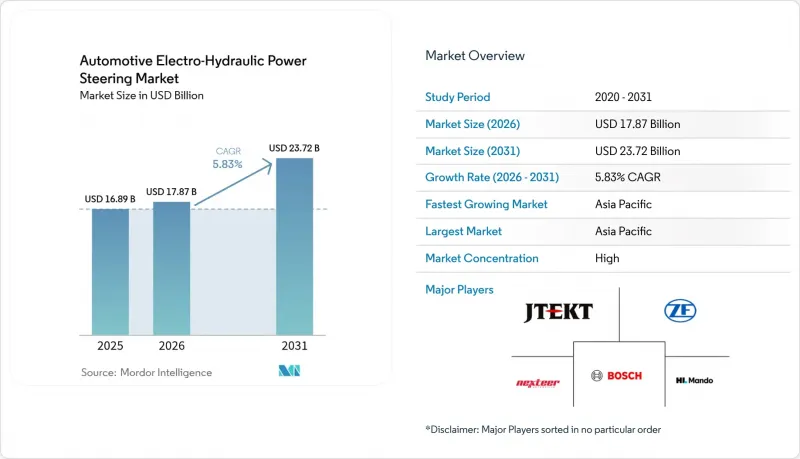
본 보고서는 차종별(승용차, 소형 상용차 등), 부품 유형별(스티어링 모터, 유압 펌프 등), 구동 방식별(내연기관 등), 판매 채널별(OEM, 애프터마켓), 지역별로 분류되어 있습니다. 시장 예측은 금액(달러) 기준으로 제시되어 있습니다.
전 세계 자동차용 전동 유압식 파워 스티어링 시장 동향 및 인사이트
EV 생산 확대 및 12V 보조 부하 증가
배터리 전기자동차(BEV) 및 플러그인 하이브리드 자동차(PHEV)의 판매 대수가 증가함에 따라, 공조, 인포테인먼트, 안전 기능을 위한 보조 부하가 증가하고 있으며, 이로 인해 온디맨드식 EHPS 펌프와 연속 구동식 유압 펌프 간의 효율 격차가 확대되고 있습니다. 2024년 전 세계 전기차 판매 대수는 1,400만 대에 달하며, 그중 배터리 전기자동차(BEV)가 출하 대수의 73%를 차지하여 EHPS 시스템에 상당한 잠재 시장이 형성되고 있습니다. 상용차 부문도 유사한 추세를 보이고 있으며, 2024년 전기버스 출하 대수가 30% 증가함에 따라 에너지 절약형 스티어링 솔루션의 채택이 촉진되고 있습니다. 현재 엔지니어링 분야의 최우선 과제는 정상 주행 시 전류 소비를 최소화하기 위해 차량의 에너지 관리와 연계된 펌프 제어 알고리즘 개발에 주력하고 있습니다.
L3+ ADAS용 스티어링 이중화에 대한 OEM 수요
레벨 3 이상의 자율주행에서는 ISO 26262에 따라, 조향 제어에 ASIL-D 수준의 무결성이 요구되는 ‘페일 오퍼레이셔널(고장 시에도 작동 가능)’ 조향 요건이 부과됩니다. EHPS 아키텍처는 듀얼 전동 모터와 유압 보조 경로를 갖추고 있어, 전원 차단이나 액추에이터 고장 시에도 조향성을 유지하기 위해 필요한 이중화 및 내결함성을 제공합니다. NIO의 ET9에 탑재된 스티어 바이 와이어 솔루션 등 최근 양산 사례는 EHPS 모듈이 전자식 구동 장치와 결합되어 가변 조향 비나 긴급 개입을 실현하고 있음을 여실히 보여줍니다. 따라서 각 공급업체들은 기능 안전 감사 요건을 충족하는 진단, 센서 퓨전 및 폴백 전략을 위한 연구 개발에 주력하고 있습니다.
희토류 영구자석 모터공급망 변동
2024년 수출 라이선싱 제도 변경으로 인해 현물 가격이 상승하고 재고가 부족해짐에 따라, 자동차 제조업체들은 자석을 사용하지 않는 동기 릴랙턴스 모터를 검토하거나 펌프 어셈블리의 조달처를 2개사로 분산하는 움직임을 보이고 있습니다. 스티어링 부품 공급업체들은 리드 타임을 안정화하기 위해 안전 재고를 늘리고, 광산 업체와 직접 인수 계약을 체결하고 있습니다.
부문 분석
2025년에는 소형차, 중형차, 고급차 플랫폼에서의 보급이 확대됨에 따라 승용차가 전동 유압식 파워 스티어링(EHPS) 시장의 63.86%를 차지했습니다. 자동차 제조업체들은 공회전 정지 기능과의 호환성, 마일드 하이브리드의 보급 확대, 그리고 ADAS 장비 증가를 실현하기 위해 EHPS를 도입하고 있습니다. 소형 상용차용 전동 유압식 파워 스티어링 시장 규모는 도시 지역 주행 사이클에서 소포 배송 차량이 에너지 절약을 중시하고 있기 때문에 연평균 성장률(CAGR) 7.18%로 확대될 것으로 예측됩니다.
승용차의 점유율은 효율적인 생산 규모, 모델 체인지 주기, 그리고 전자 펌프의 추가 비용을 상쇄할 수 있는 높은 생산 대수를 반영하고 있습니다. 중국, 유럽 및 미국 일부 주에서 라스트 마일 배송에 관한 규제가 강화되는 가운데, 상용차 프로그램에서는 대수 증가세가 가속화되고 있습니다. 대형 트럭과 버스는 뒤처져 있지만, 배터리 팩의 비용 효율성과 고전압 스티어링 구동 기술이 융합된다면 향후 성장 여지가 있습니다.
2025년 기준, 스티어링 모터는 전동 유압식 파워 스티어링 시장에서 36.23%의 점유율을 차지했습니다. 높은 재료 가치와 성능 면에서의 중요한 역할이 부품 구성의 기반이 되고 있습니다. 센서 및 토크 모듈은 시스템당 위치 및 토크 감지 채널 수를 두 배로 늘리는 ISO 26262의 중복성 요구사항에 힘입어, 2031년까지 연평균 성장률(CAGR) 7.61%를 기록할 전망입니다.
영구자석식 브러쉬리스 모터는 높은 출력 밀도와 신속한 응답성을 발휘하기 때문에 여전히 업계 표준으로 자리 잡고 있습니다. 각 공급업체들은 희토류 의존도를 낮추기 위해 페라이트 계열 또는 릴랙턴스 방식의 설계에 투자를 확대되고 있습니다. 스티어 바이 와이어(Steer-by-Wire)의 소프트웨어 계층이 확대됨에 따라 제어용 ECU는 더 높은 대역폭을 가진 마이크로컨트롤러로 전환되고 있으며, 한편 밀폐형 펌프 하우징에는 가동 주기를 연장하기 위해 일체형 냉각 재킷이 통합되어 있습니다.
지역별 분석
아시아태평양은 여전히 뚜렷한 수요의 중심지입니다. 이 지역은 2025년에 전동 유압식 파워 스티어링 시장의 47.12%를 차지할 것으로 예상되며, 2031년까지 연평균 성장률(CAGR) 8.63%로 확대될 것으로 전망되어 가장 크고 가장 빠르게 성장하는 지역이 되고 있습니다. 중국의 배터리식 전기차 및 플러그인 하이브리드차 생산 규모가 펌프에 대한 대량 수요를 견인하고 있습니다. 인도의 FAME-II 및 PLI 제도는 국내 스티어 바이 와이어 및 펌프 제조 시설에 대한 현지 조달을 촉진하고 있습니다. 일본은 수출용 모델에 대한 ISO 26262 기준을 충족하는 고신뢰성 센서 및 모터 제어 장치를 공급하고 있습니다. 상하이, 광저우, 첸나이, 나고야에 집중된 OEM 공장에 대해 정부의 인센티브를 통해 운송 비용 절감과 공급망 단축이 도모되어, 지역 공급업체들이 혜택을 보고 있습니다.
북미에서는 배기가스 규제 강화에 따라 꾸준한 확대가 이어지고 있습니다. EPA의 ‘다중 오염 물질 기준’ 및 캘리포니아주의 ‘Advanced Clean Cars II’ 프로그램에 따라, 자동차 제조업체들은 차량 군 목표를 달성하기 위해 스티어링을 포함한 보조 장치의 전동화를 피할 수 없게 되었습니다. 2024년 이후 배터리식 전기 배송 밴의 도입 대수는 두 배로 증가했으며, 이에 따라 소포 배송 및 식료품 배송 차량군에도 EHPS가 도입되고 있습니다. 국내 자동차 제조업체들도 페라이트 및 릴랙턴스 모터 연구에 자금을 지원함으로써 희토류 리스크를 헤지하고 있으며, 이는 공급 충격에 대한 지역 내 전동 유압식 파워 스티어링(EHPS) 시장 규모의 회복력을 뒷받침하고 있습니다. 캐나다의 청정 운송 크레딧 제도는 미국의 정책을 반영하고 있으며, 국경을 초월한 생산의 시너지 효과를 강화하고 있습니다.
유럽은 고급차 분야의 혁신을 주도하고 있습니다. 독일, 스웨덴, 프랑스의 각 브랜드는 EHPS 펌프를 안전 중복 액추에이터로 통합한 스티어 바이 와이어 플랫폼을 전개하고 있으며, ZF는 2025년 초 중국 고급차 브랜드를 위한 양산을 시작했습니다. 2030년까지 차량 전체의 CO2 배출량을 55% 감축하겠다는 유럽연합(EU)의 목표에 따라, 공급업체들은 부품 수준에서 효율성을 높여야 한다는 압박을 계속해서 받고 있습니다. 고급차 및 고성능차 부문이 800V 아키텍처로 전환되는 가운데, 스마트한 에너지 회생 알고리즘을 갖춘 EHPS 모듈이 Brake-by-wire 및 액티브 서스펜션 시스템을 보완하고 있습니다. 동유럽과 중동은 신흥 조립 거점으로 부상하고 있지만, 인프라 격차와 가격 민감성으로 인해 단기적인 보급은 제한적이며, 향후 10년 동안 아시아태평양이 주요 성장 동력이 될 전망입니다.
기타 혜택:
- Excel 형식 시장 예측(ME) 시트
- 3개월간의 애널리스트 지원
자주 묻는 질문
목차
제1장 서론
제2장 분석 방법
제3장 주요 요약
제4장 시장 구도
제5장 시장 규모·성장률 예측
제6장 경쟁 구도
제7장 시장 기회와 향후 전망
LSH 26.09.02According to Mordor Intelligence, the automotive electro-hydraulic power steering market size was valued at USD 16.89 billion in 2025 and estimated to grow from USD 17.87 billion in 2026 to reach USD 23.72 billion by 2031, at a CAGR of 5.83% during the forecast period (2026-2031).
This report is Segmented by Vehicle Type (Passenger Cars, Light Commercial Vehicles, and More), Component Type (Steering Motors, Hydraulic Pumps, and More ), Propulsion ( Internal Combustion Engine, and More), Sales Channel (Original Equipment Manufacturer (OEM), Aftermarket), and by Geography. The Market Forecasts are Provided in Terms of Value (USD).
Global Automotive Electro-Hydraulic Power Steering Market Trends and Insights
Growing EV Production and Higher Auxiliary-12 V Loads
Escalating battery electric and plug-in hybrid volumes raise auxiliary loads for climate, infotainment, and safety functions, which amplifies the efficiency gap between on-demand EHPS pumps and continuously driven hydraulic pumps. Global EV sales reached 14 million units in 2024, with battery electric vehicles taking 73% of deliveries, creating a sizeable addressable base for EHPS systems. Commercial segments follow a similar path as electric buses logged 30% shipment growth in 2024, encouraging the adoption of energy-saving steering solutions. The engineering priority now focuses on pump control algorithms coordinating with vehicle energy management to minimize current draw during steady-state cruising.
OEM Demand for Steering Redundancy for L3+ ADAS
Level 3 and above automated driving creates fail-operational steering requirements under ISO 26262, stipulating ASIL-D integrity for steering control. EHPS architecture, with its dual electric motor and hydraulic assist paths, delivers the redundancy and fault tolerance needed to maintain steerability during power interruptions or actuator faults. Recent production launches such as the steer-by-wire solution in NIO's ET9 highlight how EHPS modules pair with electronic actuation to achieve variable steering ratios and emergency intervention. Suppliers, therefore, align R&D toward diagnostics, sensor fusion, and fallback strategies that satisfy functional safety audits
Supply Chain Volatility of Rare-Earth Permanent Magnet Motors
Neodymium, dysprosium, and terbium supply remains concentrated in small mines, with China accounting for more than 60% of refined output. Export licensing changes in 2024 raised spot prices and strained inventory, prompting automakers to review magnet-free synchronous reluctance motors and to dual-source pump assemblies. Steering suppliers are lengthening safety stocks and entering direct offtake agreements with miners to stabilize lead times.
Other drivers and restraints analyzed in the detailed report include:
- Rapid Electrification of Light Commercial Vehicles
- Integration of Steer-By-Wire Modules With EHPS Pumps
- Up-Front Cost Premium vs Conventional HPS
For complete list of drivers and restraints, kindly check the Table Of Contents.
Segment Analysis
Passenger cars commanded 63.86% of the electric hydraulic power steering market in 2025 on the strength of widespread adoption across compact, mid-size, and luxury platforms. Carmakers integrate EHPS to unlock stop-start compatibility, mild hybrid gains, and growing ADAS content. Electric hydraulic power steering market size for light commercial vehicles is projected to expand at a 7.18% CAGR because parcel fleets favor energy savings during urban duty cycles.
The passenger car share reflects efficient scale, model refresh cadence, and high configuration volumes that absorb the added cost of electronic pumps. Commercial vehicle programs show faster unit growth as final mile delivery regulations tighten in China, Europe, and several United States states. Heavy trucks and buses trail but represent future upside once battery pack economics and high voltage steering actuation converge.
Steering motors held 36.23% electric hydraulic power steering market share in 2025. Their high material value and critical performance role anchor the component mix. Sensors and torque modules will record a 7.61% CAGR through 2031, driven by ISO 26262 redundancy targets that double the number of position and torque sensing channels per system.
Permanent magnet brushless motors remain the industry standard because they deliver high power density and rapid response. Suppliers are investing in ferrite-based or reluctance designs to sidestep rare-earth exposure. Control ECUs migrate toward higher bandwidth microcontrollers as steer-by-wire software layers expand, while sealed pump housings incorporate integrated cooling jackets to extend duty cycles.
Complete Report Scope:
- By Vehicle Type
- Passenger Cars
- Light Commercial Vehicles
- Heavy Commercial Vehicles
- Buses and Coaches
- Off-highway and Specialty Vehicles
- By Component Type
- Steering Motors
- Hydraulic Pumps
- Sensors and Torque Modules
- ECU / Controllers
- Reservoirs, Hoses and Others
- By Propulsion Type
- Internal-Combustion Engine (ICE)
- Hybrid Electric Vehicle (HEV)
- Battery Electric Vehicle (BEV)
- Plug-in Hybrid Electric Vehicles
- Fuel-Cell Electric Vehicle (FCEV)
- By Sales Channel
- Original Equipment Manufacturer (OEM)
- Aftermarket
- By Geography
- North America
- United States
- Canada
- Rest of North America
- South America
- Brazil
- Argentina
- Rest of South America
- Europe
- Germany
- United Kingdom
- France
- Italy
- Spain
- Russia
- Rest of Europe
- Asia-Pacific
- China
- Japan
- India
- South Korea
- Indonesia
- Vietnam
- Philippines
- Australia
- New Zealand
- Rest of Asia-Pacific
- Middle East and Africa
- United Arab Emirates
- Saudi Arabia
- Turkey
- South Africa
- Rest of Middle East and Africa
- North America
Geography Analysis
Asia-Pacific remains the clear demand center. The region accounted for 47.12% electric hydraulic power steering market share in 2025 and is projected to expand at an 8.63% CAGR through 2031, making it the largest and fastest-growing territory. China's battery-electric and plug-in hybrid production scale drives high pump volumes. India's FAME-II and PLI schemes channel local sourcing toward domestic steer-by-wire and pump facilities. Japan contributes high-reliability sensors and motor controls that meet ISO 26262 targets for export models. Regional suppliers benefit from government incentives that lower landed costs and shorten supply chains for OEM plants clustered in Shanghai, Guangzhou, Chennai, and Nagoya.
North America follows with steady expansion as emissions rules tighten. The EPA's Multi-Pollutant Standards and California's Advanced Clean Cars II program compel automakers to electrify auxiliaries, including steering, to meet fleet targets. Battery-electric delivery van adoption has doubled since 2024, pulling EHPS content into parcel and grocery fleets. Domestic automakers also hedge rare-earth risk by funding ferrite and reluctance motor research, which supports regional electric hydraulic power steering market size resilience against supply shocks. Canada's clean-transport credits mirror United States policy and reinforce cross-border production synergies.
Europe anchors premium vehicle innovation. German, Swedish, and French brands are rolling out steer-by-wire platforms that integrate EHPS pumps as safety-redundant actuators, and ZF began series production for a Chinese luxury marque in early 2025. The European Union target of a 55% fleet-wide CO2 cut by 2030 keeps pressure on suppliers to deliver efficiency gains at component level. As luxury and performance segments migrate to 800 V architectures, EHPS modules with smart energy-recovery algorithms complement brake-by-wire and active suspension systems. Eastern Europe and the Middle East provide emerging assembly bases, but infrastructure gaps and price sensitivity temper near-term penetration, positioning Asia-Pacific as the principal growth engine through the decade.
- JTEKT Corporation
- Robert Bosch GmbH
- ZF Friedrichshafen AG
- Nexteer Automotive Corporation
- Mando Corporation
- NSK Ltd.
- Continental AG
- Thyssenkrupp Presta AG
- Hitachi Astemo
- Showa Corporation
- Knorr-Bremse Commercial Vehicle Systems GmbH
- Shanghai OE Industrial Co., Ltd. (Brogen EV Solutions)
Additional Benefits:
- The market estimate (ME) sheet in Excel format
- 3 months of analyst support
TABLE OF CONTENTS
1 Introduction
- 1.1 Study Assumptions & Market Definition
- 1.2 Scope of the Study
2 Research Methodology
3 Executive Summary
4 Market Landscape
- 4.1 Market Overview
- 4.2 Market Drivers
- 4.2.1 OEM Demand For Steering Redundancy For L3+ ADAS
- 4.2.2 Growing EV Production and Higher Auxiliary-12 V Loads
- 4.2.3 Rapid Electrification Of Light Commercial Vehicles (Elcv)
- 4.2.4 Tightening CO2 / CAFE Regulations Pushing Steering Efficiency
- 4.2.5 Integration Of Steer-By-Wire Modules With EHPS Pumps
- 4.2.6 Local Sourcing Incentives In China and India (PLI, MIIT, FAME-II)
- 4.3 Market Restraints
- 4.3.1 Supply-Chain Volatility Of Rare-Earth PM Motors
- 4.3.2 Up-Front Cost Premium Vs. Conventional HPS
- 4.3.3 Reliability Concerns In High-Temperature Duty Cycles
- 4.3.4 Competition From Full-Electric Power Steering (EPS) In B-/C-Segment Cars
- 4.4 Value / Supply-Chain Analysis
- 4.5 Regulatory Landscape
- 4.6 Technological Outlook
- 4.7 Porter's Five Forces Analysis
- 4.7.1 Bargaining Power of Suppliers
- 4.7.2 Bargaining Power of Buyers
- 4.7.3 Threat of New Entrants
- 4.7.4 Threat of Substitutes
- 4.7.5 Intensity of Competitive Rivalry
5 Market Size and Growth Forecasts (Value, USD)
- 5.1 By Vehicle Type
- 5.1.1 Passenger Cars
- 5.1.2 Light Commercial Vehicles
- 5.1.3 Heavy Commercial Vehicles
- 5.1.4 Buses and Coaches
- 5.1.5 Off-highway and Specialty Vehicles
- 5.2 By Component Type
- 5.2.1 Steering Motors
- 5.2.2 Hydraulic Pumps
- 5.2.3 Sensors and Torque Modules
- 5.2.4 ECU / Controllers
- 5.2.5 Reservoirs, Hoses and Others
- 5.3 By Propulsion Type
- 5.3.1 Internal-Combustion Engine (ICE)
- 5.3.2 Hybrid Electric Vehicle (HEV)
- 5.3.3 Battery Electric Vehicle (BEV)
- 5.3.4 Plug-in Hybrid Electric Vehicles
- 5.3.5 Fuel-Cell Electric Vehicle (FCEV)
- 5.4 By Sales Channel
- 5.4.1 Original Equipment Manufacturer (OEM)
- 5.4.2 Aftermarket
- 5.5 By Geography
- 5.5.1 North America
- 5.5.1.1 United States
- 5.5.1.2 Canada
- 5.5.1.3 Rest of North America
- 5.5.2 South America
- 5.5.2.1 Brazil
- 5.5.2.2 Argentina
- 5.5.2.3 Rest of South America
- 5.5.3 Europe
- 5.5.3.1 Germany
- 5.5.3.2 United Kingdom
- 5.5.3.3 France
- 5.5.3.4 Italy
- 5.5.3.5 Spain
- 5.5.3.6 Russia
- 5.5.3.7 Rest of Europe
- 5.5.4 Asia-Pacific
- 5.5.4.1 China
- 5.5.4.2 Japan
- 5.5.4.3 India
- 5.5.4.4 South Korea
- 5.5.4.5 Indonesia
- 5.5.4.6 Vietnam
- 5.5.4.7 Philippines
- 5.5.4.8 Australia
- 5.5.4.9 New Zealand
- 5.5.4.10 Rest of Asia-Pacific
- 5.5.5 Middle East and Africa
- 5.5.5.1 United Arab Emirates
- 5.5.5.2 Saudi Arabia
- 5.5.5.3 Turkey
- 5.5.5.4 South Africa
- 5.5.5.5 Rest of Middle East and Africa
- 5.5.1 North America
6 Competitive Landscape
- 6.1 Market Concentration
- 6.2 Strategic Moves
- 6.3 Market Share Analysis
- 6.4 Company Profiles (includes Global level Overview, Market level overview, Core Segments, Financials as available, Strategic Information, Market Rank/Share for key companies, Products & Services, and Recent Developments)
- 6.4.1 JTEKT Corporation
- 6.4.2 Robert Bosch GmbH
- 6.4.3 ZF Friedrichshafen AG
- 6.4.4 Nexteer Automotive Corporation
- 6.4.5 Mando Corporation
- 6.4.6 NSK Ltd.
- 6.4.7 Continental AG
- 6.4.8 Thyssenkrupp Presta AG
- 6.4.9 Hitachi Astemo
- 6.4.10 Showa Corporation
- 6.4.11 Knorr-Bremse Commercial Vehicle Systems GmbH
- 6.4.12 Shanghai OE Industrial Co., Ltd. (Brogen EV Solutions)