

|
시장보고서
상품코드
2121628
필리핀의 태양에너지 : 시장 점유율 분석, 업계 동향과 통계, 성장 예측(2026-2031년)Philippines Solar Energy - Market Share Analysis, Industry Trends & Statistics, Growth Forecasts (2026 - 2031) |
||||||
 Mordor Intelligence
Mordor Intelligence에 따르면 필리핀의 태양에너지 시장 규모는 2025년 4.25기가와트에서 2026년에는 5.43기가와트로 확대되고, 2026년부터 2031년까지 CAGR 27.78%를 기록하며 2031년까지 18.49기가와트에 달할 것으로 예측됩니다.
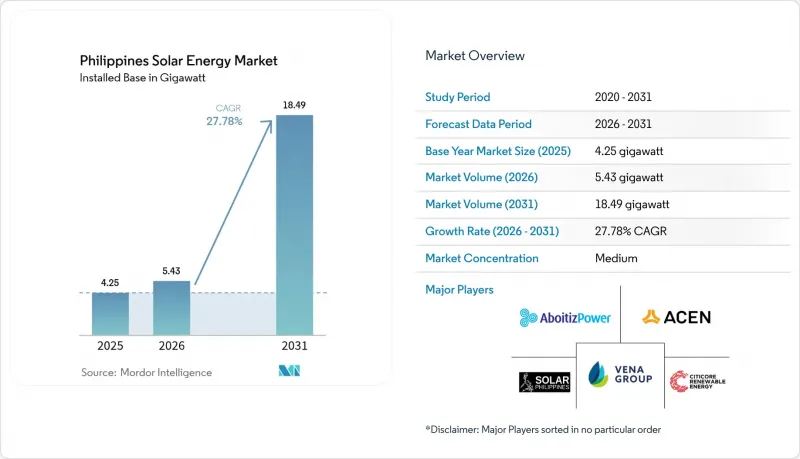
본 보고서는 기술별(태양광 및 집광형 태양광), 계통연계 형태별(계통연계형 및 독립형), 최종사용자별(대규모 발전, 상업·산업용, 주거용)로 분류되어 있습니다. 시장 규모 및 전망은 설치 용량(GW) 단위로 표시되어 있습니다.
필리핀 태양에너지 시장의 동향 및 인사이트
태양광 모듈 및 BOS 비용의 급격한 하락
세계 유틸리티 규모 태양광발전의 균등화 발전 비용은 2023년에 0.044달러/kWh까지 하락하여 2010년 대비 90% 감소했습니다. 이에 따라 필리핀의 각 프로젝트에 대한 자본 지출이 대폭 감소하고 있습니다. 현재 현지 기업들은 Tier 1 모듈에 대해 0.19달러/W 미만의 견적을 받고 있으며, 이는 프로젝트의 이익률을 확대하는 동시에 Sol-Go사가 필리핀에 조립 라인을 설치하는 계기가 되고 있습니다. 기존에 아시아 태양에너지 예산의 75%를 차지하던 시스템 관련 비용(BOS)은 새로운 국내 부가가치 창출원이 되고 있으며, 금속 프레임, 인버터, 케이블 제조사들이 수출을 위해 사업 재편을 추진하고 있습니다. 이러한 비용 추이에 따라 필리핀 태양에너지 시장은 수입 LNG 및 기존의 석탄 발전에 대한 경쟁력을 높여가고 있으며, 전력 회사의 조달 및 기업 간 전력 구매 계약(PPA) 체결이 가속화되고 있습니다. 중기적으로는 2030년까지 연간 3-5GW의 모듈을 공급할 가능성이 있는 신흥 현지 제조 기반을 뒷받침하게 되어, 공급망을 더욱 견고하게 만들 것입니다.
2025년 이후 그린 에너지 입찰(GEAP)이 1GW 이상의 태양광 프로젝트를 유발할 전망
에너지부의 경쟁 입찰 모델은 고정가격매입제도를 대체하여 가격 발견 메커니즘을 도입하고 있으며, 1차 라운드에서 1GW 규모의 태양광 프로젝트를 선정한 데 이어, 태양광과 에너지 저장을 결합한 하이브리드 시스템을 포함한 제4차 경매에서는 9,378MW의 목표를 설정하고 있습니다. 개발업자들의 의욕은 여전히 높으며, GEA-3에서는 상한선 4,650MW에 비해 7,500MW의 입찰이 몰려, 매입 가격 인하와 20년간의 안정적인 전력 구매가 확보되었습니다. 입찰 연계형 전력구매계약(PPA)은 자금 조달 위험을 낮추고, 대출 기관은 스프레드를 축소할 수 있으며, 개발사는 에너지 저장 설비를 추가함으로써 설비 가동률을 높일 수 있게 됩니다. GEA-4 이후 배터리 시스템 도입 의무화는 주간 출력 억제 문제를 해결할 수 있는, 송전망에 부담이 적은 재생에너지를 지향하는 정책의 성숙도를 보여줍니다. 전반적으로 경매는 필리핀의 태양에너지 시장을 예측 가능한 건설 주기와 투명한 비용 기준으로 이끌고 있습니다.
비사야·민다나오 회랑의 송전 용량 부족
2023년까지 16건의 우선 송전 프로젝트 중 완공된 것은 고작 6건에 그쳤으며, 520억 필리핀 페소 규모의 민다나오-비사야 간 간선 송전망 완공이 3년 지연되었습니다. 이러한 병목 현상으로 인해 루손 섬 이남 지역의 태양광발전 설비 확충이 제한되고 있으며, 개발업자들은 계통연계가 가능한 지역에 집중할 수밖에 없어 풍부한 일사량을 충분히 활용하지 못하고 있는 실정입니다. ‘2022-2040년 송전 개발 계획’에는 확장 계획이 제시되어 있지만, 그 실행은 송전망 수요를 따라가지 못하고 있습니다. 고전압 송전선이 수요를 따라잡을 때까지는 프로젝트 파이프라인이 루손 섬에 편중된 상태가 지속될 것입니다.
부문 분석
2025년 설치 기반은 태양에너지가 전량을 차지하고 있으며, 필리핀 태양에너지 시장의 점유율은 100.00%를 기록할 것으로 예상됩니다. 고효율 n형 i-TOPCon 및 양면 모듈은 발전량을 늘리고 필요한 부지 면적을 줄여, 필리핀 태양에너지 시장 규모가 연평균 성장률(CAGR) 27.78%로 확대되는 요인이 되고 있습니다. CSP는 토지 부족과 태풍의 영향으로 인해 여전히 상업적으로 성립되지 않고 있으며, 에너지부(DOE)의 마스터 플랜에는 이 기술에 대한 목표가 설정되어 있지 않습니다.
시장에서 스트링 인버터나 태양광 에너지와 에너지 저장을 결합한 하이브리드 방식으로의 전환으로 가동률이 향상되어, 기업의 PPA(전력 구매 계약)에 명시된 연중무휴 24시간 조달 조항을 충족할 수 있게 됩니다. 테라 솔라(Terra Solar)사의 3.5 GW 태양광발전 및 4.5 GWh 에너지 저장 시설은 이러한 하이브리드화 추세를 뒷받침하며, 하이퍼스케일러 기업들과의 장기 공급 계약을 공고히 하고 있습니다.
기타 혜택:
- 엑셀 형식의 시장 예측(ME) 시트
- 3개월간의 애널리스트 지원
자주 묻는 질문
목차
제1장 소개
제2장 조사 방법
제3장 주요 요약
제4장 시장 구도
제5장 시장 규모와 성장 예측
제6장 경쟁 구도
제7장 시장 기회와 향후 전망
KSM 26.09.07According to Mordor Intelligence, the Philippines solar energy market size is expected to grow from 4.25 gigawatt in 2025 to 5.43 gigawatt in 2026 and is forecast to reach 18.49 gigawatt by 2031 at 27.78% CAGR over 2026-2031.
This report is Segmented by Technology (Solar Photovoltaic and Concentrated Solar Power), Grid Type (On-Grid and Off-Grid), and End-User (Utility-Scale, Commercial and Industrial, and Residential). The Market Sizes and Forecasts are Provided in Terms of Installed Capacity (GW).
Philippines Solar Energy Market Trends and Insights
Rapid Decline in PV Module & BOS Costs
Global utility-scale solar leveledized costs fell to USD 0.044 /kWh in 2023, a 90% drop since 2010, slashing capital outlays for every Philippine project.Local firms now receive price quotes under USD 0.19 /W for Tier-1 modules, widening project margins and spurring Sol-Go to locate assembly lines in the country. Balance-of-system spending, historically 75% of Asian solar budgets, is becoming a new domestic value-add avenue, with metal frame, inverter, and cable manufacturers repositioning for export. This cost trajectory raises the competitive standing of the Philippines' solar energy market against imported LNG and legacy coal, accelerating utility procurement and corporate PPAs. Over the medium term, it also underpins a nascent local manufacturing base that could supply 3-5 GW of modules annually by 2030, further anchoring the supply chain.
Green Energy Auctions (GEAP) Unlocking >=1 GW Solar Pipeline from 2025
The Department of Energy's competitive tender model replaces static feed-in tariffs with price discovery, awarding 1 GW of solar in its inaugural round and setting a 9,378 MW target for the fourth auction that includes solar-storage hybrids. Developer appetite remains robust, GEA-3 drew 7,500 MW of solar bids for a 4,650 MW cap, compressing tariffs and ensuring 20-year off-take certainty. Auction-linked PPAs lower financing risk, enabling lenders to trim spreads and developers to stretch capacity factors with storage add-ons. The integration of mandatory battery systems from GEA-4 onwards signals policy maturation toward grid-friendly renewables that can address midday curtailment. Collectively, auctions move the Philippines' solar energy market toward predictable build-out cycles and transparent cost benchmarks.
Weak Grid Capacity in Visayas-Mindanao Corridor
Only 6 of 16 priority transmission projects were completed by 2023, delaying the PHP 52 billion Mindanao-Visayas backbone by three years.Bottlenecks restrict solar additions south of Luzon, compelling developers to cluster where interconnection is available and leaving ample irradiance unexploited. The Transmission Development Plan 2022-2040 maps expansions, but execution lags grid demand. Until high-voltage lines catch up, project pipelines will stay skewed toward Luzon.
Other drivers and restraints analyzed in the detailed report include:
- Corporate PPAs by Hyperscalers & BPOs Demanding 24/7 Clean Power
- DOE Net-Metering Reform Lifting 100 kW Cap to 1 MW (2024)
- High Financing Costs vs Vietnam & Malaysia (>=9% WACC)
For complete list of drivers and restraints, kindly check the Table Of Contents.
Segment Analysis
Solar photovoltaic accounted for the entire 2025 installation base, reinforcing a Philippines solar energy market share of 100.00%. High-efficiency n-type i-TOPCon and bifacial modules lift output and cut land needs, helping the Philippines' solar energy market size for PV rise at a 27.78% CAGR. CSP remains commercially non-viable due to land scarcity and typhoons, and the DOE master plan allocates no targets for the technology.
The market's equipment shift toward string inverters and hybrid PV-plus-storage architectures improves uptime and meets 24/7 procurement clauses in corporate PPAs. Terra Solar's 3.5 GW PV and 4.5 GWh storage confirm this hybrid trend, locking in long-duration supply contracts with hyperscalers.
Complete Report Scope:
- By Technology
- Solar Photovoltaic (PV)
- Concentrated Solar Power (CSP)
- By Grid Type
- On-Grid
- Off-Grid
- By End-User
- Utility-Scale
- Commercial and Industrial (C&I)
- Residential
- By Component (Qualitative Analysis)
- Solar Modules/Panels
- Inverters (String, Central, Micro)
- Mounting and Tracking Systems
- Balance-of-System and Electricals
- Energy Storage and Hybrid Integration
List of Companies Covered in this Report:
- Solar Philippines Power Project Holdings
- ACEN Corp.
- Vena Energy
- Citicore Power Inc.
- Aboitiz Power Corp.
- Solenergy Systems Inc.
- SunAsia Energy
- Helios Solar Energy Corp.
- Cleantech Global Renewables
- Trina Solar Ltd.
- Canadian Solar
- JinkoSolar
- First Gen Corp.
- Meralco PowerGen (MGen)
- Shell Pilipinas - Solar
- TotalEnergies - Solar
- NextGen Power
- Enfinity Global
- Rizal Wind-Solar Energy Corp.
- Greenergy Holdings
Additional Benefits:
- The market estimate (ME) sheet in Excel format
- 3 months of analyst support
TABLE OF CONTENTS
1 Introduction
- 1.1 Study Assumptions & Market Definition
- 1.2 Scope of the Study
2 Research Methodology
3 Executive Summary
4 Market Landscape
- 4.1 Market Overview
- 4.2 Market Drivers
- 4.2.1 Rapid decline in PV module & BOS costs
- 4.2.2 Green energy auctions (GEAP) unlocking >=1 GW solar pipeline from 2025
- 4.2.3 Corporate PPAs by hyperscalers & BPOs demanding 24/7 clean power
- 4.2.4 DOE net-metering reform lifting 100 kW cap to 1 MW (2024)
- 4.2.5 Floating-solar deployment on irrigation reservoirs (National Irrigation Admin MoU)
- 4.2.6 ASEAN-wide carbon border adjustment pressure on export manufacturers
- 4.3 Market Restraints
- 4.3.1 Weak grid capacity in Visayas-Mindanao corridor
- 4.3.2 High financing costs vs. Vietnam & Malaysia (>=9 % WACC)
- 4.3.3 Land-acquisition disputes under CARP agrarian rules
- 4.3.4 Typhoon-related O&M disruptions raising LCOE by ~4 %
- 4.4 Supply-Chain Analysis
- 4.5 Regulatory Landscape
- 4.6 Technological Outlook
- 4.7 Porter's Five Forces
- 4.7.1 Threat of New Entrants
- 4.7.2 Bargaining Power of Buyers
- 4.7.3 Bargaining Power of Suppliers
- 4.7.4 Threat of Substitutes
- 4.7.5 Competitive Rivalry
- 4.8 PESTLE Analysis
5 Market Size & Growth Forecasts
- 5.1 By Technology
- 5.1.1 Solar Photovoltaic (PV)
- 5.1.2 Concentrated Solar Power (CSP)
- 5.2 By Grid Type
- 5.2.1 On-Grid
- 5.2.2 Off-Grid
- 5.3 By End-User
- 5.3.1 Utility-Scale
- 5.3.2 Commercial and Industrial (C&I)
- 5.3.3 Residential
- 5.4 By Component (Qualitative Analysis)
- 5.4.1 Solar Modules/Panels
- 5.4.2 Inverters (String, Central, Micro)
- 5.4.3 Mounting and Tracking Systems
- 5.4.4 Balance-of-System and Electricals
- 5.4.5 Energy Storage and Hybrid Integration
6 Competitive Landscape
- 6.1 Market Concentration
- 6.2 Strategic Moves (M&A, Partnerships, PPAs)
- 6.3 Market Share Analysis (Market Rank/Share for key companies)
- 6.4 Company Profiles (includes Global level Overview, Market level overview, Core Segments, Financials as available, Strategic Information, Products & Services, and Recent Developments)
- 6.4.1 Solar Philippines Power Project Holdings
- 6.4.2 ACEN Corp.
- 6.4.3 Vena Energy
- 6.4.4 Citicore Power Inc.
- 6.4.5 Aboitiz Power Corp.
- 6.4.6 Solenergy Systems Inc.
- 6.4.7 SunAsia Energy
- 6.4.8 Helios Solar Energy Corp.
- 6.4.9 Cleantech Global Renewables
- 6.4.10 Trina Solar Ltd.
- 6.4.11 Canadian Solar
- 6.4.12 JinkoSolar
- 6.4.13 First Gen Corp.
- 6.4.14 Meralco PowerGen (MGen)
- 6.4.15 Shell Pilipinas - Solar
- 6.4.16 TotalEnergies - Solar
- 6.4.17 NextGen Power
- 6.4.18 Enfinity Global
- 6.4.19 Rizal Wind-Solar Energy Corp.
- 6.4.20 Greenergy Holdings
7 Market Opportunities & Future Outlook
- 7.1 White-space & Unmet-Need Assessment


