

|
시장보고서
상품코드
2121978
중국의 당뇨병 기기 : 시장 점유율 분석, 업계 동향과 통계, 성장 예측(2026-2031년)China Diabetes Devices - Market Share Analysis, Industry Trends & Statistics, Growth Forecasts (2026 - 2031) |
||||||
 Mordor Intelligence
Mordor Intelligence에 따르면 중국의 당뇨병 기기 시장 규모는 2025년에 39억 1,000만 달러로 평가되며, 2026년 41억 8,000만 달러에서 2031년까지 60억 5,000만 달러에 달할 것으로 예측되고 있으며, 예측 기간(2026-2031년)에 CAGR은 7.67%에 달할 전망입니다.
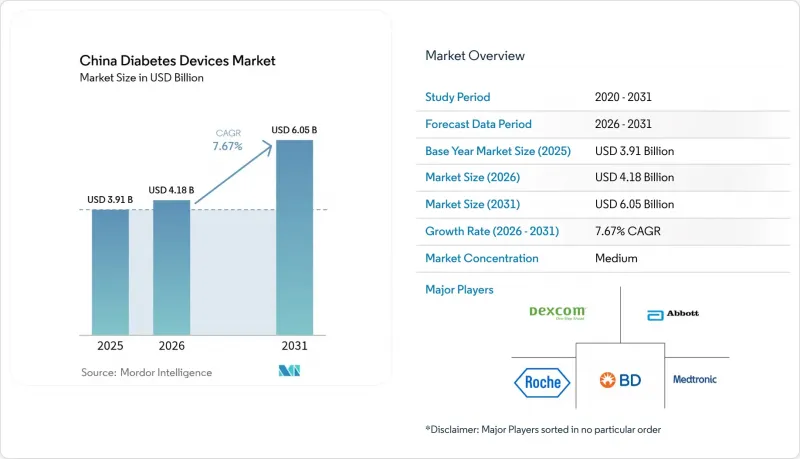
이 보고서는 기기 카테고리(혈당 측정 기기, 인슐린 투여 기기, 기타 당뇨병 관리 기기), 당뇨병 유형(제1형 당뇨병, 제2형 당뇨병, 임신성 당뇨병, 기타) 및 최종사용자(병원, 전문 클리닉, 재택 간호 환경, 기타 최종사용자)별로 분류되어 있습니다. 이 보고서에서는 상기 각 부문에 대해 시장 규모(달러) 및 수량(단위)을 제시하고 있습니다.
중국 당뇨병 기기 시장의 동향 및 인사이트
당뇨병 유병률 상승 및 발병 연령 하락
중국에서는 2025년 시점에 진단된 환자가 1억 4,100만 명, 미진단 성인이 7,350만 명에 달하여 잠재 유병률은 총 49.7%에 달합니다. 베이징, 톈진, 상하이에서는 식습관이나 앉아서 하는 업무 등이 발병 연령의 조기화에 기여하고 있으며, 연령 조정 유병률은 20%를 초과하고 있습니다. ‘건강 중국 2030’ 계획에서는 35세 이상의 모든 성인을 대상으로 공복 혈당 검사를 의무화하고 있으며, 이를 통해 매년 800만-1,000만 명의 신규 환자가 확인될 것으로 예상됩니다. 질병 기간이 길어질수록 합병증 위험이 높아지기 때문에 임상의들은 미세혈관 손상의 진행을 늦추기 위해 지속적인 모니터링을 시행하고 있습니다. 광둥성과 절강성은 2025년에 23억 위안(3억 1,600만 달러)을 지역 당뇨병 프로그램에 투입하여, 지원 대상인 혈당 측정기와 교육을 세트로 제공할 예정입니다.
CGM 및 인슐린 펜에 대한 정부 보험 적용 확대
베이징, 상하이, 톈진, 광둥, 허난, 윈난 각 성은 2024-2025년에 CGM 센서와 스마트 펜을 기본 의료보험 적용 대상 리스트에 추가하여 환자의 본인 부담금을 40-60% 감면했습니다. 현재 18개 성이 의료기기 보험 적용 리스트을 공표하고 있으며, 전국적인 보급의 조짐이 보입니다. 성을 넘나드는 결제 네트워크는 550,400개 병원을 연결하여 실시간 청구 승인을 실현하고 있습니다. 이러한 진전으로 인해 경과 관찰을 위해 고향의 진료소를 자주 방문해야 하는 이주 노동자들도 CGM을 도입하기가 쉬워졌습니다. 300개 도시에서 판매되고 있는 민간 의료보험은 센서 비용의 70-80%를 공동 보험으로 보장하는 또 다른 지급 주체가 되고 있습니다. 다만, 불균형은 여전히 남아 있습니다. 베이징시에서는 제1형 당뇨병 환자의 CGM 비용의 80%를 부담하는 반면, 제2형 당뇨병 환자의 경우 30%에 그치고 있으며, 소아 환자나 인슐린 펌프에 의존하는 이용자를 위한 보험료 기금을 유지하고 있습니다.
첨단 의료기기의 고액 초기 비용
14일 분량의 CGM 센서 팩과 송신기를 조합할 경우, 연간 비용은 24,000-3만 6,000위안(3,300-4,950달러)에 달하며, 이는 3급 현의 평균 가처분 소득의 86-129%에 해당합니다. 18,000-45,000위안인 인슐린 펌프는 대부분의 제2형 당뇨병 환자에게 여전히 감당하기 어려운 가격입니다. 보상 대상에 소모품이 포함되는 경우는 거의 없어, 각 가구는 매년 8,000-15,000 위안(1,100-2,065 달러)의 비용을 본인 부담해야만 합니다. 인지도는 낮은 실정입니다. 2024년 중국당뇨병학회가 실시한 조사에 따르면 제2형 당뇨병 환자 응답자의 62%는 CGM의 이용 가능성을 알지 못했고, 74%는 펌프가 병원 전용 기기라고 인식하고 있었습니다. 대량 조달을 통해 테스트 스트립 가격은 최대 80%까지 인하될 전망이지만, 이로 인해 CGM으로의 전환이 더뎌질 가능성이 있습니다. Yuwell사의 월 99위안 구독 방식 시범 사업은 초기 단계에서 유망한 성과를 보이고 있지만, 여전히 저장성 도시 지역에 집중되어 있습니다.
부문 분석
2025년 중국 당뇨병 기기 시장에서 혈당 모니터링은 59.83%를 차지했습니다. 이는 하루 2-4회 측정을 하는 제2형 당뇨병 환자들 사이에서 SMBG 측정기의 보급이 확대된 데 따른 결과입니다. 중국 당뇨병 기기 시장내 모니터링 분야의 점유율은 Sinocare에 편중되어 있습니다. 이 회사는 다국적 기업의 동종 제품에 비해 35-50% 저렴한 비용으로 테스트 스트립을 생산하고 있으며, 판매량의 30-40%를 차지하고 있습니다. 6개 성이 환자의 비용을 거의 절반으로 줄여주는 센서의 보험 적용을 승인함에 따라 연속 모니터링 시장은 급속히 확대되고 있습니다. Sibionics와 Yuwell은 애보트(Abbott)보다 30-40% 저렴한 가격에 센서를 판매하여 1년 이내에 합계 12%의 시장 점유율을 확보했습니다. 애보트가 2025년 11월에 리콜을 실시함에 따라 국내 제조업체 제품에 판매 기회가 생겼습니다.
인슐린 투여 시장은 연평균 성장률(CAGR) 8.78%로 성장하고 있으며, 블루투스 지원 펜이나 패치형 펌프의 보급이 확대됨에 따라 이 부문이 중국 당뇨병 기기 시장을 주도하게 될 것입니다. 장쑤 델프사가 15만 대의 연결 단말기에서 인슐린 사용량을 21% 줄였음을 입증한 후, 2025년에는 펜형 인슐린 투여 장치가 전체 투여 시장 매출의 68%를 차지했습니다. 마이크로텍의 ‘Equil’과 메드트램의 ‘A7+’ 펌프는 보다 저렴한 가격대로 기초 인슐린 양의 자동 조정을 원하는 환자들에게 더 넓은 선택지를 제공하고 있습니다. CGM 데이터를 활용하여 기초 인슐린 양을 미세 조정하는 폐쇄 루프 시스템은 2026년에 클리닉에서 애보트와 메드트로닉의 상호 운용성이 도입된다면 중증 제1형 당뇨병 치료 분야를 휩쓸 것으로 전망됩니다.
기타 혜택:
- 엑셀 형식의 시장 예측(ME) 시트
- 3개월간의 애널리스트 지원
자주 묻는 질문
목차
제1장 서론
제2장 조사 방법
제3장 개요
제4장 시장 구도
제5장 시장 규모와 성장 예측
제6장 경쟁 구도
제7장 시장 기회와 향후 전망
KSA 26.09.04According to Mordor Intelligence, the China diabetes devices market size was valued at USD 3.91 billion in 2025 and is estimated to grow from USD 4.18 billion in 2026 to reach USD 6.05 billion by 2031, at a CAGR of 7.67% during the forecast period (2026-2031).
This report is Segmented Into Device Category (Glucose Monitoring Devices, Insulin Delivery Devices, Other Diabetes-Care Devices), Diabetes Type (Type 1 Diabetes, Type 2 Diabetes, Gestational Diabetes, and Others), and End User (Hospital, Specialty Clinics, Home-Care Settings, Other End Users). The Market Provides the Value (in USD) and (in Units) for the Above-Mentioned Segments.
China Diabetes Devices Market Trends and Insights
Rising Diabetes Prevalence and Earlier Disease Onset
China reported 141 million diagnosed cases in 2025, plus 73.5 million undiagnosed adults, for a total of 49.7% latent prevalence. Age-standardized rates exceed 20% in Beijing, Tianjin, and Shanghai, where diets and sedentary work contribute to earlier onset. Healthy China 2030 now requires fasting glucose checks for every adult above 35, adding 8-10 million newly identified patients each year. Longer disease duration increases the risk of complications, prompting clinicians to monitor continuously to delay microvascular injury. Guangdong and Zhejiang set aside RMB 2.3 billion (USD 316 million) in 2025 for community diabetes programs that bundle subsidized glucometers with education.
Government Reimbursement Expansion for CGM and Insulin Pens
Beijing, Shanghai, Tianjin, Guangdong, Henan, and Yunnan moved CGM sensors and smart pens onto basic medical insurance lists between 2024 and 2025, lowering patient out-of-pocket spending by 40-60%. Eighteen provinces now publish reimbursement device catalogs, signaling nationwide diffusion. The cross-provincial settlement network links 550,400 hospitals and provides real-time claim approval, an advance that eases adoption for migrant workers who often return to hometown clinics for follow-up. Commercial health policies sold in 300 cities add another payor layer that covers sensors at 70-80% co-insurance. Asymmetry remains: Beijing shoulders 80% of CGM costs for Type 1 but only 30% for Type 2, preserving premium price pools for pediatric and pump-dependent users.
High Upfront Cost of Advanced Devices
Fourteen-day CGM packs coupled with transmitters generate annual spending of RMB 24,000-36,000 (USD 3,300-4,950), equal to 86-129% of average disposable income in Tier 3 counties. Pumps priced between RMB 18,000 and RMB 45,000 remain beyond the reach of most Type 2 patients. Reimbursement seldom covers consumables, leaving households to absorb RMB 8,000-15,000 (USD 1,100-2,065) each year. Awareness is low; a 2024 Chinese Diabetes Society survey found that 62% of Type 2 respondents were unaware of CGM availability and 74% believed pumps were hospital-only devices. Volume-based procurement will cut strip prices by up to 80% and could slow CGM conversion. Subscription pilots, such as Yuwell's RMB 99-per-month model, show early promise but remain concentrated in urban Zhejiang.
Other drivers and restraints analyzed in the detailed report include:
- Domestic Manufacturing Cost Advantage Lowering Prices
- E-Commerce Reach into Lower-Tier Cities
- Fragmented and Evolving NMPA Regulatory Pathways
For complete list of drivers and restraints, kindly check the Table Of Contents.
Segment Analysis
Glucose monitoring accounted for 59.83% of the China diabetes devices market in 2025, supported by widespread use of SMBG meters among Type 2 patients who test 2-4 times daily. The Chinese diabetes devices market share for monitoring skews toward Sinocare, which produces strips at costs 35-50% under multinational equivalents and holds 30-40% of volumes. Continuous monitoring is climbing quickly after six provinces reimbursed sensors that cut patient costs nearly in half. Sibionics and Yuwell secured 12% combined share within one year by pricing sensors 30-40% below Abbott, whose November 2025 recall opened shelf space for domestic models.
Insulin delivery will grow at an 8.78% CAGR, and its segment will drive the China diabetes devices market as the adoption of Bluetooth pens and patch pumps widens. Pens generated 68% of delivery revenue in 2025 after Jiangsu Delfu demonstrated 21% insulin savings across 150,000 connected units. MicroTech's Equil and Medtrum's A7+ pumps expand the options for patients seeking automated basal adjustment at a lower entry price. Closed-loop systems that use CGM data to fine-tune basal rates are poised to dominate high-acuity Type 1 care once Abbott-Medtronic interoperability is implemented in clinics in 2026.
Complete Report Scope:
- By Device Category
- Glucose Monitoring Devices
- Self-Monitoring Blood Glucose (SMBG) Devices
- Glucometers
- Test Strips
- Lancets
- Continuous Glucose Monitoring (CGM) Devices
- Sensors
- Durables (Receivers & Transmitters)
- Self-Monitoring Blood Glucose (SMBG) Devices
- Insulin Delivery Devices
- Insulin Pens
- Insulin Pumps
- Insulin Syringes
- Jet Injectors
- Other Diabetes-Care Devices
- Glucose Monitoring Devices
- By Diabetes Type
- Type 1 Diabetes
- Type 2 Diabetes
- Gestational & Others
- By End User
- Hospital
- Specialty Clinics
- Home Care Settings
- Other End Users
List of Companies Covered in this Report:
- Abbott Laboratories
- Ascensia
- B. Braun
- Beckton Dickinson
- Dexcom
- Eli Lilly and Company
- Gan & Lee Pharm
- Insulet
- Lepu Medical
- Lifescan
- Medtronic
- MicroPort
- MicroTech Medical Co.
- Novo Nordisk
- Roche
- Sanofi
- Senseonics Holdings
- Sinocare
- SOOIL Development
- Tandem Diabetes Care
- Ypsomed
- Yuwell Medical
Additional Benefits:
- The market estimate (ME) sheet in Excel format
- 3 months of analyst support
TABLE OF CONTENTS
1 Introduction
- 1.1 Study Assumptions & Market Definition
- 1.2 Scope of the Study
2 Research Methodology
3 Executive Summary
4 Market Landscape
- 4.1 Market Overview
- 4.2 Market Drivers
- 4.2.1 Rising Diabetes Prevalence & Earlier Disease Onset
- 4.2.2 Government Reimbursement Expansion for CGM & Insulin Pens
- 4.2.3 Domestic Manufacturing Cost Advantage Lowering ASPs
- 4.2.4 E-Commerce Reach into Lower-Tier Cities
- 4.2.5 Hospital Digital-Health Upgrades Accelerating Connected-Device Uptake
- 4.2.6 Provincial Volume-Based Procurement Lowering SMBG Kit Costs
- 4.3 Market Restraints
- 4.3.1 High Upfront Cost of Advanced Devices
- 4.3.2 Fragmented & Evolving NMPA Regulatory Pathways
- 4.3.3 Data-Privacy & Cybersecurity Concerns for Cloud-Linked Devices
- 4.3.4 Sensor-Grade Rare-Earth Supply Risks Inflating BOM Costs
- 4.4 Regulatory Landscape
- 4.5 Technological Outlook
- 4.6 Porter's Five Forces Analysis
- 4.6.1 Threat of New Entrants
- 4.6.2 Bargaining Power of Buyers
- 4.6.3 Bargaining Power of Suppliers
- 4.6.4 Threat of Substitute Products
- 4.6.5 Intensity of Competitive Rivalry
5 Market Size & Growth Forecasts (Value & Volume)
- 5.1 By Device Category
- 5.1.1 Glucose Monitoring Devices
- 5.1.1.1 Self-Monitoring Blood Glucose (SMBG) Devices
- 5.1.1.1.1 Glucometers
- 5.1.1.1.2 Test Strips
- 5.1.1.1.3 Lancets
- 5.1.1.2 Continuous Glucose Monitoring (CGM) Devices
- 5.1.1.2.1 Sensors
- 5.1.1.2.2 Durables (Receivers & Transmitters)
- 5.1.1.1 Self-Monitoring Blood Glucose (SMBG) Devices
- 5.1.2 Insulin Delivery Devices
- 5.1.2.1 Insulin Pens
- 5.1.2.2 Insulin Pumps
- 5.1.2.3 Insulin Syringes
- 5.1.2.4 Jet Injectors
- 5.1.3 Other Diabetes-Care Devices
- 5.1.1 Glucose Monitoring Devices
- 5.2 By Diabetes Type
- 5.2.1 Type 1 Diabetes
- 5.2.2 Type 2 Diabetes
- 5.2.3 Gestational & Others
- 5.3 By End User
- 5.3.1 Hospital
- 5.3.2 Specialty Clinics
- 5.3.3 Home Care Settings
- 5.3.4 Other End Users
6 Competitive Landscape
- 6.1 Market Concentration
- 6.2 Market Share Analysis
- 6.3 Company Profiles (includes Global Level Overview, Market Level Overview, Core Segments, Financials as Available, Strategic Information, Market Rank/Share for Key Companies, Products & Services, and Recent Developments)
- 6.3.1 Abbott Diabetes Care
- 6.3.2 Ascensia Diabetes Care
- 6.3.3 B. Braun Melsungen AG
- 6.3.4 Becton Dickinson and Company
- 6.3.5 Dexcom Inc.
- 6.3.6 Eli Lilly and Company
- 6.3.7 Gan & Lee Pharm
- 6.3.8 Insulet Corporation
- 6.3.9 Lepu Medical Technology
- 6.3.10 LifeScan
- 6.3.11 Medtronic
- 6.3.12 MicroPort Scientific
- 6.3.13 MicroTech Medical Co.
- 6.3.14 Novo Nordisk A/S
- 6.3.15 Roche Diabetes Care
- 6.3.16 Sanofi S.A.
- 6.3.17 Senseonics Holdings
- 6.3.18 Sinocare Inc.
- 6.3.19 SOOIL Development
- 6.3.20 Tandem Diabetes Care
- 6.3.21 Ypsomed AG
- 6.3.22 Yuwell Medical
7 Market Opportunities & Future Outlook
- 7.1 White-space & Unmet-Need Assessment


