

|
시장보고서
상품코드
2113217
인도의 당뇨병 의료기기 : 시장 점유율 분석, 업계 동향과 통계, 성장 예측(2026-2031년)India Diabetes Devices - Market Share Analysis, Industry Trends & Statistics, Growth Forecasts (2026 - 2031) |
||||||
 Mordor Intelligence
Mordor Intelligence에 따르면 인도의 당뇨병 의료기기 시장 규모는 2026년에 26억 7,000만 달러로 추정되고 있으며, 예측 기간(2026-2031년)에 CAGR 2.49%로 추이하며, 2031년에는 30억 2,000만 달러에 달할 것으로 전망되고 있습니다.
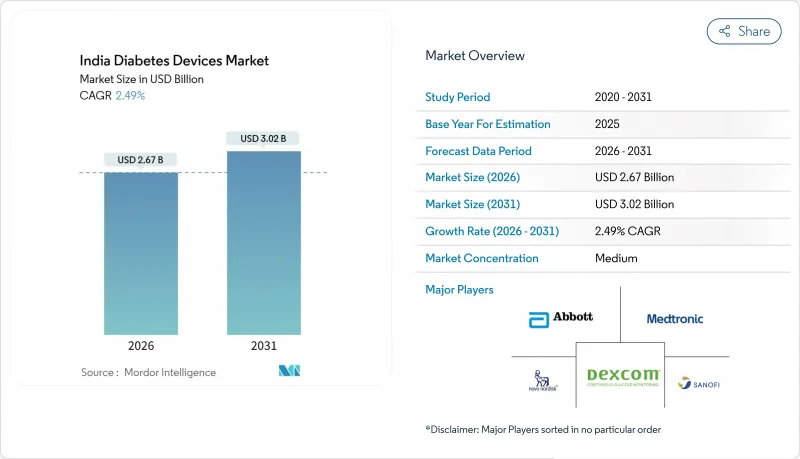
이 보고서는 제품 유형(모니터링 기기, 관리 기기), 환자 유형(제1형 당뇨병, 제2형 당뇨병), 최종사용자(병원·전문 클리닉, 1차 진료·당뇨병 센터, 재택 의료)별로 분류되어 있습니다. 시장 전망은 금액(달러) 기준으로 제시되어 있습니다.
인도 당뇨병 의료기기 시장의 동향 및 인사이트
청소년층의 비만 유병률 상승이 당뇨병의 조기 발병을 가속화하고 있습니다.
인도 청소년의 비만 증가로 인해 당뇨병 발병이 35세 미만 연령층으로 확대되고 있으며, 이는 향후 수십년에 의료기기 수요를 창출하고 있습니다. 2024년 Journal of the Endocrine Society의 연구에 따르면 35세 미만 인도인의 당뇨병 유병률은 17.9%였습니다. 의료기기 제조사들은 전략을 재검토하고 있습니다. Dexcom은 2024년에 ONE+를 월 4,000루피에 출시하며, 젊은 층의 제2형 당뇨병 환자를 대상으로 스마트폰과 연동된 데이터 분석 기능을 추진하고 있습니다. 기업의 웰니스 플랜도 이에 발맞추고 있으며, MediBuddy의 데이터에 따르면 18-45세 직원의 당뇨병 전단계 유병률은 24.40%에 달해, CGM(연속 혈당 모니터링) 기기 대여가 포함된 단체 보험 계약 도입이 확대되고 있습니다. 비만인 젊은 층에서 지질이상증과 고혈압이 동반됨에 따라 단독 혈당 측정기보다 통합형 CGM 플랫폼의 사업적 타당성이 더욱 강화되고 있습니다. 인도 당뇨병 의료기기 시장에서는 이 기술에 정통한 계층을 중심으로 제품 로드맵이 점점 더 구체화되고 있습니다.
CGM 센서에 대한 공적 보험 급여 확대
중앙 정부의 의료보험 제도에서는 2024년 급여 기준에 따라 센서가 장착된 인슐린 펌프의 급여 상한선을 30만 인도 루피로, 14일간의 CGM 이용에 대한 급여 상한선을 4,000 인도 루피로 인상했습니다. 현재 이 제도의 수혜자는 400만 명에 불과하지만, 이러한 정책 전환은 지속적인 모니터링에 대한 전략적 지원을 보여줍니다. 타밀나두 주의 주 계획에서는 제1형 당뇨병 환자에 대한 연간 CGM 급여가 추가되었으며, 급여 상한선은 5만 인도 루피로 설정되었습니다. 의사의 지식 부족이 보급을 저해하고 있습니다. 인도 당뇨병 연맹의 조사에 따르면 외래 혈당 프로파일 해석에 관한 교육을 받은 일차 진료 의사는 30% 미만이었습니다. 그럼에도 불구하고 다른 주들이 선행 도입 주의 사례를 따르면서, 이러한 급여 확대의 호재는 인도 당뇨병 의료기기 시장의 성장 궤도에 중요한 요소가 되고 있습니다.
검사용 소모품에 대한 높은 본인 부담금
자가 측정용 테스트 스트립은 1팩당 380-1,993 인도 루피이며, 하루 2회 측정을 할 경우 연간 13,860-19,930 인도 루피의 지출이 발생합니다. 애보트(Abbott)의 FreeStyle Libre 3 센서는 14일마다 5,000인도 루피가 들기 때문에 CGM의 연간 지출은 130,000인도 루피에 달합니다. 이러한 금액은 많은 3급 도시의 가구 소득 중앙값을 상회하여, 환자들은 검사를 자제할 수밖에 없게 되고, CGM으로의 전환이 더뎌지고 있습니다. 민간 보험사는 당뇨병 관련 소모품에 대한 연간 보상 한도를 약 10,000인도 루피로 설정하고 있는데, 이는 CGM 비용의 10% 미만을 충당하는 수준에 불과합니다. 경제적 부담은 여전히 인도 당뇨병 의료기기 시장의 가장 큰 장벽으로 남아 있습니다.
부문 분석
관리 기기는 2031년까지 연평균 성장률(CAGR) 3.53%를 기록할 것으로 예상되며, 모니터링 기기를 능가하는 성장을 보일 것으로 전망됩니다. 이러한 수요는 120만 명의 제1형 당뇨병 환자들 사이에서 인슐린 펌프가 빠르게 보급되고, 도시 지역의 제2형 당뇨병 환자층에서 일회용 펜형 인슐린 주사기의 사용이 확대됨에 따라 지원되고 있습니다. 2024년에 출시된 메드트로닉(Medtronic)의 하이브리드 폐쇄 루프 시스템인 MiniMed 780G는 5분마다 기초 인슐린량을 자동으로 조정하여, 인도에서 실시된 임상 시험에서 목표 범위내 체류 시간을 15% 확대했습니다. AgVa Healthcare의 INSUL 펌프는 현지 가격이 24,999 인도 루피로 수입 펌프보다 90%나 저렴하며, 블루투스를 통한 투여 기록 기능을 통합하고 있으며, 가격에 민감한 소비자층을 확보하고 있습니다. Schott의 국내 생산 카트리지 튜브 덕분에 인슐린 펜의 총 비용이 20% 절감됨에 따라 Novo Nordisk는 바이알 형태를 단계적으로 폐지하고 FlexPen 기기로의 전환을 추진하고 있습니다.
모니터링 기기는 8,000만 명의 혈당 측정기 사용자에 힘입어 2025년에도 여전히 매출 점유율의 61.78%를 차지하고 있지만, 연평균 성장률(CAGR)은 1.9%에 그쳐 시장 전체의 성장 속도를 따라가지 못하고 있는 상황입니다. 가격에 민감한 구매자들에게는 SMBG(자가혈당측정)용 테스트 스트립이 여전히 주류를 이루고 있지만, CGM(연속 혈당 모니터링)은 가장 빠르게 성장하는 하위 부문으로 자리 잡고 있습니다. 애보트(Abbott)의 Libre 3 센서는 직경이 불과 2.9mm이며, 블루투스를 통해 1분마다 측정값을 전송합니다. 한편, 덱스콤(Dexcom)의 ONE+는 센서 수명이 10일이며, 월 이용료는 4,000인도 루피입니다. 이러한 신제품 출시가 맞물리면서 인도의 당뇨병 의료기기 시장은 지속적인 데이터 수집으로 나아가고 있지만, 높은 가격대 탓에 이미 당뇨병 진단을 받은 환자 중 보급률은 7% 미만에 그치고 있습니다.
기타 혜택:
- 엑셀 형식의 시장 예측(ME) 시트
- 3개월간의 애널리스트 지원
자주 묻는 질문
목차
제1장 서론
제2장 조사 방법
제3장 개요
제4장 시장 구도
제5장 시장 규모와 성장 예측
제6장 시장 지표
제7장 경쟁 구도
제8장 시장 기회와 향후 전망
KSA 26.08.25According to Mordor Intelligence, the India diabetes devices market size is estimated at USD 2.67 billion in 2026, and is expected to reach USD 3.02 billion by 2031, at a CAGR of 2.49% during the forecast period (2026-2031).
This report is Segmented by Product Type (Monitoring Devices, Management Devices), Patient Type (Type-1 Diabetes, Type-2 Diabetes), and End User (Hospitals & Specialty Clinics, Primary Care & Diabetes Centres, Home-Care Settings). The Market Forecasts are Provided in Terms of Value (USD).
India Diabetes Devices Market Trends and Insights
Rising Prevalence of Obesity Among Youth Accelerating Earlier-Onset Diabetes
India's adolescent obesity wave is pulling diabetes incidence into the under-35 cohort, creating multi-decade device demand. A 2024 Journal of the Endocrine Society study reported 17.9% diabetes prevalence among Indians below 35 years. Device makers are repositioning: Dexcom launched ONE+ in 2024 at INR 4,000 per month, promoting smartphone-linked insights for young Type 2 users. Employer wellness plans follow suit, with MediBuddy data showing 24.40% pre-diabetes prevalence in employees aged 18-45, prompting group policies that bundle CGM rentals. Convergence of dyslipidemia and hypertension in obese youth strengthens the business case for integrated CGM platforms over stand-alone glucometers. The India diabetes devices market increasingly orients product roadmaps around this technology-savvy demographic.
Expanding Public Reimbursement for CGM Sensors
The Central Government Health Scheme raised the ceiling to INR 300,000 for sensor-augmented pumps and INR 4,000 for 14-day CGM use in its 2024 rate list. Although only 4 million beneficiaries currently qualify, the policy shift signals strategic support for continuous monitoring. Tamil Nadu's state plan added annual CGM coverage for Type-1 patients, capping benefits at INR 50,000. Limited physician familiarity stalls uptake: the Indian Diabetes Federation found fewer than 30% of primary-care doctors were trained to interpret ambulatory glucose profiles. Still, the reimbursement tailwind is material to the India diabetes devices market trajectory as other states emulate early adopters.
High Out-of-Pocket Costs on Testing Consumables
SMBG strips cost INR 380-1,993 per pack, implying an annual spend of INR 13,860-19,930 for twice-daily testing. Abbott's FreeStyle Libre 3 sensor at INR 5,000 every 14 days lifts annual CGM spend to INR 130,000. These figures exceed the median household income in many tier-3 cities, forcing patients to ration tests and slowing the transition to CGM. Private insurers cap diabetes consumable reimbursement at around INR 10,000 per year, covering less than 10% of CGM expenses. Affordability remains the sharpest brake on the India diabetes devices market.
Other drivers and restraints analyzed in the detailed report include:
- Rising Prevalence and Earlier Onset of Type-2 Diabetes
- Government PLI Scheme Spurring Local Diabetes-Device Manufacturing
- Low CGM-Prescription Awareness Among Primary-Care Physicians
For complete list of drivers and restraints, kindly check the Table Of Contents.
Segment Analysis
Management devices are forecast to post a 3.53% CAGR through 2031, outstripping monitoring counterparts. Demand rides on rapid insulin-pump uptake among 1.2 million Type-1 patients and swelling disposable-pen use in urban Type-2 cohorts. Medtronic's MiniMed 780G hybrid closed-loop system, launched in 2024, automatically adjusts basal insulin every five minutes and has widened time-in-range by 15% in Indian trials. AgVa Healthcare's INSUL pump, locally priced at INR 24,999, undercuts imported pumps by 90% and integrates Bluetooth dosing logs, capturing value-conscious consumers. Schott's domestic cartridge tubing reduced landed costs on insulin pens by 20%, encouraging Novo Nordisk to phase out vial formats in favor of FlexPen devices.
Monitoring devices still delivered a 61.78% revenue share in 2025, buoyed by 80 million glucometer users; however, their 1.9% CAGR lags behind the market pace. SMBG strips remain the default for price-sensitive buyers, but CGM is the fastest-growing sub-segment. Abbott's Libre 3 sensor measures just 2.9 mm in diameter and beams one-minute readings via Bluetooth, while Dexcom's ONE+ offers a 10-day sensor life at INR 4,000 per month. Combined, these launches have nudged the India diabetes devices market toward continuous data capture, although premium pricing keeps penetration below 7% of diagnosed diabetics.
Complete Report Scope:
- By Product Type
- Monitoring Devices
- Self-Monitoring Blood Glucose Devices
- Continuous Glucose Monitoring
- Management Devices
- Insulin Pumps
- Insulin Syringes
- Insulin Cartridges
- Disposable Pens
- Other Management Devices
- Monitoring Devices
- By Patient Type
- Type-1 Diabetes
- Type-2 Diabetes
- By End User
- Hospitals & Specialty Clinics
- Primary Care & Diabetes Centres
- Home-Care Settings
List of Companies Covered in this Report:
- Abbott Laboratories
- AgVa Healthcare
- Ascensia
- Becton Dickinson (BD)
- Beckton Dickinson
- Dexcom
- Eli Lilly and Company
- HTL-Strefa
- Insulet
- LifeScan (J&J)
- Medtronic
- Nipro
- Novo Nordisk
- Roche
- Sanofi
- Senseonics
- Tandem Diabetes Care
- Terumo
- Ypsomed
Additional Benefits:
- The market estimate (ME) sheet in Excel format
- 3 months of analyst support
TABLE OF CONTENTS
1 Introduction
- 1.1 Study Assumptions & Market Definition
- 1.2 Scope of the Study
2 Research Methodology
3 Executive Summary
4 Market Landscape
- 4.1 Market Overview
- 4.2 Market Drivers
- 4.2.1 Rising Prevalence of Obesity Among Youth Accelerating Earlier-Onset Diabetes
- 4.2.2 Expanding Public Reimbursement for CGM Sensors
- 4.2.3 Rising Prevalence & Earlier Onset of Type-2 Diabetes
- 4.2.4 Government PLI Scheme Spurring Local Diabetes-Device Manufacturing
- 4.2.5 Pharmacy-Led Diabetes-Management Programs Boosting SMBG Adherence
- 4.2.6 Employer-Funded Health-Tech Benefit Platforms Widening Device Access
- 4.3 Market Restraints
- 4.3.1 High Out-of-Pocket Costs on Testing Consumables
- 4.3.2 Low CGM-Prescription Awareness Among Primary-Care Physicians
- 4.3.3 Patchy Cold-Chain Capacity for Insulin Cartridges in Tier-3 Cities
- 4.3.4 Data-Privacy Concerns Around Connected Pumps & Apps
- 4.4 Value/Supply Chain Analysis
- 4.5 Regulatory Landscape
- 4.6 Technological Outlook
- 4.7 Porter's Five Forces Analysis
- 4.7.1 Threat of New Entrants
- 4.7.2 Bargaining Power of Buyers
- 4.7.3 Bargaining Power of Suppliers
- 4.7.4 Threat of Substitutes
- 4.7.5 Competitive Rivalry
5 Market Size & Growth Forecasts
- 5.1 By Product Type
- 5.1.1 Monitoring Devices
- 5.1.1.1 Self-Monitoring Blood Glucose Devices
- 5.1.1.2 Continuous Glucose Monitoring
- 5.1.2 Management Devices
- 5.1.2.1 Insulin Pumps
- 5.1.2.2 Insulin Syringes
- 5.1.2.3 Insulin Cartridges
- 5.1.2.4 Disposable Pens
- 5.1.2.5 Other Management Devices
- 5.1.1 Monitoring Devices
- 5.2 By Patient Type
- 5.2.1 Type-1 Diabetes
- 5.2.2 Type-2 Diabetes
- 5.3 By End User
- 5.3.1 Hospitals & Specialty Clinics
- 5.3.2 Primary Care & Diabetes Centres
- 5.3.3 Home-Care Settings
6 Market Indicators
- 6.1 Type-1 Diabetes Population
- 6.2 Type-2 Diabetes Population
7 Competitive Landscape
- 7.1 Market Concentration
- 7.2 Market Share Analysis
- 7.3 Company Profiles (includes Global level Overview, Market-level Overview, Core Segments, Financials, Strategic Information, Market Rank/Share, Products & Services, Recent Developments)
- 7.3.1 Abbott
- 7.3.2 AgVa Healthcare
- 7.3.3 Ascensia Diabetes Care
- 7.3.4 Becton Dickinson (BD)
- 7.3.5 BeatO
- 7.3.6 Dexcom
- 7.3.7 Eli Lilly
- 7.3.8 HTL-Strefa
- 7.3.9 Insulet
- 7.3.10 LifeScan (J&J)
- 7.3.11 Medtronic
- 7.3.12 Nipro
- 7.3.13 Novo Nordisk
- 7.3.14 Roche
- 7.3.15 Sanofi
- 7.3.16 Senseonics
- 7.3.17 Tandem Diabetes Care
- 7.3.18 Terumo
- 7.3.19 Ypsomed
8 Market Opportunities & Future Outlook
- 8.1 White-space & Unmet-need Assessment


