

|
시장보고서
상품코드
2101949
당뇨병 관리 기기 시장 기회, 성장 촉진요인, 업계 동향 분석 및 예측(2026-2035년)Diabetes Care Devices Market Opportunity, Growth Drivers, Industry Trend Analysis, and Forecast 2026 - 2035 |
||||||

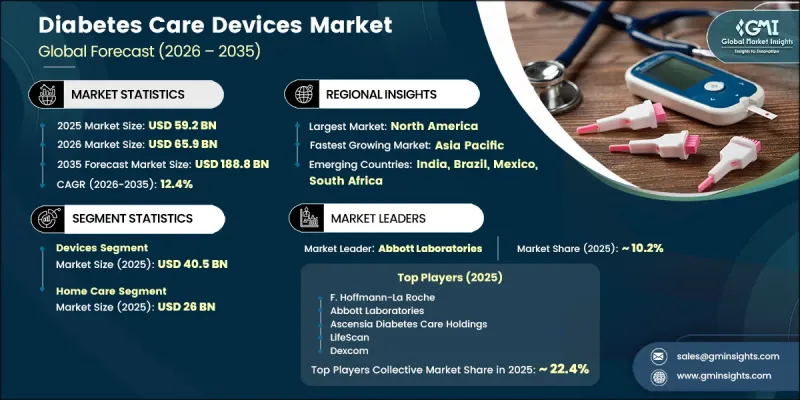
세계의 당뇨병 관리 기기 시장은 2025년에 592억 달러 규모에 달하고, CAGR 12.4%로 성장하여 2035년까지 1,888억 달러에 달할 것으로 추정됩니다.
당뇨병 유병률의 증가에 따라, 효과적인 질환 관리와 장기적인 환자 관리를 지원하는 첨단 솔루션에 대한 강력한 수요가 지속적으로 발생하고 있습니다. 또한, 전 세계 당뇨병 관리 기기 시장은 환자의 편의성을 향상시키면서 지속적인 건강 모니터링을 가능하게 하는 최소침습형 및 웨어러블 기술에 대한 수요 증가의 혜택을 받고 있습니다. 이러한 의료기기는 혈당 모니터링, 인슐린 투여 및 전반적인 당뇨병 관리에 있어 필수적인 역할을 수행하며, 치료의 정확성과 편의성을 향상시킴으로써 환자가 자신의 질환을 보다 적절하게 관리할 수 있도록 지원하고 있습니다. 공공 기관 및 민간 조직의 재정 지원 확대는 예방 대책, 조기 진단 프로그램, 장기적인 질환 관리 전략을 촉진함으로써 시장 확대를 더욱 가속화하고 있습니다. 디지털 헬스케어 인프라, 웨어러블 기술 및 커넥티드 의료기기에 대한 투자는 당뇨병 관리 생태계 전체를 지속적으로 강화하는 동시에, 환자들이 첨단 치료 솔루션을 더 쉽게 이용할 수 있도록 하고 있습니다. 급속한 기술 혁신은 여전히 주요 동향이며, 각 제조사는 임상 성능을 향상시키고 다양한 의료 현장에서 환자의 예후 개선을 지원하는, 비용 대비 효과가 높고 사용하기 쉬우며 신뢰성이 높은 당뇨병 관리 기기 개발에 주력하고 있습니다.
| 시장 범위 | |
|---|---|
| 시작 연도 | 2025년 |
| 예측 기간 | 2026-2035년 |
| 시작 시점 시장 규모 | 592억 달러 |
| 예측액 | 1,888억 달러 |
| CAGR | 12.4% |
의료기기 부문은 2025년에 405억 달러의 시장 규모를 기록할 것으로 예상되며, 첨단 당뇨병 관리 기술의 보급에 힘입어 2035년까지 1,309억 달러에 달하고 연평균 성장률(CAGR)은 12.6%를 기록할 전망입니다. 혈당 모니터링 시스템 및 인슐린 투여 솔루션의 지속적인 혁신을 통해 치료 정확도 향상, 질환 관리 간소화, 그리고 환자의 치료 순응도 향상이 도모되고 있습니다. 정확한 혈당 모니터링과 효율적인 인슐린 투여에 대한 수요가 증가함에 따라, 예측 기간 동안 강력한 성장이 유지될 것으로 전망됩니다.
재택 케어 분야는 2025년에 260억 달러를 차지했습니다. 자율적인 질환 관리, 편의성 향상, 그리고 장기적인 치료 효율에 대한 중요성이 커짐에 따라 재택형 당뇨병 케어 솔루션에 대한 수요는 계속해서 확대되고 있습니다. 커넥티드 헬스케어 기술, 원격 환자 모니터링 및 원격의료 서비스의 확대로 지속적인 건강 상태 추적과 환자 및 의료진 간의 원활한 소통이 가능해지면서 이 분야는 더욱 강화되고 있습니다. 또한, 비침습적이고 사용하기 쉬운 기기에 대한 선호도가 높아지면서 재택 케어 환경 전반에 걸친 지속적인 보급이 뒷받침되고 있습니다.
2025년, 북미 당뇨병 관리 기기 시장은 41.9%의 점유율을 차지했습니다. 이 지역의 시장 확대는 당뇨병 환자 수의 증가와 장기적인 질환 관리 솔루션에 대한 수요 증가에 힘입어 이루어지고 있습니다. 생활습관병 유병률의 상승과 고령화가 맞물리면서 환자 기반은 지속적으로 확대되고 있으며, 이는 첨단 당뇨병 관리 기술 및 커넥티드 의료기기에 대한 지속적인 수요를 창출하고 있습니다.
자주 묻는 질문
목차
제1장 조사 방법
제2장 주요 요약
제3장 업계 인사이트
제4장 경쟁 구도
제5장 시장 추정 및 예측 : 제품별, 2022-2035년
제6장 시장 추정 및 예측 : 최종사용별, 2022-2035년
제7장 시장 추정 및 예측 : 지역별, 2022-2035년
제8장 기업 개요
KSM 26.08.05The Global Diabetes Care Devices Market was valued at USD 59.2 billion in 2025 and is estimated to grow at a CAGR of 12.4% to reach USD 188.8 billion by 2035.
Rising diabetes prevalence continues to create strong demand for advanced solutions that support effective disease management and long-term patient care. The global diabetes care devices market is also benefiting from increasing preference for minimally invasive and wearable technologies that improve patient comfort while enabling continuous health monitoring. These medical devices play an essential role in blood glucose monitoring, insulin administration, and overall diabetes management, allowing patients to better manage their condition through improved treatment accuracy and convenience. Growing financial support from both public and private organizations is further accelerating market expansion by encouraging prevention initiatives, early diagnosis programs, and long-term disease management strategies. Investments in digital healthcare infrastructure, wearable technologies, and connected medical devices continue to strengthen the overall diabetes care ecosystem while improving patient access to advanced treatment solutions. Rapid technological innovation remains a key market trend, with manufacturers focusing on developing cost-effective, user-friendly, and highly reliable diabetes care devices that deliver improved clinical performance and support better patient outcomes across diverse healthcare settings.
| Market Scope | |
|---|---|
| Start Year | 2025 |
| Forecast Year | 2026-2035 |
| Start Value | $59.2 Billion |
| Forecast Value | $188.8 Billion |
| CAGR | 12.4% |
The devices segment generated USD 40.5 billion in 2025 and is anticipated to reach USD 130.9 billion by 2035, registering a CAGR of 12.6%, supported by increasing adoption of advanced diabetes management technologies. Continuous innovation in glucose monitoring systems and insulin delivery solutions continues to improve treatment precision, simplify disease management, and enhance patient compliance. Growing demand for accurate glucose monitoring and efficient insulin administration is expected to maintain strong growth throughout the forecast period.
The home care segment accounted for USD 26 billion in 2025. Rising emphasis on independent disease management, greater convenience, and long-term treatment efficiency continues to drive demand for home-based diabetes care solutions. The expansion of connected healthcare technologies, remote patient monitoring, and telehealth services has further strengthened this segment by enabling continuous health tracking and seamless communication between patients and healthcare professionals. Increasing preference for minimally invasive, easy-to-use devices is also supporting sustained adoption across home care environments.
North America Diabetes Care Devices Market captured 41.9% share in 2025. Market expansion across the region is being driven by the growing number of individuals living with diabetes and the increasing need for long-term disease management solutions. Rising rates of lifestyle-related health conditions, together with an aging population, continue to expand the patient base, creating sustained demand for advanced diabetes care technologies and connected medical devices.
Major companies operating in the global diabetes care devices market include Abbott Laboratories, ARKRAY, Ascensia Diabetes Care, B. Braun Melsungen, Becton Dickinson and Company, Bionime, DarioHealth, Dexcom, Dr. Reddy's Laboratories, Eli Lilly and Company, F. Hoffmann-La Roche, Insulet, Medtronic, Nova Biomedical, Novo Nordisk, Pendiq, LifeScan, Sanofi, Sinocare, Tandem Diabetes Care, and Ypsomed Holding. Companies operating in the diabetes care devices market continue to strengthen their market position by investing heavily in research and development to introduce innovative, connected, and patient-centric solutions. Manufacturers are focusing on integrating digital health technologies, wearable platforms, and advanced data management capabilities to improve treatment outcomes and enhance patient engagement. Product portfolio expansion, continuous technological innovation, and development of minimally invasive devices remain important competitive strategies. Strategic partnerships, regulatory approvals, and broader geographic expansion are also helping companies increase market penetration and strengthen customer reach.
Table of Contents
Chapter 1 Research Methodology
- 1.1 Research approach
- 1.2 Quality commitments
- 1.2.1 GMI AI policy & data integrity commitment
- 1.2.1.1 Source consistency protocol
- 1.2.1 GMI AI policy & data integrity commitment
- 1.3 Research trail & confidence scoring
- 1.3.1 Research trail components
- 1.3.2 Scoring components
- 1.4 Data collection
- 1.4.1 Partial list of primary sources
- 1.5 Data mining sources
- 1.5.1 Paid sources
- 1.5.1.1 Sources, by region
- 1.5.1 Paid sources
- 1.6 Base estimates and calculations
- 1.6.1 Base year calculation
- 1.7 Forecast model
- 1.7.1 Quantified market impact analysis
- 1.7.1.1 Mathematical impact of growth parameters on forecast
- 1.7.1 Quantified market impact analysis
- 1.8 Research transparency addendum
- 1.8.1 Source attribution framework
- 1.8.2 Quality assurance metrics
- 1.8.3 Our commitment to trust
Chapter 2 Executive Summary
- 2.1 Industry 360° synopsis
- 2.2 Key market trends
- 2.2.1 Regional trends
- 2.2.2 Product trends
- 2.2.3 End use trends
- 2.3 CXO perspectives: Strategic imperatives
Chapter 3 Industry Insights
- 3.1 Industry ecosystem analysis
- 3.2 Industry impact forces
- 3.2.1 Growth drivers
- 3.2.1.1 Growing prevalence of diabetes across the world
- 3.2.1.2 Rising technological advancements in diabetes care devices
- 3.2.1.3 Increasing investments by public and private organizations for diabetes care
- 3.2.1.4 Increasing demand for minimally invasive and wearable devices
- 3.2.2 Industry pitfalls and challenges
- 3.2.2.1 High cost of diabetes care devices
- 3.2.2.2 Rigorous regulatory framework
- 3.2.2.3 Privacy, cybersecurity, and compliance risks in connected devices
- 3.2.3 Market opportunities
- 3.2.3.1 Integrated care models combining CGM, insulin delivery, and telehealth
- 3.2.3.2 AI-enabled decision support and closed-loop insulin automation
- 3.2.1 Growth drivers
- 3.3 Growth potential analysis
- 3.4 Regulatory landscape
- 3.4.1 North America
- 3.4.2 Europe
- 3.4.3 Asia Pacific
- 3.5 Technological advancements
- 3.5.1 Current technological trends
- 3.5.2 Emerging technologies
- 3.5.2.1 Non-Invasive glucose monitoring technologies
- 3.5.2.2 Nanotechnology applications
- 3.6 Diabetes epidemiology and disease burden analysis
- 3.6.1 Regional diabetes prevalence trends
- 3.6.2 Gestational diabetes prevalence
- 3.6.3 Complication rates and healthcare costs
- 3.7 Patent landscape analysis for diabetes device innovations
- 3.8 Clinical trial pipeline assessment for emerging technologies
- 3.9 Supply chain risk analysis for key device components
- 3.10 Patient behavior and technology adoption patterns in diabetes care devices
- 3.11 Reimbursement scenario
- 3.11.1 Coding and reimbursement
- 3.11.2 Reimbursement policies and public healthcare sector insurance coverage for insulin delivery systems
- 3.11.2.1 U.S.
- 3.11.2.2 Europe
- 3.12 Pricing trend analysis
- 3.13 Future market trends
- 3.14 Gap analysis
- 3.15 Impact of AI & Generative AI on the Market (Driven by Primary Research)
- 3.16 Porter's analysis
- 3.17 PESTEL analysis
Chapter 4 Competitive Landscape, 2025
- 4.1 Introduction
- 4.2 Company matrix analysis
- 4.3 Company market share analysis (Driven by Primary Research)
- 4.3.1 Global
- 4.3.2 North America
- 4.3.3 Europe
- 4.3.4 Asia Pacific
- 4.3.5 LAMEA
- 4.4 Competitive analysis of major market players
- 4.5 Competitive positioning matrix
- 4.6 Key developments
- 4.6.1 Mergers & acquisitions
- 4.6.2 Partnerships & collaborations
- 4.6.3 New product launches
- 4.6.4 Expansion plans
Chapter 5 Market Estimates and Forecast, By Product, 2022 - 2035 ($ Mn)
- 5.1 Key trends
- 5.2 Devices
- 5.2.1 Blood glucose monitoring devices
- 5.2.1.1 Self-monitoring blood glucose meters
- 5.2.1.2 Continuous glucose monitors
- 5.2.2 Insulin delivery devices
- 5.2.2.1 Insulin pumps
- 5.2.2.1.1 Tubed pumps
- 5.2.2.1.2 Tubeless pumps
- 5.2.2.2 Pens
- 5.2.2.2.1 Reusable
- 5.2.2.2.2 Disposable
- 5.2.2.3 Other insulin delivery devices
- 5.2.2.1 Insulin pumps
- 5.2.1 Blood glucose monitoring devices
- 5.3 Consumables
- 5.3.1 Testing strips
- 5.3.2 Lancets
- 5.3.3 Pen needles
- 5.3.3.1 Standard
- 5.3.3.2 Safety
- 5.3.4 Syringes
- 5.3.5 Insulin pump consumables
Chapter 6 Market Estimates and Forecast, By End Use, 2022 - 2035 ($ Mn)
- 6.1 Key trends
- 6.2 Hospital
- 6.3 Ambulatory surgical centers
- 6.4 Diagnostic centers
- 6.5 Homecare
- 6.6 Other end users
Chapter 7 Market Estimates and Forecast, By Region, 2022 - 2035 ($ Mn)
- 7.1 Key trends
- 7.2 North America
- 7.2.1 U.S.
- 7.2.2 Canada
- 7.3 Europe
- 7.3.1 Germany
- 7.3.2 UK
- 7.3.3 France
- 7.3.4 Spain
- 7.3.5 Italy
- 7.3.6 Netherlands
- 7.4 Asia Pacific
- 7.4.1 China
- 7.4.2 Japan
- 7.4.3 India
- 7.4.4 Australia
- 7.4.5 South Korea
- 7.5 Latin America
- 7.5.1 Brazil
- 7.5.2 Mexico
- 7.5.3 Argentina
- 7.6 MEA
- 7.6.1 South Africa
- 7.6.2 Saudi Arabia
- 7.6.3 UAE
Chapter 8 Company Profiles
- 8.1 Abbott Laboratories
- 8.2 ARKRAY
- 8.3 Ascensia Diabetes Care
- 8.4 B. Braun Melsungen
- 8.5 Becton, Dickinson and Company
- 8.6 Bionime
- 8.7 DarioHealth
- 8.8 Dexcom
- 8.9 Dr. Reddy's Laboratories
- 8.10 Eli Lilly and Company
- 8.11 F. Hoffmann-La Roche
- 8.12 Insulet
- 8.13 LifeScan
- 8.14 Medtronic
- 8.15 Nova Biomedical
- 8.16 Novo Nordisk
- 8.17 Pendiq
- 8.18 Sanofi
- 8.19 Sinocare
- 8.20 Tandem Diabetes Care
- 8.21 Ypsomed Holding


