|
시장보고서
상품코드
2124278
식품 캔 시장 : 시장 점유율 분석, 업계 동향 및 통계, 성장 예측(2026-2031년)Food Cans - Market Share Analysis, Industry Trends & Statistics, Growth Forecasts (2026 - 2031) |
||||||
 Mordor Intelligence
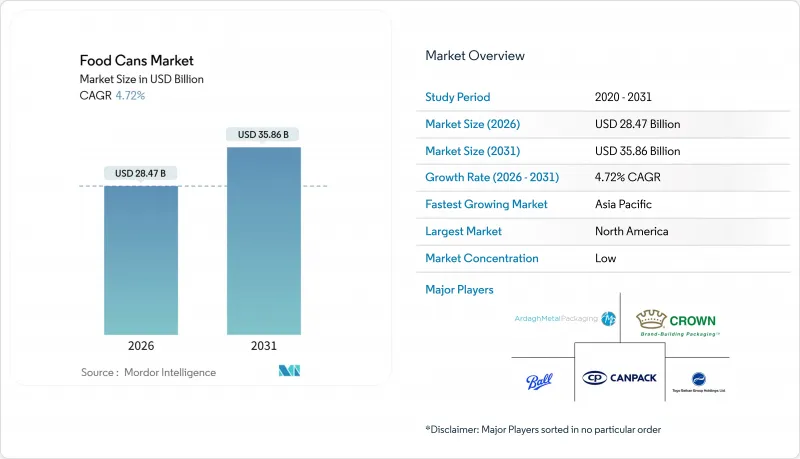
Mordor Intelligence에 의하면, 식품 캔 시장 규모는 2026년에 284억 7,000만 달러로 추정되고, 2031년까지 358억 6,000만 달러에 이를 것으로 예측되며, CAGR은 4.72%로 추이할 전망입니다.
본 보고서는 소재별(강철/양철, 알루미늄), 캔 유형별(2피스 캔, 3피스 캔), 캔 크기별(소, 중, 대), 용도별(즉석식, 어패류, 과일 및 채소, 가공식품, 반려동물사료, 기타), 지역별(북미, 남미, 유럽, 아시아태평양, 중동 및 아프리카)로 분류되어 있습니다. 시장 예측은 금액(달러) 기준으로 제시되어 있습니다.
세계의 식품 캔 시장 동향 및 인사이트
가처분 소득 증가와 도시화가 가공식품 소비를 촉진
인도, 인도네시아, 브라질 전역에서 급속히 진행되는 도시 이주로 인해 가정에서 직접 요리할 수 있는 시간이 줄어들고 있어, 각 가정에서는 냉장 보관이 필요 없는 상온 보관 가능한 단백질, 과일, 채소를 비축하고 있습니다. 인도의 Reliance Consumer Products는 통합형 식품 단지에 4,000억 루피(48억 달러)를 투자하기로 결정했으며, 쿠르누르에 건설된 첫 번째 공장에서는 통조림 제품 생산에 주력하고 있습니다. 이는 가공업체들이 콜드체인 인프라가 정비될 때까지의 과도기 동안 금속 포장을 첫 번째 선택지로 간주하고 있음을 보여줍니다. 브라질의 소매 매출은 2024년에 1,830억 달러에 달했지만, 소비자들은 해당 카테고리를 외면하기보다는 가격 부담이 적은 통조림 필수품으로 구매를 전환하고 있으며, 이러한 경향은 남미 각지의 지방 도시에서도 마찬가지로 관찰됩니다.
현대적인 소매 및 전자상거래를 통한 식료품 유통 채널의 확대
소비자 직접 판매형 식료품 비즈니스 모델에서는 냉장 보관 없이도 라스트 마일의 진동에 견딜 수 있는 포장이 요구되며, 이 점에서 금속 캔은 유리병에 비해 구조적인 우위를 가지고 있습니다. 2024년, 멕시코의 현대 유통 부문은 가계 식품 지출의 50% 이상을 차지했으며, 전자상거래 매출액은 5억 4,200만 달러에 달했습니다. 이에 따라 자체 브랜드 통조림 콩과 칠리의 진열 공간이 확대되었습니다. 아랍에미리트는 2026년에 일부 일회용 플라스틱 제품을 금지할 예정이며, 이에 따라 패스트푸드점들은 배달 플랫폼을 위해 상온 보관이 가능한 통조림 수프를 도입하기 시작했습니다.
비용 및 무게상의 이점을 고려한 연질 플라스틱 파우치 및 종이팩으로의 전환
연질 파우치는 동급 캔에 비해 최대 40% 가벼우므로, 운송 시 이산화탄소 배출량 감축을 목표로 하는 브랜드 소유주들은 과일 컵이나 그레이비 토퍼에 이를 채택하고 있습니다. 도요제칸은 프라이빗 브랜드가 더 저렴한 1인분용 제품을 요구하는 가운데, 2024년에 레토르트 파우치 제품 시장 점유율 확대를 보고했습니다. SIG와 같은 카톤 공급업체들은 금속 캔의 차단 성능에 근접하기 위해 얇은 알루미늄 라미네이트를 사용하고 있으며, 유럽 전역의 상온 보관 가능한 수프 상품 시장에 도전하고 있습니다.
부문 분석
2025년, 식품용 캔 시장 매출의 63.06%를 강철 및 양철 캔이 차지했으나, 2031년까지 연평균 성장률(CAGR)이 5.43%로 가장 높은 성장세를 보인 것은 알루미늄 캔이었습니다. 경량 합금을 사용함으로써 파열 강도를 저하시키지 않고 벽 두께를 10%-15% 얇게 만들 수 있기 때문에 알루미늄 식품 캔 시장 규모는 확대되고 있습니다. 노벨리스는 2024년, 압연 제품 라인업 전체에서 63%의 재활용 소재 함유율을 달성하고, 1차 생산에 비해 탄소 강도를 90% 이상 감축하는 폐쇄형 순환 경제의 유효성을 입증했습니다. 알루미늄의 가소성 덕분에 이음매 없는 2피스 구조의 설계가 가능해져 고급 반려동물사료 및 즉석식 브랜드를 유치하고 있지만, 한편 강철 캔은 대량 생산을 통해 심압금형의 상각을 도모하는 가격 주도형 카테고리에서 여전히 지배적인 지위를 유지하고 있습니다.
가공업체들은 부피 중량으로 요금이 부과되는 EC 창고로의 출하 시 알루미늄을 선호하며, 또한 이 소재가 비철금속이기 때문에 산성 토마토 베이스에 의한 부식도 피할 수 있습니다. 자성을 띠는 강철은 지자체별 분리 수거 작업을 간소화하기 때문에 성숙한 북미의 재활용 시스템에서는 우위를 점하고 있습니다. 신흥 시장에서는 재용해 능력이 제한적이어서 알루미늄의 채택이 억제되고 있으며, 그 결과 대표적인 통조림 채소 부문에서는 강철이 여전히 입지를 유지하고 있습니다. 이처럼 두 재료가 공존하는 상황에서 가공업체들은 가격 변동을 헤지하기 위해 여러 공급처에서 재료를 조달하는 경우가 많으며, 각 기업이 유통 채널이나 지역에 맞추어 재료를 최적화함에 따라 식품 캔 시장은 더욱 발전하고 있습니다.
2025년에는 3피스 용접 캔이 매출의 58.63%를 차지했지만, 2피스 인발·프레스 성형 설계는 2031년까지 연평균 성장률(CAGR) 5.32%로 확대되고 있습니다. 크로네스(Krones)사의 충전 라인은 현재 시간당 12만 개 이상을 처리하고 있으며, 이를 통해 가공업체는 고가의 금형 비용을 더 빨리 상각할 수 있고, 표준 400그램 캔 1개당 비용을 0.30달러 이하로 억제할 수 있게 되었습니다. 이음매 없는 캔 본체 덕분에 측면 용접이 불필요해지고, 코팅의 필요성이 줄어들며, 진열 시의 어필력이 높아지기 때문에 고급 반려동물사료나 전자레인지용 레토르트 식품에 채택이 확대되고 있습니다.
2피스 형태의 식품 캔 시장 점유율은 아시아태평양에서 가장 빠르게 성장하고 있습니다. 이 지역에서는 신규 공장에서 기존 용접 공정을 완전히 생략하는 경우가 많습니다. 볼 코퍼레이션은 인도의 금속 포장 수요가 두 자릿수 성장세를 보임에 따라, 안드라프라데시 주에 6,000만 달러를 투자하여 2피스 형태의 생산 능력을 확대할 예정입니다. 500그램을 초과하는 산업용 캔의 경우, 심압 성형에는 더 고가의 금형이 필요하기 때문에 3피스 방식이 여전히 선호되고 있습니다. 가공업체들이 비용, 속도, 재료 사용량의 균형을 고려함에 따라 두 형태가 공존하고 있으며, 이는 식품 캔 시장에 견고한 기판의 다양성을 가져오고 있습니다.
지역별 분석
2025년, 북미는 전 세계 매출의 39.87%를 차지했습니다. 이는 정착된 통조림 생산 라인, 확립된 공급망, 높은 1인당 소비량이 기본적인 물량을 뒷받침하고 있기 때문입니다. 인구 증가세가 정체되어 성장률은 전 세계 연평균 성장률(CAGR)보다 낮지만, 생산 시설의 현대화가 이익률을 뒷받침하고 있습니다. 크라운 홀딩스는 자본을 북미의 특수 식품용 캔 사업에 재분배하기 위해 유럽의 양철 사업 부문을 매각하며, 고수익성 틈새 시장으로의 전환을 강조했습니다. 철강 가격 변동과 2023년 알루미늄 캔 재활용률이 43%에 그친 점 등으로 인해 고철 공급이 부족해지면서, 가공업체들은 추가 비용을 전가할 수밖에 없는 상황입니다.
아시아태평양은 도시화, 가처분 소득 증가, 현지 공급망에 대한 투자에 힘입어 연평균 성장률(CAGR) 6.42%라는 가장 빠른 속도로 확대되고 있습니다. 볼(Ball)사의 스리 시티와 타로자에서의 확장은 인도에 진출하는 다국적 식품 가공업체에 대응하기 위해 세계 유수의 기업들이 2피스 캔 생산 라인을 현지화하고 있음을 보여줍니다. 중국의 양철판 공장이나 동남아시아의 참치 생산 거점에서는 일본의 코팅 기술과 현지 유통망을 융합한 합작 사업이 주목을 받고 있습니다. 인도에서 개최된 ‘월드 푸드 인디아(World Food India)’ 정상회의에서는 1조 200억 루피(122억 달러) 규모의 투자 약속을 확보했으며, 제한된 콜드체인을 보완하기 위해 통조림 제품으로의 전환이 진행되고 있습니다.
유럽 시장은 연평균 성장률(CAGR) 약 4.3%로 확대되고 있으며, 인구 증가 둔화로 인해 그 속도는 억제되고 있지만, 지속가능성 규제로 인해 활기를 띠고 있습니다. 2024년 12월 BPA 금지 조치로 인해 가공업체들은 차세대 내장재 채택을 강요받고 있어 자본 수요가 증가하지만, 선점 기업들에게는 마케팅상의 우위가 생기고 있습니다. 할인점이 가치 중심의 통조림 상품 구성을 추진하는 가운데, 자체 브랜드의 침투율은 계속 상승하고 있습니다. 남미, 중동 및 아프리카는 중간 한 자릿수 성장률을 보이고 있습니다. 브라질의 1,830억 달러 규모의 소매 시장은 견조한 모습을 유지하고 있으며, 아랍에미리트의 플라스틱 금지 조치로 인해 푸드서비스 산업 부문의 통조림 수요가 더욱 증가하고 있습니다.
기타 혜택
- 엑셀 형식 시장 예측(ME) 시트
- 3개월간의 애널리스트 지원
자주 묻는 질문
목차
제1장 서론
제2장 조사 방법
제3장 주요 요약
제4장 시장 구도
제5장 시장 규모 및 성장 예측
제6장 경쟁 구도
제7장 시장 기회 및 향후 전망
AJY 26.09.11According to Mordor Intelligence, the food cans market size stands at USD 28.47 billion in 2026 and is forecast to reach USD 35.86 billion by 2031, progressing at a 4.72% CAGR.
This report is Segmented by Material Type (Steel/Tin, and Aluminum), Can Type (2-Piece Cans, and 3-Piece Cans), Can Size (Small, Medium, and Large), Application (Ready Meals, Fish and Seafood, Fruits and Vegetables, Processed Food, Pet Food, and More), and Geography (North America, South America, Europe, Asia-Pacific, and Middle East and Africa). The Market Forecasts are Provided in Terms of Value (USD).
Global Food Cans Market Trends and Insights
Rising Disposable Incomes and Urbanization Boosting Packaged Food Consumption
Rapid migration to cities across India, Indonesia, and Brazil is shrinking the window for home cooking, so households are stocking shelf-stable proteins, fruits, and vegetables that require no refrigeration. India's Reliance Consumer Products has committed INR 40,000 crore (USD 4.8 billion) to integrated food parks, with the inaugural plant in Kurnool focusing on canned produce. This signals that processors view metal packaging as a first wave before cold-chain infrastructure matures.Brazil's retail turnover reached USD 183 billion in 2024, with consumers trading down into value-priced canned staples rather than exiting categories, a pattern replicated in secondary cities across South America.
Expansion of Modern Retail and E-commerce Grocery Channels
Direct-to-consumer grocery models rely on packaging that can withstand last-mile bumps without refrigeration, giving metal cans a structural advantage over glass. Mexico's modern retail sector captured more than 50% of household food expenditures in 2024, with e-commerce sales reaching USD 542 million, thereby widening shelf space for private-label canned beans and chilies.The United Arab Emirates banned several single-use plastic items in 2026, prompting quick-service restaurants to adopt ambient-stable canned soups for delivery platforms.
Shift Toward Flexible Plastic Pouches and Cartons Due to Cost and Weight Advantages
Flexible pouches weigh up to 40% less than equivalent cans, so brand owners chasing lower transport emissions adopt them for fruit cups and gravy toppers. Toyo Seikan reported share gains for its retort-pouch line in 2024 as private labels sought cheaper single-serve options. Carton suppliers such as SIG use thin aluminum laminate to approximate metal-can barrier properties, challenging ambient soup SKUs across Europe.
Other drivers and restraints analyzed in the detailed report include:
- Superior Barrier Properties and Shelf Life Extension Compared to Flexible Packaging
- Increasing Pet Ownership Driving Demand for Wet Pet Food in Metal Cans
- Volatility in Aluminum and Steel Prices Affecting Profit Margins
For complete list of drivers and restraints, kindly check the Table Of Contents.
Segment Analysis
Steel and tin-based cans generated 63.06% of food cans market revenue in 2025, yet aluminum posted the fastest 5.43% CAGR through 2031. The food cans market size for aluminum formats is widening because lightweight alloys allow 10%-15% thinner walls that reduce freight cost without compromising burst strength. Novelis delivered 63% recycled content across its rolled-product mix in 2024, validating closed-loop economics that reduce carbon intensity by more than 90% relative to primary production. Aluminum's malleability enables seamless two-piece designs that attract premium pet food and ready-meal brands, while steel stays dominant in price-led categories where deep-draw tooling amortizes over high volumes.
Converters favor aluminum when shipping to e-commerce warehouses that bill by dimensional weight, and the material's non-ferrous nature avoids corrosion in acidic tomato bases. Still, magnetic steel simplifies municipal sortation, an edge in mature North American recycling systems. In emerging markets, limited remelt capacity caps aluminum uptake, so steel maintains hold in staple canned vegetables. The dual-material landscape means processors often dual-source to hedge price swings, further advancing the food cans market as players align substrate to channel and geography.
Three-piece welded cans captured 58.63% of revenue in 2025, but two-piece drawn-and-ironed designs are expanding at a 5.32% CAGR through 2031. Krones filling lines now process more than 120,000 units per hour, allowing converters to amortize higher tooling costs faster and achieve a sub-USD 0.30 cost for a standard 400-gram can. Seamless bodies eliminate side welds, reducing coating needs and enhancing shelf appeal, which boosts adoption in premium pet food and microwavable ready meals.
The food cans market share for two-piece formats climbs fastest in the Asia-Pacific region, where greenfield plants often skip legacy welding altogether. Ball Corporation will invest USD 60 million in Andhra Pradesh to add two-piece capacity, in line with India's double-digit growth in metal packaging demand. Three-piece technology remains favored for institutional cans weighing above 500 grams because deep draws would require more costly tooling. As processors balance cost, speed, and material intensity, both formats coexist, giving the food cans market resilient substrate diversity.
Complete Report Scope:
- By Material Type
- Steel/Tin
- Aluminum
- By Can Type
- 2-piece Cans
- 3-piece Cans
- By Can Size
- Small (Less than Equal to 200 g)
- Medium (201-500 g)
- Large (More than 500 g)
- By Application
- Ready Meals
- Fish and Seafood
- Fruits and Vegetables
- Processed Food
- Pet Food
- Other Applications
- By Geography
- North America
- United States
- Canada
- Mexico
- South America
- Brazil
- Argentina
- Rest of South America
- Europe
- Germany
- United Kingdom
- France
- Italy
- Spain
- Rest of Europe
- Asia-Pacific
- China
- Japan
- India
- South Korea
- Australia
- Rest of Asia-Pacific
- Middle East and Africa
- Middle East
- Saudi Arabia
- United Arab Emirates
- Turkey
- Rest of Middle East
- Africa
- South Africa
- Egypt
- Nigeria
- Rest of Africa
- Middle East
- North America
Geography Analysis
North America held 39.87% of the global revenue in 2025, as entrenched canning lines, established supply chains, and high per-capita consumption sustain baseline volumes. Growth lags behind the global CAGR as the population plateaus, yet operational upgrades support margins. Crown Holdings sold its European tinplate arm to reallocate capital toward North American specialty food cans, underscoring a shift to higher-margin niches. Steel price volatility and a 43% aluminum-can recycling rate in 2023 have tightened scrap supply, nudging converters to pass through surcharges.
The Asia-Pacific region expands at the fastest rate, with a 6.42% CAGR, driven by urbanization, increased disposable income, and investment in local supply chains. Ball's Sri City and Taloja expansions demonstrate how global majors are localizing two-piece lines to cater to multinational food processors entering India. China's tinplate mills and Southeast Asian tuna corridors attract joint ventures blending Japanese coating know-how with local distribution. India's World Food India summit drew INR 1.02 trillion (USD 12.2 billion) in pledges, pivoting toward canned produce to circumvent limited cold chains.
Europe advances at roughly 4.3% CAGR, a pace dampened by slow demographic growth but energized by sustainability rules. The December 2024 BPA ban forces converters to adopt next-generation linings, amplifying capital needs yet giving early movers a marketing edge. Private-label penetration continues to rise as discounters promote value-oriented canned assortments. South America and the Middle East and Africa grow at mid-single digits; Brazil's USD 183 billion retail market shows resilience and the UAE plastic-ban shift adds incremental can volumes in foodservice settings.
- Crown Holdings Inc.
- Silgan Holdings Inc.
- Trivium Packaging
- Toyo Seikan Group Holdings Ltd.
- CANPACK S.A.
- Sonoco Products Company
- Ardagh Metal Packaging
- Ball Corporation (Food Can Division)
- Wells Can Company
- Kian Joo Group
- Visy Industries
- Jamestrong Packaging
- Colep Packaging
- Aaron Packaging Inc.
- CPMC Holdings Ltd.
- Greif Inc.
- Daeryuk Can Co. Ltd.
- Huber Packaging Group
- Crown Asia Pacific Holdings
- HPM Packaging
Additional Benefits:
- The market estimate (ME) sheet in Excel format
- 3 months of analyst support
TABLE OF CONTENTS
1 INTRODUCTION
- 1.1 Study Assumptions and Market Definition
- 1.2 Scope of the Study
2 RESEARCH METHODOLOGY
3 EXECUTIVE SUMMARY
4 MARKET LANDSCAPE
- 4.1 Market Overview
- 4.2 Market Drivers
- 4.2.1 Rising Disposable Incomes and Urbanization Boosting Packaged Food Consumption
- 4.2.2 Expansion of Modern Retail and E-commerce Grocery Channels
- 4.2.3 Superior Barrier Properties and Shelf Life Extension Compared to Flexible Packaging
- 4.2.4 Increasing Pet Ownership Driving Demand for Wet Pet Food in Metal Cans
- 4.2.5 Increased Adoption of High-speed Two-piece Can Manufacturing Lines in Emerging Markets
- 4.2.6 Growing Use of Smart Can QR Codes Enabling Traceability and Consumer Engagement
- 4.3 Market Restraints
- 4.3.1 Shift Toward Flexible Plastic Pouches and Cartons Due to Cost and Weight Advantages
- 4.3.2 Volatility in Aluminum and Steel Prices Affecting Profit Margins
- 4.3.3 Stringent Regulations Against BPA-based Epoxy Linings
- 4.3.4 Limited Recycling Infrastructure for Multi-layer Polymer Coated Steel Cans in Developing Economies
- 4.4 Industry Value Chain Analysis
- 4.5 Impact of Macroeconomic Factors on the Market
- 4.6 Regulatory Landscape
- 4.7 Technological Outlook
- 4.8 Porter's Five Forces Analysis
- 4.8.1 Bargaining Power of Suppliers
- 4.8.2 Bargaining Power of Buyers
- 4.8.3 Threat of New Entrants
- 4.8.4 Threat of Substitute Products
- 4.8.5 Intensity of Competitive Rivalry
- 4.9 Investment Analysis
5 MARKET SIZE AND GROWTH FORECASTS (VALUE)
- 5.1 By Material Type
- 5.1.1 Steel/Tin
- 5.1.2 Aluminum
- 5.2 By Can Type
- 5.2.1 2-piece Cans
- 5.2.2 3-piece Cans
- 5.3 By Can Size
- 5.3.1 Small (Less than Equal to 200 g)
- 5.3.2 Medium (201-500 g)
- 5.3.3 Large (More than 500 g)
- 5.4 By Application
- 5.4.1 Ready Meals
- 5.4.2 Fish and Seafood
- 5.4.3 Fruits and Vegetables
- 5.4.4 Processed Food
- 5.4.5 Pet Food
- 5.4.6 Other Applications
- 5.5 By Geography
- 5.5.1 North America
- 5.5.1.1 United States
- 5.5.1.2 Canada
- 5.5.1.3 Mexico
- 5.5.2 South America
- 5.5.2.1 Brazil
- 5.5.2.2 Argentina
- 5.5.2.3 Rest of South America
- 5.5.3 Europe
- 5.5.3.1 Germany
- 5.5.3.2 United Kingdom
- 5.5.3.3 France
- 5.5.3.4 Italy
- 5.5.3.5 Spain
- 5.5.3.6 Rest of Europe
- 5.5.4 Asia-Pacific
- 5.5.4.1 China
- 5.5.4.2 Japan
- 5.5.4.3 India
- 5.5.4.4 South Korea
- 5.5.4.5 Australia
- 5.5.4.6 Rest of Asia-Pacific
- 5.5.5 Middle East and Africa
- 5.5.5.1 Middle East
- 5.5.5.1.1 Saudi Arabia
- 5.5.5.1.2 United Arab Emirates
- 5.5.5.1.3 Turkey
- 5.5.5.1.4 Rest of Middle East
- 5.5.5.2 Africa
- 5.5.5.2.1 South Africa
- 5.5.5.2.2 Egypt
- 5.5.5.2.3 Nigeria
- 5.5.5.2.4 Rest of Africa
- 5.5.5.1 Middle East
- 5.5.1 North America
6 COMPETITIVE LANDSCAPE
- 6.1 Market Concentration
- 6.2 Strategic Moves
- 6.3 Market Share Analysis
- 6.4 Company Profiles (includes Global Level Overview, Market Level Overview, Core Segments, Financials as available, Strategic Information, Market Rank/Share for key companies, Products and Services, and Recent Developments)
- 6.4.1 Crown Holdings Inc.
- 6.4.2 Silgan Holdings Inc.
- 6.4.3 Trivium Packaging
- 6.4.4 Toyo Seikan Group Holdings Ltd.
- 6.4.5 CANPACK S.A.
- 6.4.6 Sonoco Products Company
- 6.4.7 Ardagh Metal Packaging
- 6.4.8 Ball Corporation (Food Can Division)
- 6.4.9 Wells Can Company
- 6.4.10 Kian Joo Group
- 6.4.11 Visy Industries
- 6.4.12 Jamestrong Packaging
- 6.4.13 Colep Packaging
- 6.4.14 Aaron Packaging Inc.
- 6.4.15 CPMC Holdings Ltd.
- 6.4.16 Greif Inc.
- 6.4.17 Daeryuk Can Co. Ltd.
- 6.4.18 Huber Packaging Group
- 6.4.19 Crown Asia Pacific Holdings
- 6.4.20 HPM Packaging
7 MARKET OPPORTUNITIES AND FUTURE OUTLOOK
- 7.1 White-space and Unmet-need Assessment