

|
시장보고서
상품코드
2154809
선박용 배터리 에너지 저장 시스템 : 시장 점유율 분석, 업계 동향과 통계, 성장 예측(2026-2031년)Vessel Battery Energy Storage Systems - Market Share Analysis, Industry Trends & Statistics, Growth Forecasts (2026 - 2031) |
||||||
 Mordor Intelligence
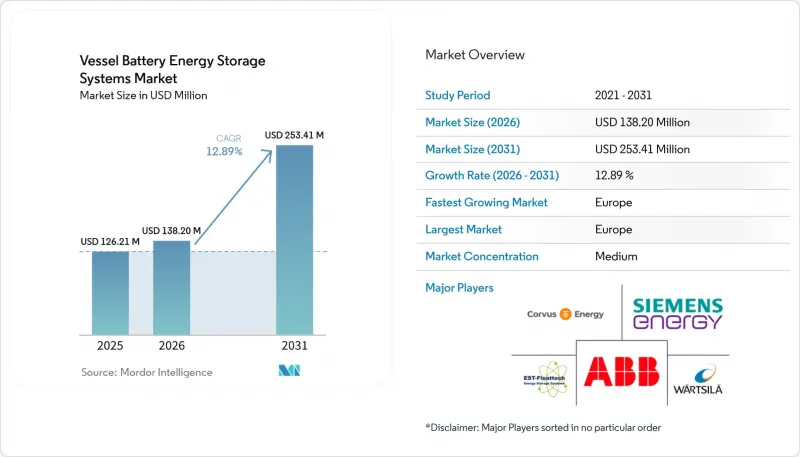
에 따르면 선박용 배터리 에너지 저장 시스템 시장 규모는 2025년 1억 2,621만 달러에서 2026년에는 1억 3,820만 달러로 확대되어, 2031년까지 2억 5,341만 달러에 달할 것으로 예상되며, 2026년부터 2031년까지 CAGR 12.89%로 성장할 것으로 전망됩니다.
전 세계 선박용 배터리 에너지 저장 시스템 시장의 동향 및 인사이트
하이브리드 선박 및 전기 선박에 대한 수요 증가가 배터리 시스템 수요를 견인하고 있습니다.
하이브리드 및 완전 전기 추진 시스템은 운항 주기가 빈번한 단거리 항로에서 더욱 매력적인 선택지가 되고 있습니다. 배터리의 충방전 주기가 단순한 규제 준수를 넘어 총 운영 비용 절감에도 기여할 수 있다면, 선박용 배터리 에너지 저장 시스템 시장은 그 혜택을 누릴 수 있습니다. 발츠일라(Wartsila)는 2026년 1월, 인캣 태즈메이니아(Incatt Tasmania)로부터 몰슬린옌(Morslinjen)사의 고속 페리용으로 3건 연속 전기 추진 시스템 수주를 확보했습니다. 이러한 반복적인 선정은 운항 사업자가 관련 선박 전체에 걸쳐 검증된 아키텍처를 표준화할 수 있음을 보여줍니다. 이러한 접근 방식을 통해 후속 선박에 필요한 설계 작업이 줄어들고, 조달 결정 기간을 단축할 수 있습니다. 또한, 예측 가능한 항로와 충전 환경을 갖춘 페리 운항 사업자에서 배터리의 보다 광범위한 도입을 촉진합니다.
엄격한 환경 규제가 청정에너지 도입을 가속화
규제로 인해 배출 성능은 현재 운항상의 과제가 되고 있으며, 이것이 유럽 및 국제 항로에서의 선박용 배터리 에너지 저장 시스템 시장을 뒷받침하고 있습니다. 국제해사기구(IMO)는 2025년 4월 제83차 MEPC 회의에서 ‘넷 제로 프레임워크’를 승인했습니다. 이는 전 세계 선박 연료에 대한 온실가스 강도 기준과 배출량 가격 책정 메커니즘을 결합한 것입니다. 이 프레임워크는 2027년에 발효될 전망입니다. ‘FuelEU Maritime’는 2025년 1월 1일부터 전면적으로 적용되고 있으며, 2026년 1월 31일까지 검증된 2025년도 온실가스 강도 데이터의 제출이 요구됩니다. 규정 위반에 대한 제재는 2026년 5월 1일부터 적용됩니다. 배터리를 활용한 운항을 통해 온실가스 강도를 낮출 수 있을 뿐만 아니라, 실적이 규제 요건을 초과할 경우 자금화하거나 양도할 수 있는 컴플라이언스 잉여 단위를 창출할 가능성이 있습니다.
높은 초기 투자 비용으로 인해 선도적인 사업자 이외의 분야에서의 도입이 제한되고 있습니다.
초기 투자는 중소 규모 해운사, 어선단 및 저소득 무역 지역의 운항 사업자에게 여전히 장벽으로 작용하고 있습니다. 올보 대학의 분석에 따르면, 표준 전기 페리의 10년간 총 소유 비용은 328만 유로인 반면, 동등한 디젤·전기 페리의 경우 248만 유로였습니다. 이 조사에서는 1일당 항로 이용률이 높은 경우에만 양자의 비용이 동등해지는 것으로 밝혀졌습니다. 선박용 인증 시스템에는 진동 대책, 안전 인클로저, 선급 인증 요건 등이 포함되어 있으며, 이러한 요소들이 비용을 상승시키고 있습니다. 따라서 운항 빈도가 높은 근해 페리 노선의 경우, 원양 노선이나 이용률이 낮은 화물 운송 용도보다 더 빨리 경제적으로 수익성이 확보되는 수준에 도달할 수 있습니다. 이러한 비용 격차는 경험과 비용 면에서 우위를 점할 수 있는 조기 도입자에게 우대 조치를 제공함으로써 선박용 배터리 에너지 저장 시스템 시장을 형성하고 있습니다.
부문 분석
2025년 시점에서 NMC는 선박용 배터리 에너지 저장 시스템 시장에서 금액 기준 79.1%의 점유율을 차지했습니다. 이는 NMC의 에너지 밀도가 제한된 공간이나 중량 제한이 있는 설계에 대응할 수 있기 때문입니다. LFP는 2026년부터 2031년까지 연평균 성장률(CAGR) 15.8%로 성장할 것으로 예측되며, 이는 화학 계열 유형 중 가장 높은 성장률입니다. 열적 안정성 덕분에 화재 위험과 관련된 인증 절차의 복잡성을 줄일 수 있을 뿐만 아니라, 중국 제조사들이 LFP 셀의 비용 절감을 주도하고 있습니다. 싱가포르 해양 연구소가 7종류의 선박을 대상으로 실시한 평가에 따르면, 충방전 사이클 특성 및 안전 요건 측면에서 LFP가 페리, 해양지원선, 어선에 적합한 것으로 밝혀졌습니다. 선박용 배터리 에너지 저장 시스템 업계에서는 NMC의 공간적 우위와 LFP의 안전성 및 수명주기 특성이 균형을 이루고 있습니다.
Ni-Cd 배터리는 극한 온도 범위에서의 운용이 요구되는 군사 용도에서 여전히 중요한 역할을 하고 있는 반면, LTO 배터리는 급속 충전으로 인한 높은 비용이 정당화되는 단주기 운항 페리나 항만 예인선에 채택되고 있습니다. 2026년 1월에 발간된 ISO 18962:2026은 교체 가능한 선박용 배터리의 설치 및 운영 요건을 규정하고 있습니다. 이 규격은 선박용 배터리 에너지 저장 시스템 시장에서 모듈식 설계를 지원하며, 시스템 전체를 교체하지 않고도 선박의 운항 기간 동안 배터리 화학 성분을 업그레이드할 수 있게 할 가능성이 있습니다. Corvus Energy와 BYD Energy Storage는 2026년 5월, 고출력 LFP 선박용 시스템을 개발하기 위한 전략적 협력 협약을 체결했습니다. 이 협정은 주요 선박용 배터리 공급업체들이 LFP 개발을 추진하는 한편, NMC 공급업체들이 공간 제약이 있는 용도에서 자사의 입지를 유지하려 하고 있음을 보여줍니다.
2025년, 선박용 배터리 에너지 저장 시스템 시장에서 신조선에 탑재된 비중이 75.2%를 차지했습니다. 이는 신조선의 경우 처음부터 배터리 베이 및 전기 시스템을 고려하여 설계할 수 있기 때문입니다. 한편, 개조 시장은 2026년부터 2031년까지 연평균 성장률(CAGR) 15.6%로 성장할 것으로 예측됩니다. 이는 운항 사업자가 선박 교체를 기다리지 않고, 계획된 드라이독 기간 중에 배터리 팩을 추가하기 때문입니다. 이를 통해 노후화된 디젤·전기 추진 선단의 온실가스 배출 강도를 개선할 수 있게 됩니다. 또한, 선사가 기존 선체를 유지하면서 규제 요건을 충족하는 데에도 도움이 됩니다. 선박용 배터리 에너지 저장 시스템 업계는 신조선 조달 준비가 되어 있지 않은 선단에 대한 진입 경로를 더욱 넓히고 있습니다.
개조 프로젝트에서는 기존 전기 시스템, 선박 레이아웃 및 선급 협회의 요건과의 신중한 통합이 요구됩니다. 와사라인(Wasa Line)의 ‘오로라 보토니아(Aurora Botnia)’호는 2026년 초 10.4 MWh의 LFP 배터리를 장착하는 개조를 거쳐 DNV의 선급 승인을 획득하고, 선내 총 용량을 12.6 MWh로 늘렸습니다. 이 프로젝트는 대규모 배터리 업그레이드라도 운항 중단 시간을 최소화하며 완료할 수 있음을 입증했습니다. 에버렌스(Everence)와 WE테크 솔루션즈(WE Tech Solutions)는 정기적인 드라이독 입항 기간 동안 최대 33척을 대상으로 한 파워 테이크오프(PTO) 및 가변 주파수 구동 장치(VFD) 업그레이드에 관한 시범 사업에 대해 협의해 왔습니다. 이러한 설치 방식은 선박 교체까지 장기간 운항을 지속하는 화물선 및 어선 선단에 특히 적합합니다.
지역별 분석
유럽은 2025년 선박용 배터리 에너지 저장 시스템 시장 점유율의 70.8%를 차지하고 있으며, 2031년까지 연평균 성장률(CAGR) 14.1%로 성장할 것으로 예측됩니다. 이러한 우위는 배기가스 규제, 확립된 페리 전기화 회랑, 그리고 노르웨이, 독일, 스웨덴, 네덜란드에 기반을 둔 선박용 배터리 공급업체의 존재를 반영합니다. 독일의 HADAG사는 함부르크에서 3척의 완전 전기식 항만 페리를 운항하고 있으며, 각 선박에는 3.8 MWh 용량의 Lehmann Marine사 CUBE LFP 시스템이 탑재되어 있습니다. 스칸디나비아 지역에서는 Aurora Botnia호의 개조 및 Baltic Whale사의 화물 운송 사업을 통해 대규모 도입 실적이 입증되었습니다. 활발한 페리 교체 프로그램과 2030년 이후 여객선 및 컨테이너선에 대해 EU가 의무화할 부두 전원 공급 요건이 지속적인 수요를 뒷받침하고 있습니다.
아시아태평양은 선박용 배터리 에너지 저장 시스템 시장에서 기술적으로 가장 활발하게 성장하고 있는 지역입니다. 중국에서는 2026년 4월, 20,000 kWh의 배터리 저장 용량과 자율 항해 기능을 통합한 1만 톤급 순수 전기식 스마트 컨테이너선이 취항했습니다. 이 선박은 고전압 부두 전원 및 배터리 컨테이너 스와핑 기술도 채택하고 있습니다. 일본의 ‘MEGURI 2040’ 프로그램에서는 2026년에 4척의 자율 항해 선박이 정부 인증을 획득했으며, 미쓰이 상선(MOL)은 여러 선박을 육상에 위치한 함대 운영 센터와 실시간으로 연결했습니다. 이러한 진전에 따라, 신뢰성이 높은 배터리를 통한 전력 품질이 자율 항해 선박 운항의 핵심이 되고 있습니다.
북미에서는 주 정부가 추진하는 페리 프로그램과 배터리 구동 선박 시스템에 대한 국방 분야의 관심을 통해 진전이 나타나고 있습니다. 워싱턴주 페리의 하이브리드 전기 신조선에는 ABB사와 Corvus Energy사의 제휴를 통해 13.2 MWh 규모의 배터리 시스템이 채택되었습니다. BC 페리의 ‘서밋 클래스(Summit Class)’ 선박은 1척당 최대 70 MWh의 배터리를 탑재할 수 있도록 설계되었습니다. 남미에서는 충전 인프라가 아직 구축 단계에 있기 때문에 도입은 초기 단계에 머물러 있습니다. 한편, 중동 및 아프리카도 사우디아라비아와 아랍에미리트(UAE)의 관심이 있기는 하지만, 도입은 초기 단계에 머물러 있습니다.
기타 혜택:
- 엑셀 형식의 시장 예측(ME) 시트
- 3개월간의 애널리스트 지원
자주 묻는 질문
목차
제1장 소개
- 조사 가정과 시장 정의
- 조사 범위
제2장 조사 방법
제3장 주요 요약
제4장 시장 구도
- 시장 개요
- 시장 성장 촉진요인
- 시장 성장 억제요인
- 공급망 분석
- Porter's Five Forces 분석
- 기술 동향
- 규제 상황
- 투자 분석
제5장 시장 규모와 성장 예측
- 화학별
- 도입 구성별
- 선박 종류별
- 용도별
- 지역별
- 북미
- 미국
- 캐나다
- 멕시코
- 유럽
- 독일
- 프랑스
- 이탈리아
- 스페인
- 영국
- 폴란드
- 러시아
- 기타 유럽 국가
- 아시아태평양
- 중국
- 인도
- 일본
- 한국
- 호주
- 인도네시아
- 베트남
- 태국
- 기타 아시아태평양 국가
- 남미
- 브라질
- 아르헨티나
- 칠레
- 기타 남미 국가
- 중동 및 아프리카
- 사우디아라비아
- 아랍에미리트
- 이집트
- 남아프리카공화국
- 모로코
- 기타 중동 및 아프리카 국가
- 북미
제6장 경쟁 구도
- 시장 집중도
- 전략적 동향
- 시장 점유율 분석
- 기업 개요
- ABB Ltd
- AYK Energy
- BorgWarner Inc.
- Corvus Energy Holding AS
- EAS Batteries GmbH
- Echandia Marine AB
- ePropulsion Europe SLU
- EST-Floattech B.V.
- EVE Energy Co., Ltd.
- Kongsberg Gruppen ASA
- KREISEL Electric GmbH
- Leclanche SA
- Lehmann Marine GmbH
- Saft Groupe S.A.S.
- Siemens Energy AG
- Sunlight Group
- Wartsila Oyj Abp
- ZEM AS
제7장 시장 기회와 향후 전망
KSMAccording to Mordor Intelligence, the vessel battery energy storage systems market size is expected to increase from USD 126.21 million in 2025 to USD 138.20 million in 2026 and reach USD 253.41 million by 2031, growing at a CAGR of 12.89% over 2026-2031.
Global Vessel Battery Energy Storage Systems Market Trends and Insights
Rising Demand for Hybrid and Electric Vessels Drives Battery System Volume
Hybrid and all-electric propulsion have become more attractive for short-haul routes with frequent operating cycles. The vessel battery energy storage systems market benefits when battery cycling can reduce total operating costs rather than only support compliance. Wartsila received its third successive electric propulsion order for a Molslinjen high-speed ferry at Incat Tasmania in January 2026. The repeated selection shows that operators can standardize a proven architecture across related vessels. This approach reduces the engineering effort needed for follow-on ships and can shorten procurement decisions. It also supports wider battery deployment among ferry operators that have predictable routes and charging access.
Stringent Environmental Regulations Accelerate Clean Energy Adoption
Regulation has made emissions performance a current operating issue that supports the vessel battery energy storage systems market in European and international trades. The IMO approved its Net-Zero Framework at MEPC 83 in April 2025, combining a global marine-fuel greenhouse gas intensity standard with an emissions pricing mechanism. The framework is anticipated to enter into force in 2027. FuelEU Maritime has applied fully since January 1, 2025, and requires verified 2025 greenhouse gas intensity data by January 31, 2026. Penalties for noncompliance apply from May 1, 2026. Battery-assisted operations can lower attained greenhouse gas intensity and may create bankable or transferable compliance surplus units when performance exceeds the regulation's requirements.
High Initial Capital Cost Constrains Adoption Beyond Lead-Operator Segments
Initial investment remains a barrier for smaller shipping companies, fishing fleets, and operators in lower-income trade regions. An Aalborg University analysis found that a baseline electric ferry produced EUR 3.28 million in 10-year total cost of ownership, compared with EUR 2.48 million for a diesel-electric equivalent. The study found parity only at higher daily route utilization. Marine-certified systems include vibration protection, safety enclosures, and class-certification requirements that add cost. High-frequency short-sea ferry routes can therefore reach a workable economic threshold earlier than offshore or low-utilization cargo applications. This cost divide shapes the vessel battery energy storage systems market by favoring early users who can build experience and cost advantages.
Other drivers and restraints analyzed in the detailed report include:
- Technological Advancements Improve Marine Battery Performance and Lifecycle Economics
- Shore Power and Port Electrification Reshape Vessel Battery Utility
- Inadequate Port Charging Infrastructure Limits Battery-Dependent Route Expansion
For complete list of drivers and restraints, kindly check the Table Of Contents.
Segment Analysis
NMC held 79.1% of the vessel battery energy storage systems market by value in 2025 because its energy density supports designs with tight space and weight limits. LFP is forecast to grow at a 15.8% CAGR from 2026 to 2031, the fastest rate among chemistry types. Its thermal stability can reduce fire-risk certification complexity, while Chinese manufacturers have supported a declining LFP cell cost curve. A Singapore Maritime Institute assessment of 7 vessel types identified LFP as suitable for ferries, offshore support vessels, and fishing vessels because of their cycling patterns and safety requirements. The vessel battery energy storage systems industry is balancing NMC's space advantage against LFP's safety and lifecycle attributes.
Ni-Cd remains relevant in military applications that require operation across extreme temperatures, while LTO serves short-turnaround ferries and harbor tugs where rapid charging can justify a cost premium. ISO 18962:2026, published in January 2026, sets installation and operating requirements for swappable ship batteries. The standard supports modular designs in the vessel battery energy storage systems market and may enable chemistry upgrades during a vessel's working life without a full system replacement. Corvus Energy and BYD Energy Storage signed a strategic cooperation agreement in May 2026 to develop high-rate LFP marine systems. The agreement shows that a major marine battery supplier is pursuing LFP development while NMC suppliers seek to sustain their position in space-constrained applications
Newbuild installations held 75.2% of the vessel battery energy storage systems market in 2025 because new vessels can be designed around battery bays and electrical systems from the beginning. Retrofits are forecast to grow at a 15.6% CAGR from 2026 to 2031 as operators add packs during planned dry-docking periods rather than wait for vessel replacement. This allows aging diesel-electric fleets to improve greenhouse gas intensity performance. It also helps operators manage regulatory requirements while preserving the use of existing hulls. The vessel battery energy storage systems industry is finding a wider route into fleets that are not ready for newbuild procurement.
Retrofit projects require careful integration with existing electrical architecture, vessel layout, and class requirements. Wasaline's Aurora Botnia received a 10.4 MWh LFP retrofit in early 2026, lifting total onboard capacity to 12.6 MWh with DNV class approval. The project demonstrated that large battery upgrades can be completed with limited operational downtime. Everllence and WE Tech Solutions were discussing a pilot covering up to 33 vessels for Power Take-Off and Variable Frequency Drive upgrades during scheduled dry dockings. This installation route is particularly relevant for cargo and fishing fleets that operate for long periods before replacement.
Complete Report Scope:
- By Chemistry
- NMC (Lithium Nickel Manganese Cobalt Oxide Battery)
- LFP (Lithium Iron Phosphate Battery)
- Ni-Cd (Nickel-Cadmium Battery)
- Lithium Titanate Oxide (LTO)
- Other Types (NCA, TNO, XNO, etc.)
- By Installation Configuration
- Newbuild
- Retrofit
- By Vessel Type
- Cargo Ships
- Passenger Ships
- Naval Vessels
- Fishing Vessels
- Offshore Support Vessels
- Others
- By Application
- Auxiliary Power Units
- Main Propulsion Systems
- Emergency Power Supply
- Renewable Energy Integration
- Hybrid Power Systems
- By Geography
- North America
- United States
- Canada
- Mexico
- Europe
- Germany
- France
- Italy
- Spain
- United Kingdom
- Poland
- Russia
- Rest of Europe
- Asia-Pacific
- China
- India
- Japan
- South Korea
- Australia
- Indonesia
- Vietnam
- Thailand
- Rest of Asia-Pacific
- South America
- Brazil
- Argentina
- Chile
- Rest of South America
- Middle East and Africa
- Saudi Arabia
- United Arab Emirates
- Egypt
- South Africa
- Morocco
- Rest of Middle East and Africa
- North America
Geography Analysis
Europe held 70.8% of vessel battery energy storage systems market share in 2025 and is forecast to grow at a 14.1% CAGR through 2031. Its lead reflects emissions regulation, established ferry electrification corridors, and marine battery suppliers in Norway, Germany, Sweden, and the Netherlands. Germany's HADAG fleet is deploying 3 fully electric harbor ferries in Hamburg, each with a 3.8 MWh Lehmann Marine CUBE LFP system. Scandinavia has demonstrated large installed capacity through the Aurora Botnia retrofit and the Baltic Whale freight operation. Active ferry replacement programs and the EU shore power requirement for passenger and container ships from 2030 provide continued demand support.
Asia-Pacific is the most technically active growth region in the vessel battery energy storage systems market. China commissioned a 10,000-ton-class pure-electric intelligent container ship in April 2026 with 20,000 kWh of battery storage and integrated autonomous navigation. The vessel also uses high-voltage shore power and battery-container swapping. Japan's MEGURI2040 program secured government certification for 4 autonomous vessels in 2026, and MOL connected multiple ships in real time to land-based Fleet Operation Centers. These developments place reliable battery-backed power quality at the center of autonomous vessel operations.
North America is advancing through state-procured ferry programs and defense interest in battery-electric vessel systems. Washington State Ferries' hybrid-electric newbuilds use 13.2 MWh battery systems through an ABB and Corvus Energy partnership. BC Ferries' Summit Class vessels are designed for up to 70 MWh per vessel. South America remains at an earlier stage because charging infrastructure is still being developed, while the Middle East and Africa are also early in adoption despite interest from Saudi Arabia and the United Arab Emirates.
- ABB Ltd
- AYK Energy
- BorgWarner Inc.
- Corvus Energy Holding AS
- EAS Batteries GmbH
- Echandia Marine AB
- ePropulsion Europe SLU
- EST-Floattech B.V.
- EVE Energy Co., Ltd.
- Kongsberg Gruppen ASA
- KREISEL Electric GmbH
- Leclanche SA
- Lehmann Marine GmbH
- Saft Groupe S.A.S.
- Siemens Energy AG
- Sunlight Group
- Wartsila Oyj Abp
- ZEM AS
Additional Benefits:
- The market estimate (ME) sheet in Excel format
- 3 months of analyst support
TABLE OF CONTENTS
1 INTRODUCTION
- 1.1 Study Assumptions and Market Definition
- 1.2 Scope of the Study
2 RESEARCH METHODOLOGY
3 EXECUTIVE SUMMARY
4 MARKET LANDSCAPE
- 4.1 Market Overview
- 4.2 Market Drivers
- 4.2.1 Rising Demand for Hybrid and Electric Vessels to Reduce Emissions.
- 4.2.2 Stringent Environmental Regulations Driving Adoption of Clean Energy Solutions.
- 4.2.3 Technological Advancements in Marine Battery Systems are Improving Efficiency.
- 4.2.4 Increasing Investments in Renewable Energy Integration for Maritime Operations.
- 4.2.5 Growing Demand for Shore Power and Port Electrification is Supporting Vessel Battery Adoption.
- 4.2.6 Expansion of Autonomous and Digitally Connected Vessels is Increasing Demand for Reliable Onboard Energy Storage.
- 4.3 Market Restraints
- 4.3.1 High Initial Cost of Battery Energy Storage Systems for Vessels.
- 4.3.2 Limited Charging Infrastructure in Ports and Marine Routes.
- 4.3.3 Safety Concerns Related to Battery Thermal Management and Fire Risks.
- 4.3.4 Short Lifecycle and Performance Degradation In Harsh Marine Environments.
- 4.4 Supply-Chain Analysis
- 4.5 Porter's Five Forces Analysis
- 4.5.1 Bargaining Power of Suppliers
- 4.5.2 Bargaining Power of Buyers
- 4.5.3 Threat of New Entrants
- 4.5.4 Threat of Substitutes
- 4.5.5 Competitive Rivalry
- 4.6 Technology Outlook
- 4.7 Regulatory Landscape
- 4.8 Investment Analysis
5 MARKET SIZE AND GROWTH FORECASTS
- 5.1 By Chemistry
- 5.1.1 NMC (Lithium Nickel Manganese Cobalt Oxide Battery)
- 5.1.2 LFP (Lithium Iron Phosphate Battery)
- 5.1.3 Ni-Cd (Nickel-Cadmium Battery)
- 5.1.4 Lithium Titanate Oxide (LTO)
- 5.1.5 Other Types (NCA, TNO, XNO, etc.)
- 5.2 By Installation Configuration
- 5.2.1 Newbuild
- 5.2.2 Retrofit
- 5.3 By Vessel Type
- 5.3.1 Cargo Ships
- 5.3.2 Passenger Ships
- 5.3.3 Naval Vessels
- 5.3.4 Fishing Vessels
- 5.3.5 Offshore Support Vessels
- 5.3.6 Others
- 5.4 By Application
- 5.4.1 Auxiliary Power Units
- 5.4.2 Main Propulsion Systems
- 5.4.3 Emergency Power Supply
- 5.4.4 Renewable Energy Integration
- 5.4.5 Hybrid Power Systems
- 5.5 By Geography
- 5.5.1 North America
- 5.5.1.1 United States
- 5.5.1.2 Canada
- 5.5.1.3 Mexico
- 5.5.2 Europe
- 5.5.2.1 Germany
- 5.5.2.2 France
- 5.5.2.3 Italy
- 5.5.2.4 Spain
- 5.5.2.5 United Kingdom
- 5.5.2.6 Poland
- 5.5.2.7 Russia
- 5.5.2.8 Rest of Europe
- 5.5.3 Asia-Pacific
- 5.5.3.1 China
- 5.5.3.2 India
- 5.5.3.3 Japan
- 5.5.3.4 South Korea
- 5.5.3.5 Australia
- 5.5.3.6 Indonesia
- 5.5.3.7 Vietnam
- 5.5.3.8 Thailand
- 5.5.3.9 Rest of Asia-Pacific
- 5.5.4 South America
- 5.5.4.1 Brazil
- 5.5.4.2 Argentina
- 5.5.4.3 Chile
- 5.5.4.4 Rest of South America
- 5.5.5 Middle East and Africa
- 5.5.5.1 Saudi Arabia
- 5.5.5.2 United Arab Emirates
- 5.5.5.3 Egypt
- 5.5.5.4 South Africa
- 5.5.5.5 Morocco
- 5.5.5.6 Rest of Middle East and Africa
- 5.5.1 North America
6 COMPETITIVE LANDSCAPE
- 6.1 Market Concentration
- 6.2 Strategic Moves
- 6.3 Market Share Analysis
- 6.4 Company Profiles (includes Global Level Overview, Market Level Overview, Core Segments, Financials as available, Strategic Information, Products and Services, Recent Developments)
- 6.4.1 ABB Ltd
- 6.4.2 AYK Energy
- 6.4.3 BorgWarner Inc.
- 6.4.4 Corvus Energy Holding AS
- 6.4.5 EAS Batteries GmbH
- 6.4.6 Echandia Marine AB
- 6.4.7 ePropulsion Europe SLU
- 6.4.8 EST-Floattech B.V.
- 6.4.9 EVE Energy Co., Ltd.
- 6.4.10 Kongsberg Gruppen ASA
- 6.4.11 KREISEL Electric GmbH
- 6.4.12 Leclanche SA
- 6.4.13 Lehmann Marine GmbH
- 6.4.14 Saft Groupe S.A.S.
- 6.4.15 Siemens Energy AG
- 6.4.16 Sunlight Group
- 6.4.17 Wartsila Oyj Abp
- 6.4.18 ZEM AS
7 MARKET OPPORTUNITIES AND FUTURE OUTLOOK
- 7.1 White-Space and Unmet-Need Assessment


