|
시장보고서
상품코드
2124662
아시아태평양의 유리병 및 용기 시장 : 시장 점유율 분석, 업계 동향 및 통계, 성장 예측(2026-2031년)Asia-Pacific Glass Bottles And Containers - Market Share Analysis, Industry Trends & Statistics, Growth Forecasts (2026 - 2031) |
||||||
 Mordor Intelligence
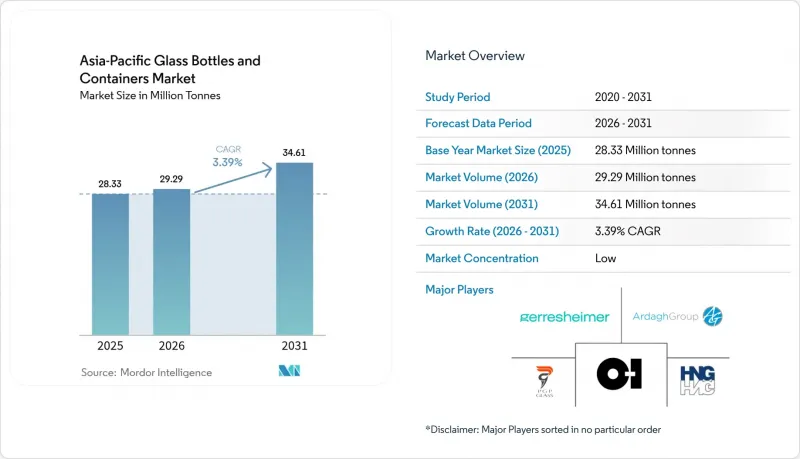
Mordor Intelligence에 의하면, 아시아태평양의 유리병 및 용기 시장 규모는 2025년에 2,833만 톤으로 평가되었고, 2026년 2,929만 톤에서 2031년까지 3,461만 톤에 이를 것으로 예측되며, 예측 기간(2026-2031년) CAGR은 3.39%를 나타낼 전망입니다.
본 보고서는 최종 사용자별(음료(주류(맥주, 와인, 증류주 등) 및 무알코올 음료(탄산음료(CSD), 유제품 베이스 음료 등)), 식품(잼·젤리, 조미료·소스 등), 화장품 및 퍼스널케어, 기타), 색상별(플린트, 앰버, 기타) 및 국가별로 분류되어 있습니다. 시장 예측은 수량(톤) 단위로 표시됩니다.
아시아태평양의 유리병 및 용기 시장 동향 및 인사이트
중국과 인도가 유리 용기 수출을 확대
중국은 수십 년에 걸친 대규모 용해로 생산 능력과 비용 최적화된 물류망을 활용하여, 수입에 의존하는 인근 아세안(ASEAN) 시장에 공급하고 있습니다. 한편, 인도는 낮은 인건비와 국제 품질 기준에 부합하는 최신 설비를 활용하고 있습니다. 인도와 스리랑카에 걸쳐 있는 PGP Glass의 일일 1,600톤 생산 능력은 수출 지향형 모델을 보여주고 있으며,이를 통해 동남아시아의 소규모 생산자들로부터 시장 점유율을 빼앗기 시작하고 있지만, 이러한 우위가 지속될지는 에너지 비용 우위를 유지하고 경쟁력 있는 가격으로 카렛(폐유리)을 확보할 수 있느냐에 달려 있습니다. 양국 간의 이러한 수출 호조는 양국의 용광로 가동률을 높이고 해외 출하 단위 비용을 절감함으로써, 지역 전체의 연평균 성장률(CAGR)을 총 약 0.8포인트 끌어올리고 있습니다.
유리 제조 기술의 발전
재생에너지로 생산된 전력을 80%, 가스 연소를 20%로 가동하는 하이브리드 용광로는 특히 게레스하이머(Geresheimer)와 아르다그(Ardag)가 운영하는 시설에서 시범 단계에서 상업적 규모로 전환되었습니다. 베랄리아(Veralia)사가 코냑에 도입한 완전 전기 용광로는 100% 전기화가 실현 가능함을 입증하고 있으며, 스코프 1 배출량을 대폭 감축할 수 있는 길을 제시하고 있습니다. 인더스트리 4.0을 통한 제어, 예측 유지보수, 디지털 품질 검사, 실시간 에너지 최적화와 결합된 이러한 혁신 기술은 톤당 에너지 소비량을 최대 30%까지 절감할 수 있어, 아시아태평양의 용기용 유리 시장 전체에서 수익성 향상과 규제 준수 준비 태세를 직접적으로 강화하는 데 기여합니다.
유리 제조의 높은 에너지 소비
용해로 가동은 공장 전체 에너지 소비량의 60-70%를 차지할 수 있으며, 제조업체들은 전기 요금 급등과 가스 가격 변동 위험에 노출되어 있습니다. 중국의 겨울철 전력 배급 조치와 인도의 송전망 신뢰성 문제는 시급한 비용 압박을 초래하고 있으며, 사업자들은 칼렛 사용을 가속화하고 바이오 LNG나 그린 수소 등의 대체 연료 도입을 시도할 수밖에 없는 상황입니다. O-I사가 할로우 공장에서 실시한 100% 바이오연료 시험에서는 88%의 칼렛 사용률과 대폭적인 CO2 감축이 입증되었으며, 원료 확보가 여전히 과제이긴 하지만 현실적인 배출 감축 방안이 제시되었습니다.
부문별 분석
화장품 및 퍼스널케어 부문은 2025년 시점에서도 음료가 아시아태평양 용기용 유리 시장 점유율의 62.12%를 차지했음에도 불구하고, 연평균 성장률(CAGR) 4.63%로 다른 모든 부문을 상회할 것으로 예측됩니다. 향수병은 단위당 이익률이 가장 높고, 복잡한 형상, 엠보싱 가공, 착색 유리가 요구되는 경우가 많기 때문에 평균 판매 가격은 범용 음료 용기를 크게 상회합니다.
또한, 프리미엄 증류주나 수제 맥주의 경우 브랜드 스토리텔링에 부합하는 맞춤형 플린트 유리나 앰버 유리병이 지정되는 경우가 많아, 이에 따라 아시아태평양 용기용 유리 시장의 수익원은 더욱 다양해지고 있습니다. 바이알이나 앰플을 제외한 의약품 분야 수요는 안정적이지만, 규제상의 무결성 요건으로 인해 유리가 여전히 주요 소재로 선택되고 있어 신뢰할 수 있는 기반 사업이 유지되고 있습니다.
기타 혜택 :
- 엑셀 형식 시장 예측(ME) 시트
- 3개월간의 애널리스트 지원
자주 묻는 질문
목차
제1장 서론
제2장 조사 방법
제3장 주요 요약
제4장 시장 구도
제5장 시장 규모 및 성장 예측
제6장 경쟁 구도
제7장 시장 기회 및 향후 전망
AJY 26.09.15According to Mordor Intelligence, the Asia-Pacific glass bottles and Containers Market size was valued at 28.33 million tonnes in 2025 and estimated to grow from 29.29 million tonnes in 2026 to reach 34.61 million tonnes by 2031, at a CAGR of 3.39% during the forecast period (2026-2031).

This report is Segmented by End-User (Beverages [Alcoholic {Beer, Wine, Spirits, and More}, and Non-Alcoholic {Carbonated Drinks (CSDs), Dairy Product Based Drinks, and More}], Food [Jam and Jelly, Condiments and Sauces, and More], Cosmetics and Personal Care, and More), Color (Flint, Amber, and More) and Country. The Market Forecasts are Provided in Terms of Volume (Tonnes).
Asia-Pacific Glass Bottles And Containers Market Trends and Insights
China and India Ramping Up Glass Container Exports
China leverages decades of large-scale furnace capacity and cost-optimized logistics to serve neighboring import-dependent ASEAN markets, while India capitalizes on lower labor costs and newer assets tailored for global quality standards. PGP Glass's 1,600 tons-per-day capacity across India and Sri Lanka illustrates an export-oriented model that has begun diverting share away from smaller Southeast Asian producers, although the permanence of these gains hinges on maintaining energy-cost advantages and access to cullet at competitive prices. Such bilateral export momentum collectively adds roughly 0.8 percentage points to the regional CAGR by improving furnace utilization in both countries and narrowing unit costs for overseas shipments.
Technological Advancements in Glass Manufacturing
Hybrid furnaces operating on 80% renewable electricity and 20% gas combustion have moved from pilot to commercial scale, notably at facilities operated by Gerresheimer and Ardagh. Verallia's fully electric furnace in Cognac demonstrates the feasibility of 100% electrification, signaling a path toward drastically lower Scope 1 emissions. Coupled with Industry 4.0 controls, predictive maintenance, digital quality inspection, and real-time energy optimization, these innovations can lower energy consumption per ton by up to 30%, directly lifting margins and regulatory compliance readiness across the Asia-Pacific container glass market.
High Energy Consumption in Glass Production
Furnace operations can consume 60-70% of total plant energy, exposing manufacturers to elevated electricity tariffs and gas price volatility. China's winter power-rationing episodes and India's grid reliability challenges add immediate cost pressure, compelling operators to accelerate cullet utilization and experiment with alternative fuels such as bio-LNG and green hydrogen. O-I's 100% biofuel trial at its Harlow plant demonstrated an 88% cullet rate and sizable CO2 reductions, hinting at a realistic mitigation pathway even though feedstock availability remains a hurdle.
Other drivers and restraints analyzed in the detailed report include:
- Government Regulations Supporting Recycling
- Rising Demand from Food and Beverage Sector
- Volatility in Raw Material Prices
For complete list of drivers and restraints, kindly check the Table Of Contents.
Segment Analysis
The cosmetics and personal care segment is projected to outpace all others at a 4.63% CAGR, even though beverages still commanded 62.12% of the Asia-Pacific container glass market share in 2025. Perfumery bottles yield the highest unit margins and often require complex shapes, embossing, and colored glass, pushing average selling prices well above commodity beverage containers.
Premium spirits and craft beer also specify custom flint and amber bottles that align with brand storytelling, further diversifying revenue streams within the Asia-Pacific container glass market. Although pharmaceutical demand outside vials and ampoules remains stable, regulatory integrity requirements keep glass as the substrate of choice, preserving a dependable baseline business.
Complete Report Scope:
- By End-user
- Beverages
- Alcoholic
- Beer
- Wine
- Spirits
- Other Alcoholic Beverages (Cider and Other Fermented Drinks)
- Non-Alcoholic
- Juices
- Carbonated Drinks (CSDs)
- Dairy Product Based Drinks
- Other Non-Alcoholic Beverages
- Alcoholic
- Food (Jam, Jelly, Marmalades, Honey, Sausages and Condiments, Oil, Pickles)
- Cosmetics and Personal Care
- Pharmaceuticals (excluding Vials and Ampoules)
- Perfumery
- Beverages
- By Color
- Green
- Amber
- Flint
- Other Colors
- By Country
- China
- India
- Japan
- Thailand
- Australia and New Zealand
- South Korea
- Vietnam
- Rest of Asia-Pacific
List of Companies Covered in this Report:
- O-I Glass, Inc.
- Ardagh Group S.A.
- Verallia S.A.
- PGP Glass Private Limited
- Hindusthan National Glass & Industries Ltd.
- Feemio Glass Co., Ltd.
- Toyo Glass Co., Ltd.
- Nihon Yamamura Glass Co., Ltd.
- Gerresheimer AG
- Saverglass SAS
- Vitro S.A.B. de C.V.
- BA Glass Portugal, S.A.
- Stoelzle Glass Group GmbH
- Heinz-Glas GmbH & Co. KGaA
- Vetropack Holding AG
- Zignago Vetro S.p.A.
- Park Cam Sanayi ve Ticaret A.S.
- Orora Limited
- Koa Glass Co., Ltd.
- Bormioli Luigi S.p.A.
Additional Benefits:
- The market estimate (ME) sheet in Excel format
- 3 months of analyst support
TABLE OF CONTENTS
1 INTRODUCTION
- 1.1 Study Assumptions and Market Definition
- 1.2 Scope of the Study
2 RESEARCH METHODOLOGY
3 EXECUTIVE SUMMARY
4 MARKET LANDSCAPE
- 4.1 Market Overview
- 4.2 Market Drivers
- 4.2.1 China and India ramping up glass container exports
- 4.2.2 Technological Advancements in Glass Manufacturing
- 4.2.3 Government Regulations Supporting Recycling
- 4.2.4 Rising Demand from Food and Beverage Sector
- 4.2.5 Consumer Preference for Premium and Sustainable Packaging
- 4.2.6 Expansion of Recycling Infrastructure in Developed Asia-Pacific Countries
- 4.3 Market Restraints
- 4.3.1 High Energy Consumption in Glass Production
- 4.3.2 Volatility in Raw Material Prices
- 4.3.3 Infrastructure Limitations in Emerging Markets
- 4.3.4 Competitive Pressure from Plastic and Metal Alternatives
- 4.4 Industry Supply-Chain Analysis
- 4.5 Container Glass Furnace Capacity and Locations in Asia-Pacific
- 4.5.1 Plant Locations and Year of Commencement
- 4.5.2 Production Capacities
- 4.5.3 Types of Furnaces
- 4.5.4 Color of Glass Produced
- 4.6 Export-Import Data of Container Glass - Covering Key Import and Export Destinations
- 4.6.1 Import Volume and Value, 2021-2024
- 4.6.2 Export Volume and Value, 2021-2024
- 4.7 Porter's Five Forces Analysis
- 4.7.1 Threat of New Entrants
- 4.7.2 Bargaining Power of Suppliers
- 4.7.3 Bargaining Power of Buyers
- 4.7.4 Threat of Substitutes
- 4.7.5 Competitive Rivalry
- 4.8 Raw Material Analysis
- 4.9 Recycling Trends for Glass Packaging
- 4.10 Demand vs Supply Analysis for Glass Packaging
5 MARKET SIZE AND GROWTH FORECASTS (VOLUME)
- 5.1 By End-user
- 5.1.1 Beverages
- 5.1.1.1 Alcoholic
- 5.1.1.1.1 Beer
- 5.1.1.1.2 Wine
- 5.1.1.1.3 Spirits
- 5.1.1.1.4 Other Alcoholic Beverages (Cider and Other Fermented Drinks)
- 5.1.1.2 Non-Alcoholic
- 5.1.1.2.1 Juices
- 5.1.1.2.2 Carbonated Drinks (CSDs)
- 5.1.1.2.3 Dairy Product Based Drinks
- 5.1.1.2.4 Other Non-Alcoholic Beverages
- 5.1.1.1 Alcoholic
- 5.1.2 Food (Jam, Jelly, Marmalades, Honey, Sausages and Condiments, Oil, Pickles)
- 5.1.3 Cosmetics and Personal Care
- 5.1.4 Pharmaceuticals (excluding Vials and Ampoules)
- 5.1.5 Perfumery
- 5.1.1 Beverages
- 5.2 By Color
- 5.2.1 Green
- 5.2.2 Amber
- 5.2.3 Flint
- 5.2.4 Other Colors
- 5.3 By Country
- 5.3.1 China
- 5.3.2 India
- 5.3.3 Japan
- 5.3.4 Thailand
- 5.3.5 Australia and New Zealand
- 5.3.6 South Korea
- 5.3.7 Vietnam
- 5.3.8 Rest of Asia-Pacific
6 COMPETITIVE LANDSCAPE
- 6.1 Market Concentration
- 6.2 Strategic Moves and Developments
- 6.3 Company Market Share Analysis, (Based on Latest Production Capacity)
- 6.4 Company Profiles (includes Global level Overview, Market level overview, Core Segments, Financials as available, Strategic Information, Market Rank/Share for key companies, Products and Services, and Recent Developments)
- 6.4.1 O-I Glass, Inc.
- 6.4.2 Ardagh Group S.A.
- 6.4.3 Verallia S.A.
- 6.4.4 PGP Glass Private Limited
- 6.4.5 Hindusthan National Glass & Industries Ltd.
- 6.4.6 Feemio Glass Co., Ltd.
- 6.4.7 Toyo Glass Co., Ltd.
- 6.4.8 Nihon Yamamura Glass Co., Ltd.
- 6.4.9 Gerresheimer AG
- 6.4.10 Saverglass SAS
- 6.4.11 Vitro S.A.B. de C.V.
- 6.4.12 BA Glass Portugal, S.A.
- 6.4.13 Stoelzle Glass Group GmbH
- 6.4.14 Heinz-Glas GmbH & Co. KGaA
- 6.4.15 Vetropack Holding AG
- 6.4.16 Zignago Vetro S.p.A.
- 6.4.17 Park Cam Sanayi ve Ticaret A.S.
- 6.4.18 Orora Limited
- 6.4.19 Koa Glass Co., Ltd.
- 6.4.20 Bormioli Luigi S.p.A.
7 MARKET OPPORTUNITIES AND FUTURE OUTLOOK
- 7.1 White-space and Unmet-Need Assessment