

|
시장보고서
상품코드
2125420
이탈리아의 초음파 기기 시장 : 점유율 분석, 업계 동향과 통계, 성장 예측(2026-2031년)Italy Ultrasound Devices - Market Share Analysis, Industry Trends & Statistics, Growth Forecasts (2026 - 2031) |
||||||
 Mordor Intelligence
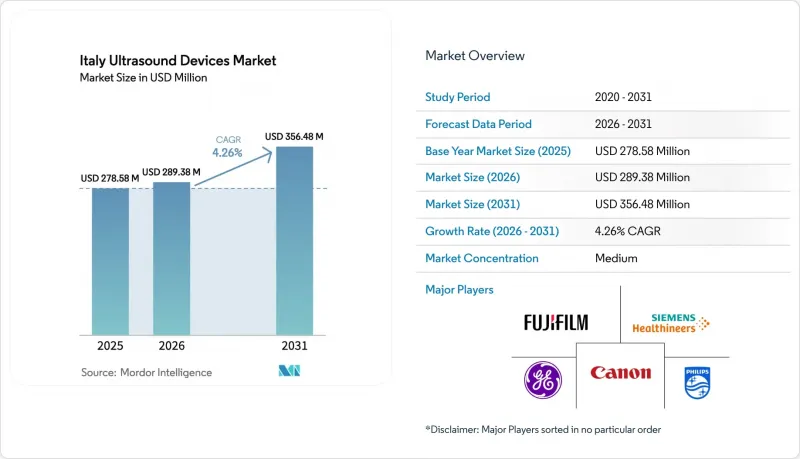
Mordor Intelligence에 의하면, 이탈리아 초음파 기기 시장 규모는 2025년 2억 7,858만 달러에서 2026년에는 2억 8,938만 달러로 확대되어 2026년부터 2031년까지 CAGR 4.26%로 성장을 지속하여, 2031년에는 3억 5,648만 달러에 이를 것으로 예측됩니다.
본 보고서는 용도(마취과, 순환기과, 산부인과, 근골격계, 방사선과 등), 기술(2D 초음파 영상 진단, 3D 및 4D 초음파 영상 진단 등), 휴대성(고정형 시스템 등), 최종 사용자(병원, 진단센터 등)별로 분류되어 있습니다. 시장 예측은 금액(달러) 및 수량(대)으로 제시되어 있습니다.
이탈리아 초음파 기기 시장 동향 및 인사이트
고령화와 만성 질환 부담 증가
이탈리아의 65세 이상 인구는 계속 증가하고 있으며, 이는 심장학, 근골격계 및 혈관 질환 치료 분야에서 초음파 진단에 대한 수요를 높이고 있습니다. 병원에서는 허약한 환자에 대해 병상 옆에서 즉시 사용할 수 있고, 비용 대비 효과가 높으며, 방사선 피폭이 없습니다는 이유로 이온화 방사선을 이용한 영상 진단보다 초음파 진단을 선호하고 있습니다. 노인 병동에서는 흉수 검사나 방광 스캔에 카트형 콘솔의 사용이 증가하는 한편, 병동 회진을 위해 휴대용 프로브도 도입되고 있습니다. SSN(이탈리아 국민건강보험)에 의한 안정적인 보험급여 제도가 높은 이용률을 보장하고 있으며, 구형 기기의 교체 주기를 유지하는 동시에 이탈리아 초음파 기기 시장의 성장 궤도를 뒷받침하고 있습니다.
3D/4D 및 AI 지원 영상 진단으로의 기술 전환
산과 부문에서는 상세한 해부학적 스캔을 의무화하는 이탈리아 산부인과 초음파 학회(Societa Italiana di Ecografia Ostetrica e Ginecologica)의 프로토콜을 따르고 있기 때문에 3D 및 4D 초음파가 시장 가치의 대부분을 차지하고 있습니다. GE 헬스케어의 ‘SonoLyst’와 같은 AI 모듈은 검사 시간을 65% 단축하는 한편, 심장학 분야에서는 MRI로 산출된 박출률에 근사한 값을 산출하는 휴대용 AI 도구의 유효성이 확인되었습니다. 병원 측은 처리 능력 향상과 측정 결과의 일관성을 정량화함으로써 고가의 비용을 정당화하고 있으며, 이에 따라 각 벤더사는 이미 도입된 전체 장비를 대상으로 한 소프트웨어 업그레이드를 통해 수익화를 추진하고 있습니다.
높은 도입 및 유지 비용
고급 3D/4D 콘솔의 정가는 10만-15만 유로이며, 연간 서비스 요금은 구매 가격의 8-12%에 달할 전망입니다. 이는 1인당 의료비가 전국 평균보다 낮은 칼라브리아주, 캄파니아주, 시칠리아주의 병원들에게 큰 과제가 되고 있습니다. PNRR(국가 부흥·회복 계획) 입찰에서는 8만 2,000유로 상당의 중급 플랫폼이 선호되지만, 리스나 종량제 요금 모델은 여전히 제한적입니다. 이러한 비용 압박으로 인해 5,000-1만 유로 가격대의 휴대용 기기의 연평균 성장률(CAGR)은 7.18%로 가속화되고 있으며, 이는 이탈리아 초음파 기기 시장 전체의 모달리티 구성에도 영향을 미치고 있습니다.
부문 분석
중환자 치료용 초음파는 5.83%의 연평균 성장률(CAGR)을 보일 것으로 예측되며, 다른 모든 용도를 능가하는 성장이 예상됩니다. 이 부문에서 이탈리아 초음파 기기 시장은 의사의 79%가 폐 및 심장 프로토콜, 연속 혈역학 모니터링, 병상 시술을 채택하고 있다는 점에서 혜택을 받고 있습니다. 방사선과는 여전히 2025년 매출의 38.13%를 차지하며 최대 점유율을 유지하고 있지만, 성장률 둔화는 복잡한 증례에서 CT 및 MRI와의 경쟁을 반영하고 있습니다. 한편, 순환기내과, 산부인과, 근골격계, 혈관내과 등 각 진료과에서는 정해진 간격으로 초음파 검사를 의무화하는 전문 학회의 지침에 힘입어 수요가 꾸준히 이어지고 있습니다.
방사선과에서는 고도의 도플러 및 엘라스토그래피 기능을 갖춘 다기능 콘솔의 도입이 이어지고 있지만, 중환자실(ICU)이나 응급실에서는 감염 대책 및 배터리 구동 시간에 최적화된 휴대용 또는 핸드헬드형 장비가 조달되고 있습니다. 이러한 양극화로 인해 판매 채널의 전문화가 진행되고 있습니다. 구매 팀은 기기의 특성을 워크플로우의 요구에 맞추기 위해 임상 분야별로 조달 안건을 분할하는 경향이 강해지고 있습니다. 그 결과, 병원 예산 범위 내에서 이탈리아 초음파 기기 시장의 중환자 치료 용도 점유율은 꾸준히 상승하고 있습니다.
산부인과 및 심장 분야 수요에 힘입어 3차원 및 4차원 영상 진단은 2025년 기술 매출의 41.87%를 차지했으나, 고강도 집속 초음파(HIFU)는 연평균 성장률(CAGR) 5.33%로 성장할 전망입니다. 밀라노, 볼로냐, 라퀼라의 종양학 및 정형외과 센터에서는 현재 MR 유도 시스템을 이용하여 골전이, 골양성 종양, 자궁근종의 절제술을 시행하고 있으며, 이로 인해 시술 건수가 증가하고 있습니다. SSN에 의한 보상 범위 확대로 인해 전립선암 및 췌장암에 대한 적용이 가능해질 가능성이 있습니다.
도플러 및 기존의 2D 초음파는 혈관 매핑 및 복부 검사에서 여전히 필수적이며, 다양한 모달리티의 조합이 확보되어 있습니다. 각 벤더사는 100만-200만 유로에 달하는 설비 투자를 상쇄하기 위해, 치료 1회당 지불 방식의 금융 패키지를 제공함으로써 HIFU의 잠재 고객을 확보하려고 하고 있습니다. 그 결과, 이탈리아의 HIFU 초음파 기기 시장 규모는 여전히 작지만, 기존 모달리티에 비해 두드러진 성장세를 보이고 있습니다.
기타 혜택:
- 엑셀 형식 시장 예측(ME) 시트
- 3개월간의 애널리스트 지원
자주 묻는 질문
목차
제1장 서론
제2장 조사 방법
제3장 주요 요약
제4장 시장 구도
제5장 시장 규모와 성장 예측
제6장 경쟁 구도
제7장 시장 기회와 향후 전망
JHS 26.09.11According to Mordor Intelligence, the Italy ultrasound devices market size is expected to grow from USD 278.58 million in 2025 to USD 289.38 million in 2026 and is forecast to reach USD 356.48 million by 2031 at 4.26% CAGR over 2026-2031.
This report is Segmented by Application (Anesthesiology, Cardiology, Gynecology/Obstetrics, Musculoskeletal, Radiology, and More), Technology (2D Ultrasound Imaging, 3D & 4D Ultrasound Imaging, and More), Portability (Stationary Systems, and More), End User (Hospitals, Diagnostic Centers, and More). The Market Forecasts are Provided in Terms of Value (USD) and Volume (Units).
Italy Ultrasound Devices Market Trends and Insights
Ageing Population & Chronic-Disease Burden Escalation
Italy's population aged >= 65 continues to expand, elevating demand for ultrasound in cardiology, musculoskeletal, and vascular care. Hospitals prefer ultrasound over ionizing imaging for frail patients because it is bedside-ready, cost-efficient, and radiation-free. Geriatric wards increasingly rely on cart-based consoles for pleural-effusion checks and bladder scanning, while adding handheld probes for ward rounds. Stable reimbursement under the SSN assures high utilization, sustaining the replacement cycle for legacy fleets and reinforcing the trajectory of the Italy ultrasound devices market.
Technology Shift to 3D/4D & AI-Enabled Imaging
3D and 4D ultrasound dominate value, as obstetrics departments follow the protocols of the Societa Italiana di Ecografia Ostetrica e Ginecologica, which mandate detailed anatomy scans. AI modules such as GE HealthCare's SonoLyst trim examination time by 65%, while cardiac departments validate handheld AI tools that approximate MRI-derived ejection fraction. Hospitals justify the premium by quantifying throughput gains and consistent measurements, prompting vendors to monetize software upgrades across installed bases.
High Acquisition & Maintenance Costs
Premium 3D/4D consoles list at EUR 100,000-150,000, with annual service at 8-12% of purchase price, challenging hospitals in Calabria, Campania, and Sicily, where per-capita health spending trails the national mean. PNRR tenders favor mid-tier platforms costing EUR 82,000, but leasing and pay-per-use models remain scarce. Cost pressure accelerates the 7.18% CAGR for handheld devices priced at EUR 5,000-10,000 and influences the modality mix throughout the Italy ultrasound devices market.
Other drivers and restraints analyzed in the detailed report include:
- Rapid Adoption of Point-Of-Care Ultrasound
- Favorable SSN Reimbursement for Ultrasound Procedures
- Shortage of Skilled Sonographers
For complete list of drivers and restraints, kindly check the Table Of Contents.
Segment Analysis
Critical-care ultrasound is projected to post a 5.83% CAGR, outpacing all other uses. The Italian ultrasound devices market for this segment benefits from 79% physician adoption of lung and cardiac protocols, serial hemodynamic monitoring, and bedside-guided procedures. Radiology still accounts for the largest slice at 38.13% of 2025 revenue, but its lower growth reflects competition from CT and MRI in complex cases. Parallel demand persists in cardiology, obstetrics-gynecology, musculoskeletal, and vascular clinics, each supported by specialty society guidelines that mandate ultrasound at defined intervals.
Radiology departments continue to purchase feature-rich consoles equipped with advanced Doppler and elastography, while ICUs and emergency rooms procure portable or handheld units optimized for infection-control and battery runtime. This bifurcation deepens channel specialization: purchasing teams increasingly split tenders by clinical domain to match device attributes with workflow needs. As a result, the Italy ultrasound devices market share for critical-care applications steadily rises within hospital budgets.
Three- and four-dimensional imaging captured 41.87% of 2025 technology revenue driven by obstetric and cardiac demand, yet high-intensity focused ultrasound (HIFU) is set to expand at a 5.33% CAGR. Oncology and orthopedics centers in Milan, Bologna, and L'Aquila now ablate bone metastases, osteoid osteoma, and uterine fibroids with MR-guided systems, supporting incremental procedure volumes. Broader SSN reimbursement could unlock applications for prostate and pancreatic cancers.
Doppler and conventional 2D remain essential for vascular mapping and abdominal exams, ensuring a diversified modality mix. Vendors court HIFU prospects by offering pay-per-treatment finance packages to offset capital outlays of EUR 1-2 million. Consequently, the Italy ultrasound devices market size for HIFU, while still small, exhibits outsized momentum relative to legacy modalities.
Complete Report Scope:
- By Application
- Anesthesiology
- Cardiology
- Gynecology / Obstetrics
- Musculoskeletal
- Radiology
- Critical Care
- Urology
- Vascular
- Other Applications
- By Technology
- 2D Ultrasound Imaging
- 3D & 4D Ultrasound Imaging
- Doppler Imaging
- High-Intensity Focused Ultrasound
- Other Technologies
- By Portability
- Stationary Systems
- Portable Cart-based Systems
- Hand-held / Pocket Devices
- By End User
- Hospitals
- Diagnostic Centers
- Ambulatory Surgical Centers
- Home Healthcare Settings
- Other End Users
List of Companies Covered in this Report:
- Analogic Corp.
- BK Medical ApS
- Butterfly Network Inc.
- Canon
- Chison Medical Technologies Co. Ltd.
- Clarius Mobile Health Corp.
- EDAN Instruments Inc.
- Esaote S.p.A.
- FUJIFILM
- GE Healthcare
- Konica Minolta
- Koninklijke Philips
- Samsung Medison Co. Ltd.
- Mindray
- Siemens Healthineers
- SonoScape Medical Corp.
Additional Benefits:
- The market estimate (ME) sheet in Excel format
- 3 months of analyst support
TABLE OF CONTENTS
1 Introduction
- 1.1 Study Assumptions & Market Definition
- 1.2 Scope of the Study
2 Research Methodology
3 Executive Summary
4 Market Landscape
- 4.1 Market Overview
- 4.2 Market Drivers
- 4.2.1 Ageing Population & Chronic-Disease Burden Escalation
- 4.2.2 Technology Shift To 3D/4D & AI-Enabled Imaging
- 4.2.3 Rapid Adoption of Point-Of-Care Ultrasound (POCUS)
- 4.2.4 Favorable SSN Reimbursement for Ultrasound Procedures
- 4.2.5 Tele-Ultrasound Integration Backed by PNRR Digital-Health Funds
- 4.2.6 EU Green-Procurement Push for Energy-Efficient Scanners
- 4.3 Market Restraints
- 4.3.1 High Acquisition & Maintenance Costs
- 4.3.2 Shortage of Skilled Sonographers
- 4.3.3 MDR Conformity-Assessment Delays Slowing Procurement
- 4.3.4 North-South Healthcare Funding Disparities
- 4.4 Regulatory Landscape
- 4.5 Technological Outlook
- 4.6 Porter's Five Forces Analysis
- 4.6.1 Threat of New Entrants
- 4.6.2 Bargaining Power of Buyers
- 4.6.3 Bargaining Power of Suppliers
- 4.6.4 Threat of Substitute Products
- 4.6.5 Intensity of Competitive Rivalry
5 Market Size & Growth Forecasts (Value & Volume)
- 5.1 By Application
- 5.1.1 Anesthesiology
- 5.1.2 Cardiology
- 5.1.3 Gynecology / Obstetrics
- 5.1.4 Musculoskeletal
- 5.1.5 Radiology
- 5.1.6 Critical Care
- 5.1.7 Urology
- 5.1.8 Vascular
- 5.1.9 Other Applications
- 5.2 By Technology
- 5.2.1 2D Ultrasound Imaging
- 5.2.2 3D & 4D Ultrasound Imaging
- 5.2.3 Doppler Imaging
- 5.2.4 High-Intensity Focused Ultrasound
- 5.2.5 Other Technologies
- 5.3 By Portability
- 5.3.1 Stationary Systems
- 5.3.2 Portable Cart-based Systems
- 5.3.3 Hand-held / Pocket Devices
- 5.4 By End User
- 5.4.1 Hospitals
- 5.4.2 Diagnostic Centers
- 5.4.3 Ambulatory Surgical Centers
- 5.4.4 Home Healthcare Settings
- 5.4.5 Other End Users
6 Competitive Landscape
- 6.1 Market Concentration
- 6.2 Market Share Analysis
- 6.3 Company Profiles (includes Global Level Overview, Market Level Overview, Core Segments, Financials as Available, Strategic Information, Market Rank/Share for Key Companies, Products & Services, and Recent Developments)
- 6.3.1 Analogic Corp.
- 6.3.2 BK Medical ApS
- 6.3.3 Butterfly Network Inc.
- 6.3.4 Canon Medical Systems Corp.
- 6.3.5 Chison Medical Technologies Co. Ltd.
- 6.3.6 Clarius Mobile Health Corp.
- 6.3.7 EDAN Instruments Inc.
- 6.3.8 Esaote S.p.A.
- 6.3.9 FUJIFILM SonoSite Inc.
- 6.3.10 GE HealthCare
- 6.3.11 Konica Minolta Inc.
- 6.3.12 Koninklijke Philips N.V.
- 6.3.13 Samsung Medison Co. Ltd.
- 6.3.14 Shenzhen Mindray Bio-Medical Electronics Co. Ltd.
- 6.3.15 Siemens Healthineers AG
- 6.3.16 SonoScape Medical Corp.
7 Market Opportunities & Future Outlook
- 7.1 White-space & Unmet-Need Assessment


