

|
시장보고서
상품코드
2125427
미국의 초음파 기기 시장 : 점유율 분석, 업계 동향과 통계, 성장 예측(2026-2031년)United States Ultrasound Devices - Market Share Analysis, Industry Trends & Statistics, Growth Forecasts (2026 - 2031) |
||||||
 Mordor Intelligence
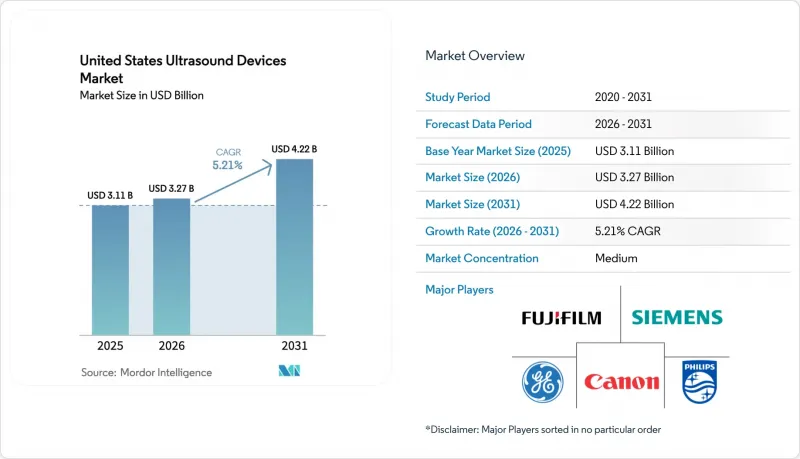
Mordor Intelligence에 의하면, 미국 초음파 기기 시장 규모는 2025년에 31억 1,000만 달러로 평가되었고 2026년 32억 7,000만 달러에서 2031년까지 42억 2,000만 달러에 이를 것으로 예측되며, 예측 기간(2026-2031년) CAGR은 5.21%를 나타낼 전망입니다.
본 보고서는 용도별(마취과, 순환기과, 산부인과 등),기술별(2D 초음파 영상 진단, 3D 및 4D 초음파 영상 진단, 도플러 영상 진단 등), 휴대성별(고정형 시스템 등), 최종 사용자(병원 및 클리닉 등), 지역(북동부, 중서부, 남부, 서부)별로 분류되어 있습니다. 시장 전망은 금액(달러) 기준으로 제시되어 있습니다.
미국 초음파 기기 시장 동향 및 인사이트
외래 영상 진단의 보험 급여 전환
메디케어는 2025년에 외래 영상 진단의 지급액을 2.9% 인상할 예정이며, 이로 인해 검사가 입원 시설에서 외래 시설로 전환되는 움직임이 가속화되고 있습니다. 그 결과, 병원 그룹은 복도의 혼잡을 신속하게 해소하고 더 많은 환자를 처리할 수 있는 소형 카트형 시스템을 선호하게 되었습니다. Smith+Nephew 및 JointVue와 같은 합작 기업은 이온화 방사선을 사용하지 않는 3D 초음파 내비게이션을 정형외과 센터에 도입하고 있습니다. 현재 구매 위원회는 스캐너를 처리 능력 지표나 스캔 1회당 비용으로 평가하고 있으며, 미국 초음파 기기 시장에서 분석 대시보드를 서비스 계약에 포함시키는 공급업체에게 우위가 생기고 있습니다.
AI를 활용한 워크플로우 최적화
전미에서 활동하는 진단용 초음파 검사 기사는 불과 81,080명에 불과하기 때문에 머신러닝을 통한 지침은 필수적입니다. GE 헬스케어와 NVIDIA는 Isaac 플랫폼에서 자율적인 프로토콜을 공동 개발하여 측정 일관성을 향상시키는 동시에 재스캔을 최대 30%까지 줄였습니다. 후지필름 소노사이트의 ‘Voice Assist’ 기능을 통해 사용자는 콘솔을 건드리지 않고도 명령을 내릴 수 있어 수술실의 무균 상태를 유지할 수 있습니다. 현재 가치를 창출하는 가장 빠른 방법은 새로운 하드웨어를 도입하는 것이 아니라 소프트웨어를 업그레이드하는 것이며, 이로 인해 병원들은 수년에 걸친 구독 계약을 체결하도록 유도되어 미국 초음파 기기 시장에서 공급업체의 수익을 안정적으로 유지하고 있습니다.
FDA 510(k) 신청 처리 지연으로 인한 규제상의 지연
FD&C법 제524B조에 따라, 현재 네트워크에 연결된 모든 스캐너에 대해 소프트웨어 부품 목록을 포함한 광범위한 사이버 보안 관련 문서의 제출이 의무화되어 있습니다. 인공지능(AI) 모듈의 경우 알고리즘 드리프트 데이터 제출이 요구되고 있어, 심사 주기가 기존 기준을 크게 초과하는 기간으로 길어지고 있습니다. 중소규모 기업은 수익화까지의 기간이 길어짐에 따라, 사내에 규제 대응 팀을 보유한 유서 깊은 제조업체에 시장 점유율을 빼앗길 가능성이 있습니다. 그로 인해 미국 초음파 기기 시장에서는 특히 높은 성장이 예상되는 치료 용도 분야에서 혁신의 확산이 둔화될 위험이 있습니다.
부문 분석
2025년, 방사선과는 빈도가 높은 진단 프로토콜을 통해 미국 초음파 기기 시장 점유율의 37.18%를 차지했습니다. 중환자 치료 분야는 연평균 성장률(CAGR) 6.42%로 확대되고 있으며, 중환자실 체류 기간을 단축하는 병상 옆 평가의 혜택을 받고 있습니다. 심혈관 분야에서는 통합 심초음파 검사 및 혈역학 모니터링을 평가하는 종합적 지불 모델 하에서 이용 범위가 확대되고 있습니다. 스포츠 클리닉이 주사 시술 시 실시간 가이드를 채택함에 따라 근골격계 영상 진단도 성장하고 있습니다. 비뇨기과 분야에서는 초음파 유도 하 절제술을 인증하는 새로운 CPT 코드가 도입됨에 따라 성장이 가속화되고 있습니다. 메디케어가 예방 프로그램에 자금을 지원하고 있기 때문에 혈관 스크리닝 시장은 안정적인 모습을 보이며, 미국 초음파 기기 시장의 기초 수요를 뒷받침하고 있습니다.
방사선 진단 분야의 미국 초음파 기기 시장 규모는 워크플로우 개선 도구를 통해 장비당 스캔 횟수가 증가하는 한편, 응급실의 예산 비중이 점차 확대되고 있는 중환자 치료 분야 수요도 더해져 완만하게 성장할 것으로 전망됩니다. 휴대용 장치의 도입이 앞서고 있지만, 고해상도 복부 및 골반 검사에는 여전히 멀티프로브 카트 시스템이 필수적입니다. 각 벤더는 예산 제약 속에서도 평균 판매 가격을 높이기 위해 엘라스토그래피 및 인공지능(AI) 패키지를 번들로 판매하고 있으며, 이를 통해 병원 방사선과 내 플랫폼의 정착률이 강화되고 있습니다.
3D 및 4D 플랫폼은 산과 및 심장 진단을 향상시키는 뛰어난 공간 렌더링 기능 덕분에 42.05%의 점유율을 차지했습니다. 고강도 집속 초음파(HIFU)는 연평균 성장률(CAGR) 5.89%를 기록하며, 실험 단계의 종양학에서 보험 적용 대상인 전립선 및 자궁근종 치료로 전환되고 있습니다. 도플러는 혈관 혈류 검사에 필수적이며, 2D는 비용 면에서의 우위 덕분에 응급도가 낮은 진료 현장에서 계속 활용되고 있습니다.
미국 내 치료용 HIFU 초음파 기기 시장 규모는 여전히 작지만, 임상적 근거가 확산됨에 따라 성장세가 가속화되고 있습니다. FDA가 특정 치료용 프로브를 클래스 II로 재분류함에 따라 진입 장벽이 낮아졌으며, 학술 기관들은 선점 우위를 확보하기 위해 경쟁하고 있습니다. 기존 벤더들은 열량 모니터링 기능을 통합하는 한편, 틈새 시장을 노리는 스타트업 기업들은 빔 포밍 소프트웨어 라이선스를 제공합니다. 이 두 가지 경로를 통한 혁신이 가격 다양성을 유지하며, 미국 초음파 기기 산업의 다방면에 걸친 성장을 뒷받침하고 있습니다.
기타 혜택:
- 엑셀 형식 시장 예측(ME) 시트
- 3개월간의 애널리스트 지원
자주 묻는 질문
목차
제1장 서론
제2장 조사 방법
제3장 주요 요약
제4장 시장 구도
제5장 시장 규모와 성장 예측
제6장 경쟁 구도
제7장 시장 기회와 향후 전망
JHS 26.09.11According to Mordor Intelligence, the United States ultrasound devices market size was valued at USD 3.11 billion in 2025 and estimated to grow from USD 3.27 billion in 2026 to reach USD 4.22 billion by 2031, at a CAGR of 5.21% during the forecast period (2026-2031).
This report is Segmented by Application (Anesthesiology, Cardiology, Gynecology/Obstetrics, and More), Technology (2D Ultrasound Imaging, 3D & 4D Ultrasound Imaging, Doppler Imaging, and More), Portability (Stationary Systems, and More), End User (Hospitals & Clinics, and More), and Region (Northeast, Midwest, South, West). The Market Forecasts are Provided in Terms of Value (USD).
United States Ultrasound Devices Market Trends and Insights
Shift toward Outpatient Imaging Reimbursement
Medicare increased outpatient imaging payments by 2.9% in 2025, encouraging procedure migration from inpatient suites to ambulatory sites. Hospital groups consequently favor compact cart systems that clear corridors quickly and process higher patient volumes. Joint ventures such as Smith+Nephew and JointVue equip orthopedic centers with 3D ultrasound navigation that bypasses ionizing radiation. Purchasing committees now rank scanners on throughput metrics and cost-per-scan figures, giving an edge to vendors that bundle analytics dashboards with service contracts in the United States ultrasound devices market.
AI-Driven Workflow Optimization
Only 81,080 diagnostic medical sonographers serve the entire country, so machine-learning guidance is indispensable. GE HealthCare and NVIDIA co-developed autonomous protocols on the Isaac platform that cut rescans by up to 30% while improving measurement consistency. Fujifilm Sonosite's Voice Assist lets users issue commands without touching the console, preserving sterile fields in operating rooms. Software upgrades rather than new hardware now represent the most expedient path to value, pushing hospitals to sign multi-year subscription agreements that stabilize vendor revenues within the United States ultrasound devices market.
Regulatory Delays Due to FDA 510(k) Backlog
Section 524B of the FD&C Act now requires extensive cybersecurity documentation, including a software bill of materials, for every connected scanner. Artificial intelligence modules must submit algorithm drift data, stretching review cycles well beyond historic norms. Smaller companies face longer time-to-revenue and may cede ground to legacy manufacturers that maintain in-house regulatory teams. The United States ultrasound devices market therefore risks slower innovation diffusion, particularly for high-growth therapeutic applications.
Other drivers and restraints analyzed in the detailed report include:
- Proliferation of Handheld Ultrasound Devices
- Bundled Ultrasound Integration in Cardiology Procedures
- Capital Expenditure Deferrals by Hospitals
For complete list of drivers and restraints, kindly check the Table Of Contents.
Segment Analysis
Radiology held 37.18% of the United States ultrasound devices market share in 2025 through high-volume diagnostic protocols. Critical care, advancing at a 6.42% CAGR, benefits from bedside assessments that shorten intensive-care stays. Cardiology usage broadens under bundled payment models that reward integrated echocardiography and hemodynamic monitoring. Musculoskeletal imaging grows as sports clinics adopt real-time guidance for injections. Urology accelerates after new CPT codes validated ultrasound-guided ablation. Vascular screening remains steady as Medicare funds preventive programs, sustaining baseline demand for the United States ultrasound devices market.
The United States ultrasound devices market size for radiology is projected to expand moderately as workflow improvement tools extract more scans per machine, while critical care gains incremental budget share from emergency departments. Handheld devices lead adoption curves, yet multi-probe cart systems remain indispensable for high-resolution abdominal and pelvic exams. Vendors now bundle elastography and artificial intelligence packages to raise average selling prices despite budget constraints, reinforcing platform stickiness in hospital radiology suites.
3D and 4D platforms captured 42.05% share through superior spatial rendering that enhances obstetric and cardiac diagnostics. High-intensity focused ultrasound, at 5.89% CAGR, transitions from experimental oncology to reimbursed prostate and uterine fibroid therapies. Doppler remains essential for vascular flow studies, and 2D persists in low-acuity settings due to cost advantages.
United States ultrasound devices market size for therapeutic HIFU remains small but accelerates as clinical evidence broadens. FDA reclassification of select therapeutic probes to Class II lowers entry barriers, and academic centers race to secure first-mover advantage. Established vendors integrate thermal dose monitoring, while niche start-ups license beam-forming software. This dual-path innovation sustains price diversity and supports multi-segment growth within the United States ultrasound devices industry.
Complete Report Scope:
- By Application
- Anesthesiology
- Cardiology
- Gynecology / Obstetrics
- Musculoskeletal
- Radiology
- Critical Care
- Urology
- Vascular
- Other Applications
- By Technology
- 2D Ultrasound Imaging
- 3D & 4D Ultrasound Imaging
- Doppler Imaging
- High-Intensity Focused Ultrasound
- Other Technologies
- By Portability
- Stationary Systems
- Portable Cart-based Systems
- Hand-held / Pocket Devices
- By End User
- Hospitals & Clinics
- Diagnostic Imaging Centers
- Ambulatory Surgical Centers
- Other End Users
- By Region
- Northeast
- Midwest
- South
- West
List of Companies Covered in this Report:
- GE Healthcare
- Siemens Healthineers
- Koninklijke Philips
- Canon
- FUJIFILM
- Samsung Group
- Mindray Medical Intl.
- Butterfly Network
- Clarius Mobile Health
- Analogic
- Hitachi Healthcare
- Terason Ultrasound
- BK Medical (GE)
- Esaote
- Hologic (AIT)
- Zoll Medical
- EchoNous
- Caption Health
- Exo Imaging
Additional Benefits:
- The market estimate (ME) sheet in Excel format
- 3 months of analyst support
TABLE OF CONTENTS
1 Introduction
- 1.1 Study Assumptions & Market Definition
- 1.2 Scope of the Study
2 Research Methodology
3 Executive Summary
4 Market Landscape
- 4.1 Market Overview
- 4.2 Market Drivers
- 4.2.1 Shift Toward Outpatient Imaging Reimbursement
- 4.2.2 AI-Driven Workflow Optimization
- 4.2.3 Proliferation of Handheld Ultrasound Devices
- 4.2.4 Bundled Ultrasound Integration in Cardiology Procedures
- 4.2.5 OEM Financing & Leasing Programs
- 4.2.6 Telehealth Expansion Supporting Remote Ultrasound
- 4.3 Market Restraints
- 4.3.1 Regulatory Delays Due to FDA 510(k) Backlog
- 4.3.2 Capital Expenditure Deferrals by Hospitals
- 4.3.3 Rising Cybersecurity Compliance Costs
- 4.3.4 Fragmented Reimbursement Landscape
- 4.4 Regulatory Landscape
- 4.5 Technological Outlook
- 4.6 Porter's Five Forces Analysis
- 4.6.1 Threat of New Entrants
- 4.6.2 Bargaining Power of Buyers
- 4.6.3 Bargaining Power of Suppliers
- 4.6.4 Threat of Substitute Products
- 4.6.5 Intensity of Competitive Rivalry
5 Market Size & Growth Forecasts (Value & Volume)
- 5.1 By Application
- 5.1.1 Anesthesiology
- 5.1.2 Cardiology
- 5.1.3 Gynecology / Obstetrics
- 5.1.4 Musculoskeletal
- 5.1.5 Radiology
- 5.1.6 Critical Care
- 5.1.7 Urology
- 5.1.8 Vascular
- 5.1.9 Other Applications
- 5.2 By Technology
- 5.2.1 2D Ultrasound Imaging
- 5.2.2 3D & 4D Ultrasound Imaging
- 5.2.3 Doppler Imaging
- 5.2.4 High-Intensity Focused Ultrasound
- 5.2.5 Other Technologies
- 5.3 By Portability
- 5.3.1 Stationary Systems
- 5.3.2 Portable Cart-based Systems
- 5.3.3 Hand-held / Pocket Devices
- 5.4 By End User
- 5.4.1 Hospitals & Clinics
- 5.4.2 Diagnostic Imaging Centers
- 5.4.3 Ambulatory Surgical Centers
- 5.4.4 Other End Users
- 5.5 By Region
- 5.5.1 Northeast
- 5.5.2 Midwest
- 5.5.3 South
- 5.5.4 West
6 Competitive Landscape
- 6.1 Market Concentration
- 6.2 Market Share Analysis
- 6.3 Company Profiles (includes Global Level Overview, Market Level Overview, Core Segments, Financials as Available, Strategic Information, Market Rank/Share for Key Companies, Products & Services, and Recent Developments)
- 6.3.1 GE Healthcare
- 6.3.2 Siemens Healthineers AG
- 6.3.3 Koninklijke Philips N.V.
- 6.3.4 Canon Medical Systems
- 6.3.5 Fujifilm Holdings Corporation
- 6.3.6 Samsung Medison
- 6.3.7 Mindray Medical Intl.
- 6.3.8 Butterfly Network
- 6.3.9 Clarius Mobile Health
- 6.3.10 Analogic Corporation
- 6.3.11 Hitachi Healthcare
- 6.3.12 Terason Ultrasound
- 6.3.13 BK Medical (GE)
- 6.3.14 Esaote SpA
- 6.3.15 Hologic (AIT)
- 6.3.16 Zoll Medical
- 6.3.17 EchoNous
- 6.3.18 Caption Health
- 6.3.19 Exo Imaging
7 Market Opportunities & Future Outlook
- 7.1 White-space & Unmet-Need Assessment


